4.9 Derivatives of Carboxylic acids
 Call Kai
 Learn
 Practice Test
 Spaced Repetition
 Match
 Flashcards
 Knowt Play
1/27

There's no tags or description
Looks like no tags are added yet.
28 Terms
ethanol + methanoic acid = ethyl methanoatle + water
methanol + ethanoic acid = methyl ethanoate + water
ethanol + 3-chloropropanoic acid = ethyl 3-chloropropanoate + water
2-chloroethanol + propanoic acid = 2-chloroethyl propanoate + water


Esters smell
pleasant fruity smell, neutral liquids
Boiling point
COO- permanent dipoles-dipole between molecules, higher BP than hydrocarbon (VDW), lower acids/alchohol (Hydrogen)
Carbon chain length increases,BP increase, more electrons in carbon chin stronger VDW more energy
Solubility
hydrogen bond form between oxygen atoms in esters and water molecules, esters soluble with water. As non-polar carbon chain increases in length solubility in water decreases, as water molecules cannot form effective VDW to carbon chains
Alcohol + carboxylic acid → ester
CH3CH2OH + CH3COOH = CH3COOCH2CH3 + H2O
ethyl ethanoate
Condensation reaction water produced, esters hydrolysed by water making reaction reversible, concentrated sulfuric acid as catalyst to remove water and to increase yield
Preparation of an ester from an alcohol and a carboxylic acid:
Place a mixture of alcohol and concentrated sulfuric acid in a pear shaped/round bottomed flask
Add mixture of alcohol and carboxylic acid slowly(Exothermic) from a dropping funnel
Swirl mixture. (promote smooth boiling)
Add some anti-bumping granules and heat under reflux
Arrange apparatus for distillation, heat mixture gently and collect distillate around 2° C either side of boiling point of ester.
Place crude ester in a separating funnel and shake with sodium carbonate solution. Invert tunnel and open tap occasionally to release pressure. Remove stopper, allow layers to separate and discard aqueous layer; (to decide which layer is aqueous one, add 5 cm; of water to separating funnel, and aqueous layer is one which increases in volume)
Add a spatula measure of anhydrous calcium chloride/sodium sulfate/magnesium sulfate (drying agent) to organic layer in a flask, stopper and shake. Repeat until ester changes from cloudy to clear.
Filter or decant to remove calcium chloride
Redistill to remove any remaining organic impurities, collecting fraction at boiling point
Alcohol + acyl chloride
CH3CH2OH(l) + CH3COCl (l) → CH3COCH2CH3(l) + HCl (g)
more effective way of ester production: yield higher, hydrogen chloride leaves reaction mixture as gas, reaction cannot reverse. reaction quick, does not require refluxing or a catalyst. HCl toxic gas, care taken when carrying out reaction on larger scale
Ester acid catalysed hydrolysis
CH3COOCH3 + H2O = CH3COOH + CH3OH
Base ester
CH3CH2COOCH3 + NaOH → CH3CH2COONa + CH3OH
acid regenerated by adding dilute strong acid

Acyl chloride
-oyl chloride

Acyl chloride BP
permanent dipoles-dipole betweeen mol, no hydrogen bonds, similar to esters. acyl chlorides could form hydrogen bonds to water molecules to dissolve. practice acyl chlorides immediately react when in contact with water
Acyl chloride preparation
CH3CH2COOH + PCI5 → CH3CH2COCI + POCI3 + HCl
Acyl chloride + water highly reactive
CH3COCI+ H2O → CH3COOH + HCl
Fumes of hydrogen chloride gas observed
ACl + alcohol → ester high yield
CH3COCI + CH3CH2OH → CH3COOCH2CH3 + HCl
Fats solids
Oils liquids
Glycerol
Triol (3 OH group) can form 3 ester links
CH2OHCHOHCH2OH

C=C unsaturated
C-C saturated
Stearic acid -
CH3(CH2)16COOH - octadeconic acid, saturated

Oleic acid -
CH2(CH2)7CHCH(CH2)7COOH (9Z)-octadec-9-enoic acid). Z double bond on ninth and tenth carbons, unsaturated fatty acid

Fats formation.
three condensation reactions between one glycerol molecule and three fatty acids to form three ester linkages. + 3H2O

glyceryl tristearate (stearin) Form
Glycerol + 3 steraic acid
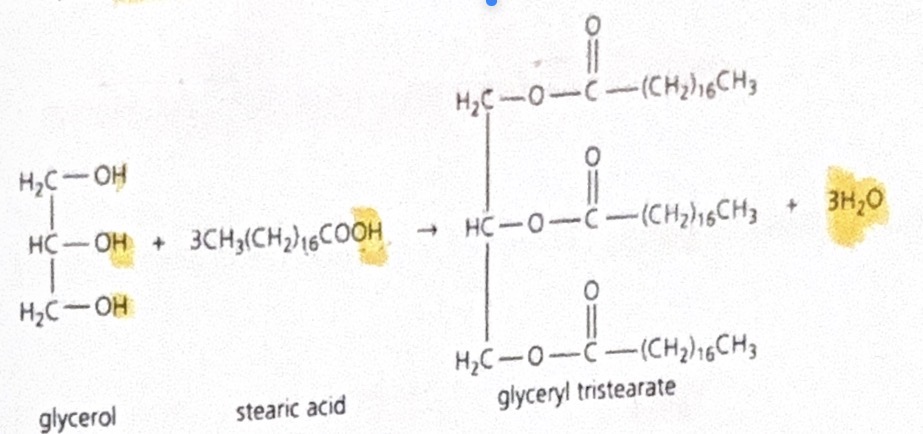
Formation of glyceryl trioleate
Glycerol + oleaic acid → glyceryl trioleate + water

Fats melting point
Saturated fatty acids long, straight hydrocarbon chains.high MP as fatty acid chains can pack together efficiently to give strong VDW forces between fat molecules. C=C bonds cause fatty acid chain to 'kink' or bend, so chains cannot pack together as efficiently. reduces strength of VDW between fat molecules leading unsaturated fats have lower MP.

Heart disease
Saturated fats provide energy and insulation fo body. increase levels of low-density lipoprotein (LDL) can contribute to coronary heart disease. Unsaturated fats increase levels of high-density lipoprotein, reduces risk of coronary heart disease. artificial trans (E) unsaturated fats can increase risk of heart disease.
polyunsaturated fats
Fats with Two or more C=C bonds
Hydrogenation oils
Hardened into fats by hydrogen , addition reaction across C=C bond, making saturated, increase strength in VDW. at 180°C in presence of finely divided nickel

Saponification/Fat hydrolysis