Study Guide Based Art History
 Call Kai
 Learn
 Practice Test
 Spaced Repetition
 Match
 Flashcards
 Knowt Play
1/92

There's no tags or description
Looks like no tags are added yet.
93 Terms

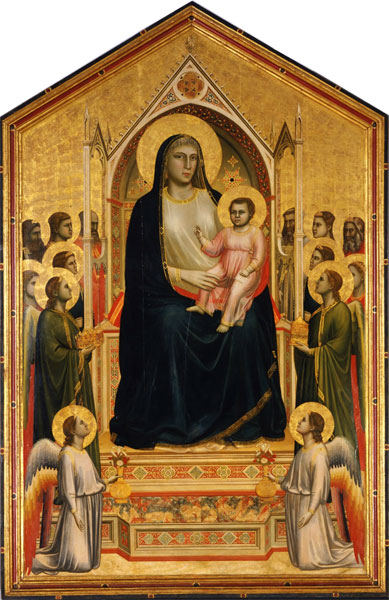
Artist/Style: Cimabue — Byzantine / Italo-Byzantine
Title: Enthroned Madonna with Angels and Prophets/ “ET Virgin Mary”
Date: c. 1280–1285
Medium: Tempera on panel
Location: Uffizi Gallery, Florence
4 Discussion Points:
What you see: Mary and Jesus are hierarchically larger than the surrounding angels and prophets; the figures are highly stylized with elongated proportions, gold background, and limited sense of depth.
Iconography: Mary wears blue, Jesus is on her lap, halos identify holy figures, and John the Baptist/St. John appears in his characteristic clothing. The gold background represents the heavenly realm.
Why it matters: This represents the Byzantine tradition that dominated Italian religious painting before the major naturalistic changes of the Renaissance.
Style/development: The lack of convincing anatomy, weight, emotion, and spatial depth contrasts with later artists such as Giotto. [ADDED] Cimabue is important partly because his work demonstrates the artistic starting point from which Giotto developed greater naturalism.
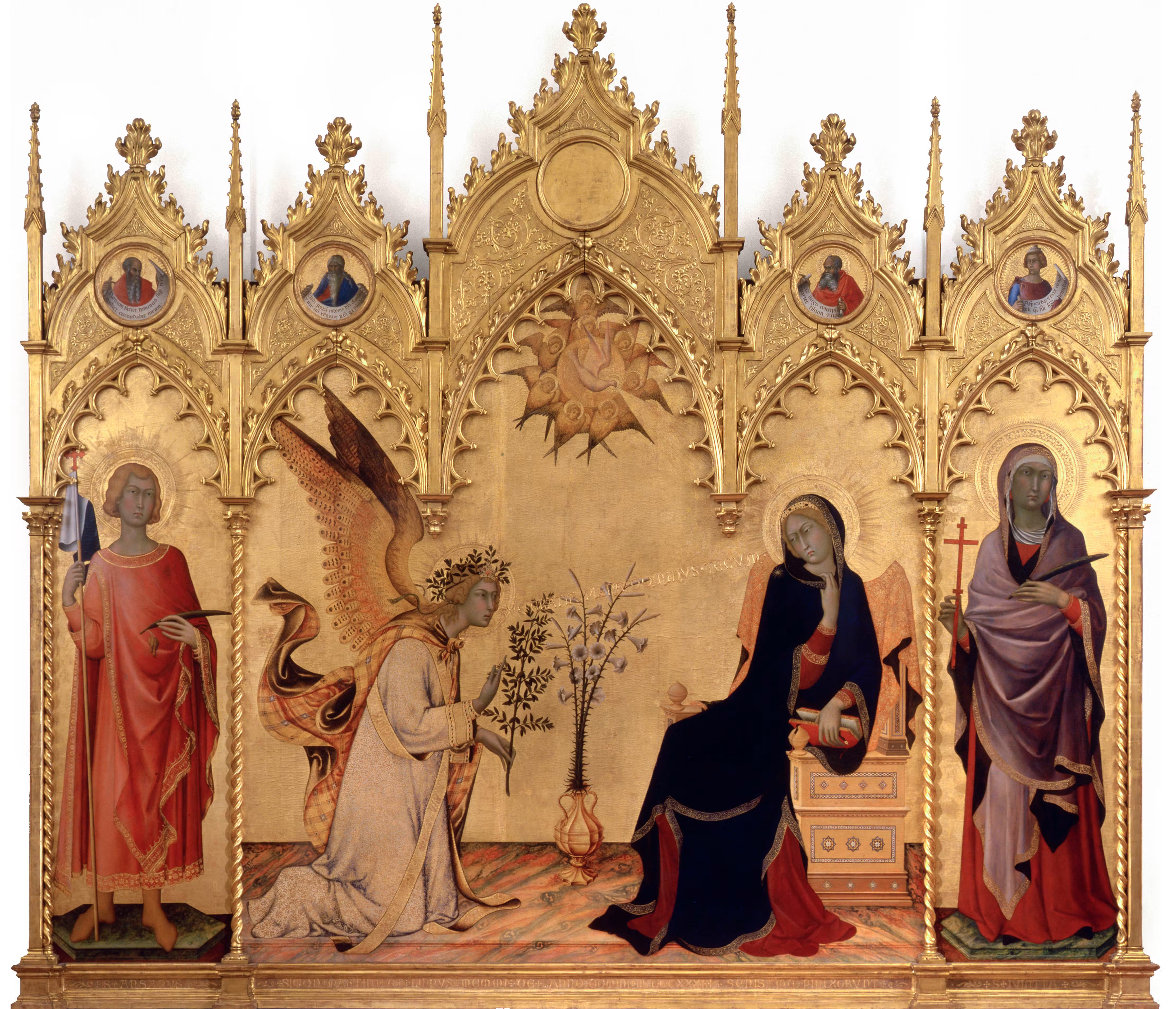
Artist/Style: Giotto — Proto-Renaissance
Title: Ognissanti Madonna / Madonna Enthroned with Saints “5 o’clock Shadow Baby Jesus”
Date: c. 1310–1315
Medium: Tempera on panel
Location: Uffizi Gallery, Florence
4 Discussion Points:
What you see: Mary and Jesus still have Byzantine iconographic elements, but their bodies have noticeably more weight and volume through shading.
Naturalism: Giotto uses chiaroscuro to create three-dimensional bodies and makes the figures appear physically present rather than flat symbols.
Space: The throne creates an architectural setting and the angels overlap one another, beginning to create convincing spatial depth, although perspective is not yet fully developed.
Style/development: Giotto bridges Byzantine/Medieval painting and Renaissance naturalism. [ADDED] His emphasis on believable bodies, emotions, and physical space became highly influential on later Renaissance artists.
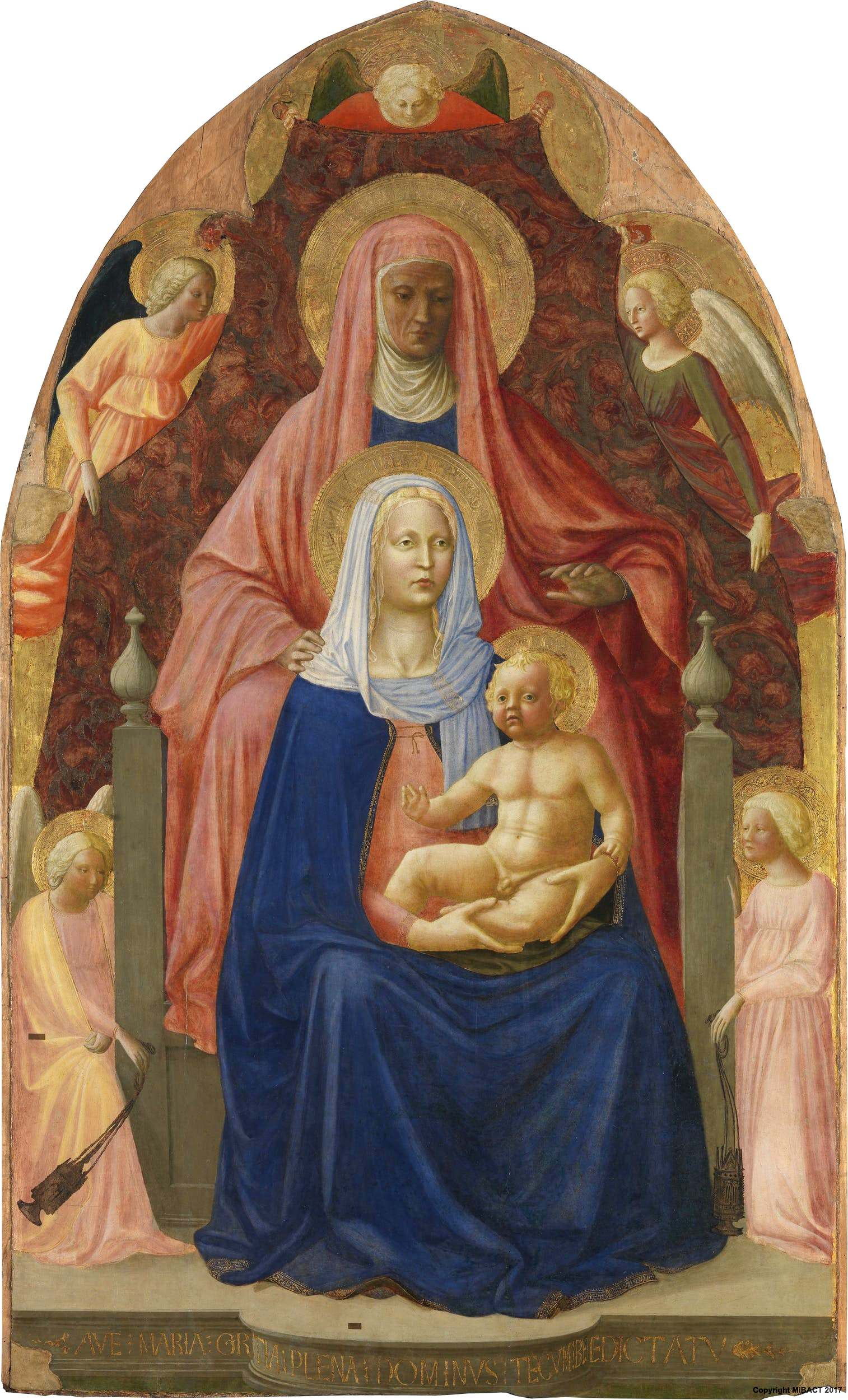
Artist/Style: Simone Martini — International Gothic
Title: Annunciation / “Side Eye Virgin Mary”
Date: 1333
Medium: Tempera and gold on panel
Location: Uffizi Gallery, Florence
4 Discussion Points:
What you see: Gabriel approaches Mary, who turns away with a dramatic sideways glance. The figures have elongated bodies and flowing, decorative drapery.
Gothic style: The S-curve, elegant poses, elongated proportions, gold background, and emphasis on beautiful patterning are characteristic of Gothic art.
Iconography: Mary wears blue and is associated with purity and holiness; Gabriel carries a message of the Incarnation. [ADDED] The vase of lilies symbolizes Mary's purity.
Style/development: Unlike Giotto's increasing interest in physical naturalism, Martini prioritizes elegance, spirituality, decoration, and supernatural beauty.
Artist/Style: Masolino and Masaccio — Early Renaissance transition
Title: Sant'Anna Metterza / “6 Pack Baby Jesus”
Date: c. 1424–1425
Medium: Tempera on panel
Location: Uffizi Gallery, Florence
4 Discussion Points:
What you see: St. Anne sits behind Mary, who holds the Christ Child. The figures are arranged in a hierarchical triangular composition.
Naturalism: Masaccio's contribution can be seen in the stronger modeling of bodies through light and shadow, giving the figures greater physical weight.
Depth: There is an attempt to create spatial depth through overlapping figures and recession, although perspective is not yet as convincing as in later Renaissance works.
Style/development: The work demonstrates the transition from earlier Gothic/Proto-Renaissance traditions toward the Early Renaissance interest in naturalism, volume, and believable space.

Artist/Style: Sandro Botticelli — Early Renaissance
Title: Birth of Venus
Date: c. 1484–1486
Medium: Tempera on canvas
Location: Uffizi Gallery, Florence
4 Discussion Points:
What you see: Venus stands on a shell emerging from the sea, surrounded by figures representing wind and spring. Her pose is the Venus Pudica, an ancient pose of modesty.
Classical antiquity: Botticelli revives a subject from Classical mythology rather than depicting a Christian subject, demonstrating Renaissance interest in ancient Greece and Rome.
Style: Venus has deliberately idealized and somewhat unnatural proportions—long neck, sloping shoulders, flowing hair, and delicate body—which shows that Renaissance naturalism did not always mean literal realism.
Context: [CORRECTION] The painting was likely made for a Medici-associated setting, probably Lorenzo di Pierfrancesco de' Medici, although its exact original commission/location is debated. Its canvas support and tempera medium made it different from the more typical tempera-on-panel works of the period.

Artist/Style: Piero della Francesca — Early Renaissance
Title: Double Portrait of the Duke and Duchess of Urbino / “Lord Farquaad”
Date: c. 1473–1475
Medium: Tempera on panel
Location: Uffizi Gallery, Florence
4 Discussion Points:
What you see: Federico da Montefeltro and Battista Sforza are shown in profile against a landscape. Federico faces right and Battista faces left.
Portraiture: The work emphasizes recognizable individual features rather than idealized religious figures, reflecting Renaissance interest in the individual.
Composition: Their profiles create a highly controlled, balanced composition, while the landscape behind them creates a sense of spatial depth.
Context: [ADDED] Battista died in 1472, so her portrait may have been created posthumously. The reverse sides show allegorical scenes celebrating the couple's virtues.

Artist/Style: Leonardo da Vinci — Early Renaissance
Title: Annunciation /”Glazed Donut Virgin Mary”
Date: c. 1472–1475
Medium: Tempera and oil on panel
Location: Uffizi Gallery, Florence
4 Discussion Points:
What you see: Gabriel announces Mary's pregnancy while Mary sits before an architectural setting and landscape. Leonardo uses a more naturalistic treatment of bodies and faces.
Leonardo's observation: Mary and Gabriel have more believable anatomy and three-dimensional volume than earlier Gothic figures. [ADDED] Leonardo's study of nature and anatomy contributed to his approach to painting.
Perspective: The architectural elements create a convincing sense of depth, showing the Renaissance interest in mathematical/spatial organization.
Style/development: The painting demonstrates the Early Renaissance movement toward naturalism and perspective that eventually develops into High Renaissance techniques.

Artist/Style: Andrea del Verrocchio with Leonardo da Vinci — Early Renaissance → High Renaissance transition
Title: Baptism of Christ
Date: c. 1472–1475
Medium: Tempera and oil on panel
Location: Uffizi Gallery, Florence
4 Discussion Points:
What you see: Christ stands in the center while John the Baptist baptizes him; angels appear to the side, with a landscape behind the figures.
Leonardo's contribution: Leonardo's angels have softer modeling and more atmospheric appearance, especially compared with the harder treatment of the other figures.
Sfumato: Leonardo uses sfumato, or soft transitions between light and dark/color, producing less sharply defined edges. [ADDED] This becomes one of Leonardo's signature techniques.
Style/development: The painting demonstrates the movement toward High Renaissance naturalism, atmospheric effects, and subtle modeling while still retaining Early Renaissance elements.
Shift from Early Renaissance to High Renaissance
SJB Cheeks
Differences in the color of the cheeks; color from within
Sfumato, fumo: smoke; Leonardo invented the soft blending technique
As seen on the angels compared to SJB
Verrocchio was Leonardo’s teacher

Artist/Style: Michelangelo — High Renaissance
Title: Doni Tondo / Holy Family “Hulk Baby Jesus”
Date: c. 1506
Medium: Tempera on panel
Location: Uffizi Gallery, Florence
4 Discussion Points:
What you see: Mary twists dramatically to receive the Christ Child from Joseph; the figures have powerful, muscular bodies and complicated poses (connects to his prefernce for sculpture).
Naturalism: Michelangelo emphasizes anatomy and physical movement. The figures look monumental even though the work is relatively small.
Composition: The figures are arranged in a tight circular composition appropriate to the tondo format. [ADDED] The twisting poses create visual movement around the circular shape.
Style/development: This is High Renaissance art: idealized bodies, strong composition, classical influence, and sophisticated spatial organization. Michelangelo's muscular figures also foreshadow the dramatic style associated with his later work.
Voristic: true to life

Artist/Style: Sandro Botticelli — Early Renaissance
Title: Primavera
Date: c. 1480
Medium: Tempera on panel
Location: Uffizi Gallery, Florence
4 Discussion Points:
What you see: Venus stands in the center surrounded by mythological figures, including the Three Graces, Mercury, Cupid, Zephyrus, Chloris, and Flora.
Classical mythology: The subject is drawn from Classical mythology rather than Christian scripture, reflecting Renaissance interest in antiquity.
Medici context: [CORRECTION] The painting is strongly associated with the Medici family, but its exact patron and original purpose are uncertain. Orange trees may allude to the Medici through the family's association with citrus, but this interpretation is not certain.
Style: Botticelli prioritizes graceful line, flowing hair/drapery, and elegant figures over strict anatomical realism. The layered paint creates dimensional effects, especially in the vegetation.
We went up really close to see the 3D effect the layered paint made, especially by the grass
Aristotle defined magnificence as the virtue of wealth
SHORT ANSWER QUESTION: Was there a contradiction or change in the view of wealth during this time?
St. Francis denouncing wealth and the Medicis relishing in it
By funding churches, buildings, and artistic works, families like the Medici legitimized their wealth, absolved themselves of religious guilt over banking practices, and aligned pride with Christian beliefs.
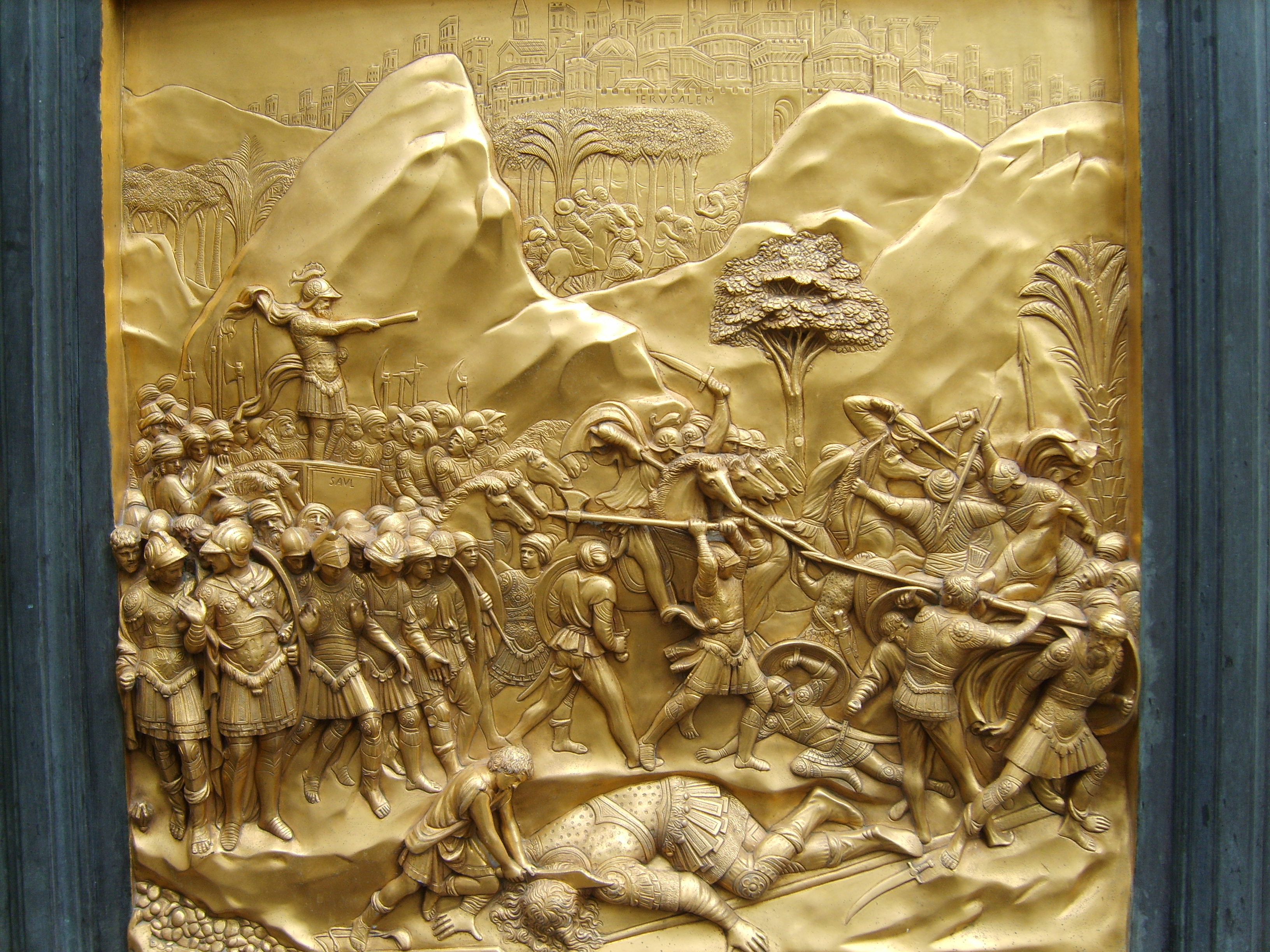
Artist/Style: Lorenzo Ghiberti — Early Renaissance
Title: Gates of Paradise
Date: 1425–1452
Medium: Gilded bronze relief
Location: East doors of the Florence Baptistery
4 Discussion Points:
What you see: Unlike the earlier doors' many separate quatrefoil panels, Ghiberti's doors use 10 large panels containing Old Testament scenes.
Perspective: Ghiberti uses rilievo schiacciato, varying relief depth to create the illusion of foreground, middle ground, and background.
Classical influence: Figures and architecture show increasing interest in Classical forms, proportion, and believable space.
Why it matters: The doors represent a major development in Renaissance relief sculpture and demonstrate the increasing importance of perspective and naturalism.
David and Goliath Panel (bottom left)
David and Goliath foreground, armies in background
Meeting of Sheba and King Solomon (bottom right)
Uses 1 point linear perspective
Shows interior of cathedral
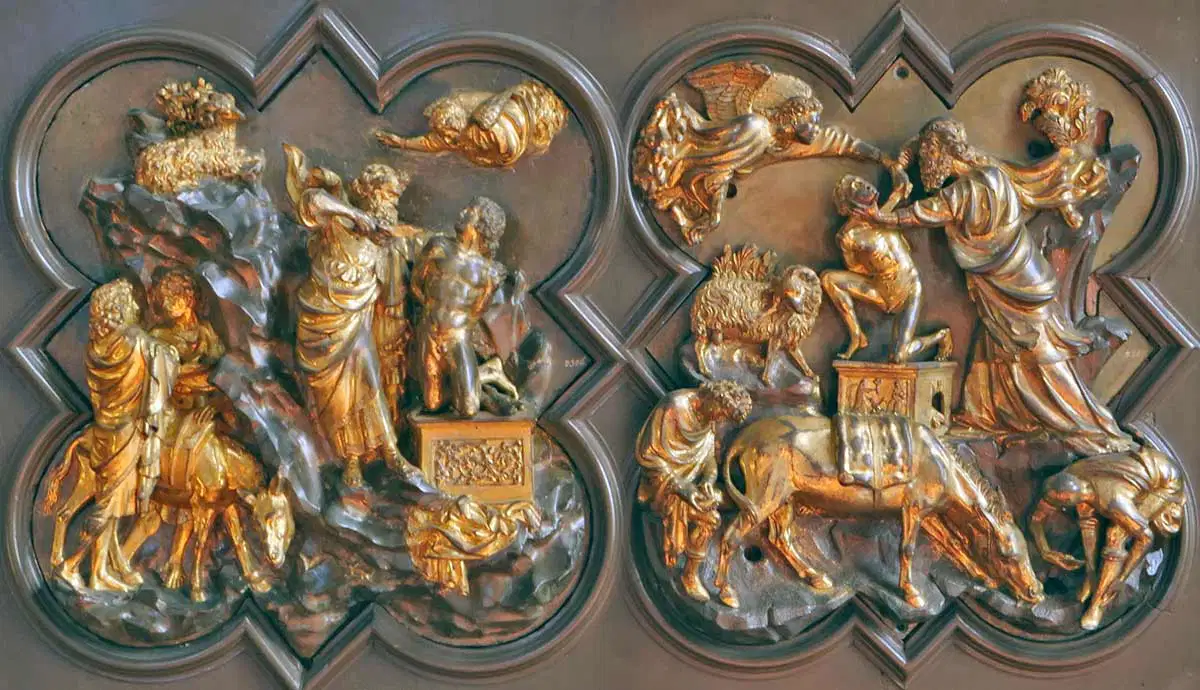
Artist/Style: Early Renaissance, Ghiberti and Brunelleschi
Title: Competition Panels for the Baptistery Doors
Date: 1401
Medium: Gilded bronze relief
Location: Florence
4 Discussion Points:
Subject: Both artists represented the Sacrifice of Isaac for the 1401 competition.
What to compare: Ghiberti's composition is elegant, balanced, and Gothic-influenced, while Brunelleschi's is more dramatic and physically forceful. [ADDED]
Technique: Both demonstrate sophisticated bronze casting and relief sculpture.
Why it matters: The competition is traditionally treated as an important moment in the development of Renaissance art and patronage, although the famous story that it single-handedly "started the Renaissance" is an oversimplification. [ADDED/CORRECTION]
These two works were created as test panels to help the Arte di Calimala (the guild of luxury cloth importers) decide which artist to hire for the bronze door project at the Baptistery. Each artist was to cast the same scene, the Sacrifice of Isaac, a story from the Old Testament (if you need a refresher of the story, see the box below) and was to utilize the quatrefoil shape. To impress the hiring committee, both Ghiberti and Brunelleschi took inspiration from ancient Roman sculpture in order to create dynamic, naturalistic figures. The conscious reference to antiquity will become the foundation of Italian Renaissance art; these are the works that started it all!
Ghiberti won, and his was also lighter (thus cheaper)

Artist/Style: Lorenzo Monaco — Late Gothic
Title: Marriage of the Virgin
Date: c. 1420
Medium: Fresco
Location: Bartolini-Salimbeni Chapel, Santa Trinita
4 Discussion Points:
What you see: Mary and Joseph are surrounded by figures in an elaborate scene with flowing drapery and elongated bodies.
Gothic style: The figures have elegant, swaying poses and stylized proportions rather than realistic anatomy.
Context: This is part of a larger cycle depicting the life of the Virgin. [ADDED] The use of expensive blue pigment from lapis lazuli could communicate the patron's wealth.
Condition: The fresco was covered with plaster in the 1700s and later uncovered; damage also resulted from WWII-era bombing and deterioration.

Artist/Style: Lorenzo Monaco — Late Gothic
Title: Annunciation
Date: c. 1420
Medium: Tempera and gold on panel
Location: Santa Trinita / Bartolini-Salimbeni Chapel
4 Discussion Points:
What you see: Mary and Gabriel are elongated and stylized, with elaborate clothing, gold background, and jewel-like colors.
Gold: The gold background emphasizes the sacred/supernatural setting and reflects candlelight.
Depth: The architectural structure gives some spatial depth, but there is no fully developed linear perspective or vanishing point.
Gothic vs. Renaissance: Mary remains calm and stylized, demonstrating the Gothic preference for spiritual elegance over convincing physical realism.

Artist/Style: Domenico Ghirlandaio — Early Renaissance
Title: Adoration of the Shepherds
Date: 1485
Medium: Tempera on panel
Location: Sassetti Chapel, Santa Trinita
4 Discussion Points:
Patronage: Francesco Sassetti, a wealthy Florentine banker, commissioned the chapel and included references to himself and his family.
Naturalism: Ghirlandaio depicts realistic faces, clothing, textures, and bodies, including the rough clothing of the shepherds.
Perspective/Classical influence: The scene uses a convincing vanishing point and Corinthian columns, connecting Christianity to the architecture and visual language of antiquity.
Symbolism: The manger resembles a Roman sarcophagus, connecting Christ's birth to his eventual death and resurrection. [ADDED]

Artist/Style: Domenico Ghirlandaio — Early Renaissance
Title: Resurrection of the Boy
Date: c. 1485
Medium: Fresco
Location: Sassetti Chapel, Santa Trinita
4 Discussion Points:
Subject: St. Francis raises a dead boy back to life.
Florentine setting: Instead of placing the miracle in its original historical setting, Ghirlandaio places it in recognizable Florence, with Santa Trinita visible in the background.
Patron context: The Sassetti family's personal story parallels the miracle: after the death of a son, Francesco Sassetti and his wife had another child. This gives the scene personal significance.
Franciscan contrast: Franciscan friars wear simple brown habits reflecting their vow of poverty, while wealthy Florentines wear elaborate clothing, visually contrasting poverty and wealth.

Artist/Style: Coppo di Marcovaldo — Byzantine / Romanesque
Title: Bardi Altarpiece
Date: c. 1250
Medium: Tempera on panel
Location: Santa Croce, Florence
4 Discussion Points:
What you see: St. Francis is represented in a highly stylized, frontal manner against a gold background.
Francis iconography: Brown habit, rope belt, tonsure, halo, and stigmata identify St. Francis.
Style: Byzantine/Romanesque characteristics include flatness, stylization, gold background, hierarchical proportions, and limited naturalistic space.
Why it matters: This gives you a visual baseline for comparing later Franciscan imagery by Giotto, where Francis becomes much more physically and emotionally naturalistic.
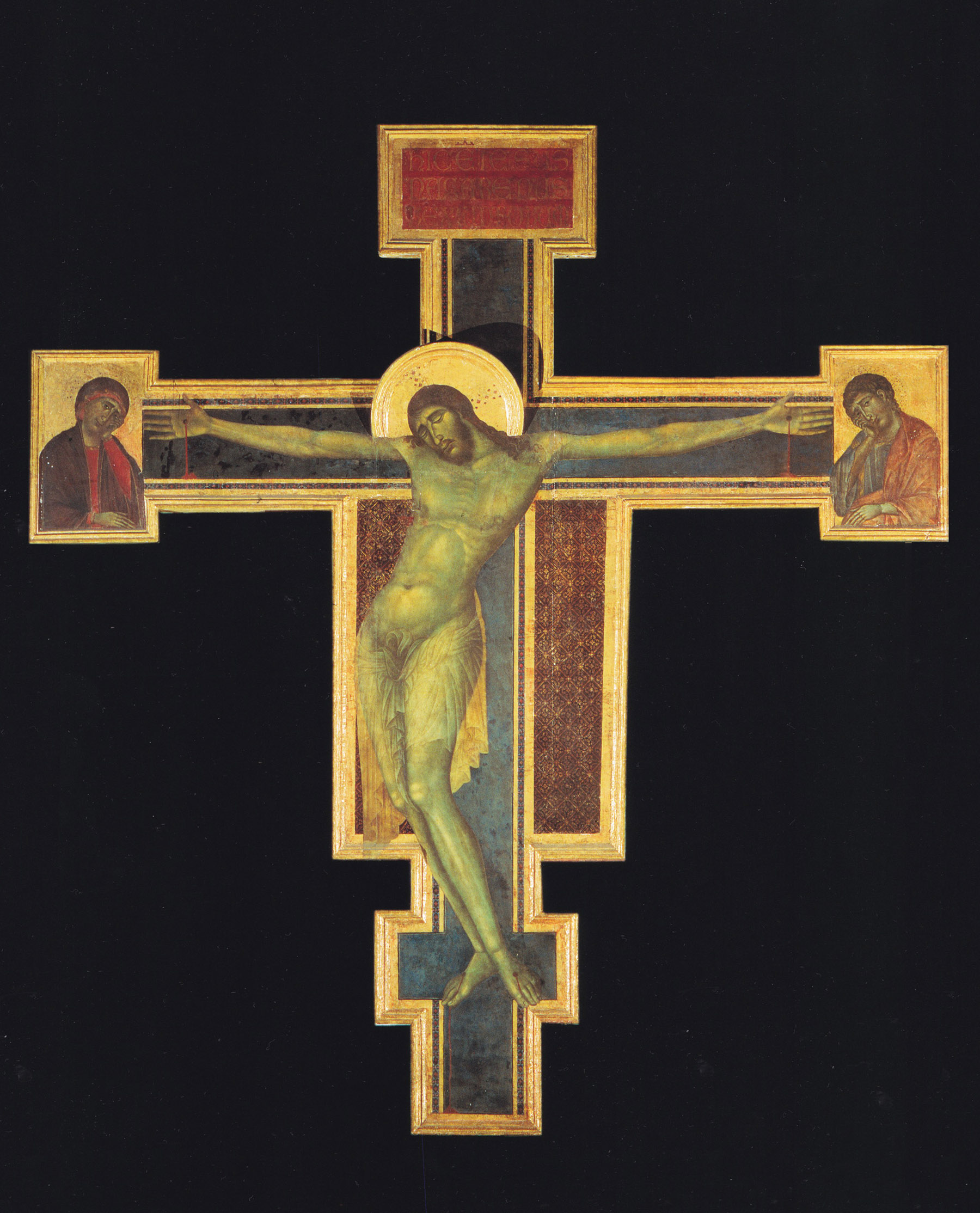
Artist/Style: Cimabue — Byzantine/Romanesque → Proto-Renaissance transition
Title: Crucifixion
Date: c. 1270–1280
Medium: Tempera on panel
Location: Santa Croce
4 Discussion Points:
What you see: Christ hangs on the cross with a more convincing body and emotional expression than earlier Byzantine images.
Naturalism: Cimabue introduces stronger shading, bodily weight, and emotional expression, creating a more human Christ.
Technique: Chiaroscuro helps model the body and create the illusion of three-dimensional form.
Development: Cimabue remains rooted in Byzantine traditions but moves toward the naturalism that Giotto develops further. The work was badly affected by the 1966 Florence flood.

Artist/Style: Giotto — Proto-Renaissance
Title: St. Francis Receiving the Stigmata
Date: c. 1317
Medium: Fresco
Location: Bardi Chapel, Santa Croce
4 Discussion Points:
Subject/iconography: St. Francis receives the wounds of Christ—the stigmata—from a vision of Christ with wings. Francis wears his brown Franciscan habit and halo.
Naturalism: Francis reacts physically and emotionally to the vision rather than appearing as a flat symbolic figure.
Space: Giotto uses overlapping forms, landscape, and foreshortening to create a more convincing environment.
Style/development: Giotto moves significantly beyond Byzantine/Romanesque stylization toward Proto-Renaissance naturalism, believable movement, emotion, and physical space.

Artist/Style: Giotto — Proto-Renaissance
Title: Renunciation of Worldly Goods
Date: c. 1317
Medium: Fresco
Location: Bardi Chapel, Santa Croce
4 Discussion Points:
Subject: St. Francis rejects his worldly possessions and commits himself to poverty.
Composition: Franciscan/religious figures occupy one side while secular/merchant figures occupy the other, creating a visual contrast.
Context: The Bardi family were wealthy bankers, making the Franciscan message of poverty especially interesting within a wealthy family's private chapel.
Why it matters: The fresco demonstrates how religious ideals, wealthy patrons, and Florentine society could coexist within Renaissance art.
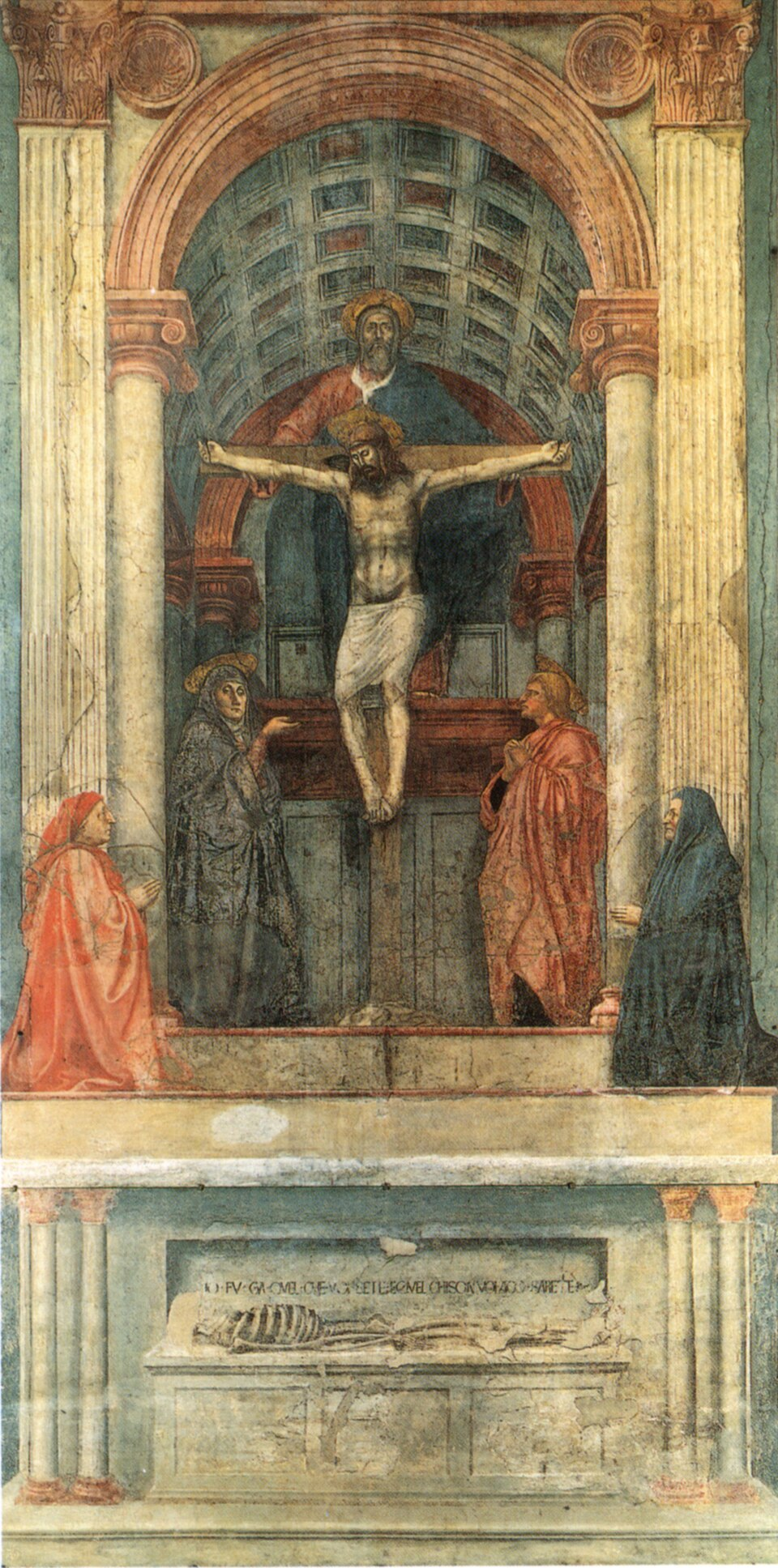
Artist/Style: Masaccio — Early Renaissance. Patron= Lenzi family
Title: Holy Trinity
Date: c. 1425–1427
Medium: Fresco
Location: Santa Maria Novella
4 Discussion Points:
Perspective: Masaccio uses one-point linear perspective to create the illusion of a deep architectural chapel on a flat wall.
Composition: God, Christ, and the Holy Spirit form a Trinity, while Mary and St. John stand beside Christ. The patrons appear below the sacred scene.
Memento mori: The skeleton in the tomb at the bottom reminds viewers of death: human beings will eventually become what the skeleton represents.
Why it matters: This is one of the most important demonstrations of Renaissance perspective, naturalism, and the integration of the viewer/patron into sacred space.

Artist/Style:
Frescos - Nardo di Cione
Altarpiece - Orcagna Late Gothic / Post-Giotto
Title: Strozzi Chapel decoration and altarpiece
Date: c. 1350s
Medium: Fresco and tempera/panel
Location: Santa Maria Novella
4 Discussion Points:
What you see: The chapel includes scenes of the Last Judgment and Hell, reflecting medieval concern with salvation and damnation.
Gothic characteristics: Compartmentalized organization and a central Christ figure retain the hierarchical/icon-like qualities of Gothic art.
Dominican context: Santa Maria Novella was a Dominican church; St. Thomas Aquinas is represented, connecting the chapel to Dominican emphasis on learning and theology.
Historical context: The work was created after the Black Death, making themes of death, judgment, punishment, and salvation particularly relevant. [ADDED]

Artist/Style: Romanesque / Pisan Romanesque with Gothic influences
Title: Cathedral Complex / Campo dei Miracoli Pisa
Date: 11th–14th centuries, 11th/12 cent duomo
Medium: Marble, stone, architectural sculpture
Location: Pisa
4 Discussion Points:
Romanesque: Rounded arches and repeated arcades are major Romanesque characteristics.
Gothic transition: Pointed arches appear in later additions and demonstrate the transition toward Gothic architecture.
Civic pride: Pisa's enormous cathedral complex demonstrates competition between Italian city-states during the age of pilgrimage.
Context: Pisa's wealth from Mediterranean trade and military victories helped finance its monumental buildings. [ADDED]
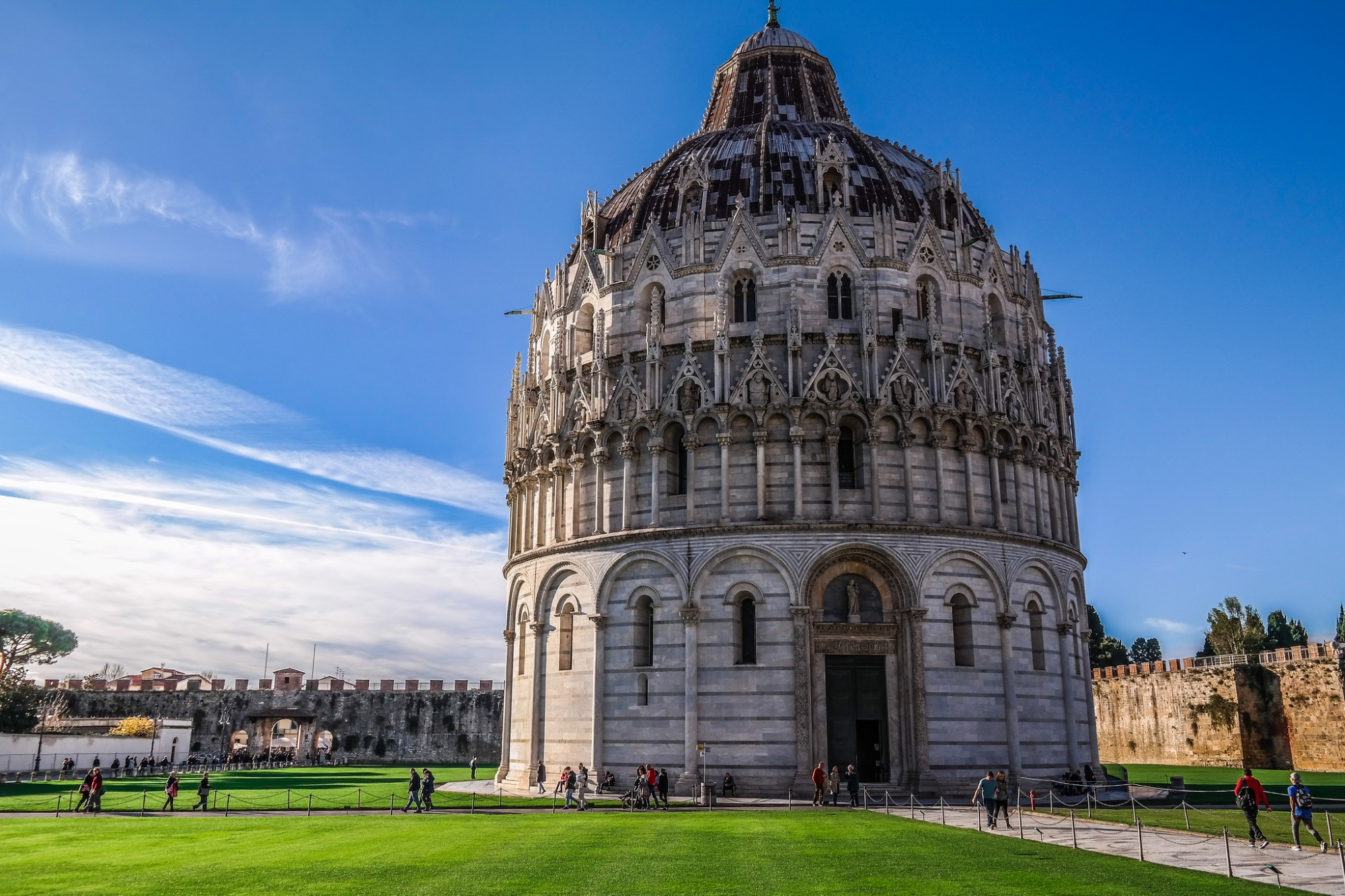
Artist/Style: Romanesque → Gothic
Title: Baptistery of San Giovanni, Pisa
Date: Begun 1152; completed over subsequent centuries
Medium: Marble and stone
Location: Pisa
4 Discussion Points:
What you see: The building combines rounded Romanesque arches with pointed Gothic arches and a large dome.
Transition: Its architecture demonstrates the gradual movement from Romanesque toward Gothic rather than a sudden stylistic change.
Materials: White marble and green serpentine create the distinctive striped appearance associated with Pisan architecture.
Structure: [ADDED] The pointed dome and structural organization help distribute forces through the building, while the layered exterior combines Roman, Islamic, and local influences.

Artist/Style: Nicola Pisano (father of Giovanni)— Romanesque
Title: Pulpit of Pisa Baptistery
Date: c. 1260
Medium: Marble sculpture
Location: Pisa Baptistery
4 Discussion Points:
What you see: Scenes from life of Christ
Influenced by Classicism from classic period, based on relief sculptures by Romans (done on sarcophagi)
Crucifixion scene
Very crowded composition; Lack of dead space (horror vacuae)
Naturalism: drapery/movement of figures/ body of Jesus, head and arm placement are very detailed
Far L big woman is Mary, hierarchy of scale
Way ahead of time stylistically → Classical
Low v high relief, attempt at scale
Connects with Arnofo di Cambio bc they studied together

Artist/Style: Buonamico Buffalmacco, Late Medieval / Gothic
Title: Triumph of Death
Date: c. 1330s–1340s
Medium: Fresco
Location: Camposanto, Pisa
4 Discussion Points:
Subject: Death is presented as something that ultimately affects everyone, regardless of social status.
bottom R death (with scythe) is diving in but people in orange grove aren’t paying attention to seriousness of coming death
bottom L: three phases of decomposition
Top L Thebaid: hermits who live on own as close to Christ as possible
Middle pile of people from all classes → souls (rep. by babies) being taken
Afterlife: The fresco contrasts salvation and damnation and encourages viewers to consider their own moral preparation for death.
Context: The imagery became especially powerful in the aftermath of the Black Death, which had devastated European populations. [ADDED]
Pisa/Camposanto: The Camposanto was associated with sacred burial and was believed to contain soil brought from the Holy Land, making it an especially appropriate location for meditation on death and resurrection.
Created 1270s
Dirt is relic from Crusades
before WW2 was big spot fpr eople to come (1944) but during WW2 a bomb fell and fire melted many plasters off
Monuments Men Dean Keller and Enzo Carli tried to save artwork
Rounded arches of camposanto start Romanesque and then decorated with pointed arch (gothic)
Use of porphyry in the space: purple granite from river Nile basin associated with royalty, Roman emperors quarry to extinction

Artist/Style: Giovanni Pisano (Son of Nicola) — Gothic
Title: Pulpit of Pisa Cathedral
Date: c. 1300-1310
Medium: Marble sculpture
Location: Pisa Cathedral
What you see: Biblical narratives are presented continuously across the pulpit with figures interacting dramatically.
Gothic style: Figures have elongated proportions (long torso), expressive movement, and elaborate flowing drapery.
Naturalism: Compared with earlier Byzantine/Romanesque sculpture, figures show greater emotional and physical movement.
Development: Giovanni Pisano continues the naturalistic direction associated with Nicola Pisano while retaining Gothic drama.
Nude Daniel, Arrival of 3 kings scene
More naturalistic
Gothic
Elongated drapery
Continuous narrative
Similarities to dad: Lack of dead space (horror vacuae)
Contemporaries with Cimabue and Giotto

Artist/Style: Byzantine Cimabue designed it
Title: Apse Mosaic of Christ
Date: c. 1290
Medium: Mosaic
Location: Pisa Cathedral
4 Discussion Points:
What you see: Christ dominates the apse against a shimmering gold background, surrounded by other holy figures.
Byzantine style: Gold background, frontal/iconic representation, hierarchy, and stylized forms emphasize the heavenly rather than earthly world.
Medium: Small pieces of glass called tesserae reflect light, causing the gold and colored surfaces to shimmer.
Context: Venetian artisans contributed to the mosaic work. [ADDED] The use of Byzantine mosaic traditions demonstrates the continuing influence of Eastern Christian art in medieval Italy.
Cimabue did the design, not the mosaic
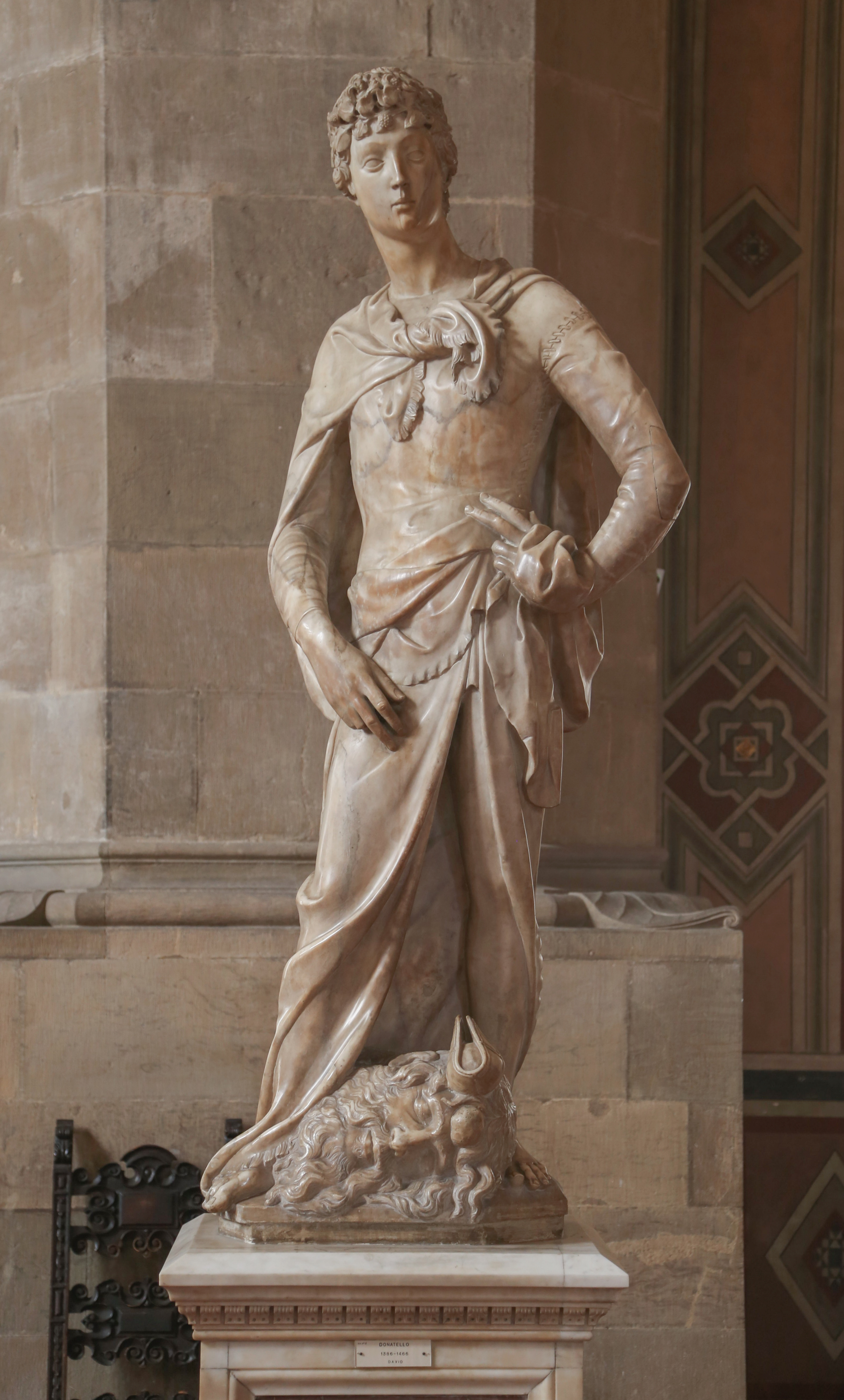
Artist/Style: Donatello — Early Renaissance
Title: David
Date: c. 1408–1409
Medium: Marble
Location: Museo Nazionale del Bargello, Florence
4 Discussion Points:
What you see: David appears as a young, clothed biblical hero with the head of Goliath at his feet.
Pose: His stance begins to show greater naturalism than medieval sculpture, although it is less dramatically contrapposto than later Renaissance Davids.
Comparison: Compared with Donatello's later bronze David, this version is clothed and more traditionally Christian/biblical.
Development: [ADDED] Donatello's revival of the human figure in sculpture helped establish the Renaissance interest in freestanding, naturalistic bodies.

Artist/Style: Donatello — Early Renaissance
Title: St. George
Date: c. 1415–1417
Medium: Marble
Location: Museo Nazionale del Bargello / originally Orsanmichele
[CORRECTION: The original sculpture was made for an exterior niche at Orsanmichele.]
4 Discussion Points:
Naturalism: Donatello gives him a convincing body, weight, and psychologically alert expression.
Contrapposto: His body shifts naturally, creating a sense of potential movement rather than a rigid frontal pose.
reated for Orsanmichele for the Armorer’s Guild, whose patron saint was St. George.
Shows George as a young soldier standing confidently, but his furrowed brow and distant gaze suggest apprehension before fighting the dragon. Michelangelo later used a similar psychological expression in David.
Originally had a helmet, sword, and belt made by the guild, adding to the sculpture’s realism and connection to the armorers.
The predella shows George fighting the dragon and uses rilievo schiacciato, creating depth through extremely shallow relief.
Donatello makes the landscape recede using overlapping trees, hills, angled architecture, and the cave, creating the illusion of 3D space.
Key takeaway: St. George combines naturalism, psychological expression, and innovative perspective with the emerging Renaissance interest in Classical and realistic representation.

Artist/Style: Donatello — Early Renaissance
Title: David “sassy david”
Date: c. 1430–1440
Medium: Bronze, lost-wax cast
Location: Museo Nazionale del Bargello
4 Discussion Points:
What you see: David is nude, youthful, and standing over Goliath's severed head. He holds a sword and wears an unusual hat.
Classical revival: The nude, freestanding male figure strongly recalls ancient Greek and Roman sculpture.
Contrapposto: David shifts his weight onto one leg, creating a relaxed, natural pose.
Context: [ADDED] The nude figure and private/palatial context distinguish this David from Donatello's earlier clothed marble David and show the Renaissance revival of Classical sculpture.
Also makes sense given he was housed in a private setting
One of the first nearly life-size nude sculptures since antiquity, reviving Classical traditions (all’antica).
David stands in contrapposto and is shown after defeating Goliath; his nudity presents him as a Classical hero, while his young, less idealized body emphasizes realism and his status as the underdog.
Likely commissioned by the Medici family and documented in their palace courtyard by 1469. The laurel wreath and berries at the base may reference Medici symbols.
Because it was made for a private setting, the nude figure was less controversial and suited the Medici’s interest in Classical antiquity.
Possible alternative interpretation: the figure may be Mercury (Hermes) rather than David. His hat resembles Mercury’s petasos, while the severed head may be Argus. Mercury was associated with commerce and prosperity, making the subject particularly relevant to the wealthy Medici bankers.
Key takeaway: whether David or Mercury, the sculpture demonstrates the Renaissance revival of Classical nudity, contrapposto, and naturalism.
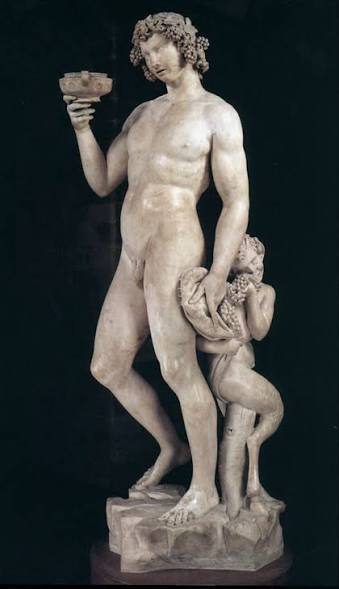
Artist/Style: Michelangelo / Renaissance Classical revival
Title: Bacchus
Date: c. 1490s
Medium: Marble
Location: Museo Nazionale del Bargello
4 Discussion Points:
Subject: Bacchus is the Roman god of wine and is shown with grapes and a drinking cup.
Naturalism: His body is intentionally human and somewhat awkward, emphasizing his drunken state rather than an idealized divine body.
Composition: The grapes, cup, and supporting satyr draw attention toward the subject of wine and drunkenness.
Classical revival: The mythological subject and nude figure demonstrate Renaissance interest in ancient Roman culture.
This work was created by Michelangelo in 1496-97, when he was just 21 years old. At the time, he was living in Rome, trying to make a name for himself as a sculptor. He was hired by a powerful cardinal named Raffaele Riario to make a statue of Bacchus (Greek = Dionysus; the god of wine, parties, insanity, and theater) for the courtyard of his palace. This was Michelangelo’s first attempt at life-size figure sculpture.
Famously was rejected bc Bacchus looked drunk

Artist/Style: Michelangelo — High Renaissance. Patron is Opera del Duomo
Title: David
Date: 1501–1504
Medium: Marble
Location: Galleria dell'Accademia, Florence
4 Discussion Points:
What you see: David stands in contrapposto, staring intensely toward Goliath before the battle. The slingshot is the main attribute identifying him.
Naturalism/anatomy: Michelangelo creates extraordinarily detailed anatomy, veins, muscles, hands, hair, and facial expression, making the figure appear psychologically and physically alive.
Scale/viewing: The statue is nearly 18 feet tall. The oversized hands, feet, and head were appropriate to the intended elevated placement. [ADDED]
Political context: [ADDED/CORRECTION] Although commissioned for the cathedral, David was ultimately placed in Florence's civic center, Piazza della Signoria. He became associated with the Florentine Republic and resistance to Medici rule after the Medici were expelled.
MORE NOTES:
Intended viewing point would have been him looking at you from the top of the Duomo
Thus, hands, feet, and head are really big, but body has perfect anatomy
Just under 18 ft. tall and weighs about 5.5-6 ton
Has grey veins going through him (which means a bad block of marble)
Quarried in 1464
Was started 11 years before Michelangelo was born
Was meant to be one of 12 Old Testament figures meant for the top of the Duomo
Was abandoned for 24 yrs
The only icon is the slingshot
No head of Goliath
Also not a 12-13 year old boy
This was him staring at Goliath, not post-killing him
He has a small male part because, in classical sculptures, that meant they thought more with their head than their male parts
His inspiration was St. George by Donatello
Can tell he was a Greek athlete from one side and not a God because he looks less confident and from the other side looks more like a God
It is a moment of resolve/pull yourself together moment
Michelangelo captures the psychological component of sculpture and makes you feel what the subject is feeling
It is so naturalistic it looks and feels like he could step right off the pedestal
Also realistic veining in hands, shadows on hair and back
The stump is a counterweight for the sculpture
In a contrapposto (counter pose)
Greeks did it first, then the Romans did
Very naturalistic
He did not go on the Duomo because he was too impressive/big and also too heavy
People had to decide between placing by Town Hall or 3 Arch Loggia
Debate became pro v anti Medici politics, anti Medici won out, placed at Town Hall, looking out at the expelled Medici
Symbol for the last hurrah of Florentine Republic
Life of Michelangelo
1475-1564
Michelangelo doesn’t work with measurements which makes him extremely unique compared to other artists
He started at age 12 working as apprentice to Domenico Ghirlandaio (guy who did Sesseti chapel)
prestigious workshop: like Harvard
left the workshop after 2 years, bc he didn’t like painting
He wants to become a sculpturist
Trains with Bertoldo Giovanni (the star student of Donatello)
The GOAT of Renaissance sculpture = Donatello
early Mich. is influenced by Donatello and Classicism (Romans and Greeks)
He creates a fawn (half boy, half goat) sculpture and is adopted by the Medici family
1490s ives with Medici family and gets best education
Moves to Rome when Medicis get exiled 1496, 21 years old
Starts working on the Bacchus, which gets REJECTED bc patron because he looked too drunk
But this allows him to be introduced to a cardinal who commissions him in 1499 to do the Pieta: Skyrockets his fame, put his name on Mary’s clothes
1500 - he moves back to Florence, stops in Siena on the way and then takes on the David (1501-1504)
The slaves/prisoners (two structures) 1506, realized it took too long and called off project by Pope Julius II to do Sistine ceiling (1528-32)
called the slaves/prisoners because Michelangelo said when he looks at a block of marble he sees the figure within and his goal is to liberate them
Can see his process (e.g. starting with the torso and working his way out, head last)
Medici Family Context
Bank opens 1397 by Giovanni di Bici who dies 1439
Son of Giovanni is Cosimo the Elder di Medici in power 1436-1464
First Medici Pater Patri (Father of the fatherland)
exiled for 2 years goes to Venice, but then Florence wants Medici and their money back
Medici Rule Republic of Florence De-Facto from 1436-1492
Lorenzo the Magnificent - was the Medici family Patriarch (1467-1492)
He was the “humanist of humanist Medici”
He hosted the 15th century book club where they had deep conversations about philosophy and ancient Greece
Adopts Michelangelo
The Birth of Venus was built for him, friends with Boticelli
He married a Roman noble woman, dies 1492
1494: Medici sent into Political exile while Piero, son of Lorenzo, is leading
Go to Rome
Pope Leo the 10th is Giovanni Medici, ends exile (1512)
Ends the exile of the Medici family and brings them back to Florence

Artist/Style: High Renaissance / Michelangelo + Bonerotti. Patrons Medici (Pope Leo X)
Title: New Sacristy / Medici Chapel
Date: Begun 1520s
Medium: Architecture, marble sculpture
Location: Basilica of San Lorenzo, Florence
4 Discussion Points:
Architecture: Michelangelo modeled the New Sacristy partly on Brunelleschi's Old Sacristy but introduced a much more dramatic architectural vocabulary.
Dichotomy: The space uses opposing elements—square/circle, interior/exterior, light/dark, and opposing tombs—to create tension.
Tombs: The Medici tombs include allegorical figures of Dawn/Dusk and Night/Day, emphasizing the passage of time and mortality.
Medici patronage: The chapel demonstrates how wealthy families used architecture and sculpture to memorialize themselves and communicate power, status, and religious identity.
EXTRAS
Michelangelo loves dichotomy
gray and white
square and circle
tombs
indicular arches (broken) and impedimented (triangle) arch
Statues
1 active, 1 passive
Man v Woman
Lorenzo the Magnificent & Giuliano de' Medici (The "Magnificents"): Dusk (M) Dawn (W)
Kids Lorenzo de' Medici and Allesandro: Night (W) Day (M)
1:2 ratio
Unfinished, has to go back to Rome
Virgin Mary flanked by Cosmos and Domiano (Medic Saints, Patron Sts of Medicis)

Artist/Style: Michelangelo — High Renaissance
Title: Tomb of Lorenzo de' Medici / Tomb of Giuliano de' Medici
Date: c. 1520s–1530s
Medium: Marble sculpture
Location: New Sacristy, San Lorenzo
4 Discussion Points:
What you see: Each tomb combines an idealized portrait figure with allegorical figures representing time/day and night.
Lorenzo: Dusk (M) Dawn (W)
Kids: Night (W) Day (M)
Naturalism: The bodies are highly muscular and anatomically convincing while remaining idealized.
Dichotomy: Day/Night and Dawn/Dusk create paired opposites and emphasize the passage of time.
Meaning: [ADDED] The figures can be interpreted as meditations on mortality, time, and the transience of earthly life.

Artist/Style: Early Renaissance, Benozzo Gozzoli (1459). Patron: Pierro di Guoti
Title: Procession of the Magi
Date: 1459–1460
Medium: Fresco
Location: Chapel of the Magi, Palazzo Medici Riccardi
4 Discussion Points:
What you see: The Medici family and their allies appear within a magnificent procession of the Magi.
Patronage: Cosimo de' Medici commissioned the chapel, and Medici family members are incorporated into the sacred narrative.
Wealth: Expensive lapis lazuli, gold details, elaborate clothing, horses, and hunting imagery communicate immense wealth and social status.
Political message: [ADDED] By placing themselves within a sacred procession, the Medici could associate their family's political prominence and wealth with Christian devotion and legitimate civic authority.
has Medici family faces painted into the crowd, to show off their wealth. Entire chapel was treated like a Fresco Cycle
Medium: Fresco - ultra expensive details such as lapis lazuli (in the sky) and gold leaf details on knights armor
Three wise kings on the journey to visit newborn baby jesus
Holy crowd with Lorenzo the Magnificent leading on a white horse, Cosimo the elder, and Piero the Gouty
Political message: to display power of immense banking wealth (proven by the expensive gold and blue paint) and that their political control over Florence was blessed by God
Lorenzo dressed as youngest of the three kings
Piero the Gouty– Mule/Donkey. Men on horse- sons of main allies of the family.
Voristic: true to life

Artist/Style: Fra Angelico — Early Renaissance. Patron Cosimo the elder Medici
Title: San Marco Altarpiece / San Marco Altarpiece (Madonna and Child with Saints)
Date: c. 1438–1443
Medium: Tempera on panel
Location: Museo Nazionale di San Marco
4 Discussion Points:
Composition: The Madonna and Child are surrounded by saints in a sacra conversazione, or sacred conversation, rather than separated into individual compartments.
Carpet would have been something owned by Medici that they asked to be used
Perspective: Fra Angelico uses one-point linear perspective to organize the architectural space.
Medici patronage: Cosimo de' Medici was a major patron of San Marco and supported the Dominican convent.
Style: The figures retain some idealization and religious serenity while incorporating Renaissance spatial organization and naturalism.
Composition as sacred conversation
Triangle formation
Idealized figures (rather than true to life)
Uses 1 point linear perspective!
Subjects:
Peter Martyr (Dominican friar)
St Lorenzo (L)
John (with books)
St Dominic (flowers)
SF Assisi
St Marco
Two Medic Saints (St Cosmas and St Damiano)

Artist/Style: Artist Fra Angelico in Early Ren style, Patron Cosimo the elder Medici
Title: Crucifixion with Saints
Date: 1442
Medium: Fresco
Location: Museo Nazionale di San Marco, Chapter House
Jesus with good thief and bad thief (bad is crying in pain)
on L are figures would have actually been there
Plus..
Twin cosmas and domiano
Mark with book
San Lorenzo on grill
SJB tunic needs haircut
on R are Dominicans
Pelican shown at top, they are known to make themselves bleed to feed their young → Jesusn (Intellectual, understood by Dominicans)

Artist/Style: Fra Angelico — Early Renaissance, Patron Medici
Title: Annunciation
Date: c. 1440–1445
Medium: Fresco
Location: San Marco, Florence
4 Discussion Points:
Mirrored architecture: The painted architectural setting resembles the real monastery architecture, making the biblical scene feel as though it is occurring within the monks' own environment.
Poverty: The simple architecture and bench reflect Dominican values of discipline, simplicity, and devotion.
Light: The painted light comes from the same direction as the actual window, integrating the painting with the physical space.
Color/supernatural: Gabriel's brightly colored wings contrast with the restrained architecture, visually signaling the supernatural event.
Mirrored Setting: The painted porch copies the real-life courtyard architecture downstairs at San Marco so the monks felt like the Bible scene was happening inside their own home. Classical
Fence represents Mary’s womb as well as dark room with light coming in being conception
Minimalist Style: Features simple white walls and a basic wooden bench with no luxury furniture, matching the monks' vows of poverty to prevent distraction during meditation.
Real Light Integration: The painted light comes from the left to match the actual sunlight pouring in from a real physical window located on the left side of the monastery hallway.
Vibrant Wings: While the room is plain, the angel's wings are painted with explosive rainbow colors to signal a supernatural presence breaking into a quiet, earthly space.
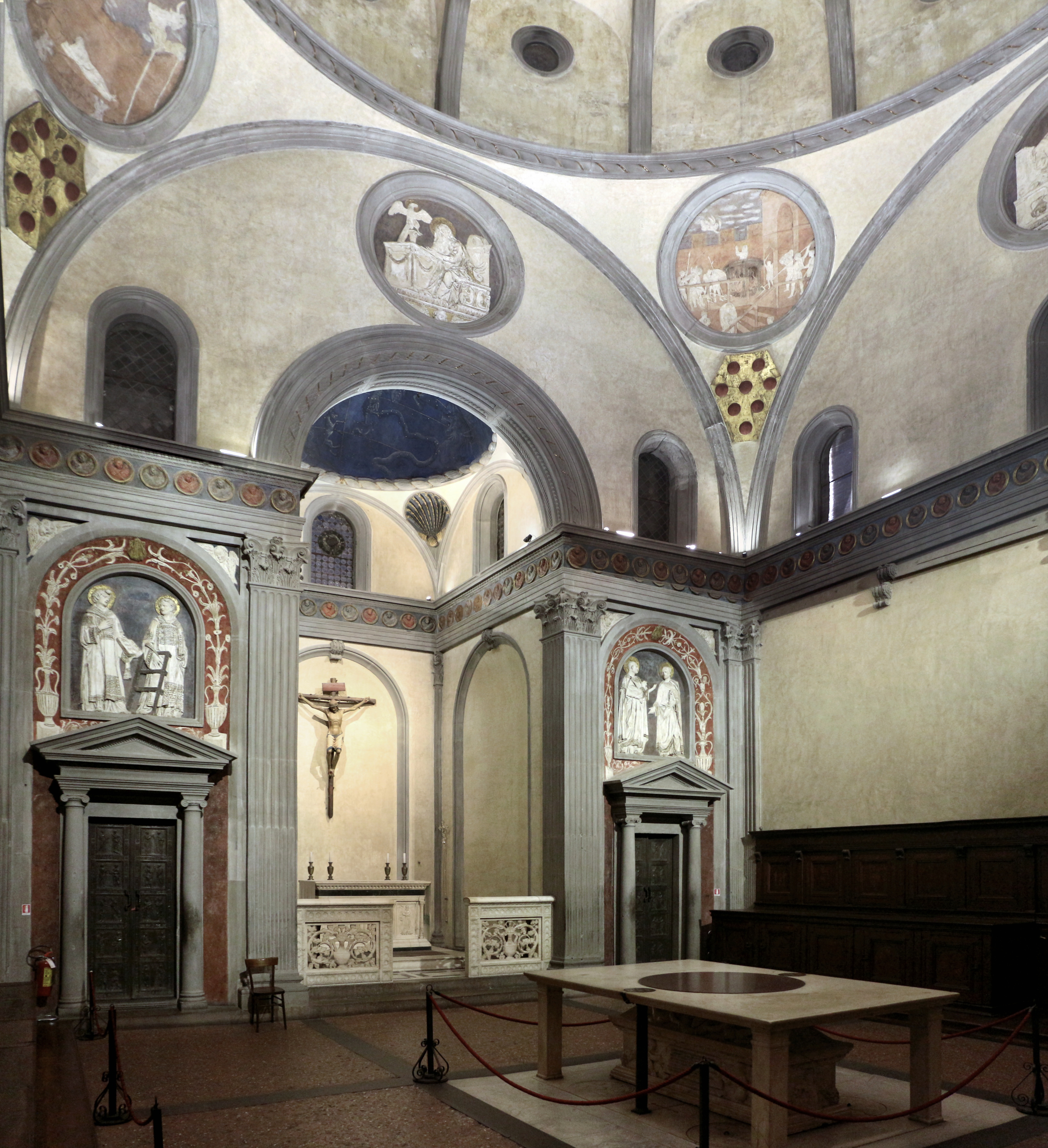
Artist/Style: Filippo Brunelleschi — Early Renaissance. Patron Giovanni di Bicci de' Medici
Title: Old Sacristy
Date: c. 1419–1429
Medium: Architecture
Location: Basilica of San Lorenzo, Florence
4 Discussion Points:
What you see: Gray and white architectural elements create a highly ordered, geometric interior.
Geometry: Brunelleschi organizes the space through mathematical proportions and modular units.
Classical influence: Columns, pilasters, arches, and harmonious proportions revive Classical architectural principles.
Medici patronage: Giovanni di Bicci de' Medici commissioned the sacristy, making the space both religious and a monument to the Medici family's growing prominence.
Carcophugus in center of room: Giovanni di Bicci buried here
Brunelleschi squares. Obviously what ratios are.
It was “exclusive,” and the VIP was Giovanni. Expect to see Giovanni di Bicchi.
Giovanni was buried in a modest tomb in the middle which is the table of the space. Porphyry stone seen gere. Sarcophagus with family crest at the bottom. The tomb is by the artist Verocchio (seen at the Bargello).
Verrocchio: Teacher of Leonardo di Davinci.
Side tomb by verocchio contains Pierro di Guopti. Title: Father of the Fatherland: Diamond ring with ribbons coming off of it.
Cosimo the Elder- had valuable lessons, wanted to keep the mass of people happy. Best politician
Buried in a massive pillar underneath the cross of the church– in the center “supporting” the whole church. He’s the exact center or trunk of the church.
In general, he was modest, but he knew what he was doing and was very smart.
Palazzo Medici (Medici Palace)
Artist/Style: Early Renaissance / Classical influence. Michelozzo artist. Patron is Cosimo the Elder
Title: Palazzo Medici
Date: Begun 1444
Medium: Architecture
Location: Florence
4 Discussion Points:
What you see: The exterior uses graduated rustication, becoming smoother and more refined on higher levels.
Rustication matches the Town Hall, seat of political power, and looks like a fortress
Public/private: The ground floor included public/business functions, while the upper floors contained the family's private living spaces.
Medici strategy: Cosimo the Elder rejected Brunelleschi's more extravagant design in favor of Michelozzo's comparatively modest exterior.
Political power: [ADDED] The palace's location along an important route through Florence made the Medici presence highly visible while the restrained exterior helped avoid appearing openly monarchical.
Architect for building: Michelozzo (commissioned by Cosimo the Elder) (begun 1444)
Cosimo the Elder turned down brunelleschi design, too flashy and hired Michelozzo instead to have something “modest” - looks humble on outside but palace on the inside
Location: Northern Entrance gate– main route of town. Passing– walk between Duomo, Baptistery, eventually town hall.
Medici primary private residence and political headquarter for 100 years roughly 1450s-1540 (lived on the second floor)
Rough and large exterior similar to that of the Palazzo Vecchio? (graduated rustication)
First floor - was a public zone had offices, bank, stables, courtyard

Artist/Style: Florentine Romanesque
Coppo di Marcovaldo: Credited with designing the dramatic central depiction of Christ the Judge and the Last Judgment on the western section of the dome.
Name: Baptistery of San Giovanni, Firenze
Date: Current building consecrated 1059; likely expanded from an earlier 4th-century baptistery
Medium: Architecture; white and green marble, mosaic
Location: Piazza San Giovanni, Florence
4 discussion points:
The Baptistery is octagonal, traditionally associated with the “eighth day” and Christian ideas of rebirth through baptism.
Its architecture uses Roman/ancient elements, including columns, pilasters, geometric organization, and reused ancient materials (spolia), connecting Florence to its Roman past.
The exterior uses white and green marble in geometric patterns; the interior contains extensive gold-ground mosaics influenced by Byzantine artistic traditions.
Its three sets of bronze doors show the development toward the Renaissance: Andrea Pisano’s south doors → Ghiberti’s north doors → Ghiberti’s Gates of Paradise. The Gates of Paradise use Renaissance perspective and rilievo schiacciato.
KEY ID CLUES: octagon + white/green marble + Romanesque + Roman columns/spolia + bronze doors + gold mosaics.
Consecrated 1059 to SJB the Patron St. of Firenze
originally built to match with Santa Reparata Church
Style: Romanesque (1000-1300)
Reuse original material from Roman Fiorentia
Fill in the OG foundation and build on top (was originally a wealthy Roman home, still window to below today)
Inspired by Roman design
Engaged Pilasters (square and attached to wall, not in the round)
Columns (round) with golden capitols (column head)
Columns are Spoglia (leftover from Roman times) so don’t all match
Columns by the church are most precious and do not match - Showing off the mismatch conveys how much they valued Roman past which helps legitimize the town
Shape:
Centrally-planned structure based on Roman nymphaium (pool of water in the middle)
Octagon: 8 means 8th day of judgement
Mural - Christ in Judgement
Iconographic elements of Christ
Stigmata
Halo containing a cross
Red and Blue
Huge size → Hierarchy of Scale
Scenes tell story of the bible
Genesis and Creation
Joseph and the Coat of Many Colors: civic duty
Scenes of SJB
End with the flood to connect to Baptism (cleansing)
All murals made with gold mosaic - tiny pieces of glass called tesserae placed in wet plaster at angles
Space originally lit by candles, light would have danced across mosaic tesserae

Architect/Style: Begun by Arnolfo di Cambio; Gothic architecture with later Renaissance additions
Cathedral of Santa Maria del Fiore (Florence Duomo)
Date: Begun 1296; dome added by Brunelleschi in the 15th century
Medium: Architecture; marble, brick, stone
Location: Piazza del Duomo, Florence
4 discussion points:
The cathedral was built during Florence’s period of economic growth and civic competition, so its enormous scale and decoration demonstrated Florentine wealth and civic pride.
The cathedral uses a Gothic structural vocabulary, but its exterior decoration and later additions incorporate Classical/Renaissance ideas.
Brunelleschi’s dome solved the enormous engineering problem of covering the cathedral’s central crossing, using a double-shell structure, ribs, and innovative brickwork.
The Duomo complex demonstrates how architecture, religion, technology, politics, and civic identity came together in Renaissance Florence. The official Opera del Duomo describes the complex as a center where faith, art, history, and engineering intersect.
KEY ID CLUES: enormous Gothic cathedral + green/white/red marble exterior + massive dome + Florence civic pride.
Brunelleschi’s Dome/Cupola
Artist/Architect: Filippo Brunelleschi
Style: Early Renaissance
Date: 1420–1436
Medium: Brick and masonry; double-shell construction
Location: Cathedral of Santa Maria del Fiore
4 discussion points:
The cathedral had an enormous opening that needed to be covered, creating an engineering problem that Brunelleschi solved without relying on traditional full wooden centering.
The dome has two shells, an inner and outer structure, with ribs and innovative brickwork distributing the weight.
Its construction demonstrates Renaissance interest in mathematics, engineering, Classical forms, and human ingenuity.
The dome became a symbol of Florentine civic achievement and competition, showing that Florence could accomplish something technologically and artistically extraordinary.
SHORT-ANSWER CONNECTION: If asked about the dome, always connect engineering → Brunelleschi → Early Renaissance → civic pride/campanilismo → Florence's wealth and ambition.
Giotto’s Campanile / Bell Tower
Architect: Giotto, continued by Andrea Pisano and Francesco Talenti
Style: Italian Gothic
Date: Begun 1334; completed 1359
Medium: Architecture; white, red, and green marble; sculptural relief
Location: Florence Cathedral complex
4 discussion points:
Giotto was appointed to design the bell tower in 1334 and began construction, but after his death the project continued under Andrea Pisano and Francesco Talenti.
The tower is covered in white, red, and green marble and decorated with geometric patterns, relief sculptures, and statues.
The lower levels contain reliefs representing Creation/Human activities, the planets, virtues, liberal arts, and sacraments, connecting everyday human life to a Christian worldview.
The upper level includes prophets, patriarchs, and sibyls; later Renaissance sculptures by Donatello and Nanni di Bartolo demonstrate the growing move toward naturalism.
KEY ID CLUES: tall square tower + polychrome marble + Gothic + lots of sculptural panels + prophets/sibyls.
Siena History
Foundation myth Romulus and Remus
Rode in on white and black horses (Siena colors)
Siena on Via Fracigena which connects Rome with France (promote trade) and allows influence of Northern European gothic style
Main economy based in fabrics (silk), specifically those dyed with Saffron. Also bank, founded 1492
Golden Age 1260-1348
Republic gov
Grand Council and Council of the 9
1260: Battle Monte Aperti
Pope (Guelf - Banking Class, Florence) v. HRE (Ghibbeline - Land-Owning Nobility, Siena)
Florence v. Siena
Night before, people of Siena takes keys of Florence and give them to a painting of Virgin Mary
battle at Sienese river: dense fog allows Sienese locals to have upperhand, recognize Mary as elected leader of city
1348: Black Death, 70% die

Palazzo Publico of Siena
In “Il Campo” natural basin between 3 hills city is on
Less fortress-like than Florence town hall
More open and inviting
Shows less political turmoil in Siena
Gothic windows, 3 sections “Trifore windows”
Crenilations and merlins for archers are more decorative
Torre de la Magia (tower) is more separated from teh structure itself
shape at top looks the same
Started construction 1297 (compared to Florence 1299) so Florence’s is bigger (campanilismo)
Symbol of Siena in black and white at top (Dominican)
Also have crest of Medici, they took over in 1555

Patron: Simone Martini
Style: Italian Gothic
Name: MAesta
Date: 1315
Medium: Fresco
Location: Palazzo Publico of Sienna; Hall of Grand Council
Subject: Mary + Jesus, SJB, St Peter (keys), Paul (sword)
Canopy is black/white with baldecino fabric
Held by saints
canopy used in big processions, Saints are here in Siena to recognize Mary, the elected leader
Sienese elements: fabric (silk) with gold trim (given fabric to include, expensive look)
Drapery dramatic, expensive appearance
Chiarascuro gives 3D appearance
Figures stylized with elongated forms not anatomically correct
Medieval hip pop curve (S curve) not Contrapposto
idealized figures
Mary is big, hierarchy of scale
Circles around
Scrolls = old testament prophets
Books= Gospel writers
Jesus with blessing ahnd and book “Word made flesh”
Two faced figure
Old = Old Law (of Moses)
Young (New Law and Future)
Mary is the idealized perfect woman and mother too all
At judgement, she will be seated at R hand of Jesus and advocate for sinners
If council messes up, they report to Mary
Mother of Mercy

Artist: Ambrogio di Lorenzetti
Name: Allegory of Good and bad Government
Style: Gothic
Date: 1337-39
Medium: Fresco Cycle
Location: Palazzo Publico of Sienna; Hall of Council of Nines
ALLEGORY GOOD GOV:
Big guy in B+W colors: city of siena, city of the virgin
Angels above are main 3 virtues: Faith (cross), Charity (Heart), and Hope (looking up)
Other women are remaining virtues
On R: Justice (sword and crown), Temperance, Magnimity
On L: Prudence, Fortitude, and Peace
On Left side of Image
Woman with scales in white is ALSO JUSTICE (must be important if shown twice)
Above head: Sapientia (wisdom)
On L side, angel punishing, on R side, angel rewarding
Holds cords of reward and punishment
Concordia = agreement
EFFECT OF GOOD GOV:
City
Red woman is bride = pop. growth
Dance celebration
Shops = working pop
Teaching in middle building
Gothic windows (bifore), Siena Duomo and tower
Building new buildings
Walls in good shape
Country (State)
Allegorical figure (Security) reigns over countryside with gallows in hand for anyone who needs brought to justice
Farming = food security
Wild boar docile when normally kill people
ALLEGORY BAD GOV:
Big guy = tyranny
Vices above: Superbia (Pride), Vanity, Avarice (greed)
Secondary vices: Greed, cruelty, fraud, Division (sawing body in half, Siena colors)
Below is Justice: Captured with scales broken
EFFECT BAD GOV:
City
Man killed
Woman in red to be raped
Buildings falling apart
Only shop is blacksmith making weapons
Country
Allegorical figure (fear) reigning
Soliders heading out
Desolate, no agriculture
town on fire

Arch: Giovani Pisano
Name: Duomo of Siena
Year: 1225
Style: Transition between Romanesque and Gothic
Dedicated to the assumption of mary
Design isn’t perfectly even all the way up, use of lots of sculpture to prevent your eye from catching that
Green and white, but the green is so dark it almost looks black: colors of Siena
Each figure has a compartment: Gothic
1338: started huge project to expand and make the nave (long side) the transcept (short side), but didn’t follow through because the black death happened 1347

Artist: Michelangelo (may have only done one sculpture, the bottom R one)
Name: Piccolomini Altar
Year: 1500
Style: Early Ren
Material: Marble
Location: Duomo Siena
Michelangelo had to leave Siena to work on David, guess did bottom R bc…
More naturalistic: folds of drapery and weight of the way it hangs
Contrapposto pose
More expressive: can tell psychological connection
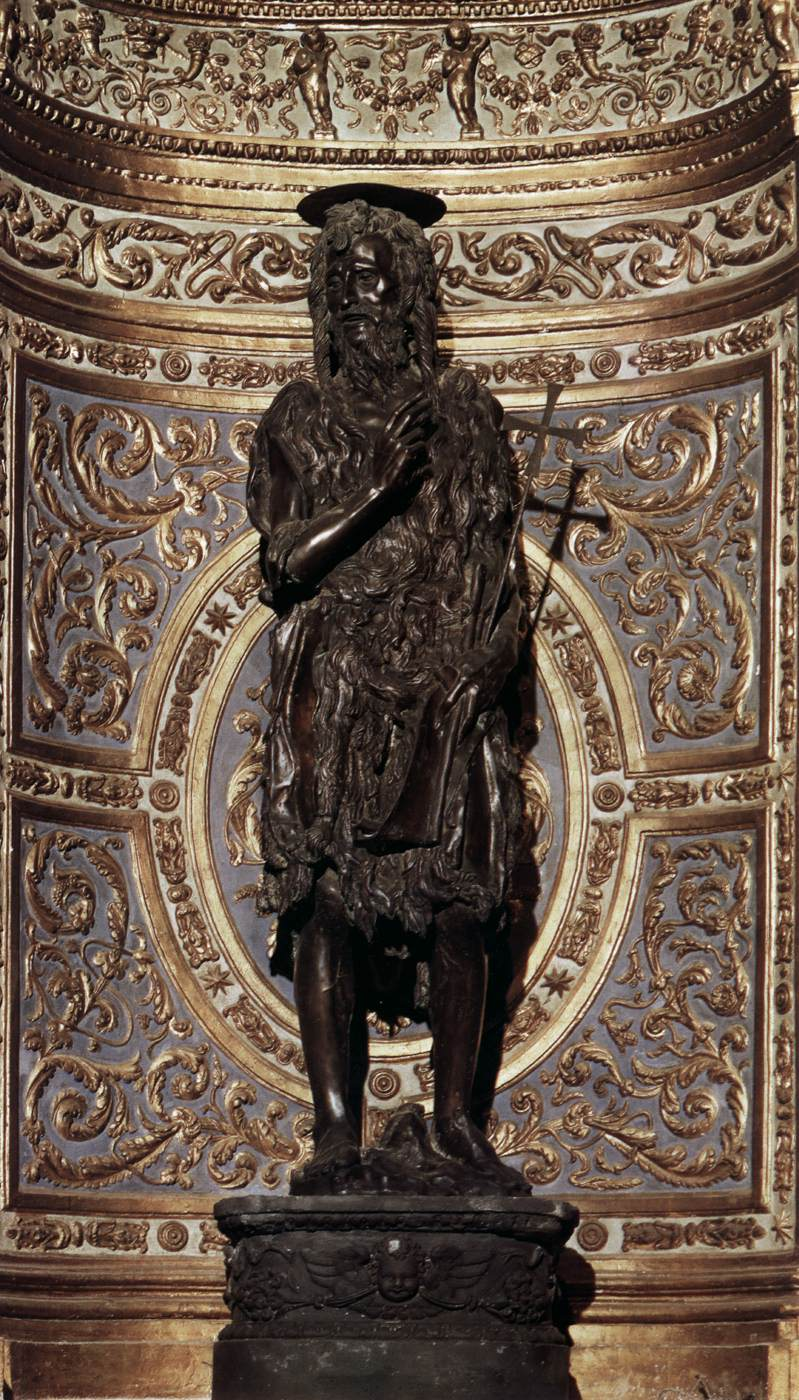
Artist: Donatello
Name: St John the Baptist
Year: 1457
Style: Early Ren
Material: Bronze (free-standing)
Location: Baptistery in Duomo Siena
Pose naturalistic
Facial expression
Anatomy is good
Halo put on head 3D
Story: Worked in Florence, didn’t get paid full amount, shipped without hand until he got full payment

Artist: Niccola and Giovanni Pisano
Pulpit of Siena Cathedral
Style: Gothic
Location: Duomo Siena
Material: Marble
Year: 1265
influenced by classical sculpture
continuous narrative
3 kings in naturalistic pose
naturalism is reminiscent of Giotto’s works
high and low relief
More Gothic than works done by Nicola Pisano alone

Artist: Duccio
Name: Maesta
Style:Gothci with Byzantine roots
Year: 1308-1311
Medium: Tempera on Panel
Location: Originally altarpiece in Siena Duomo on high altar, now in museum of duomo Siena
Mary looks to be Byzantine inspired, but not as 2D as Cimabue
Blushing, 3D in lips, brings her more to life, cloak 3D
Patterned fabric looks like comes from East
Rows od people give some sense of depth
Have scenes on Predella, Frame, and Retro
VERY important to rest of 1300s: Breaking with Byzantine
He was also very talented like Giotto, but didn’t get the same attention
On reverse:
Kiss of Judas, the Betrayal
Painting in the vernacular, real people doing real things (running in fear)
Forshortening of trees reminiscent of Giotto Bardi Chapel
Why is the Florence Baptistery + Cathedral + Campanile important as a group?
Together they represent Florence's religious and civic identity and the city's growing wealth and ambition.
The Baptistery connects Florence to Romanesque, Byzantine, and ancient Roman traditions.
The Cathedral demonstrates the scale and ambition of Gothic architecture and later Renaissance engineering.
The Campanile combines Gothic architecture with increasingly naturalistic Renaissance sculpture.
The complex therefore lets you see style developing over time: Roman/Byzantine influence → Romanesque → Gothic → Proto/Early Renaissance naturalism and engineering.
BIG CONNECTION: The complex is basically a timeline of your class: ancient Rome → medieval/Byzantine → Gothic → Renaissance.
How do the three sets of Florence Baptistery doors demonstrate stylistic development?
First doors: Andrea Pisano, 1330s, Gothic; 28 quatrefoil panels; elongated figures, decorative drapery, and Gothic organization.
Second doors: Lorenzo Ghiberti, 1403–1424, Late Gothic → Early Renaissance; still uses quatrefoil panels but figures become more naturalistic and spatially convincing.
Gates of Paradise: Ghiberti, 1425–1452, Early Renaissance; 10 large panels, perspective, classical architecture, varied relief depth, and rilievo schiacciato.
Overall: Gothic → increasing naturalism → Renaissance perspective and Classical influence.
Compare Gothic Annunciations with Renaissance Annunciations.
Lorenzo Monaco: elongated figures, gold background, elegant Gothic poses, limited perspective.
Simone Martini: extreme Gothic elegance, flowing drapery, S-curve, gold background, stylized Mary.
Leonardo: more naturalistic anatomy, believable architecture, spatial depth, subtle modeling.
Fra Angelico: Early Renaissance perspective and architecture, but simplified/restrained religious setting.
Main development: supernatural/stylized → increasingly believable human figures, space, light, and architecture.
How do different Renaissance depictions of David differ?
Artist | David | Key characteristics |
|---|---|---|
Donatello | Marble David | Young, clothed, early Renaissance |
Donatello | Bronze David | Nude, Classical, contrapposto, private setting |
Michelangelo | David | Huge, muscular, psychological, pre-battle moment |
Key comparison points:
Clothing: Donatello marble = clothed; Donatello bronze = nude; Michelangelo = nude.
Age: Donatello's versions appear youthful; Michelangelo's is older/more mature.
Moment: Michelangelo shows David before defeating Goliath; Donatello shows victory with Goliath's head.
Setting: Donatello's bronze was associated with private Medici patronage; Michelangelo's David became a public civic symbol.
Classical influence: Strongest in nude freestanding figures and contrapposto.
Psychology: Michelangelo places enormous emphasis on David's internal tension and resolve.
How does naturalism develop from Cimabue to Giotto to Masaccio?
Cimabue:
Byzantine foundation
Stylized bodies
Gold background
Hierarchical scale
Some shading/naturalism beginning
↓
Giotto:
Greater bodily weight
Chiaroscuro
Emotional reactions
More believable landscapes/spaces
Figures interact physically
↓
Masaccio:
Mathematical perspective
Stronger anatomy
Consistent light
Convincing three-dimensional space
More realistic human figures
Big idea: The Renaissance did not suddenly appear; it developed through increasingly sophisticated attempts to represent people and space as physically believable.
Show Transition from Gothic → Early Ren → High Ren
Gothic:
Elongated figures
S-curves
Flowing drapery
Gold backgrounds
Stylization
Spiritual/supernatural emphasis
↓
Early Renaissance:
Naturalism
Perspective
Proportional bodies
Classical architecture
Human emotion
Weight and volume
↓
High Renaissance:
Idealized naturalism
Balance/harmony
Monumental figures
Sophisticated perspective
Chiaroscuro
Sfumato
Classical ideals
What apparent contradiction exists between Franciscan poverty and Medici wealth?
St. Francis: poverty, simplicity, rejection of worldly wealth, service to God.
Medici: enormous banking wealth, patronage of churches, architecture, sculpture, and painting.
Wealthy patrons could use religious patronage to demonstrate devotion and civic generosity.
Important nuance: Patronage did not necessarily mean the patrons rejected Franciscan values; it allowed wealthy families to participate in religious life while also displaying their status.
[ADDED] This tension is especially visible when wealthy bankers commissioned chapels depicting saints who rejected wealth.
Byzantine Romanesque Clues
Visual clues:
Flat / 2D appearance
Gold background
Hierarchy of scale
Stylized faces
Rigid/frontal poses
Little convincing depth
Symbolic rather than realistic bodies
Halos
Heavy use of religious iconography
Rounded arches in architecture
Think: "Heavenly, symbolic, flat."
Gothic Clues
Visual clues:
Pointed arches
Elongated figures
S-curve / swaying poses
Flowing drapery
Decorative elegance
Gold backgrounds
Stylized anatomy
Emotional/spiritual emphasis rather than physical realism
Think: "Elegant, elongated, swoosh."
Proto-Renaissance Clues
Visual clues:
More bodily weight
Chiaroscuro
Emotional expressions
Figures interact physically
Beginning attempts at convincing space
More natural drapery
Still retains medieval/Byzantine characteristics
Main artist: Giotto
Think: "Starting to look human."
Early Renaissance Clues
Visual clues:
One-point perspective
Vanishing points
Naturalistic bodies
Contrapposto
Classical architecture
Interest in ancient Greece/Rome
Individualized faces
Realistic light/shadow
Balanced compositions
Main artists: Masaccio, Donatello, Brunelleschi, Botticelli, Ghirlandaio, Fra Angelico, Leonardo
Think: "Human + mathematical."
High Renaissance Clues
Visual clues:
Idealized naturalism
Monumental scale
Perfect/controlled compositions
Balance and harmony
Sophisticated anatomy
Chiaroscuro
Sfumato
Strong Classical influence
Complex but harmonious poses
Main artists: Leonardo, Michelangelo, Raphael
Think: "Perfected Renaissance."
Was there a change or contradiction in how wealth was viewed during the Renaissance? Explain.
Earlier Christian values: Medieval religious figures such as St. Francis emphasized poverty, humility, and rejection of worldly wealth.
Problem of usury: Banking created tension because Christian teachings condemned usury, making wealth accumulated through financial practices morally complicated.
Growing merchant class: Florence's expanding banking and textile industries created a wealthy merchant class with enormous financial resources.
Patronage as justification: Wealthy families such as the Medici and Sassetti used their money to fund churches, chapels, paintings, sculpture, and architecture, demonstrating generosity and religious devotion.
New attitude toward wealth: Wealth increasingly became something that could be publicly displayed and used for civic/religious purposes rather than simply condemned, allowing families to associate financial success with magnificence, piety, and civic contribution.
Big takeaway: Francis = wealth rejected → Renaissance patrons = wealth can be legitimized through patronage.
Why was Florence particularly important to the development of Renaissance art?
Economic wealth: Florence became wealthy through banking and the wool/textile industry, creating patrons who could afford expensive art and architecture.
Merchant class: Wealthy merchants and banking families became major patrons, including the Medici, Bardi, and Sassetti families.
Political competition: Florence competed with other Italian city-states through campanilismo, encouraging cities to build increasingly impressive churches, towers, and public monuments.
Classical/Roman heritage: Florence reused ancient Roman materials (spolia) and incorporated Classical architectural ideas, connecting contemporary Florence to ancient Rome.
Medici influence: The Medici used patronage of artists, churches, and public spaces to establish social and political influence, making Florence an especially important center for Renaissance art.
Big takeaway: Florence's wealth + competition + patrons + Classical heritage = environment for Renaissance art to develop.
Compare the Franciscans and Dominicans and explain how their values influenced art.
Franciscans
Founded by St. Francis, emphasizing poverty, humility, simplicity, and obedience.
Rejected excessive worldly wealth and emphasized living closer to Christ's example.
Their art often focused on emotionally accessible stories from the lives of Christ and saints.
Giotto's Bardi Chapel depicts St. Francis experiencing recognizable human emotions and physical reactions.
Their presence in Florence is especially associated with Santa Croce.
Dominicans
Emphasized discipline, structure, learning, theology, and preaching.
Their intellectual tradition is represented by figures such as St. Thomas Aquinas.
Their church in Florence was Santa Maria Novella.
Dominican art could emphasize theological organization, order, and intellectual meaning.
Fra Angelico's work at San Marco combines religious devotion with carefully organized Renaissance space and perspective.
Big takeaway:
Franciscans = poverty + emotional connection + Christ-like simplicity
Dominicans = learning + structure + theology
How did the Age of Pilgrimage contribute to the development of Italian cities and art?
Pilgrims traveled to cities containing important churches, relics, and sacred sites.
Pilgrims brought money and increased the prestige of the cities they visited.
Cities competed with one another to attract pilgrims and demonstrate their religious importance.
This contributed to campanilismo, with cities building increasingly elaborate churches, baptisteries, bell towers, and public monuments.
Florence's Baptistery and Cathedral complex can therefore be understood not only as religious buildings but also as expressions of civic pride and competition.
Why were the Franciscans and Dominicans important to Florentine society and art?
Franciscans and Dominicans were mendicant orders, meaning they depended on donations rather than accumulating wealth themselves.
Their churches became major religious and social centers within rapidly growing Florence.
The Franciscans established Santa Croce, while the Dominicans established Santa Maria Novella.
Wealthy Florentine families donated to these churches, creating a relationship between religious ideals and wealthy patronage.
Their teachings influenced the subjects and messages of artworks, especially stories about poverty, salvation, morality, learning, and death.
How did humanism and anthropocentrism change artistic representation?
Humanism encouraged renewed study of ancient Greek and Roman literature, art, philosophy, and culture.
Renaissance thinkers became increasingly interested in human potential, individuality, and the physical world.
Artists therefore studied human anatomy, movement, emotion, and proportion more closely.
Classical ideas such as contrapposto, idealized anatomy, and harmonious proportions returned to art.
This contributed to the movement from medieval stylization toward Renaissance naturalism and anthropocentrism.
What was the Renaissance relationship with ancient Greece and Rome?
Renaissance artists admired ancient Greek and Roman art for its naturalistic bodies, proportion, balance, and idealized beauty.
Artists revived Classical architectural elements such as columns, capitals, arches, pilasters, and Corinthian orders.
Sculptors revived the nude, freestanding human figure and contrapposto.
Artists also adopted Classical mythology as subject matter, as seen in Botticelli's Birth of Venus and Primavera.
Ancient Roman materials were physically reused as spolia, demonstrating that the past was both admired and incorporated into Renaissance culture.
Explain the development of naturalism from Cimabue through the Early Renaissance.
Cimabue: Remained strongly Byzantine but introduced more shading, bodily weight, and emotional expression.
Giotto: Developed these qualities further through chiaroscuro, believable bodies, movement, emotion, and environmental space.
Masaccio: Used mathematical perspective, consistent lighting, and convincing anatomy to make figures and spaces appear more physically real.
Early Renaissance artists: Continued studying anatomy, Classical sculpture, proportion, and perspective.
High Renaissance: Artists such as Leonardo and Michelangelo combined naturalism with idealized beauty and technical sophistication.
How did patronage influence Renaissance art?
Renaissance art was expensive, so artists depended heavily on wealthy patrons, churches, guilds, and civic institutions.
Patrons could commission artworks for churches, private chapels, palaces, and public spaces.
Religious commissions demonstrated devotion and could help patrons address concerns about wealth and salvation.
Family chapels and portraits allowed wealthy families to memorialize themselves and their relatives.
Patrons also used art and architecture to communicate wealth, prestige, political influence, and civic identity.
Why was the development of linear perspective significant?
Medieval and Gothic artists often used space symbolically rather than mathematically.
Renaissance artists increasingly wanted to create the illusion of a believable physical world.
One-point linear perspective organizes lines toward a vanishing point.
Masaccio's Holy Trinity famously creates the illusion of an entire chapel extending into the wall.
Perspective therefore reflects the Renaissance interest in observation, mathematics, naturalism, and the physical human experience of space.
How did Medici patronage contribute to their power?
The Medici accumulated enormous wealth through banking.
They funded churches, chapels, monasteries, palaces, paintings, sculpture, and architecture.
Their patronage allowed them to demonstrate generosity and religious devotion.
Artworks such as Gozzoli's Procession of the Magi incorporated Medici family members and communicated their wealth and importance.
Their patronage also helped establish the Medici as an important political and cultural force in Florence.
How was Brunelleschi’s dome built, and why was it significant?
Florence’s cathedral had a huge open space that needed a dome, but there was no existing technology/scaffolding method capable of supporting such a massive structure.
Brunelleschi designed a double-shell dome, with an inner and outer layer that supported each other.
He used a herringbone brick pattern and structural ribs to distribute the weight and keep the dome from collapsing.
The dome was built without traditional full-scale wooden centering underneath it.
[ADDED — not in your original notes] Construction began in 1420 and the dome was largely completed by 1436; its engineering became a major symbol of Florentine innovation and civic pride.
VIDEO NOTES:
8 sided dome, taller than normal, no central support during construction
Base was actually imprecise octagon with no true center
Divised inner and outer dome idea held together by brick arches and interlocking rings of stone and wood
Rings supposed to be like rings on barrel preventing from expanding outwards
Also designed machines to bring materials up. Ox driven hoist and lifting machine
Bricks placed in herringbone pattern so could upport themselves during active construction. Vertical bricks act as bookends to hold in place.
Laid one row a week so mortar could set
Though that maybe 1. Guide ropes ran from a flower pattern on the work platform and ropes that make a series of cones showing where bricks needed to be placed as move upward. OR 2. Vertical ropes and wooden templates were used
How does Santa Trinita show the transition between Gothic and Early Renaissance styles?
Lorenzo Monaco’s works retain Gothic characteristics: elongated figures, graceful/swaying poses, flowing drapery, gold backgrounds, and jewel-like colors.
His Annunciation uses a building to suggest depth, but there is no consistent one-point perspective, so the space remains relatively flat.
Ghirlandaio’s Sassetti Chapel moves toward Early Renaissance naturalism: figures have realistic bodies, clothing has weight, and people occupy believable space.
Ghirlandaio uses linear perspective and a vanishing point to create convincing depth.
Overall, Santa Trinita shows the movement from a more spiritual/stylized Gothic visual language toward naturalism, perspective, and connections between sacred stories and the real world.
Should Leonardo be characterized primarily as an artist or a scientist?
Leonardo is difficult to separate into “artist” and “scientist” because his observation of nature directly informed his art.
He studied anatomy, light, movement, plants, water, and the natural world so he could represent them more accurately.
His paintings use techniques such as sfumato, which creates soft transitions between light and dark and makes figures appear more lifelike.
In the Annunciation and Baptism of Christ, Leonardo demonstrates increasing attention to naturalistic faces, bodies, light, and atmosphere.
[ADDED — not in your original notes] His notebooks show that he approached observation systematically, but “scientist” is a modern category; he is more accurately understood as a Renaissance artist and polymath whose artistic and scientific investigations were deeply connected.
How does Leonardo represent the transition from Early to High Renaissance
Leonardo retains Early Renaissance interests in naturalism, perspective, and observation but pushes them further.
His figures have more convincing anatomy, psychological expression, and three-dimensionality.
Sfumato creates gradual transitions between light and dark rather than sharp outlines.
His Baptism of Christ demonstrates this transition because Leonardo’s contributions contrast with Verrocchio’s more traditional treatment.
[ADDED — not in your original notes] Leonardo’s use of atmospheric effects and unified compositions anticipates the High Renaissance emphasis on harmony, idealized naturalism, and sophisticated light/shadow.
What does Leonardo’s naturalism reveal about his approach to art?
Leonardo believed careful observation of the natural world was essential to representing it convincingly.
His interest in anatomy helped him understand how muscles, bones, and bodies actually work.
He studied light and shadow to make figures appear three-dimensional.
His faces show subtle psychological reactions rather than simply fixed expressions.
[ADDED — not in your original notes] Vasari’s writings and other Renaissance anecdotes emphasize Leonardo’s intense curiosity and experimentation, although individual anecdotes should be treated cautiously because Vasari wrote after Leonardo’s lifetime and sometimes included stories that are difficult to verify.
How does the Camposanto in Pisa connect ideas about life, death, and burial?
The Camposanto was a cemetery, making it a physical space where viewers were surrounded by reminders of death and burial.
Its Triumph of Death imagery emphasizes that death comes for everyone, regardless of wealth or social status.
The imagery contrasts salvation and damnation, encouraging viewers to consider whether they are spiritually prepared for death.
Burial spaces in churches and chapels similarly connected art with the deceased, using religious imagery to shape how families and viewers understood death.
[ADDED — not in your original notes] The Camposanto’s soil was traditionally believed to have been brought from the Holy Land, reinforcing its sacred connection to burial and pilgrimage.
How do burial chapels connect art to the idea of death?
Family chapels gave wealthy families a place to be buried and remembered while surrounding them with religious imagery.
The imagery could emphasize salvation, resurrection, saints, and the consequences of death.
In Santa Maria Novella, the Strozzi Chapel’s Last Judgment and scenes of Hell create a particularly strong reminder of death and judgment.
Masaccio’s Holy Trinity includes a memento mori beneath the sacred scene, directly reminding viewers that they will also die.
Burial chapels therefore connected family identity, religious devotion, patronage, and remembrance.
How did Donatello influence Michelangelo?
Donatello helped establish a renewed Renaissance interest in naturalistic, expressive sculpture inspired by Classical antiquity.
His sculptures, especially St George and the bronze David, demonstrate convincing bodies, movement, and psychological presence.
Michelangelo similarly emphasized powerful anatomy, contrapposto, and figures that appear psychologically engaged.
Michelangelo’s David can be compared with Donatello’s David to see how the same biblical subject could be transformed into very different Renaissance interpretations.
[CORRECTED/ADDED — not in your original notes] Michelangelo was not literally Donatello’s direct student. He studied with Bertoldo di Giovanni, a sculptor who had been trained by Donatello, and was also exposed to Donatello’s work through the Medici artistic environment.
What is the idea of the “Divine Michelangelo”?
ichelangelo was increasingly viewed as an exceptionally gifted artist whose abilities seemed almost divinely inspired.
His sculpture was praised for making marble appear alive and for revealing a figure seemingly already contained within the stone.
David demonstrates his extraordinary control of anatomy, movement, proportion, and psychological expression.
His artistic reputation extended beyond sculpture to painting and architecture, including the Sistine Chapel and New Sacristy.
[ADDED — not in your original notes] The idea of Michelangelo as a uniquely gifted “divine” artist was reinforced by Giorgio Vasari’s biography, which helped establish the artist-genius image that became central to Renaissance art history.
Why is Michelangelo’s David more than simply a biblical story?
David represents the biblical hero who defeats Goliath, but Michelangelo shows him before the battle, concentrating on the psychological moment of resolve.
His intense gaze and tense body make the sculpture feel psychologically active rather than simply narrative.
The naturalistic anatomy, contrapposto, and monumental scale connect David to Classical Greek and Roman sculpture.
The statue was originally commissioned for the cathedral but became politically significant when placed in Florence’s public civic space.
[ADDED — not in your original notes] Once installed in the Piazza della Signoria, David could be interpreted as a symbol of Florence’s strength and resistance, giving the biblical subject a specifically Florentine political meaning.
Who were the important Medici, and what did they commission?
Giovanni di Bicci de’ Medici established the family’s major Florentine banking wealth and commissioned Brunelleschi’s Old Sacristy at San Lorenzo.
Cosimo de’ Medici (the Elder) expanded the family’s political influence and commissioned/ supported major projects including the Palazzo Medici and San Marco.
Lorenzo de’ Medici (“the Magnificent”) became a major patron of Renaissance artists and humanists and was associated with artists including Botticelli and Michelangelo.
The Medici used art, architecture, and religious patronage to display wealth, establish family identity, and connect their power to Florence’s civic and religious life.
[ADDED — not in your original notes] Later Medici popes, especially Leo X, extended the family’s influence into Rome and helped facilitate the family’s return to Florence after exile.
How did Medici patronage demonstrate the changing view of wealth?
Earlier Christian ideals, especially those associated with St. Francis, emphasized poverty and rejection of material wealth.
The growth of banking and merchant wealth created tension around usury and the morality of wealth.
Wealthy families increasingly used patronage of churches, chapels, paintings, and architecture to demonstrate their devotion and civic importance.
Medici commissions made wealth visible while connecting it to religion, beauty, civic pride, and public benefit.
This represents a shift toward the Renaissance idea that wealth could be used to create magnificence, rather than simply being viewed as something spiritually dangerous.
What role did the Medici family play in the development of Renaissance Florence?
The Medici accumulated enormous wealth through banking and became one of Florence’s most influential families.
They supported artists, architects, scholars, and religious institutions through patronage.
Their projects helped shape major Florentine spaces, including San Lorenzo, the Palazzo Medici, and San Marco.
Medici patronage connected artistic achievement with family prestige and political influence.
[ADDED — not in your original notes] Their patronage did not mean they controlled every artwork in Florence, but their sustained support significantly shaped the artistic environment of 15th-century Florence.
Why is Florence’s history important for understanding its Renaissance art?
Florence developed significant wealth through the wool industry, banking, and merchant activity.
Competition between wealthy families and city-states encouraged campanilismo, or civic pride and rivalry.
Florence’s Roman past and surviving ancient materials encouraged connections to Classical antiquity.
Religious pilgrimage and competition encouraged cities to build impressive churches and attract relics and visitors.
The combination of wealth, competition, religion, humanism, and patronage helped create the environment in which Renaissance art developed.