Bio 114 Bacteria Archaea and Protists
 Call Kai
 Learn
 Practice Test
 Spaced Repetition
 Match
 Flashcards
 Knowt Play
1/42

There's no tags or description
Looks like no tags are added yet.
43 Terms
Bacteria and Archaea
Most are unicellular
all are prokaryotic
lack a membrane bound nucleus (nucleoid)
lack other membrane bound organelles (mitochondria)
How many RNA polymerase subunits do bacteria and archaea have ?
Bacteria: Just one type - 5 subunits
Archaea: just one type - 13 subunits
Bacteria vs Archaea Peptidoglycan differences
bacteria: majority have peptidoglycan
helps maintain cell shape and integrity
some lineages lost peptidoglycan
Archaea: absent and a lack
use several other cell wall components (s-layer)
First amino acid incorporated during translation for Bacteria vs Archaea
Bacteria: formylmethionine
Archaea: methionine
Histones associated with DNA for Bacteria vs Archaea
Bacteria: no
Archaea: yes
Genetic Variation through Gene Transfer
Lateral Gene Transfer allows for..
acquisition of traits not otherwise available via binary fission
3 types of genetic variation through lateral gener transfer
Transformation
when bacteria/archaea naturally take up DNA from the environment released by cell lysis or secreted
Conjugation
genetic information transferred by direct cell - cell contact, includes event called plasmid transfer
transduction
viruses pick up DNA from one prokaryotic cell and transfer it to another cell
Prokaryote Horizontal Gene Transfer
Transformation: DNA taken up from the environment
Conjugation: DNA transferred by direct cell-to-cell contact
Transduction: DNA transferred by viruses (bacteriophage virus)

Prokaryote Morphological Diversity varies in..
size
shape
motility
Prokaryote Morphological Diversity: Cell Composition
Single Circular Chromosome (DNA strand) (most)
• plasmids (independent auxiliary genetic elements (most))
Ribosomes (membrane-less bound organelles)
• Synthesizes proteins
Cell Wall (like some eukaryotes)
• Allows water to enter via osmosis
• Flagellum for movement
Prokaryote Morphological Diversity: Membrane, Cell Wall, Capsule
Inner (plasma) membrane
Cell Wall
rigid structure, prevent dehydration
Bacteria: Peptidoglycan (polymer consisting of sugars and amino acids)
Archaea: No peptidoglycan (Cell wall variable)
Outer Membrane
Bacteria: Peptidoglycan
gram positive:
single layer cell wall + thick
outer membrane not present
purple stain
gram negative:
double layer wall and thin
outer membrane present
pink stain
Capsule
Polysaccharide (sugary) secretion
Aid in attachment, dehydration, protection
from immune cells
Missing in some bacteria
Prokaryote Metabolic Diversity
Two Nutritional Needs:
Acquiring chemical energy to make ATP (adenosine triphosphate)
Obtaining molecules with C-C bonds to be used for synthesis of lipids, proteins, DNA, RNA, and other large complex compounds
Prokaryote Metabolic Diversity: Source of Energy
What are the different ways for Adenosine Triphosphate (ATP) production?
phototrophs: light used to excite electrons
ATP is made by photophosphorylation
Chemoorganotrophs (chemical carbon feeders): oxidize organic molecules with high potential energy (carbohydrates, lipids)
ATP is made by cellular respiration or fermentation pathways
Chemolithotrophs (chemical rock feeders): oxidize inorganic molecules with high potential energy H2, CO2, Fe2+, NH4+) with O2 as electron acceptor
ATP is made my cellular respiration
Prokaryote Metabolic Diversity: Source of C-C Bonds
what are the different ways for obtaining carbon-carbon blocks:
Autotrophs ( self-feeders): synthesize their own from simple starting materials (CO2 and methane)
Heterotrophs (other-feeders): absorb ready-to-use compounds from other organisms

what is cyanobacteria?
lineage of photosynthetic bacteria and were first to preform oxygenic photsynthesis.
once oxygen was common in oceans, cell could only carryout out…before this conly ___ respiration was possible
aerobic respiration
anaerobic
oxygen is
highly EN
an efficient electron acceptor
more energy released in ETC w/ oxygen as ultimate acceptor than is released with other acceptor substances
all organisms require Nitrogen (n) to..
synthesize proteins and nucleic acids
molecular nitrogen (n2) is abundant in the atmosphere but most organisms can’t use it directly, what do they do?
obtain N fro ammonia NH3 or Nitrate NO3-
nitrogen fixation
certain bacteria and archaea are only organisms capable of converting N2 to NH3
nitrogen cycle
driving movement of nitrogen atoms through ecosystems around globe
eukaryotes
diverse and range single celled organisms the size of bacteria to multicellular organisms the size of sequoia trees and blue whales
Eukaryotes share fundamental features that distinguish them from bacteria and archaea like having ___, more ___, and ____
Have organelles (ex. mitochondria and ER)
more extensive cytoskeleton (protein filaments through cytoplasm)
Nuclear envelope
Ediacaran (or vendian) period
Pre cambian
complex but enigmatic fossils
community of slow moving, small, benthic (bottom of water) or upright organisms
filter feeding, microbe glazing
The Cambrian Explosion
first animals earl sponges to more larger, bilateral, more complex animals in fossil record
In the Ediacara…
cyanobacteria crust or mat on top of sediment
little/no disturbance of sediment lower
organisms wewre microbial grazers, some filter feeders
fauna
refers to all animal life present
what triggered the cambrian explosion?
developmental (intrinsic)
new genes, new bodies:Gene
duplication and diversification
increased the number of Hox genes
in animals; allowed larger, more
complex bodies to evolve; opened
up new possibilities
lateral gene transfer
involved in biomineralization from bacteria to sponge
environmental (extrinsic)
higher oxygen levels: threshold level made aerobic respiration more efficient. allowed for larger and more active animals
ozone layer: reduced the amount of UV reaching the surface
seawater calcium concentration
volcanic activity, erosion; minerals became available for shell production
ecological changes (extrinsic)
evolution of predation: exerted selection for prey defense ( shells, exoskeletons, rapid movement)
new niches beget more new niches: increased mobility allowed the exploitation of new resources
increase size and diversity of plankton: plankton large enough to produce droppings and corpses, food for decomposers. spongers also filter and release wastes.
ediacaran mass extinction: followed by adaptive radiations

The nuclear envelope was ___ because it 1. 2. Also, it gave early eukaryotes a novel way to ___
separates transcription and translation
enables complex mrna processing, such as splicing and capping, to occur before the mRNA is exported for protein synthesis
control egen expression
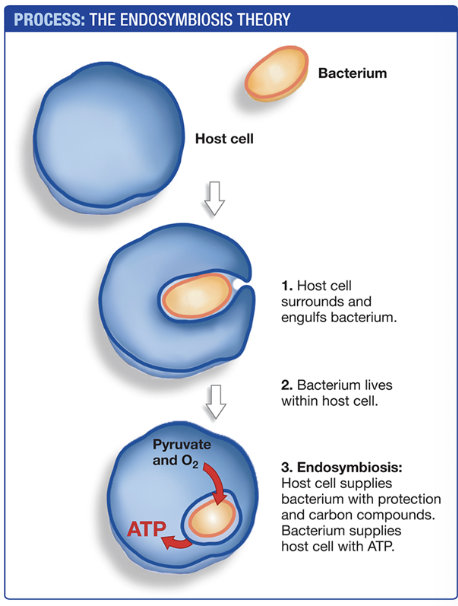
What is the origin of mitochondria?
host ancestral cell engulfs an aerobic bacterium
fails to digest it
bacterium lives and reproduces in host cell
eventually them become dependent
what is the origin of chloroplasts?
Chloroplasts have bacteria-like characteristics
Chloroplasts have circular DNA with genes similar to those in
cyanobacteria
Peptidoglycan in cell wall
Extant endosymbiotic cyanobacteria live in cells of protists and
animals
endosymbiosis leading to photosynthesis first occurred in the common ancestor of the ___ which gave rise to all of its subgroups __ ____ _ ____
plantae, primary endosymbiosis of cyanobacteria
chloroplasts also occur in __ __ __. in these species, the chloroplasts are surrounded by more than _ _____.
foure protist lineages
2 membranes
Evolution of endosymbiosis in protista
single origin or primary endosymbiosis
possibly at least 3 occasions of secondary endosymbiosis
multicellularity:
refers to organisms with more than one cell
arose independently in 7 eukaryotic lineages
How did multicellularity arise?
colonial model
coenocytical model
origins of multicellularity in Eukaryotes colonial model:
each cell exists and reproduces as an individual
then, cells derived benefit from aggregation and cooperation
then, the evolution of separate somatic and germ cell lines
finally, cells arrange to form interior/exterior polarity
origins of multicellularity in Eukaryotes coencytical model:
each cell exists and reproduces as an individual
then, cells form coenocytes by incomplete cell division
then, membranes form between nuclei, create separate cells
then, cells differentiation to form cell types, including germinal ( a single cell/cytoplasmic mass containing several nuclei)
Multicellularity has given rise to increasing ____ ____ and ____ ______ __ _____
structural complexity
greater division of labor
multicellularity has given rise to
larger size
increasingly elaborate genetic developmental programs giving rise to massive cellular diversity
greater functional specialization
emergence of complex cell-cell interaction networks
why not just one big cell?
single cells rely on diffusion; less effective as surface area to volume ratios decrease with increasing size
multicellular organisms consists of small cells that absorb and excrete substances via specialized transport systems
multicellularity may allow improved metabolic efficiency
different cells specialized for specific functions
Eukaryotic protists:
include all eukaryotic taxa not including plants, animals, or fungi
composed of 7 monophyletic groups
unikonta (one tailed flagellum)
bikonta (two tailed flagellum)
most unicellular
Protists are important for what 3 reasons?
they are important medically
malaria
they are important ecologically
harmful algal blooms
harmful to humans
they are critical to understanding the evolution of plants, fungi, and animals
key role in food chains, and in the global carbon cycle