Evolution - Pattern & Process
 Call Kai
 Learn
Learn Practice Test
 Spaced Repetition
 Match
Match Flashcards
 Knowt Play
1/86

There's no tags or description
Looks like no tags are added yet.
Name | Mastery | Learn | Test | Matching | Spaced | Call with Kai | Chat |
|---|
No analytics yet
Send a link to your students to track their progress
87 Terms
Introduction to evolution by Natural Selection
Evolution by natural selection is one of the best-supported and most important theories in modern biology
One of the great ideas in science
One of the key attributes of life;
Populations of organism evolve, or change through time
What was the idea of special creation?
Charles Darwin published On the origin of species by means of natural selection in 1859
Radically different from the idea of special creation, which claimed that
Species are independentScie (unrelated)
Life in earth is young (-6000 years old)
Species are immutable (incapable of change)
Scientifc Theory
1) Is not a guess
2) Explains a broad class of observations and is widely supported by evidence
What are the two components scientific theories are often compromised to?
1) Pattern —> Observations of the natural world
2) Process —> Mechanism that produces that pattern
The history of evolutionary thought:
Theory of evolution by natural selection is often described as revolutionary
A scientific revolution replaces an existing idea about nature with a radically different idea
The idea of special creation dominated Western thought about the nature of organisms for over 2000 years.
Plato and Typological Thinking
The Greek philosopher Plato claimed that
Every organism was an example of a perfect essence, or type, created by god
Types were essentially unchanging
Today philosophers and biologists refer to ideas like this as typological thinking.
Aristotle and the Scale of Nature
Aristotle ordered kown organims into the linear great chain of being (or scale of nature) in whiche
species were fixed types
Species were organized into a sequences based on increasing size and complexity
Sequence started with mienerals and lower plants
Humasn were at the top of the chain
Lamarck and the idea of evolution as chnage through time
In 1809 Jean-Baptiste de Lamarck was the first to propose a formal theory of evolution:
Based on Aristotle’s great chain of being, simple organisms originate at the base of the chain by spontaneous generation
Organisms evolve by moving up the chain over time
Lamarckian evolution is progressive—producing larger, more complex or “better” species over time
What process did lamarck suggest was responsible for this pattern?
Proccess: Inheritance of acquired characters
As individuals develop, their phenotype changes in response to environmental changes
Phenotypic changes are then passed on their offspring
Darwin and Wallace and Evolution by Natural Selection
Darwin and Wallace proposed that change in species through time
Does not follow a linear, progressive pattern
Is based on variation among individuals in populations
A population consists of individuals of the same species living in the same area at the same time
Individuals with certain traits produce more offspring than others without these traits.
What view do they use instead of typological thinking?
View: Population Thinking
Darwin claimed that variation among individuals in a population was the key to understanding evolution.
Typological Thinking vs Population thinking
Typological thinking views species as defined by an unchanging, ideal template, whereas population thinking views species as groups of unique individuals where variation is normal and essential.
Why was the the theory of evolution by natural selection revolutionary?
It overturned the idea that species are static and unchanging
It replaces typological thinking with population thinking'
It was scientific (testable)
It proposed a mechanism that could account for change through time
Its [predictions could be tested through observations and experimentation
Common, Misconceptions, Corrected: Evolutionary change occurs in individuals
Correction:
Natural selection just sorts existing variants among individuals; it doesn’t change them
Evolutionary change occurs only in populations
Acclimatization does not equal adaptation
Common, Misconceptions, Corrected: Evolution is goal directed
Correction:
Adaptations do not occut because organisms want or need them
Mutation, the source of new alleles occurs by chance and in random directions
Evolution is not progressive
Loss of traits can be adaptive
There is no such thing as higher or lower organism
Common, Misconceptions, Corrected: Evolution perfects organisms
Correction:
Not all traits are adaptive
Some traits cannot be optimized due to fitness trade-offs
Some traits are limited by genetic, historical, or environmental constraints
Does natural selection change individuals?
During the process of natural selection, indivudals do not chnage only the population does.
For example:
During heavy rainfall, individual beaks did not change
The average beak depth decreased over time because small, pointed-beaked individuals had relatively larger reproductive success
Natural Selection is not “Lamarckian” inheritance
In contrast to Lamarck’s hypothesis about the inheritance acquired characteristics:
Individuals do not change when they are selected, they simple produce more surviving offspring than other individuals do
Alleles in the selected individuals become more frequent in the population
(in other words, natural selection just sorts existing variants - it does not change them)
Allele
A version of a gene. Every individual inherits two copies of most
genes (one from each parent) and those two copies may be the same allele
or different alleles. It is this variation in alleles across individuals in a
population that gives natural selection something to act on.
Phenotypic plasticity
Occurs when an individual’s phenotype (outward appearance) changes in response to changes in the environment.
The individuals genotype remains fixed
The phenotypic changes associated with plasticity are not directly passed on to offspring because no alleles have changed.
Example of phenotypic plasticity
Daphnia (water fleas): these microscopic crustaceans grow protective helmets and/or spikes when they sense chemical cues from predators in the water.
Is evolution goal directed?
Evolution by natural selection is not goal directed. Mutations do not occur to solve problems (mutations are random).
Due to errors during DNA Synthesis
Adaptations do not occur because organism want or need them
Cacti example: That trait became more common over generations - not because the plant was working toward a goal, but because the environment favoured it by chance.
Evolution is NOT progressive
meaning it does not produce “better” or more complex organism
In fact, complex traits are routinely lost or simplified over time as a result of evolution by natural selection.
populations that become parasitic are particularly prone to loss of complex traits
Does evolution produce a tree of life or a ladder of life?
Taxa appearing at the tips of the branches are all extant (modern, currently living)
To say one extant taxa is more “primitive/lower” or “advanced/higher” than the other would be incorrect
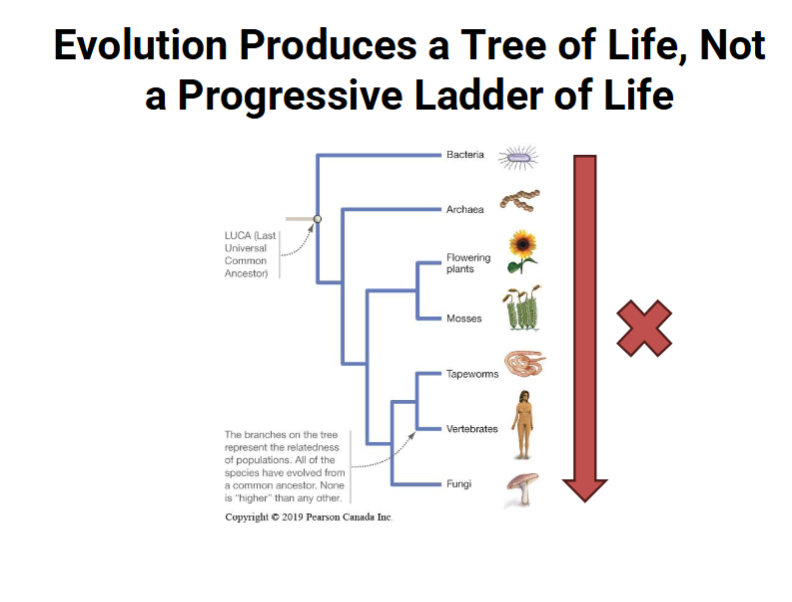
Is there such thing as a higher or lower organism?
Scientifically, there is no such thing as a “higher” or “lower” organisms
Mosses may be less structurally complex than flowering plants (e.g., lack true roots), but neither group is higher or lower than the other.
Different suite of adaptations.
Vestigial Traits
Vestigial traits confer no known benefit
Organisms possessing them do not have higher fitness than those without
Silent Mutations
Changes in the DNA sequence that do no result in aa change in the ammino acid sequence of the protein encoded by the gene
Extremely common
Do not change the phenotype and thus cannot be acted on by natural selection and are not adaptive.
Proteins
Proteins are a long chain of amino acids , in order to get the correct code, it is read 3 base pairs at a time.
Few of them can code for the same amino acid
If there is no change in the phenotype, natural selection will never see a silent mutation.
Silent mutations are extremely common
Traits are genetically constrained
selection is not able to optimize all aspects of a train due to genetic constraints
Genetic Correlations
Genetic correlation occurs,
when selection favoring alleles for one trait causes a correlated but suboptimal change in an allele for another trait
Due to pleiotropy, in which single allele affects multiple traits
Lack of genetic variation can also constrain evolution, because natural selection can work only on existing variation in a population.
Pleiotropy diagram

Fitness Trade off
A fitness trade-off is a compromise between fitness-related traits; occurs when an organism's adaptation to excel in one trait or environment comes at the cost of its performance in another.
Because selection acts on many traits at once, every adaptation is a compromise
Examples of fitness trade-offs include compromises between;
the size of eggs or seeds that an individual makes and the number of offspring’s it can produce
rapid growth and long life span
Coloration and tendency to attract predators
Traits are historically constrained
Because all traits evolve from previously exisiting traits,
adaptations are constrained by history
Natural Selection acts on structured that originally had a very different function
the best solution possible given an important historical constraint
Traits are enviornmentally constrained
Natural selection often occurs in the context of a changing enviornemnt
Abiotic and biotic feautures can fluctuate
Over time
Over the geographic range of the population
Are all traits adaptive?
Not all traits are adaptive, and even adaptive traits are constrained by genetic and historical factors
Natural selection is not the only process that causes evolutionary change.
Topic 5: Have species changed, and are they related?
Darwin described evolution as descent with modification
change over time produced modern, modified species from ancestral process
The pattern component
The pattern component of the theory of evolution by natural selection predicts
that:
Species change through time
Species are related by common ancestry
Fossils
Fossils are traces of organisms that
lived in the past
The many fossils that have been found and described in the scientific literature
make up fossil record
fossiles were initially organized according to their relative ages
Sedimentary rock
Form from sand or mud
Form in layers
Younger layers are deposited on top of older layers
How do we know how old a fossil actually is?
Radioactive parent atoms decay into stable "daughter" atoms
at a known, constant rate → this allows us to assign absolute
ages (actual numbers in years) rather than just saying one fossil
is older or younger than another
Radiometric Dating
Radiometric dating works by measuring the ratio of parent to
daughter atoms in a sample → the more daughter atoms
present, the older the sample
Example (Radiocarbon dating): Living organisms continuously
absorb ¹⁴C (parent) from the atmosphere, but when they die,
absorption stops and ¹⁴C begins to decay into ¹⁴N (daughter).
By measuring how much ¹⁴C remains, we can estimate time of
death.
¹⁴C has a half-life of ~5,730 years, meaning every 5,730
years half of the remaining ¹⁴C has decaye
The vastness of geologic time
Radiometric dating data indicate that
Earth is about 4.6 billion years old
the earliest signs of life are found in rocks about 3.4-3.8 billion years old.
Extinct species
Fossils provide evidence for extict species
Species that no longer exist
How did Darwin interpret extinction
Darwin interpreted extinction as evidence that
species are dynamic
The array of species living on Earth has changed through time
What does the fossil record suggest about extinct species?
Fossil record suggests:
Over 99% of all the species that have ever lived are now extinct
Extinction have occurred continuously throughout Earth's history (they are the rule, rather than the exception)
Law of succession
Early scientists observed that fossil species are strinkingly similar to living species in the same geogrpahic areas
this pattern became knows as the “law of succession”
How did Darwin interpret this pattern?
Darwin interpreted this pattern as evidence that:
species changed though time
extinct and living forms were related and represented ancestors and descendants
Transitional Features
Transitional features are traits in a fossil species that are intermediate between ancestral and derived species
These transitional forms provide strong evidence for change through time
For example, fossils show a gradual change from the aquatic fin to the terrestrial limb
Data like these are consistent with predictions from the theory of evolution
if the traits observed in more recent species evolved from traits in more ancient species, then transitional form are expected to occur.
Vestigial Trait
A vestigial trait in an organism is
reduced or incompletely developed structure that has no (or reduced) function
clearly similar to functioning organs or structures in closely related species
Vestigial traits are:
Inconsistent with the idea of special creation
Evidence that characteristics of species have changed over time
Current Examples of Change Through Time
Bacteria have evolved resistance to drugs
insects have evolved resitance to pesticides
Weedy plants have evolved resitance to herbicides
Bird migration, insect emergence, and blooming of flowering plants have evolved in response to climate change
Evidence of descent from a common ancestor
Data from the fossil record and contemporary species refute the hypothesis that species are immutable
There is also mounting contemporary scientific evidence of the relatedness of species common ancestry
Similar species are found in the same geographic area;
There are often striking similarities among island species
– For example, mockingbirds that Darwin collected from the Galápagos Islands were superficially similar, but different islands had distinct species
Darwin proposed that the mockingbirds were similar because they had descended from a common ancestor
Recent DNA analyses support Darwin’s hypothesis
What did comparing the mockingbird DNA on phylogenetic tree show?
The different Galapagos mockingbird species are each others closest living relatives
The share a single common ancestor.
What is homology?
Homology is a similarity that exists in species descended from a common ancestor
What is homoplasy?
a similar feature that does not come from genetic ancestry
What three interacting levels can homology be studied and recognized?
1) Genetic
2) Developmental
3) Structural
Genetic Homolgy
Genetic homolgy is a similarity in the DNA nucleotide sequences, RNA nucleotide sequences, or amino acid sequences
Example of genetic homolgy:
For example, the eyeless gene in fruit flies and the Aniridia gene in humans are so similar that their resulting amino acid sequences are 90% identical
Developmental Homology:
Developmental homology is seen in embryos of different species.
Example of developmental homolgy:
Tails and gill pouches are found in the embryos of chickens, humans, and cats
One explanation for these embryonic similarties is that the common vertebrate ancestor of these species had gill pouches and a tail
Structural Homology
Structural homology is a similarity in adult morphology
Structural homology exists because mammals evolved from an ancestral tetrapod (had the same general arrangement of bones in its limbs)
How do the three levels of homology interact?
– Genetic homologies cause the developmental homologies observed in embryos
– Chemicals that cause cancer in humans can often be identified by testing their effects on mutation rates in bacteria, yeast, zebrafish, mice, and other model organisms
– Drugs intended for human use can be tested on mice or rabbits if the proteins or other gene products targeted by the drugs are homologous
Internal consistency;
the observation that data from independant sources agree in supporting predictions made by a theory
perhaps the most powerful evidence for any scientfic theory, including evolution be natural selcetion
How did Cetaceans (Whales and dolphins) evolve?
Cetaceans evolved from land-dwelling ancestors, several independent lines of evidence all point to the same conclusion;
Morphology and the fossil record - fossil cetaceans show a gradual transition from hoofed, semi aquatic to fully aquatic, tail powered swimmers

Radiometric dating of cetaceans:
Absolute dates confirm the order of species in the phylogeny (e.g. Ambulocetus ~48 mya → Dorudon ~40 mya → modern whales)
Vestigial structures;
Hip and limb bones persist in some adult whales and dolphin embryos, remnants of their terrestrial body plan.
What did darwin base his idea of natural selection on?
– Observations exploring and documenting the diversity of plants and animals around the globe.
– Work of geologist Charles Lyell and,
– The work of Thomas Robert Malthus.
Darwin’s experimentation of Artificial Selection is pigeon breeding;
Darwin crossbred pigeons and observed how characteristics were passed on to off spring
He concluded that the diverse pigeon breeds all descend from wild pigeons
What did Darwin use as inspiration from Thomas Robert Malthus’:
An Essay on the Principle of Population
Described a “struggle for existence”
Many more individuals are born than can survive
Thus, individuals compete fro resources
What ideas did Darwin combine to arrive at his concept of natural selection?
His observations of artificial selection
The notion of struggle for existence in natural populations
variation in natural populations
Darwin’s Four Postulates
1) Individuals in a population vary in their traits
2) Some these differences are heritable; they are passed on the offspring
3) In each generation, many more offspring are produced than can survive
Only some will survive long enough to reproduce
Some will produce more offspring than others
4) Individuals with certain heritable are more likely to survive and reproduce
natural selection occurs when individuals with certain traits produce more offspring that do individuals without those traits
The individuals are selected naturally, by the environment
What will happen to the selected traits?
The selected traits will increase in frequency in the population from one generation to the next, causing evolution
Its the alleles (genetic variants) underlying traits that are passed on from one generation to the next, not the traits themselves
Thus, evolution is a change in the allele frequencies of a population over time
How did modern biologists condense Darwins four steps into three statements:
1) Variation is present
2) This variation is heritable
3) Some variation survive & reproduce more than other, aka differential reproductive success
Biological Fitness
The ability of an individual to produce surviving, fertile offspring relative to that ability in other individuals in the population
Adaptation
A heritable trait that increases an individuals fitness in a particular environment relative to individuals lacking that trait
Selection
Differential reproduction as a result of heritable variation
Case study 1: How Did Mycobacterium Tuberculosis Become Resistant to Antibiotics?
The bacterium Mycobacterium tuberculosis causes tuberculosis (TB)
TB infect the lungs often causing death
TB was once a great public health issue as cancer is now
TB receded in importance in the early 1900s due to
improved nutrition
the development of antibiotics
What happened with TB in the late 1980s?
– In the late 1980s, rates of TB surged
– In 1993 the World Health Organization declared TB a global health emergency
– Strains of the bacteria responsible for the increase were resistant to the once-effective antibiotics.
Evolution of Drug Resitance: 1) Large population of M.tuberculosis bacteria in patient lungs makes him sick. A few of the bacterial cells happen to have a point mutation in the rpoB gene.
DNA from the rifampicin-resistant bacteria was found to have a single point mutation in a gene called rpoB
rpoB codes for a component of RNA polymerase
The mutation caused a change in amino acid sequence resulting in a change in enzyme shape
Rifampicin works by binding with the M. tuberculosis RNA polymerase and interfering with transcription
The mutation prevents rifampicin from binding

2) Drug therapy begins killing most M.TB. Patient seems cured and drug therapy is ended.
Even though the population is drastically reduced, a high proportion of the remaining cells is resistant to the drug.
Rifampicin-sensitive bacteria are successfully killed off, but a few resistant strains remain
3) The mutant cells proliferate, resulting in another major infection of the lungs. The patient becomes sick again
Rifampicin-resitant bacteria begin to proliferate, making patient sick again
4) A second round of drug therapy begins but is ineffective on the drug resistant bacteria. The patient dies
Patient undergoes drug therapy again, but this time, it is ineffective. The patient succumbs to the disease
Testing Darwin’s postulates
Review example in slides (TB)
What happens if one postulate is not true?
All three conditions are necessary for evolution to occur. If one is missing, we will not observe change in the genetic composition of the population over time.
Drug Resistance: A widespread problem
Resistance to a wide variety of insecticides, fungicides, antibiotics, antiviral drugs, and herbicides has evolved in hundreds of insects, fungi, bacteria, viruses, and plants
In every case, evolution has occurred because individuals with the heritable ability to resist some chemical compound were present in the original population
As the susceptible individuals die from the pesticide, herbicide, or drug, the resistance alleles increase in frequency