Clostridium spp.
 Call Kai
 Learn
 Practice Test
 Spaced Repetition
 Match
 Flashcards
 Knowt Play
1/51

There's no tags or description
Looks like no tags are added yet.
52 Terms
spore
Clostridium spp. are _________- formers.
Feeding, absorbing or growing upon decaying organic matter --> they're ubiquitous
Most Clostridium spp. are saprophytic - what is meant by that?
opportunistic
Pathogenic clostridia are primarily saprophytic in nature, but are ______________ pathogens
toxin producers
pathogenesis caused by exotoxins
What are major virulence factors of Clostridium spp?
TOXIN
SPORES
ANAEROBIC/necrotic conditions
What are three basic things your brain should think of automatically when ya hear "Clostridium"?
beta-lactams (clostridium are gram +)
What antibiotics might we use to treat clostridial infections?
anaerobic conditions
What event/environment promotes spores to germinate into the vegetative form?
the vegetative form
What form of Clostridium spp. produces toxin?
endo
exo
Gram negative bacteria typically produce _______toxins, whereas gram positive bacteria typically produce _______toxins
myonecrosis
The following Clostridium spp. are histotoxic, and cause ___________:
C. chauvoei
C. septicum
C. perfringens
C. novyi (type A)
C. sordellii
liver
The following Clostridium spp. are histotoxic, and have _______ involvement:
C. novyi (type B)
C. haemolyticum
C. piliforme
negative
Clostridium piliforme is a gram __________, spore-forming bacterium and the infectious agent of Tyzzer's disease.
C. chauvoei
What is the etiological agent of blackleg?
C. septicum
What is the etiological agent of malignant edema (called Braxy in Europe)?
C. perfringens
What is the Clostridial etiological agent of myonecosis and gas gangrene?
C. novyi (type A)
What is the Clostridial etiological agent of myonecosis - Big head in sheep?
Acute death: rapidly progressive with tremors, ataxia, dyspnea, recumbency, coma, and death within 12 to 24 hours mortality can reach 100%
What are clinical signs of clostridial disease?
hot, edematous and crepitus (poppin' bubble wrap), painful;
then, cold and non-painful (because tissue is dead)
Describe the lesion of clostridial disease causing myonecrosis
exotoxin
What type of toxin does Clostridium spp. produce?
Trauma causing necrotic, devitalized tissue
anaerobic, low O2 tension
germination of spores
growth of vegetative form of bacteria
production of toxins
Describe the pathogenesis of clostridial myonecrosis
exogenous: introduced iatrogenically (injection sites)
endogenous: spores ingested from environment, cross gi barrier --> blood --> take up residence in muscle
Concerning the pathogenesis of clostridial myonecrosis - it can either due to endogenous or exogenous causes - explain each
endogenous
exogenous
It cattle, myonecrotic clostridial disease is primarily __________, whereas in horses, it is ___________. (exogenous/endogenous)
they are ubiquitous in the environment
So, what is the natural habitat of Clostridium spp. and how did they get into the muscle?
Clostridium chauvoei - this is Blackleg
What is the most likely clostridial species in this animal?

Clostridium perfringens type A
What is the etiologic agent of gas gangrene in horses?
acute-onset, rapidly progressive soft tissue swelling accompanied by crepitus in the area of arecent parenteral injection
What does clostridial myonecrosis look like clinically in a horse?
Clostridium perfringens type A
What is the most likely etiologic agent causing these lesions in a horse?
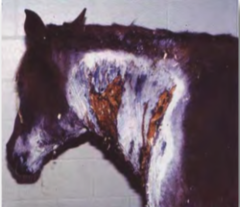
clinical presentation
presence of bacteria in vegetative form: FA test, direct smear
Diagnosis of clostridial myonecrosis is based on what things?
vegetative form
When performing a direct smear or fluorescent antibody testing for clostridial myonecrosis - are you identifying the spore form or vegetative form?
reduce risk factors
vaccination with toxin (toxoid)
How can clostridial myositis be prevented?
bacterin: is an inactivated bacteria, used to build immunity against bacteria
toxoid: is an inactivated toxin, used to build immunity against toxin
antitoxin: an antibody with the ability to neutralize a toxin - given immediately following known infection in order to try to mitigate action of toxin
What is the difference between a clostridium bacterin vs. toxoid vs. antitoxin?
Clostridium sordelli
What clostridial agent fits this disease description?
- cellulitis
- edema and swelling of affected tissue
- coldness and discoloration of the skin over affected tissue
- depression
-prostration
- sudden death
exotoxins
Enterotoxic clostridium spp. produce what kind of toxins?
Inhibits the release of Acetylcholine
Ach receptors on muscle fibers not stimulated
What is the mechanism of C. botulinum causing flaccid paralysis?
ingestion of mixed feed - contaminated with toxin
What is the major way that cattle get botulism?
round bales - dead animal baled in it on accident and toxin grows
Horses feeding off of what is a risk factor for botulism?
Suppresses release of inhibitory messenger substances
Thus, no dampening of excitatory nerve impulses from upper motor neurons
How does Clostridium tetani cause rigid paralysis?
horses!
C. difficile is a common infection/issue in what species?
types A, C, and D
Which types of C. perfringens are enterotoxic and cause diarrhea, enteritis, and enterotoxemia?
A
C. perfringens type _____ causes hemorrhagic bowel syndrome in dairy cattle
C
C. perfringens type _____ causes neonatal hemorrhagic or necrotic enteritis in calves, lambs, kids, foals, piglets
D
C. perfringens type _____ causes enterotoxemia - overeating disease, pulpy kidney disease (mainly sheep, goats, calves/cattle)
- Antimicrobial therapy, overeating, & others
- normal flora shift (how)
- both leading to opportunistic overgrowth
What are two risk factors for Clostridium difficile infection?
laminitis
What is an important sequelae of Clostridium difficile infection in horses?
Well feed, rapidly growing, and in good body condition
What kind of animals are prone to Clostridium perfringens type D infection?
- Off feed
- Diarrhea ± blood
- ataxia, trembling, stiff limbs, opisthotonus, convulsions, coma
- stomach pain: kicking at their belly, laying down and getting up, laying on their sides, panting, and crying out.
What clinical signs might you see in animals with Clostridium perfringens type D infection?
the toxin produced by the bacteria! (toxin gene in case of PCR)
When performing an ELISA or PCR to confirm diagnosis of either C. perfringens or C. difficile - these tests are detecting what exactly?
A
B
Clostridium novyi type ____ causes myonecrosis, whereas clostridium novyi type ____ has liver involvement.
haemolyticum
Clostridium ___________ causes bacillary hemoglobinuria (Red water)
Insult to liver tissue by Fasciola hepatica --> Necrotic tracts in liver
What precedes germination of Clostridium novyi type B in Black disease in cattle?
Sudden death
Depression
Reluctance to move
Cold skin
Decreased GI activity
Pain on abdominal palpation
What are some general clinical signs associated with Clostridial diseases?
Mainly laboratory animal disease (small rodents), but also young or immunocompromised animal - foals (there have also been reports in dogs, cats, raccoons, and the gray fox)
What animals are typically affected by Tyzzer's disease?