FW334 Exam 1
 Call Kai
 Learn
Learn Practice Test
 Spaced Repetition
 Match
Match Flashcards
 Knowt Play
1/159

Earn XP
Description and Tags
I hate human dimensions
Name | Mastery | Learn | Test | Matching | Spaced | Call with Kai | Chat |
|---|
No analytics yet
Send a link to your students to track their progress
160 Terms
What are the linked terms in a social-ecological system
People
Fish and wildlife
Habitat
We cannot affect 1 part without unintended / intended effects on others
Wildlife and fisheries management is…
10% wildlife and 90% human management
Wildlife management is people management
HD Definition
Discovering, understanding, and applying insights about how humans value fish and wildlife, how humans want fish and wildlife to be managed and how humans affect and are affected by fish and wildlife resources, other people, and the outcomes of FW management and conservation
Riley Et al Essence of FW management paper
What is the “essence” according to riley et al? What is the core concept associated with the “essence” and the two key precepts?
The essence → Trying to focus on + and - impacts on FW management, existence value, cultural value, etc. Our job is to address impacts
managing wildlife-related impacts
Core concept → adaptive impact management → managing these impacts to achieve + ones and avoid - ones by continuously learning and adjusting strategies based on science and feedback
2 key precepts
Multi-disciplinary integration → social science and biological science
Stakeholder participation → seek input and involvement from diverse stakeholders
Challenges to decision making
stakeholder empowerment → Governance challenges
lack of training, political pressure, data, time, etc → institutional challenges
Individual challenges → fear of loss, power, aversion to change
Decisions are the core function and integrative process of FW management
HD of FW informed by research from the social sciences → contributes insights more durable decisions
Relationships of human wildlife interactions
Relationships of population size to freq and quality of human wildlife interactions
Allows us to manage impacts of pop sizes as opposed to figuring out individual quality of interactions

What are impacts?
Subset of effects arising from recognized events with FW, evaluated by stakeholders as important to warrant a management action
Event or interaction → recognized (vs unrecog.) → Effect → high importance (vs low) → impacts
Essence considerations from riley et al
Impacts → effects arising from interactions but NOT the event of interaction itself (need insights from social sciences)
Stakeholders and beneficiaries of public trust management
Capacity and limits (social and biological)
Decision making → integrative process of management
Public trust thinking
Philosophy or approach to management emphasizing the idea of trusteeship
implies stewardship as opposed to ownership, holding onto it for someone else
trusteeship being “the job, role, or responsibility of a trustee—someone who legally manages money, property, or assets on behalf of another person or group”
6 parts
FW are an endowment (for the benefit of all + future people)
FW are not suited to exclusive, private ownership
All people deserve fair consideration
Current decisions should avoid foreclosing future options
Trust administrators must be transparent
People hold trustee accountable
last 2 related, cant hold accountable if you dont know what they did
Public trust doctrine
legal framework that holds certain natural resources are held in “trust” by gov for the peoples benefit
4 parts of the system (RABI)
Trust resources (FW)
Administration of trust resources (the way the corpus is administered)
Benefits and beneficiaries of the trust → who are these?
Outcomes of trust management → impacts as a compliment to the resources (the benefits derived from management of FW)
What is a trust?
Collection of assets (corpus) committed or entrusted to one to be managed or cared for in the interest of another
In US, FW are held by the public trust through state and federal gov
individual may own the land but they cannot own the FW
Justinian Era
“by law of nature, these things are common to all mankind: the air, water, sea, and consequently the shore of the sea”
Additionally, the magna carta recognized that the king held technical ownership over the land, but that came with the obligation to protect them for common use vs use as private property
Two important supreme court cases
Martin V Waddell
Oysters → very important in early americas/NA culture → people harvest them on the shore of some guys property → guy tried to get the people off his land, his land = his oysters → court quoted magna carta, you can own the land/water but they fall under the public trust → so he could not ban people
Geer V connecticut
Key Issue: Whether a Connecticut state law prohibiting the possession or transportation of certain game birds (woodcock, ruffled grouse, and quail) killed within the state to points outside the state violated the Interstate Commerce Clause. [1, 2]
The Ruling: The U.S. Supreme Court affirmed the conviction of Edgar M. Geer. The Court held that wild animals are owned by the state in "trust for its people," giving the state broad police power to regulate and restrict the use or export of game within its own borders without violating federal commerce laws
included wildlife in the PTD
PTD is rooted in western norms
stewardship concept
property and ownership
drives our language and how we talk about wildlife
wildlife as trust assets
Who are the trustees?
Executive branch → governor and state legislators
president and congress
State directors, commissions, comissioners → Natural resources commission in MI, 7 members appointed by governor w/ political balance
federal secretaries
Who are trust managers
Agency personnel → fish division chief, regional wildlife supervisor, FW biologists
Implement decisions from trustees, int with the public the most, informing and making recommendations to the trustees
We do not have authority over these guys like we do with trustees
Public trust functions (how a gov manages a resource)
3 broad functions of public trust administration
Sustaining trust assets (protective custody)
Developing trust assets (active stewardship)
Distributing trust benefits (good governance)
The first 2 are management, on the ground work each day
third is governance
Both are aimed at decreasing - and increasing + impacts and are more effective this way
Who does FW management work for?
Current and future gens
benefit of american people

Why does public trust matter
Foundation of FW conservation & management
✓ Spans the needs of all FW and all people
✓ Basis for broader public support
✓ Everyone has a stake in FW management
Public trust in action, line 5 permit
What is the difference between
simply assessing environmental
impacts and considering impacts to
the public trust? Why does the
article suggest that this distinction
matters?
The article describes the court's
decision as potentially expanding
what state agencies must consider
when evaluating environmental
harms. Do you think this is a major
change in how agencies make
decisions? Why?
Distinction matters because it means cant limit their reviews to projects immediate footprint, have to consider the long term, PTD creates a mandatory standard all agencies follow
Was good, originally failed to consider MEPA and PTD, sets a new standard for companies
PTD in action, climate change
Use of judicial system (courts) to require more action by state and federal
government on climate change
• No federal legislation targeting climate change
• US Constitution doesn’t explicitly protect right to clean environment
• Public trust doctrine application?
Juliana v. United States
• Our Children’s Trust file lawsuit against federal government on behalf of youth
plaintiffs
• 9th Circuit ruled in 2020 they did not have standing
Held v. Montana
• Youth plaintiffs again, state failed to uphold right to a clean environment (right
guaranteed in MT Constitution)
• Judge ruled in favor in 2023; PT application to the atmosphere; MT DEQ delinquent in failing to consider greenhouse gas/climate impact of development projects
Beneficiaries
everybody who resides in Michigan, all who recognize our benefits and those who dont, future + current
It is up to administrators to understand and weigh beneficiaries needs and desires
Stakeholders
Subset of beneficiaries, people who are directly impacted by decision and closely related to resource, not considering the future gens or those unaffected by a change in resources
significantly affects or is affected by FW or FW management
stakes may be recreational, economic, political, social, etc.
some stakes are only about how management is conducted, rather than the outcome of management
Stakeholders have interests in diff kinds of impacts
Primary impacts are the reason for management and related to
the desired outcome of management actionsCollateral impacts are unintended and simultaneously occur
with the implementation management actionsSubsequent impacts are unintended and occur as a secondary
consequence of achieving management objectives
Jurisdictional spheres of influence applied to FW management
Stakeholders can be activated at different scales of influence
may have interest in impacts beyond just a local scale → international? national?
No one decision if certain communities should be weighted more heavily than others in these cases
Customers
Further subset of stakeholders than pay for things we want, like paying for fishing/hunting licenses
funded primarily by customers
Progression from constituent and customer to stakeholder and partner in FW management
These are all beneficiaries of the PTD
Constituent: People who authorize or support the efforts of others (i.e., FW professionals) on their behalf. e.g, farmers, trappers, anglers
Client: People who pay for professional services. e.g., FW case, buy licenses that pay for the services of public agencies
Customers: Individuals seeking discrete services in return for a cost
(payment)These terms all imply “special relationships” between managers and those who benefit directly from the resources.
Cartoon illustrates the constituent and client era, the sportsman holds the authority and pays the license fees that fund the agency so they steer
this approach functions well when managers and clients share a narrow set of values
unchallenged until the 80s, now we recognize that we must include all stakeholders
the evolution from viewing the public as passive "constituents and customers" to active "stakeholders and partners" represents a profound paradigm shift. This progression moves agencies away from top-down management toward collaborative governance and shared stewardship.

Whose interests and concerns should be considered?
Different people can value the same resources for different reasons, which leads to competing ideas about appropriate management objectives and action.
The most difficult issue facing FW managers is the choice of whose values to consider and how to weight them
Must distinguish between what is scientifically defensible and what is morally or legally arguable and credible
Manager responsibilities
✓ Decision on relevant needs and
interests
✓ Needs and interests addressed fairly
✓ Group size does not = stake importance
✓ Decisions reflect public interests and values
✓ Evaluate influence of management on stakeholders and
beneficiaries
✓ Adapt management accordingly
The trouble of wilderness or getting back to the wrong nature by Cronon
What’s Cronon’s argument about the idea of
“wilderness”? What does he think we get wrong
when we treat wilderness as separate from people?
What’s the problem with this way of thinking
about nature? Who or what might be
overlooked when we draw a line between
“nature” and “people”?
Wilderness is not a pristine, untouched sanctuary somewhere out there waiting to be discovered, but a profoundly cultural invention
this idea was created by Western cultures, but historically wilderness is very impactful in our laws, stories, our understanding of nature, etc
we get wrong the fact that when we treat nature in this way we operate on a false dichotomy that nature
= spend resources on only saving untouched land then allows people to ignore their affects on environment in suburbia
sets conservation up for failure → if people in wilderness takes it away then there is no place for management or conservation (that is the problem!!)
We overlook indigenous people and local communities who live on the “pristine” land by driving them out after thousands of years of indigenous stewardship
everyday nature in local areas
+ and - impacts from conservation
“As we gaze into the mirror it holds up for us, we
too easily imagine that what we behold is Nature
when in fact we see the reflection of our own
unexamined longings and desires”
what does that have to do with FW management?
Diff stakeholders may bring diff cultural perspectives, we manage the resource how we believe it should be
Fundamentals of sociology
Sociology is “understanding what people do as members of a group or when interacting with one another” (Stedman 2012 p.58)
Sociological Imagination
“Neither the life of an individual nor the history of society can be understood without understanding both” C. Wright Mills
Troubles vs. Issues
trouble → personal problem, individual
issue → scaled up, institutional
Sociology helps clarify contextual factors affecting behavior
Emphasizes social structure influence on behavior
Studies social facts external to the individual and includes
values
cultural norms
beliefs
3 fundamental perspectives of sociology
(a general lens, framework, or philosophical position used to analyze how society works, how people behave, and how social order is maintained.)
Functionalist perspective: society agrees on shared values and works towards what is best for society as a whole
– We learn rules and they create social order & stability
– FW: policies and regulations help maintain ecological and social functions (e.g., protection, population sustainability, recreation, etc.)Conflict perspective: social organization emerges from battle over resources
– Society has winners and losers; importance of power for social interactions
– FW: powerful interests may influence conservation outcomesSymbolic interactionist perspective: we create and assign meaning to social life through social interactions (daily meaning-making!)
– We behave based on those meanings which may vary across groups
– FW: Understand how people interpret symbols like “endangered species”, how does
society reinforce those meanings?Ex: tiger vs insect as endangered, how do we view them? News articles and documentaries reinforce this idea
Sociological Theories (R/ID, ICC)
How society shapes us and we shape society on different scales
social roles and identities
culture and socialization
community
inequality stratification
Social roles and identities
Identities: meanings you hold for yourself
– Self-reflection and reinforced through feedback from others
Identities have social expectations or roles for behavior
– Society influences meanings and expected behaviors (maybe at home I can be loud while fishing, but in EL I must be quiet due to diff expectations)Situational influences results in behavior change
– May emphasize only certain aspects of identity in a certain situation (context matters!)
– Kuentzel (1994)—observing other hunters shooting birds out of range influenced others to do the same, even when self-professed attitudes didn’t support it
1. Social Expectations & Roles
Every identity carries a set of social expectations, rules, and codes of conduct prescribed by society. Society dictates the meaning behind these roles and establishes the boundaries for what is considered acceptable behavior. [1]
Contextual Rules: Behavioral norms change depending on the setting. As you noted, the expectations of your identity while fishing at home (where it may be acceptable to be loud) shift drastically when you enter a different community or strict environment (like East Lansing / EL), where quietness is mandated.
2. Situational Influences & Context
Human behavior is highly dynamic because context matters. Rather than acting out our entire self-concept all the time, situational cues trigger us to emphasize only specific aspects of our identity. [1, 2]
Salience: A situation dictates which "role" is most active. For example, a person behaves differently when their "professional" identity is activated in a boardroom versus when their "friend" identity is activated at a bar. [1, 2]
3. The Gap Between Attitudes and Actions
Situational pressure can cause immediate behavior changes that directly contradict a person's privately held beliefs.
The Kuentzel (1994) Example: When hunters observed peers shooting at birds that were clearly out of range, they mirrored the behavior. The immediate situational cue—seeing others violate a norm—created a local expectation that overrode their self-professed ethical attitudes. This highlights how immediate environmental feedback and conformity pressures can temporarily displace personal rules
Culture and Socialization
Focused on understanding factors → culturally
normative behaviors, the shared standards of behavior maintained by societyCulture: Socially transmitted customs, knowledge, and
behavior shared by a collection of peopleSocialization: The process of learning attitudes,
values, and behaviors appropriate for your cultural
group. Occurs through human interaction.
– Primary socialization occurs in childhood, very important! When did
you learn about nature and how to relate to it?
– Secondary socialization occurs through influence of peers, teachers,
extended family and institutions
Community
How people organize around shared interests, location, or social interactions
Trend toward community-based natural resources management → essentially stewardship is given to local communities
– May be better suited to local needs & increase odds of sustainability
– Community capacity & credibility (capacity, are they trained enough to do this? Credibility → will they take advantage of their position of power over others? do outside authorities trust US to manage this?)
Inequality stratification
Unequal distribution of resources affects
individual and group-level behaviorSocial stratification is the processes by which
resources and opportunities are distributed
across societyIn FW management, greater inequality
produces environmental degradation &
disparate impacts (Boyce 1998)[ High Power & Wealth Inequality ] → [ Winners can easily override Losers ] → [ Weak Environmental Protections / High Exploitation ] → [ Severe Environmental Degradation ]
– Entails winners and losers (losers: don’t exist
yet, don’t know they’re losers, or lack power
to resist)
• Winners ignore if they can & impose power on
losers
All to say that sociological perspectives argue that context matters, and in FW we see a changing social context
Changing human population/demographics
– New understandings of interaction with fish
and wildlife
– Changing fish and wildlife stakeholders
Population redistribution and
urbanization
– New urbanites with different stakes
– New meanings related to nature
Globalization and interconnectivity
– Strained managerial capacity
– Shift from management to governance...new
programs and partnerships are needed
Think of our wild horse example, sociological perspectives illustrate drivers that influence perceptions of impacts → social contexts shape what we define as wild, or feral, and therefore how we approach FW management
Psychology vs social psych
Science that seeks to understand or explain mental processes and behaviors of individuals
Social psych → subset of psych, studies ways people think about themselves and others, and how people influence each other or are influenced by their environment
Social psych differentiates
Cognitions and emotions (affect values, beliefs, and norms) used to evaluate (as in attitudes)
Objects (people, places, things) of the evaluation
Motivations (explaining the behavior)
Cognitive approach
Examines how values attitudes norms and emotions influence behavior
Benefits
understand beliefs and actions
enhance generalizability of research
better understanding of regional diff in FW values att and behaviors
understand how these work in social groups
Cognitive hierarchy
1-4 is best to least predictive of behavior
Behavioral intentions (what we say were gonna do)
Attitudes/norms
Value orientations
Values
This hierarchy describes relationship of values to behaviors
Values
Fundamental belief about modes of conduct or desired states
General views learned early in life
tied to identity
difficult to change
hard to measure, dont predict behavior bc they transcend situations → but they do orient beliefs
Two kinds
Desirable end states
terminal values such as equality, security, peace, achievement, salvation
Modes of conduct
instrumental values that we individually or collectively hold dear, such as
cleanliness, honesty, politeness, responsible
Values are not linked to specific objects or situations
Key points on values
✓ Our views of nature and what is natural and what is preferrable are
shaped by our values
✓ Values are deeply held principles about what is desirable or important
✓ Values develop young in life, are relatively few in number, and
relatively difficult to change
✓ Values form the basis for beliefs about specific people objects,
situations, and issues
✓ Our views of nature and what is natural and what is preferrable are
based on values, oriented into beliefs
✓ Individual values can become shared societal values, shaping what is
natural, preferable, or appropriate
Basic beliefs
Belief is an opinion or something a person holds to be true
we have layers of beliefs tied to values
provide a basis for attitudes and norms

Value orientation
Concept to describe the way values attain meaning for an individual
direction and intensity of belief patterns → indicative of a value


Pop vs orientations
Tells us that as pop size increases somewhere so does mutualism
Cultural Backlash
Values shift may prompt cultural backlash in the form of populism
Hunting is deeply embedded in traditional American cultural values & source of identity for many
Changing FW values may be perceived as a threat to hunting culture.... “the presence of this threat would fuel...need to ‘fight back’ against change, and to protect a cultural heritage”
Norms
standards or shared experiences about how people should behave in a certain context
Descriptive norms
what most people actually do
Injunctive norm
what people believe OTHER OUGHT TO DO
SHOULD do
Personal norms: those held by an individual about their OWN behavior
Social norms: standards or expectations shared by the members of a group about appropriate behavior (can be injunctive or descriptive)
Formal norms: codified rules used by a group or institution to define appropriate and inappropriate behavior (backed by formal sanctions)
Social Norms
Linked to concept of sanctions
– Consequences for people who break norms or rewards for compliance
– Can be formal (e.g. fines, penalties) or informal (e.g. disapproval)
Have cognitive and affective dimension as well as a social obligation component
-Cognitive: What do I believe others expect
-Affective: How do I feel about complying or violating
-Obligation: How strongly do I feel that I should complyNorms can compete with other attitudes or other norms
When are norms most likely to predict behavior? Predict behavior best if they are...
– Strongly held by groups or individuals
– High sense of obligation
– Meaningful social or external sanctionsNorms can be measured! But...theories differ in how they measure them
Application of norms theory
Understand/predict behavior of people
Predict tolerance and thresholds for impacts
influencing behavior through changing or appealing to social norms
Attitudes
An evaluation, favorable or unfavorable, of a person, object, concept, issue, or action. E.g., “I am opposed to catch and release salmon fishing.” or “It is acceptable to hunt deer with archery.” CONTEXT MATTERS!
Two dimensions usually comprise an attitude:
1. evaluative (+/-) = valence = good or bad, right or wrong,
acceptable or unacceptable
2. cognitive (refers to the belief about the attitude object)Explicit
– Deliberate, consciously expressedImplicit
– Automatic, evaluations that may occur without conscious processingWhy do we care? Attitudes are used to predict behavioral intentions and behaviors
Attitude questions typically framed in terms of like/dislike, good/bad, acceptable/unacceptable
Ex: killing of coyotes by humans, as shown in the video, is generally acceptable to me

Prediction of behavior
Attitudes can be used to predict behavior best when...
strong
consistent with identity or experience
specific (CATT)
– Target (e.g., deer)
– Context (e.g., deer are causing Lyme disease)
– Action (e.g., specialized hunt)
– Time (e.g., next month)Attitude are salient
3 key principles of attitude strength IDC
Consistency
• More consistent attitudes tend to be
stronger (meaning there’s less internal
conflict)
Direct experience
• Tend to have more beliefs and therefore
greater stability
• But direct experience can change attitudes
Identity (ex: somebody who actually hunts coyotes)
• Attitudes tied to our identities tend to be
more emotional and difficult to change
o But, can change as our identities and roles change (family of ranches → specific identity even if you dont currently ranch)

What this say
Whoa
Attitude change
CORID
Identity change
or direct experience
Swedish wolves example, everybody loved them in the 70s, they boomed in the 2000s, hunters held more negative views (and those in very close proximity w experience!)
hunters most strongly supported wolves out of all, but now were most negative bc of experience
Isolation and reference groups
girls college example
Cohort effects
attitude change at a population level, diff generations look at climate change diff
Attitude Objects
CWD in WI, doesnt change attitudes but shapes how people react to new/unknown events
Keypoints on attitudes
Attitudes are context specific – it depends on the situation!
Attitudes can be ephemeral: frequently or easily changed unless strongly held (not to be confused with “extreme attitudes”, strength means resistant to change)
Attitudes are strengthened by stronger beliefs, direct experience, and salient objects/events (i.e., relevant)
Object/event-specificity: matters for strength and measurement
Attitudes become less positive and stronger when risk shift from aesthetic impacts toward human health and safety
Theory of reasoned action
Basically assumes that we think of all of these things before we do something, not true ofc
Also, the 3 blue spheres on the left all inform one another, they do not exist in isolation'
intention =/ behavior

Attitudes toward behavior
attitudes toward behavior → determined by their accessible beliefs (what i readily believe about it)
Ex
Behavior (wearing a seatbelt) → accessible belief (this keeps me safe, prevents a ticket, etc) → evaluation (I want to feel safe and not pay a fine) → accessible beliefs link the behavior to good outcomes, i have a pos attitude, so I actually do it
Outcome Beliefs
An estimate (perception) of likelihood that the behavior will have a certain outcome
how likely is it if I wear my seatbelt, I wont get pulled over/I will be saved in a crash
Perceived behavioral control
A person’s belief about whether he or she has ability or the
subject of the attitude has the ability, to influence or
accomplish the behaviorRegular Exercise:
High PBC: "I can work out for 30 minutes a day because I own home gym equipment and have a flexible schedule."
Low PBC: "I cannot work out regularly because I work 12-hour shifts and cannot afford a gym membership." [1]
TORA and Manatees
Speeding is determined by attitudes towards disregarding speed zones vs subjective norms towards following speed zones
Normative Control: The study concluded that the behavioral intention of boaters to follow speed zones falls primarily under normative control—meaning social pressure and the influence of law enforcement drive compliance far more than personal attitudes alone.
Communication Interventions: Because the TRA highlights that intentions can be changed or reinforced by targeting beliefs and norms, the authors recommended that resource managers use normative messages. Campaigns should highlight the expectations and opinions of law enforcement, family, and peers, and clearly communicate the negative consequences of violating speed zones (such as fines, arrests, boat damage, or hitting a manatee) to effectively shift boater behavior.
Norm activation model
We do it out of perceived moral obligation, not because of an award or smth
The NAM operates through three primary psychological constructs that form a sequential chain: [1]
Awareness of Consequences (AC): An individual's recognition that failing to act (or acting) will lead to specific positive or negative consequences for other people, society, or the environment. [1, 2]
Ascription of Responsibility (AR): An individual's acceptance of personal accountability for those negative or positive consequences. (Research shows AC influences personal norms primarily through AR.) [1, 2, 3]
Personal Norms (PN): An internalized moral obligation or self-expectation to perform or avoid a specific behavior (experienced as feelings of moral duty, pride, or guilt). [1, 2, 3]
There is an integrated model, very complex, so just know that its not entirely linear like this and many things factor into NAM
An individual might passively care about the environment, but a personal norm is only activated when:
They realize that driving a gas-guzzling car or littering harms the community or climate (Awareness of Consequences). [1, 2]
They acknowledge that their personal choices contribute to that harm and that they have the power to change it (Ascription of Responsibility). [1, 2]
This triggers an internal moral push ("I ought to recycle" or "I should take public transit"), leading them to act to avoid moral guilt or gain moral pride. [1, 2]
![<p>We do it out of perceived moral obligation, not because of an award or smth</p><p>The NAM operates through three primary psychological constructs that form a sequential chain: [1]</p><ul><li><p><strong>Awareness of Consequences (AC):</strong> An individual's recognition that failing to act (or acting) will lead to specific positive or negative consequences for other people, society, or the environment. [1, 2]</p></li><li><p><strong>Ascription of Responsibility (AR):</strong> An individual's acceptance of personal accountability for those negative or positive consequences. <em>(Research shows AC influences personal norms primarily through AR.)</em> [1, 2, 3]</p></li><li><p><strong>Personal Norms (PN):</strong> An internalized moral obligation or self-expectation to perform or avoid a specific behavior (experienced as feelings of moral duty, pride, or guilt). [1, 2, 3]</p></li><li><p>There is an integrated model, very complex, so just know that its not entirely linear like this and many things factor into NAM</p></li></ul><p></p><p>An individual might passively care about the environment, but a personal norm is only <em>activated</em> when:</p><ol><li><p><span>They realize that driving a gas-guzzling car or littering harms the community or climate (<strong>Awareness of Consequences</strong>).</span> [1, 2]</p></li><li><p><span>They acknowledge that their personal choices contribute to that harm and that they have the power to change it (<strong>Ascription of Responsibility</strong>).</span> [1, 2]</p></li><li><p><span>This triggers an internal moral push (<em>"I ought to recycle"</em> or <em>"I should take public transit"</em>), leading them to act to avoid moral guilt or gain moral pride.</span> [1, 2]</p></li></ol><p></p>](https://assets.knowt.com/user-attachments/2994a8bd-4293-4f29-9a65-857f01afea57.png)
Motivations
Cognitive forces that compel people to achieve
particular conditions or goal end states.Desired psychological outcomes: recreation as a way of
achieving a particular outcome e.g., planning for a birding trip
will lead to...what??? (more birds on your list; some habitat management; relaxing weekend with friends, etc)Likelihood that your behaviors will lead to desired outcomes:
e.g., birding likely will lead to achievement of more birds on life list; habitat work will lead to better conditions for birds or
birding; escape from stressful daily routine.
Motivations that relate to FW recreation involvement
Appreciative: gain knowledge, sense of peace, belonging, or familiarity. E.g., fishing is relaxing and helps me learn about the environment...
Affiliative: involved primarily to accompany another person(s), to enjoy company and strengthen or affirm relationships. E.g. I go fishing to be with friends, play cards together...
Achievement: involved primarily to meet some standard of performance. E.g., catch big fish, catch a fish on a fly I tied...
Why is motivation research important?
Determine why people participate in
certain activitiesAnticipate conflicts among stakeholders
Interpersonal & Social → ex → fishing for fun vs for peace, for peace? now the loud idiots near me are really upsetting me → conflictDetermine substitute opportunities
→ IDC where I fish, as long as I get to with my grandpa
Satisfaction
Motivation research focuses on what initiates behavior; satisfaction research focuses on perceived outcomes of the behavior
Satisfaction is one of the most studied components of motivational theory, but... To date, not good as a direct predictor of behavior
Satisfaction varies with situation, depends on context. E.g., a bird watching trip – what went right, what went wrong, what was in recreationalist’s control?
Multiple satisfactions: recreationalists seek a variety of benefits and outcomes e.g., people seldom fish recreationally to just catch fish
A function of the discrepancy
between expectation and outcome.
Ex of norms and stuff
bomba

Interpersonal Conflict
Definition: Conflict occurs when actual physical presence
of an individual or group interferes with the goals
(motivations) of another individual or groupFor conflict to occur, must be direct or indirect contact
direct: face-to-face encounters with other activity
indirect: presence / evidence of other activity
(e.g., see tracks, hear firearm discharge)Four sources of goal interference (Jacob & Schreyer, 1980)
activity style
: The personal meaning, emotional attachment, and psychological investment an individual assigns to a specific activity (rather than the activity itself). For example, two people might both be on a trail, but one treats it as a casual social walk while the other treats it as a serious, high-focus athletic training run. [1, 2]
mode of experience
focus of bird watching is expansive vs mountain biking
resource specificity
The degree of significance or attachment a person places on using a particular setting or resource to achieve their goal.
tol for lifestyle diversity
Social Values Conflict
Definition: Occurs when individuals do not share same values,
attitudes, and / or norms about acceptable behavior
or activitiesPhysical interaction not necessary
• Just knowing activity happens initiates
conflict (e.g., wildlife viewers express
conflict with hunters at a site, but may
never see or hear hunters)
Satisfaction as a basis for management - problems
Overall “Global” Satisfaction: always high!
(e.g., overall, how satisfied are you with your visit?)
✓ nature overwhelming, overpowers satisfaction
✓ activities & settings self-selected
✓ unsatisfied users already displaced & not surveyed
✓ poor measure of management, not specific to issues
✓ not sensitive to detect change in variables of interest“Multiple Satisfactions” much better measure!
People have “multiple satisfactions:” evaluate many parts of experience (social, resource,
managerial)

What does heberlein mean when he compares white water rafting to environmental attitudes?
More effective to “read the river” (folks attitudes) and work with them than going against them, what we do should work with attitudes (more effective than changing them)
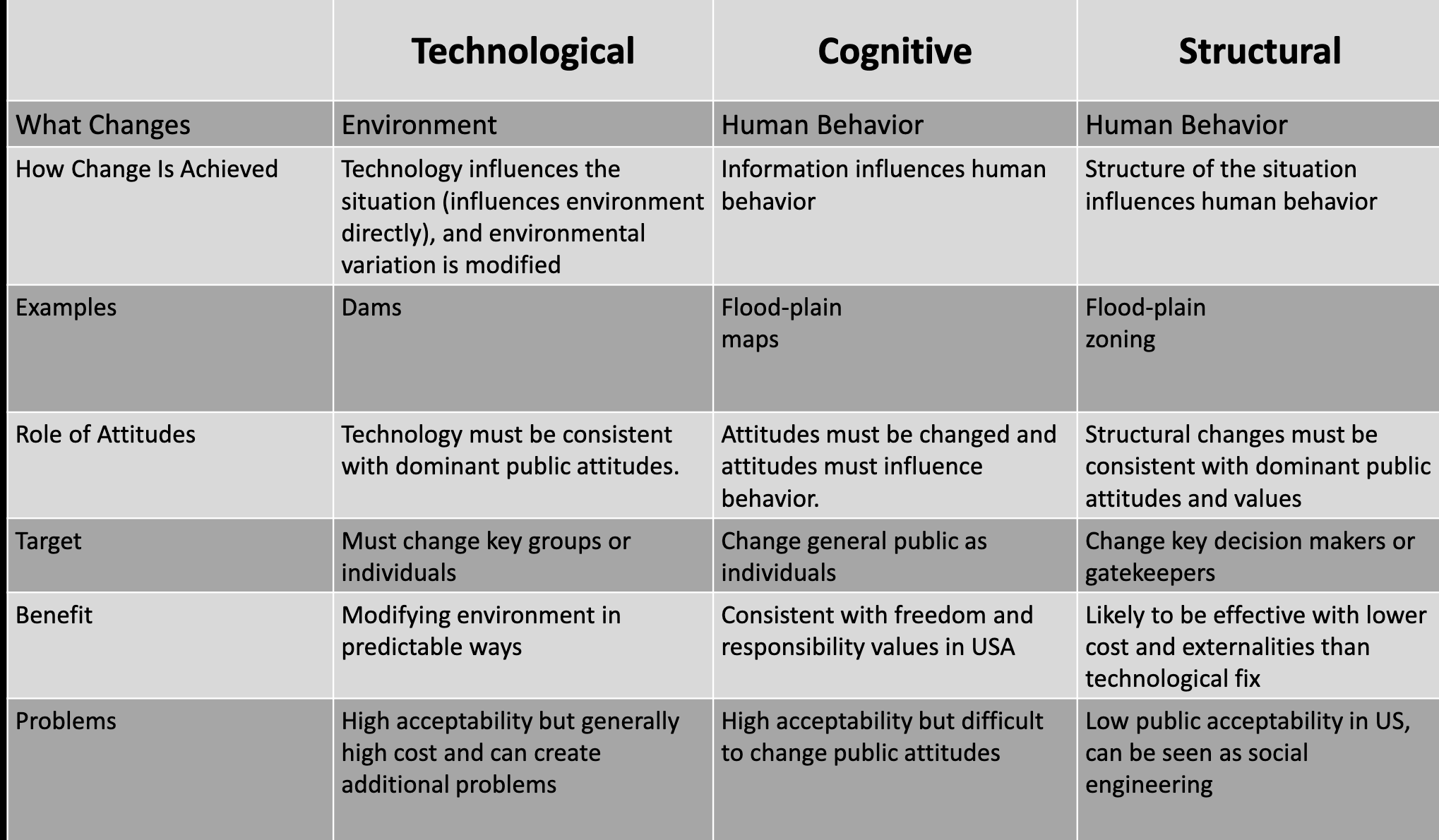
3 fixes
technological
cognitive
structural
Technological Fix
Bypass attitudes entirely, not changing peoples lives/attitudes
build a dam → prevent flooding → people think it is safe

Cognitive Fix
Put flood plain maps out, say dont build a home here!
try to directly change the attitudes that influence behavior
Attitudes that change easily with this method arent strong → dont actually predict behavior (info deficit model)

Structural Fix
Stop offering mortgages → banks wont get money back if house floods → dont issue mortgages to people who want to live there → nobody builds home there
literally forcing a change in behavior
What is a demographic
Quantifiable statistics relating to characteristics of a population
• Age
• Race
• Ethnicity
• S3x
• Gender
• Income
• Education
• Geography
• Household compositionDoesnt tell you my values, beliefs, views, etc.
Demographics are constantly changing hence why theyre important for FW institutions

3 big demographic shifts
urbanization
more people live in cities now than before → may shift their values/beliefs
racial diversity
more minorities now than back when FW was made
aging population and generational replacement
birth rate is declining, population is made up of older individuals
MI isnt one population
most people live in LP, and the racial diversity varies by location
UP is very very different than LP
½ of our hunters are over 50
Demographic difference DOES NOT MEAN AUTOMATIC DIFFERENCE IN INTERESTS OR VALUES but there can be a connection

Whats happening with MI deer hunters?
Hunting participation differs among people of the same age across different survey years
Graph shifts to the right, tells us this is a cohort effect, should be same peak each year if it was age

Age vs Generation/Cohort vs Period
Age → I behave this way because I am 16, 37, 70
reckless driving ex
Cohort → We grew up under different social conditions
how you hold up a heart
Period → something happens at a specific period regardless of age or cohort we all experience it
R3
Recruitment: Attracting new
participantsRetention: Keeping existing
participants licensed and actively
engagedReactivation: bringing previous
participants who have drifted
asway from the activities back
into the foldDifficult because a lot factors into recruitment and retention, we cannot recreate learning from peepaw or create that same social structure artificially

Cultural Fit
We can look at how much fishing/hunting aligns with certain races to understand why certain groups may not be participating and adjust accordingly
Current system → 7 sisters of north american model
1. wildlife in public trust
2. Eliminate commerce
3. Allocate use through law
4. Kill for legitimate reasons
5. international resource
6. science basis
7. hunting opportunity for all citizens
Traditionalist view mainly focused at hunters, wildlife is for the public but the public is hunters
Federal legislature for funding
1937: Federal legislation for
wildlife management funding
(grounded in hunting
expenditures) (Pittman Robertson)
1950: Federal legislation for
fisheries management funding
(grounded in fishing
expenditures) (Dingell-Johnson)
Creates issues though, very difficult to use this money towards things not outlined in the legislature, meaning we cannot be flexible with where money goes
Public can shift very quickly as to what they want (values + motives) → institutions move slowly → funding for these expenditures is even SLOWER
Barriers aren’t distributed equally
Barriers aren’t distributed equally.
• Cost
• Time
• Transportation
• Knowledge
• Physical accessibility
• Childcare
• Safety
• Discrimination
• Language
• Social norms
• Belonging
Just bc a demographic does not participate does not mean there is no interest!
Ex: younger adults think the outdoors is dangerous, nonwhite american adults think it is unsafe (police uniform for rangers ex)
What is the real question
It is both…
How do we get more kinds of people to participate in the things we
already provide?
vs
How do we understand what a changing public wants and needs from its fish and wildlife agency?
Relevancy movement
Desire to fulfill a broad public trust
responsibilityChanging relationships between people and
FWChanging trends in outdoor recreation
Concerns about funding (narrow focus of Pittman-Robertson & Dingell-Johnson Acts) and the future (declines in hunting & fishing)
Relevancy Roadmap (2019) provides
guidance for conservation agencies to
overcome barriers to changeChange the 7 sisters model, indigenize it to include indigenous groups of people who take care of the land and view it differently than traditionalist models before
Human wildlife conflict
Human-wildlife conflict: “struggles → presence or behavior of wildlife → actual or perceived, direct and recurring threat → interests or needs → disagreements between groups of people and negative impacts on people and/or wildlife.”
HWC occurs worldwide, and it is on the rise because...
1. Human uses of habitat are expanding in many places
2. Some wildlife populations are recovering and expanding into areas with people and property
3. Environmental changes (like climate change) are driving some species into areas with more people and propertyWhen it comes to deciding how to address these problems, human-human conflicts can arise.
Levels of conflict over wildlife

Factors likely to affect intensity of a conflict
Notes on slide if you GAF on 10

HWC Process
Damage → Level (severity) → Response (change behavior? seek management?) → Consequences
These all feed into each other and from attitudinal factors
Attitudinal factors in human-wildlife conflict (HWC) are the psychological, cultural, and cognitive perceptions that shape how individuals and communities view, evaluate, and respond to wild animals

Capacities and limits
Limits define the bounds of the capacity
Balancing + and - impacts
Traditionally, FW management focused on game populations
and hunter satisfactions...with increasing and diversifying
values associated with FW, managing tolerance has become
more important...Managers often fail to determine the population range that
stakeholders perceive as tolerable when three conditions arise:
– FW population is increasing or decreasing rapidly
– FW population is simultaneously creating benefits, large costs, and perceived risks
– People are divided on what represents an acceptable level of abundance
Wildlife Acceptance Capacity
“Mixture of tolerance of problems and desires for benefits from
wildlife” (Carpenter et al. 2000)
– Often characterized as the upper limits of tolerance for impacts
derived from fish/wildlife
– Reflect some balance of positive and negative impacts of wildlife
– Different groups may have different WACs
– Influenced by past experiences and social-psychological variables
Bullets are quantifying the upper limits of stakeholder tolerance
Challenges to social carrying capacity
changes over time
does it align with animal biology
ID the relevant groups to even determine this
Acceptance capacity can change over time!

Wildlife acceptance capacity and tolerance
Tolerance is passive acceptance of a wildlife population
Tolerance can take an attitudinal form & a behavioral form
Tolerance is not always framed as a capacity or limit! But, it
is an important input into WAC and a building block for
understanding WACWAC reflects a population level limit of tolerance
Research suggests some of our comm. about large carnivores w/o stating their ecological importance → increases risk values → people wont tolerate them

HWC
“HWC is more than simple competition for space, food and life; it pits different values against one another and demands attention from economic, legal, social, and environmental policy makers” Treves (2009)
Human–wildlife conflicts have proven challenging to manage, in part, we contend,
because in the majority of cases they are researched by conservation biologists working to
understand and mitigate ecological impact rather than the social dimensions”
Why are most HWCs actually human human conflicts about wildlife
you know it girl