Techniques in Wildlife Exam 2
 Call Kai
 Learn
 Practice Test
 Spaced Repetition
 Match
 Flashcards
 Knowt Play
1/125

There's no tags or description
Looks like no tags are added yet.
126 Terms
How do VHF units work?
They each have a unique frequency and sends signals every 1-2 seconds and beeps louder the closer you are aligned to it.
How do we locate an animal with a VHF tracker on it?
We can use Radio telemetry or triangulation.
What are some tradeoffs when using GPS?
GPS uses a lot more battery than VHF and the more frequent the fix rate, the faster the battery dies. So the more data being sent from the collar, the faster the battery dies.
What are some other sensors you can add to tracking units (VHF/GPS)?
Temperature sensors, proximity sensor, level sensor, and tilt sensor.
When adding more sensors to yoru VHF/GPS, what is one thing you have to think about?
You have to think about the weight your adding to the collars/vhfs when adding sensor after sensor.
What are accelerometers?
They are small, wearable motions sensors that can measure physical acceleration, body posture, and movement patterns across one to three axes.
Why/when would we use accelerometers?
It can be used as a mortality sensor, so if no movement for 8 hours, then the animal may be dead and it sends out a mortality alert.
It can also be used to infer behavior, so depending on how its moving or how much, you can infer if the animal is moving, foraging, grooming, or vigilant.
What is a home range?
An INDIVIDUAL in its normal activities of food gathering, mating, and caring for young. It can have home range without being territorial.
How can home ranges be estimated?
The Minimum Convex Poylgon (MCP) is the simplest version, Kernel density (more complicated), and utilization distribution.

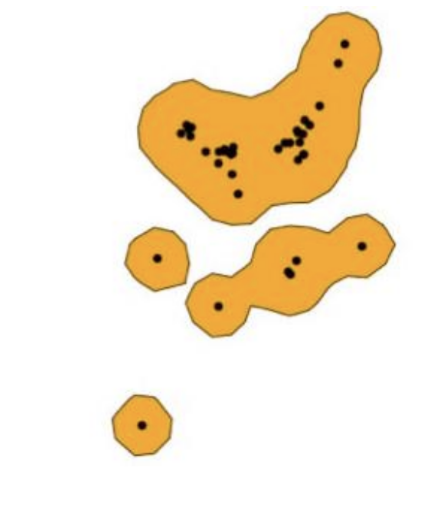
What example of home range estimation is this?
Minimum convex polygon (MCP).
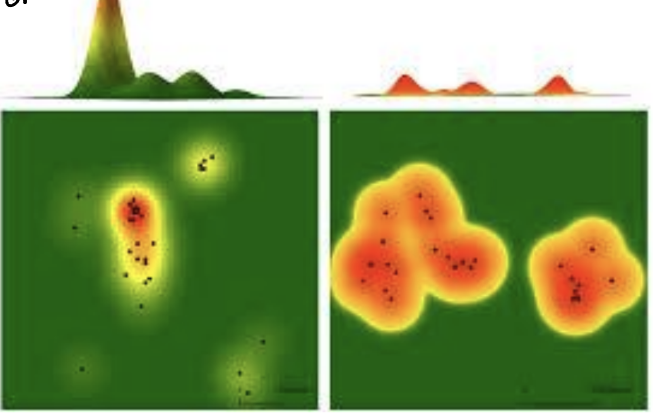
What home range estimation is this?
This is the Kernel density, which is a bit more realistic and 2-dimensional.
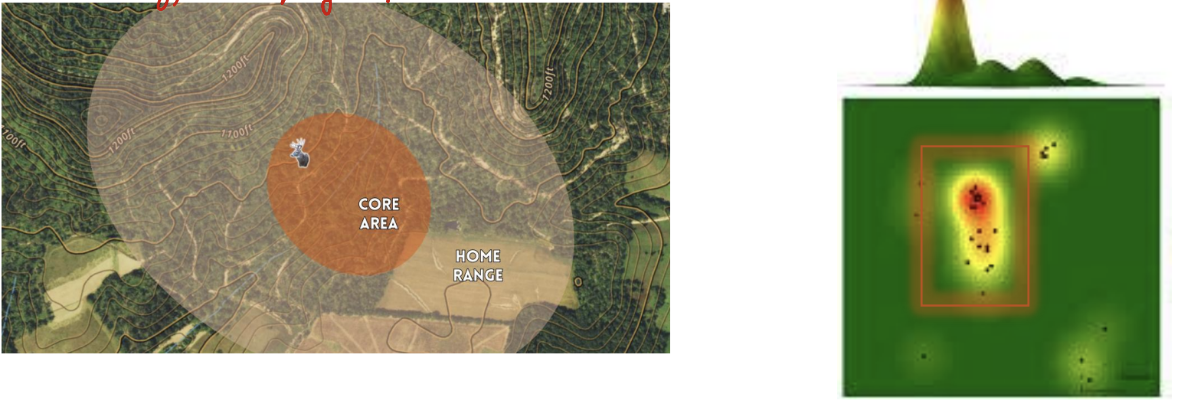
What home range is this?
Utilization distribution, which is a little more complicated and 3-dimensional or a heat map.
Do ecologists also care about ‘core areas’?
Yes

Why would we want to differentiate core areas and home ranges?
Possibly for territorial animals, maybe core areas is for denning, where young are and where they sleep or mate.
What is a cluster?
A way to track sustained or repeated visits to a small area.
What could these clusters mean for the animals?
It could mean that there is a reason there going to these areas, maybe food or water is available there.
What are clusters usually used to find?
They are used to find kills, but it is very labor intensive because once you get a cluster you send out a group to see what’s there and with predators like pumas, the terrain can be harsh.
Why are clusters usually used for large carnivores?
When killing prey, these kills can not be carried away so the predators keep going back to the site, in turn, creating these clusters.
What do resource selection models tell us?
They tell us what’s available, where the individual chooses to spend time.

What kind of analyses is this an example of?
Step selection, a type of Resource selection
What is step selection models?
They are a specific type of resource selection model that tells you whats available at a given step (movement from one location to the other location) and where the individual chooses to move.
This is what the arrows in step selection analysis look like.
Step selection arrows and they represent where the animal could have gone in the area of study.


What can resource selection tell us?
It can tell us what habitats animals need.
What defines bird ecology, what makes them unique?
Vocal and most are diurnal, feathers and flight, high metabolic rates, and many are migratory
So how are birds doing right now?
A lot are significantly declining due to habitat loss and other things as well.
What is going on with the birds in Peru?
There is gold mining that is going unregulated and damaging their habitat.
When thinking of handling birds what are the different grips you can have?
Banders grip and Photographer grips
What is the Banders Grip used for and how does it look?
The fingers are around their necks so they dont peck you and is used to band their legs.

What is photographers grip and what is it used for?
They hold the birds by their feet and used for photos and examining the bird.


What can these diagrams show?
It shows that bats and birds are active at two very different times of the day. They most likely do not interact at all during their life spans because of their active times.
What are some non-migratory game birds we want data on?
Quail and turkeys
What are migratory game birds we want data on?
Doves
How does TPWD count quails in Texas?
They usually do it statewide every year in august and use roadside surveys.
What is another way TPWD can count quails in Texas?
They can use helicopters and usually use this method since they are in hard to reach areas like large ranches. This is distance sampling.
How does TPWD get data on wild turkeys?
They use banding and GPS tracking near edwards plateau.

What is some data we have on doves?
There are 350K dove hunters every year, 32% in just texas of all nationwide mourning dove harvest and 87% of white wing dove harvest.
How does TPWD monitor mourning doves?
They use distance sampling (rural and urban surveys) and statewide banding. Using consistent population monitoring.
What makes ebird different than iNat?
Ebird uses more data, more years of gathering data specific to just birds, you do a point count basically, and shows effort. For iNat you just take a picture doesn’t really show effort.
What is a herp?
Usually they are grouped in with amphibians, turtles, lizards, snakes, and crocodiles.
Why are herps grouped together anyways?
A relic of an early classification system. They basically clumped creepy looking things together and called it a day.
What makes a herp, a herp?
Ectothermy and tied to water.
What are some pros and cons to ectothermy in herps?
Takes less energy and they do pretty well in warmer climates.
Cons- At the mercy of the environment and ranges can be restricted
What are some pros and cons to herps being tied to water?
Honestly only cons as I can see, so limited dispersal and need water, easier for population to directly and faster affect a population. Pros- two different environments to hunt, so outside of water and in the water.
Why would we need to look at these limitations that happen for herps?
We need to look at them when thinking about wildlife management concerns, especially since herps can be affected pretty fast and easily.
Which is easier to study in general, birds or herps?
Birds are usually more easier to study.
How are amphibians doing?
Pretty well, 38% are in the least concern butt 23% we do not have enough data to label them.
How are reptiles doing?
A little better than amphibians.
What makes snaked tricky when trying to handle and track them?
They are very hard to detect (sometimes underground + camouflage), no limbs so how can we mark or tag them, and some can even kill you because of their venom.
What are some ways we use to find snakes?
Cover boards and road cruising, walking around and looking at the right time of year and daya, drift fences paired with funnel traps.
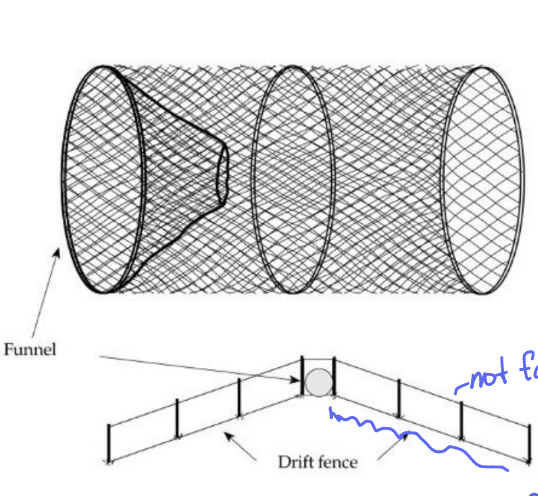
What kind of trap is this and what kind of animal is it used for?
This is a drift fence paired with funnel traps. So it is used for snakes, and instead of falling into a pit we use a funnel and they get stuck and can no9t get out. But we need to check multiple times a day.

What do we do with venomous snakes when handling them?
Never free hand them, so use grabbers and hooks. Also snake tubes as well can be useful. Use clearly marked buckets saying their venomous.
How else can you track snakes?
Radio tags and glue them on the body.
What about marking (not tracking)?
We can use PIT tags
How can we use alligators to figure out whats happening in their environment?
They can be used as bioindicators, what there eating we can look at and how healthy/unhealthy their prey is.
How can we look for alligators?
We can use their eyes in the dark since they light up like a cigarette.
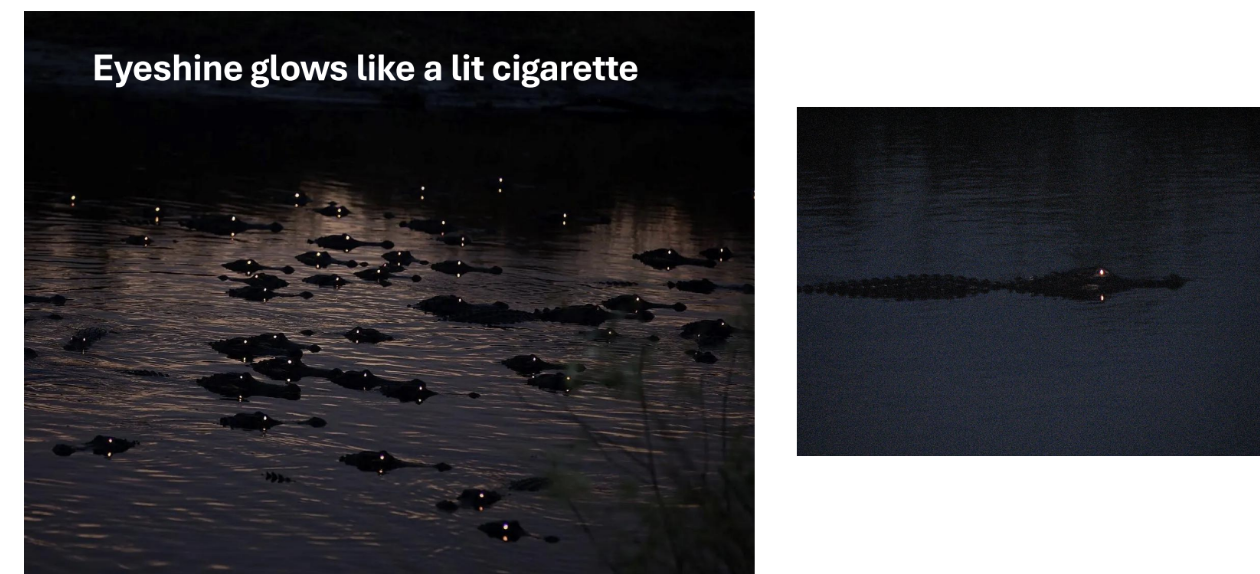
What does the process look like when trying to capture them?
We noose them around their mouth, bring them to shore to sample, and we can use paint to for marking.
How can we look at the diet of alligators?
A gastric lavage, instead of killing them we pump water in their mouth to flush the stomach and see their diet and the percentage of microplastics as well.
When trying to make wildlife management changes what two kinds are there?
There is indirect and direct changes we can make as biologists.
When thinking about critically endangered species what is one thing we can do?
Captive breeding
How does captive breeding work?
We start a new ‘population’ in captivity, often still animals in the wild. This population is often distributed across multiple locations.
What are two main goals when thinking about captive breeding?
Avoiding inbreeding (relatedness is always tracked) and
Keep them ‘wild’ for potential release
What is the end goal of captive breeding and what are the challenges that come with it?
The end goal is reintroduction. Some challenges is the environment might have changed so, new species in the area or prey no longer there. Also maybe the animal can no longer fend for itself in the wild. No political/social support from locals
What are some solutions to reintroductions and the animals not being ready or able to survive in the wild?
Soft release, so they can build these enclosures of their natural environment. So in between not being captive but also not a release yet.
What is the solution to the habitat/resource no longer supporting a reintroduced population?
We do a survey and asses the habitat for that population. So looking at the habitat/resource/and food.
What is the solution to reintroduced populations not having political/social support from locals?
We get buy ins and collaborate early. So stakeholder meetings are fairly important.
What are some of the levers we can pull to increase a population?
We can increase their prey and change policies or reduce huntings numbers for game species.
Reduce deaths, increase births and immagration
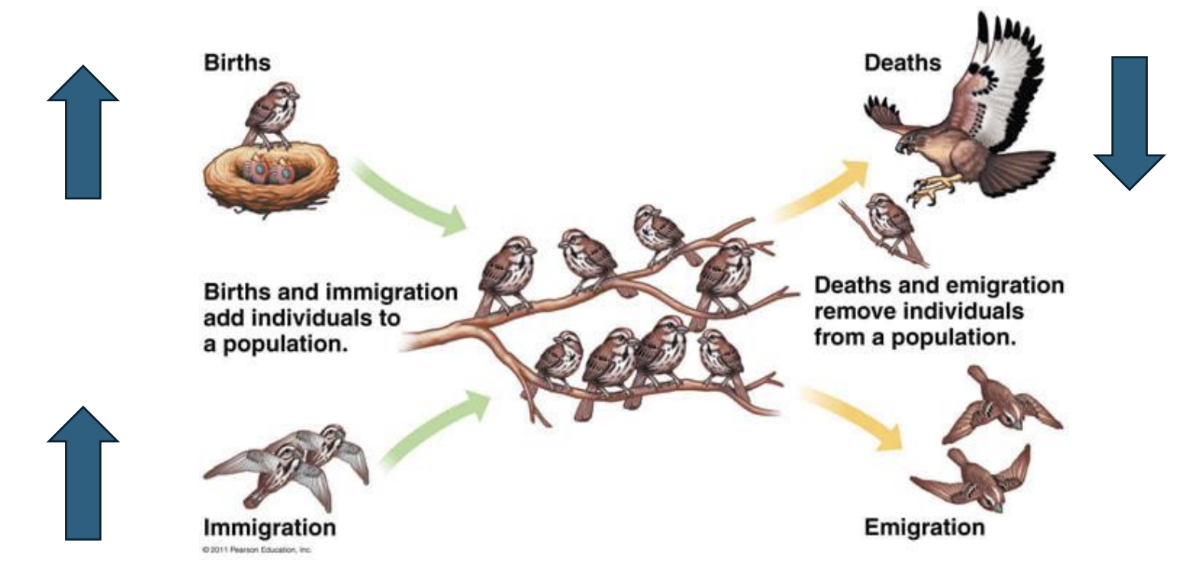
How can we reduce deaths?
Reduce harvest, reduce bag limits, males only since they aren’t the ones reducing the population, and shorten the hunting season.
Reduce non-havrest mortality, so vehicle collisions (corridors), reduce predators and diseases.
How can we increase births?
Improve female nutrition, so increase or have a better quality food source and water source. So guzzlers and food plots designated for that species.
When we increase immigration, what are we doing?
We aren’t reintroducing because there is already a population present, so we are population augmentation.
What does it mean for a population to be in overabundance?
They are damaging the ecosystem and above social carrying capacity.
What is one species that is an example of overabundance?
Snow geese, their conservation was a bit too successful. Because of grains left in fallow fields along their migration routes and damage to their breeding habitat cause the start of their conservation.
So how did biologists fix this overabundance problem with snow geese?
They let hunting season start earlier, no daily bag limits, electronic calls allowed, unplugged shotguns, and extended shooting hours.
What are some of the consequences of white tailed deer, increase population after almost killing them off?
Now they have conflict with people (cars and crop damage) and overbrowsing forests
What are some of the management levers we can pull on the white tailed deers?
Antlerless harvest (females usually don’t have antlers so killing of females)
Sharpshooting
Invasive populations are a subset of non-native populations. True or False
True, invasive are non native populations that are harmful to the ecosystem or economy.

What do invasive populations tend to have in common?
They lack predators/parasites/disease in new region
Some traits they have is fast reproduction and a generalist diet.
Prey not adapted to them
How are invasive species managed?
Removal programs
Try to stop additional spread and protect key areas
Research around them and see what biologists can do
What are some kinds of range expansions?
Some are a result of introductions (non-native) and then some are natural (not introduced by humans).
How can we track expansions?
Range maps are useful but many outdated
Can iNat data help us track range expansions?
Yes, we can compare the outdated maps with the sightings in iNat. We should definitely integrate citizen science data into new range maps.
Can these observations teach us something ecological?
Yes, but we first need to classify the observations (introduced or natural).
What do we think correlates with natural range expansion?
Temperature change, human footprint, protected areas, crop cover gain and loss, and forest cover gain and loss.
How has rural depopulation affected biodiversity?
It creates agricultural abandonment, which increases forest/generalists species and decreases open habitat specialists.

Is rural depopulation contributing to large mammal recovery?
Yes, as population of humans decrease in rural areas, then these populations increase.
What are some new opportunities to track recovery in rural depopulation?
The return of ecosystem services like predation.
New opportunities for hunting and ecotourism
Track mammal recovery and its ecological consequences.
What is a habitat?
The resources and conditions that allow a particular species to survive and reproduce, NOT a vegetation type.

We measure fitness because habitat use does not equal quality.
Having cubs does not mean their habitat is of good quality or bad quality.
What are some resources and conditions we might measure?
Water, food, cover, sunlight, shelter, and distance to water, and percent cover
What are some ways we can remotely sense habitats?
Resource selections/step selections.
What are the most types of common data we measure?
Land use/land cover
Vegetation indices (plant cover/greenness)
Climate
Terrain
Humans
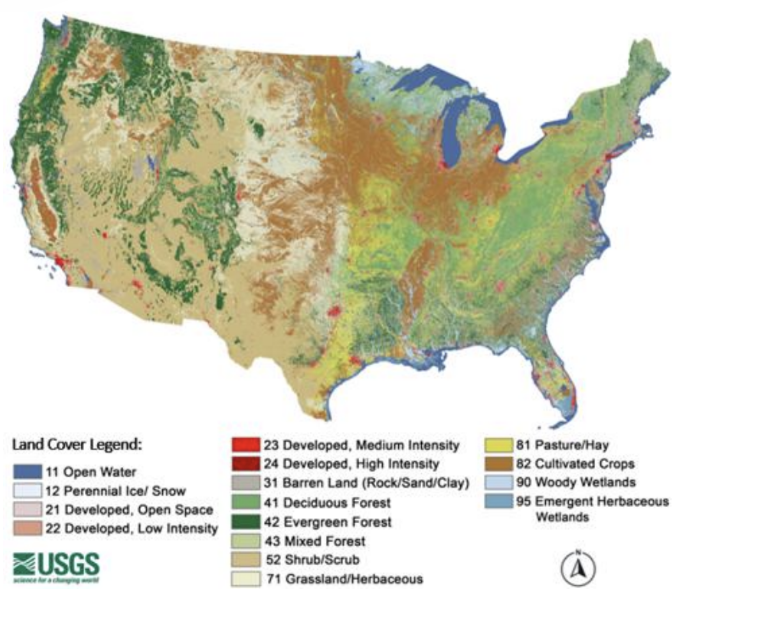
When looking at land use and cover, we can measure it over time.
So we can see what their using and when.

What are some of the things we can measure pertaining to human footprints?
Lights at night
Roads and buildings
Crops-farming
Navigable water
Mining and energy
What can we measure on the ground pertaining to vegetation?
Ground Cover
Understory
Trees
Why is understory important for wildlife?
For protection, shelter, habitat, and cover!!!

So how do we measure understory layers?
Nudds or density boards. We can use counting numbers of squares we see or don’t see. Covered or not covered.

What is another method to measure vegetation?
Robel poles, which is used more for grasses/grassland.

What can we use robel poles for?
We can use these as part of small mammal surveys because they highly rely on dense vegetation.
What is DBH, diameter at breast height?
Used for trees, we can measure the diameter of the trees. Can be used in the logging industry.

What are we trying to do with habitat management?
We want to change the successional stage

Is it easier to set succession back or forward?
It is easier to set succession back, with prescribed fires or mechanical treatments.