Agri 31 Lecture Exam (Lecture 5 - Lecture 6)
 Call Kai
 Learn
 Practice Test
 Spaced Repetition
 Match
 Flashcards
 Knowt Play
1/43

There's no tags or description
Looks like no tags are added yet.
44 Terms
Direct seeding/planting
General methods of planting
seeds/or other planting
materials are directly planted in the field
Applicable to:
a. Seeds that readily germinate
b. Inexpensive seeds
c. species in which the seedlings are sensitive to
root disturbances (e.g. corn, beans)
d. big-seeded crops like okra, beans, patola, corn
e. stem cuttings of siniguelas, cassava, sugarcane,
sweet potato are directly planted
f. other propagules e.g. suckers, crown, tuber,etc.
Broadcasting
Forms of direct seeding
Seeds are uniformly distributed on the field e.g. rice, pechay, radish, leguminous cover crops
Seeds are uniformly
distributed on the field e.g.
rice, pechay, radish,
leguminous cover crops
Hill method
Forms of direct seeding
Seeds are sown at
specified distance
between hills and
between rows of
specified distances.
e.g. corn, pineapple
Drill method
Forms of direct seeding
Specified number of
seeds are sown within
rows of specified
distances.
e.g. small-seeded crops
like mungbean
Dibble
Forms of direct seeding
Land does not require plowing, harrowing and furrowing but needs thorough clearing
Holes with no definite spacing are dug; large enough to accommodate the seeds
Seeds are put into the holes and covered with thin layer of soil.
It is alternative planting system for corn, rice, sitao, okra, etc. grown in hilly sites
Transplanting method
General methods of planting
Seedlings are initially raised in the nursery and later
planted in the field or in greenhouses
• method applicable to:
a. seeds that are difficult to germinate
b. expensive seeds like F1 hybrid vegetables
c. small-seeded plants that give rise to small
seedlings; they have to be protected initially by a
roof from heavy rain droplets
d. rooted cuttings
e. grafted plants
Population Density
• -refers to the number of plants per unit area (e.g.
10,000 plants per hectare)
• Important to know for planning purposes; e.g. how
much or how many planting materials will be
needed
• Optimum population density needed to achieve
maximum yield.
Planting density depends on:
1. Crop species and varieties
2. Soil fertility and soil management practices
3. Season (related to availability of water and solar
4. Method of propagation used radiation
5. Mechanization to be employed
6. Cropping system to be adopted
Time of planting
Planting Operations:
when soil is moist; usually at the start of rainy season
Anytime, if irrigation facilities are available
When the weather is cloudy ; in case of transplanted
seedlings
Transplanting perennials
Planting Operations:
-holes should be as deep and wide
as possible
-container must be carefully removed; making sure
that the soil does not crumble/break to avoid root
disturbance
- seedlings with weak stem need to be tied to a
support to keep them straight
Ratooning
Not planting the next crop:
• Biennial plants like sugarcane and pineapple
produce suckers which will serve as the next crop.
These new plants are called _____
• Letting these suckers grow to serve as the next
crop is called _____
• Savings in land preparation, cost of planting
materials and time make it viable.
Objectives in controlling growth
• For earlier flowering (for rapid generation advance in perennial crop breeding)
• Control timing and synchrony of flower or fruit production for year-round supply
• Induce rooting or shoot formation for propagation
• Delay senescence or inhibit germination for stored products
Plant growth regulators (PGR)
are organic compounds other than nutrients which in
minute amount promote, inhibit or modify plant
growth and development
are either synthetic or natural
phytohormones
Naturally occurring PGR’s are called
Auxins
Uses of PGR in crop production
promote rooting of stem cuttings
QuickRoot
a combination of IBA and NAA mixed with
talcum powder. The powder mixtures adheres to the stem
cuttings when dipped.
ANAA solution
stands for alpha-napthaleneacetic acid; a
synthetic auxin
Promote seed germination
Uses of PGR in crop production
Mussaenda seeds - GA, 100 ppm
Increase fruit set/ control fruit drop
Uses of PGR in crop production
tomato - Orthochlorophenoxy acetic
acid, 40 ppm
- Naphthoxy acetic acid, 50
ppm and GA, 100 ppm
• citrus (grapefruit) – 2,4-D, 60 ppm
Reduce stem elongation
Uses of PGR in crop production
• Chrysanthemum – Paclobutrazol
• Poinsettia – Paclobutrazol
• Bougainvilla – Maleic Hydrazide
• Mussaenda – Paclobutrazol
Induce/modify flowering
Uses of PGR in crop production

Stimulate latex flow
Uses of PGR in crop production
• Rubber – Ethephon (increases latex yield by delaying the
plugging of cut laticifers)
• Papaya – Ethephon (increases latex yield from immature
fruits;
• the enzyme papain is extracted from the latex
Accelerate priming or uniform ripening for
easier/synchronous harvesting
Uses of PGR in crop production
• Coffee – Ethephon, 500 to 1,250 ppm
Training
Physical Methods
techniques that direct/modify
the growth of plant in terms of
canopy size, shape and
direction
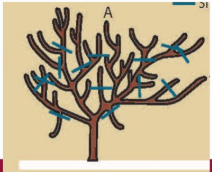
Pruning
Physical Methods
Techniques:
judicious removal of
plant parts to achieve
specific objectives
Topping/Cutting back/Pinching
Physical Methods
Techniques:
removing terminal shoot of young
plant to encourage spreading
canopy growth and/or keep the
tree dwarf
e.g. coffee, lanzones
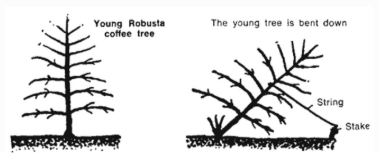
Bending
Physical Methods
Techniques:
Coffee – to produce multiple vertical shoots, thus
increase the number of bearing lateral branches
Preventive
Kinds of Pruning
removal of dead, insect-infested and
diseased plant parts
Formative
Kinds of Pruning
to modify shape of canopy
e.g. Topiary
Corrective
Kinds of Pruning
removing excess shoots that interfere
with light penetration and aeration within the
tree canopy
Rejuvenative
Kinds of Pruning
removing most of the shoots in
order to reinvigorate an old or unproductive tree
desuckering
• Done in bananas to remove excess suckers
• Too many followers or suckers compete with the main plant
bearing the fruit resulting in small bunches and fruits
• In commercial plantations, only one follower is retained
• Photoassimilates are directed to reproductive rather than
vegetative growth
Cutting out
removal of entire
branch or shoot such as in
corrective and preventive pruning

Cutting back
removal of portion of
branch or shoot such as in
formative pruning

Stubbing
a severe form of cutting back such as in rejuvenative
pruning
Windbreak establishment
Adverse effect of strong wind (typhoon)
1. Abrasion among leaves, shoot and fruits
2. Tearing of leaves
3. Defoliation
4. Breakage of branches
5. Flower and fruit fall
6. Blow down of whole tree
7. Uprooting
Characteristics of a good windbreak tree
1. Strong and extensive root system
2. Strong branches and twigs
3. Tall with dense canopy
4. Fast growing
Examples: pili, agoho, mahogany, tamarind
Height & canopy density
Windbreak establishment
Effectiveness depends on:
Height
Tall windbreak protects a larger area
It was estimated that windbreak can reduce windspeed
up to the maximum distance of 20x its height.
It could be lesser depending on other factors
Canopy density
A dense canopy provides more protection than the
windbreak with less dense canopy
At 30% density
windspeed is reduced less than 80 %
of its speed in the open to the distance of 12x the
tree height
At 50 % density
windspeed is reduced to less than 80 % of
its speed in the open to a distance of 20x the tree height
True
Rows must be oriented perpendicular to wind direction
False
The first and middle rows should be short to medium; tall ones at the
last row