LABORATORY TECHNIQUES
 Call Kai
 Learn
 Practice Test
 Spaced Repetition
 Match
 Flashcards
 Knowt Play
1/44

There's no tags or description
Looks like no tags are added yet.
45 Terms
Heating under Reflux
Allows unattended heating of a mixture for a long time without losing the mixture to evaporation by using a water condenser to capture solvent vapors and condense them back into the reaction mixture.
Reaction can be heated up to the boiling point of the solvent
A water condenser captures solvent vapors and condense them back into the reaction mixture
Heating/Evaporating Solvents
Use containers 1.5-2 times bigger than the solvent
Use magnetic stirrers or boiling chips to prevent loss of solvent due to bumping
Must be conducted under a fume hood to capture potentially toxic or flammable vapors
Heating/Evaporating solvents
Large-scale methods include distillation, evaporation under continuous stream of air, under reduced pressure
Rotary Evaporation
Rapidly evaporated solvents under reduced pressure
Rotation or the flask spreads a thin film of liquid over the thinner surface of flask to facilitate evaporation
Filtration
Used to remove solid impurities from a mixture
Used to collect a desired solid precipitate/crystal in a mixture
Can be powered by gravity, suction/vacuum, or high pressure

Gravity Filtration
Most common filtration technique
The mixture is filtered through a filter paper, where gravity draws the liquid
Useful for filtering liquids above 10 mL
Microscale filtration involves the used of a Pasteur/transfer pipette with a cotton or glass wool plug

Gravity Filtration : Filter Cones
Used to recover solid material from mixtures
Collected solids are easily scraped off

Gravity filtration: fluted filters
Increases the speed of gravity filtration: increased surface area and rapid pressure equalization
Used to remove undesired solid materials (e.g. dirt, decolorizing charcoal, boiling chips)

Gravity filtration: filter pipettes
Used to remove solid impurities from liquids less than 10 mL
Created using a Pasteur/transfer pipette with a cotton or glass wool plug

vacuum/suction filtration
Faster than gravity filtration
Used to collect solid products from precipitation/crystallization
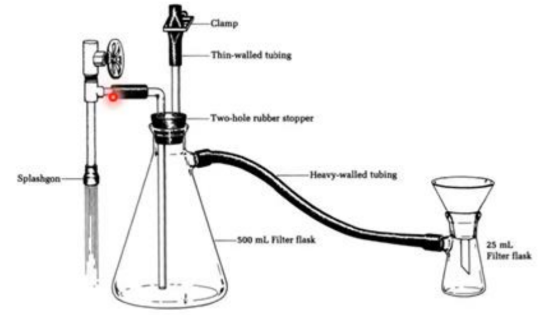
Used a filter flask connected to a heavy-walled (Vacuum) tubing
Not advisable for collecting fine particles

Vacuum/Suction Filtration
Buchner funnel: used in collecting large amounts of solids in macroscale applications
Hirsch funnel: used in microscale experiments
Porosity
Retentivity
Speed
Choosing a Filter Paper
Porosity
measure of the size of particles that can pass through the filter medium
Measures pore size, ranging from Fine (small pores) at the top to Coarse (large pores) at the bottom
Retentivity
measure of the relative affinity of a filter medium to suspend particles
Refers to the paper's ability to trap small particles. Papers with fine porosity have High retentivity, whereas coarse papers have Low retentivity.
speed
Measure of the time it takes for liquid to drain through the filter medium
Represents liquid flow rate. Fine/high-retentivity paper results in a Slow filtration rate, while coarse/low-retentivity paper allows a Fast filtration rate
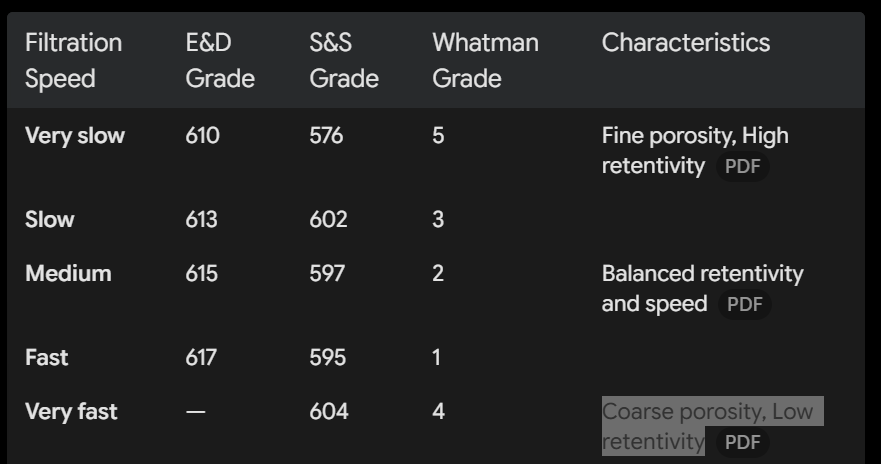
Filtration Speed: Very Slow
E&D Grade: 610
S&S Grade: 576
Whatman Grade: 5
Characteristics: Fine porosity, High retentivity

Filtration Speed: Slow
E&D Grade: 613
S&S Grade: 602
Whatman Grade: 3
Characteristics: Balanced retentivity and speed

Filtration Speed: Very Fast
E&D Grade: —
S&S Grade: 604
Whatman Grade: 4
Characteristics: Coarse porosity, Low retentivity

Syringe filters
Used to remove particles from a sample prior to analysis (e.g., HPLC)
Used in filtration of small volumes where losses by filter media absorption are significant
Used also in the filtration of gases or removal of bacteria from samples
Syringe filters
Typical pore size: 0.22 and 0.45 um
Typical diameter: 10, 13, and 25 mm
Uses a membran filter made of PTFE, PVDF, nylon or cellulose acetate
Solvent compatibility depends on the membrane filter material

Recrystallization
Used in the purification of solid substance
Impurities may be removed by filtration or through a differentiating solvent
Requires the use of a solvent where the solubility of the desired substance changes with temperature
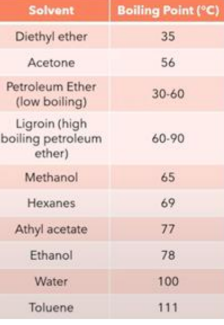
Recrystallization
Only dissolves the analyte when hot
Either insoluble to the impurities, or very soluble to the impurities
Unreactive with the analyte and easily removed/volatilized
Non-flammable, nontoxic, inexpensive
Could be a pure substance or a mixture of two or more solvents
Inducing Crystallization
Scratch the flask with a glass rod
Use a seed crystal
Heat the mixture to reduce the amount of the solvent and cool it again

Recrystallization
Recrystallization
General Distillation Process
The liquid for distillation is placed in the distilling flask and heated
The liquid vaporises, with the most volatile component at a higher concentration
The vapor condenses and flows downward to the receiving flask
General Distillation Process
The liquid for distillation is placed in the distilling ___ and heated
The liquid vaporises, with the most ___component at a ___concentration
The vapor condenses and flows ___to the receiving flask

Distillation Setup
Distillation Setup

Simple Distillation
Used in separating liquids from non-volatile impurities, or when the boiling points of the components differ by at least 25 C
The composition of the distillate is identical to the composition of the vapor

Distillation of Liquid Mixtures
The temperature does not remain constant but increases throughout the distillation
The composition of the vapor in equilibrium with the heated solution is different from the composition of the solution


Key Concepts
Dynamic Boiling Point: Unlike a pure substance, the boiling temperature of a liquid mixture does not stay constant; it increases continuously as the more volatile component evaporates.
Vapor-Liquid Equilibrium: The vapor in equilibrium with a boiling liquid solution has a different composition than the liquid itself—it is enriched in the lower-boiling, more volatile component (A).
Step-by-Step Diagram Breakdown
Phase Curves: The bottom curve is the liquid line (bubble point curve) and the top curve is the vapor line (dew point curve). Component A is more volatile because it has a lower boiling point (bp A) than component B (bp B).
First Vaporization Step (a rightarrow b):
Heating a 50:50 mixture of A and B to its boiling point reaches point a on the liquid curve.
The resulting vapor has composition point b across the horizontal tie-line, which is enriched in component A (81% A,19% B).
First Condensation Step (b rightarrow c):
When this enriched vapor condenses, it forms a distillate liquid of identical composition (81% A,19% B) at point c.
Second Vaporization & Condensation (c rightarrow d rightarrow e):
Re-boiling this new liquid forms vapor at point d, further enriching it in component A (96% A,4% B).
Condensing this vapor at point e yields a highly purified distillate of component A

Fractional distillation
Used to separate a mixture of liquids with boiling point difference < 25 C
A fractionating column enables multiple vaporization-condensation cycles to occur: the more volatile vapors exit column first

Fractional Distillation
Azeotrope: mixture of two or more liquids whose proportions cannot be altered or changed by distillation
Entrainer: an additional agent which affects the volatility of one of the constituents of an azeotrope
For ethanol-water azeotrope:
Benzene/Cyclohexene
Salt (e.g., potassium acetate)
Fractional Distillation
_____: mixture of two or more liquids whose proportions cannot be altered or changed by distillation
_____: an additional agent which affects the volatility of one of the constituents of an azeotrope
For ethanol-water azeotrope:
__
__

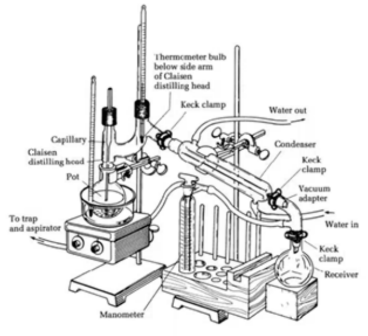
Vacuum Distillation
Used to distill liquids with high boiling points (>200 C), which undergo thermal decomposition when distilled normally

Steam distillation
Used to distill material at temperatures below 100 C
A mixture of immiscible liquids boils at a temperature lower than either of the pure liquids
The immiscible liquids mix in the vapor phase and co-distil together
Upon condensation, the desired component easily separated from the other liquid
Used to distil high-boiling substances which may decompose under normal distillation

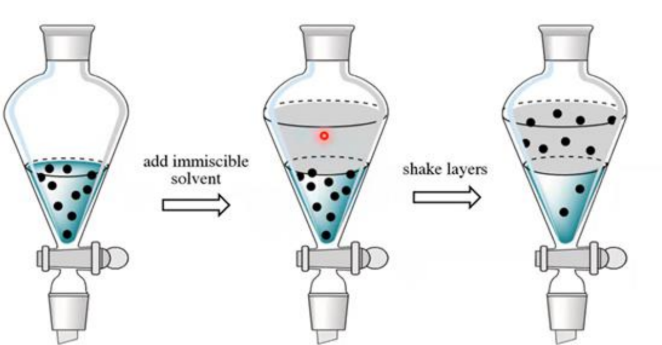
Extraction
Refers to the recovery of a material from a solid/liquid sample using a solvent that preferentially dissolves the material
Involves the transfer of a material into different phases (e.g. solid to liquid, liquid to liquid)
Used in the collection of the synthesized product in organic reactions (eliminates biproducts, solvents and unreacted reagents)
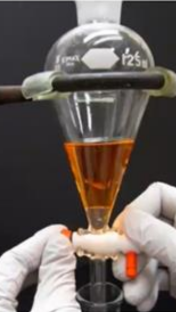

Extraction
Refers to the ratio of the two solubility values of a material in two immiscible solvents
An equilibrium constant with a characteristic value for any substance and pair of solvents

Distribution/Partition Coefficient
Multiple iterative extractions results to better recovery compared to single/bulk extraction
Consider a 100 mL aqueous solution containing 1 g of A and B


Multiple Extraction
Single Extraction
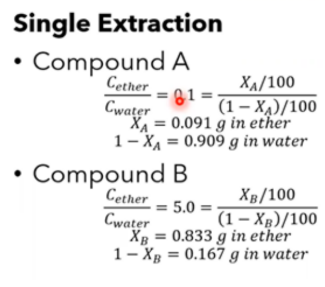
Liquid-liquid extraction
Two layers are mixed by shaking to facilitate transfer between phases
Carried out in a separatory funnel
The lower layer is drained
The remaining upper layer is poured over
Typical extractions: three extractions, followed by 1 back extraction
Dissolves the substance at room temperature
Immiscible with the matrix solvent
Nonreactive with the solute/matrix solvent
Low boiling point
Not highly flammable or toxic
Relatively inexpensive
Ideal Extraction Solvent
Water-ether
Water-dichloromethane
Water-hexane
Common Liquid-Liquid Extractions solvents
Liquid-liquid extraction
Liquid-liquid extraction

Allow the emulsion to stand/settle
Addition of saturated aqueous NaCl
Use of a centrifuge tube (microscale)
Addition of a small amount of water-soluble detergent
Gravity filtration to remove gummy/polymeric substances
Removing emulsions

Acid-Base Extraction
Involves the conversion of an organic compound into its ionic form to make it more soluble in the aqueous layer
Caboxylic acid/phenols + base
Amines + acid
Enables the removal of these compounds from other organic compounds only soluble in the organic layer
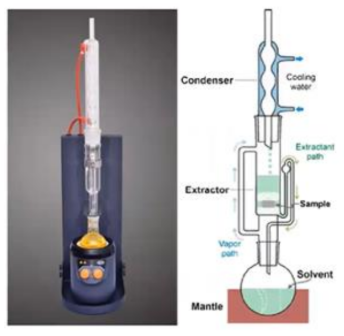
Soxhlet Extraction
used in continuous solid-liquid extraction
hot solvent evaporates and condenses into the extractor
Hot solvent fills the thimble and extracts the desired compound
A siphon removes the solvent with the desired compound into the reservoir
The process, repeated hundred of times, concentrates the desired
Continuous liquid-liquid extraction
The aqueous phase containing the desired compound is places in the extractor and filled with ether up to the side arm while the distillation flask is filled with ether
Hot ether evaporated and condenses
Ethe drips into the central tube and flows through the aqueous phase, extracting the desired compound
Excess ether flows back into the distillation flask with the desired compound into the reservoir
The extraction is rather inefficient and requires to be in operation for at least 24 hours
