6B- carbonyl compounds
 Call Kai
 Learn
 Practice Test
 Spaced Repetition
 Match
 Flashcards
 Knowt Play
1/42

There's no tags or description
Looks like no tags are added yet.
43 Terms
what are carbonyls
molecules containing the C=O bond
what do anti-bumping granules do
allow liquid to boil smoothly rather than overheating
explain why C=O is polar
oxygen is more electronegative than the carbon so pulls the shared electrons closer to itself
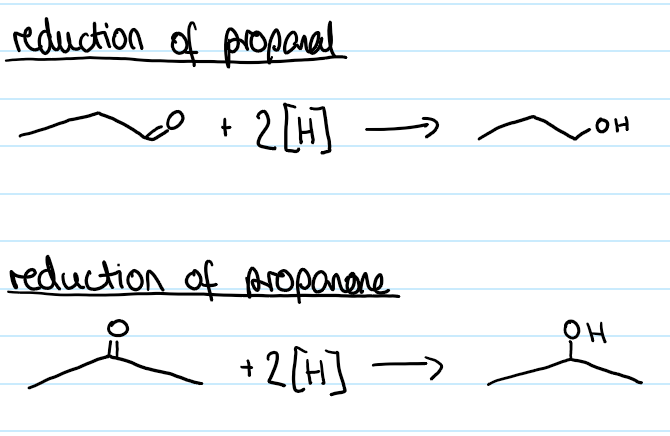
which molecules can be reduced
aldehydes and ketones
which molecules can’t be reduced
carboxylic acids
what is the reducing agent for aldehydes and ketones
NaBH4
what are aldehydes and ketones reduced back to
alcohols
what is the name of the mechanism by which the reduction of aldehydes/ketones takes place and what species is needed
nucleophilic addition, H- (hydride) ions act as the nucleophile
how to write reduction reactions
same as oxidation but reducing agent written as [H]
what is the mechanism of nucleophilic addition
(always use a water molecule)
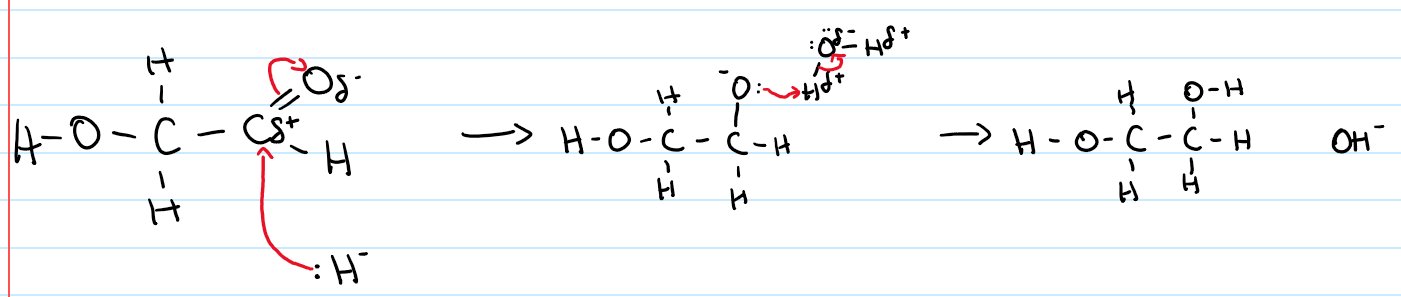
what type of fission occurs in nucleophilic addition
heterolytic
what tests for aldehydes or ketones
2,4-DNPH test (Brady’s reagent)
what does 2,4-DNPH/Brady’s reagent test for
aldehydes or ketones
what is the positive result of a 2,4-DNPH test
orange precipitate forms (occurs when aldehyde or ketone)
what is the negative result of a 2,4-DNPH test
solution remains orange (occurs when no aldehyde or ketone present)
what type of reaction happens in a 2,4-DNPH test
condensation
how can the specific aldehyde or ketone used in reaction be identified
use product from 2,4-DNPH test as 2,4-DNPH derivatives have characteristic melting points that are in data books
what is the process of identifying the specific aldehyde or ketone used in a 2,4-DNPH test
filter the solid
recrystallise the solid to purify it
measure melting point of solid
compare result with data book
when identifying the specific aldehyde or ketone used in a 2,4,-DNPH test why does the precipitate need to be recrystallised
to purify it before the melting point can be tested
what is the test for aldehydes only
Tollens test- ammoniacal silver nitrate
what does the Tollens test test for
aldehydes only
what are the reagents and conditions for the Tollens
reagents: ammoniacal silver nitrate
conditions: warm in a hot water bath
what is the positive result for the Tollens’ test
silver mirror forms (occurs if aldehyde present)
what is the negative result for the Tollens test
solution remains colourless/dirty brown (if aldehyde isn’t present)
what happens to the aldehyde in a Tollens test
Tollens solution is a mild oxidising agent, aldehyde is oxidised to a carboxylic acid and silver ions reduced to silver atoms
why does the Tollens test not react with ketones
ketones cannot be easily oxidised
why does ammoniacal silver nitrate solution not react with primary or secondary alcohols
it is not a powerful enough oxidising agent
what is a cyanide group
a carbon atom triple bonded to a nitrogen atom (1 sigma, 2 pi bonds)
what is it called when there is a cyanide group in an organic molecule
a nitrile functional group
what is a nitrile functional group
when there is a cyanide group -CN in an organic molecule
what are used in the synthesis of nitriles
cyanide ions
why are cyanide ions used in the synthesis of nitriles
they are powerful nucleophiles and will react with aldehydes and ketones via nucleophilic addition to form hydroxynitriles
what are the ways nitriles can be made
nucleophilic addition- hydroxynitriles from aldehydes and ketones
nucleophilic substitution- nitriles from haloalkanes
how can the carbon chain be extended using an aldehyde or ketone
nucleophilic addition to form hydroxynitrile
what is the mechanism for nucleophilic addition for extending the carbon chain
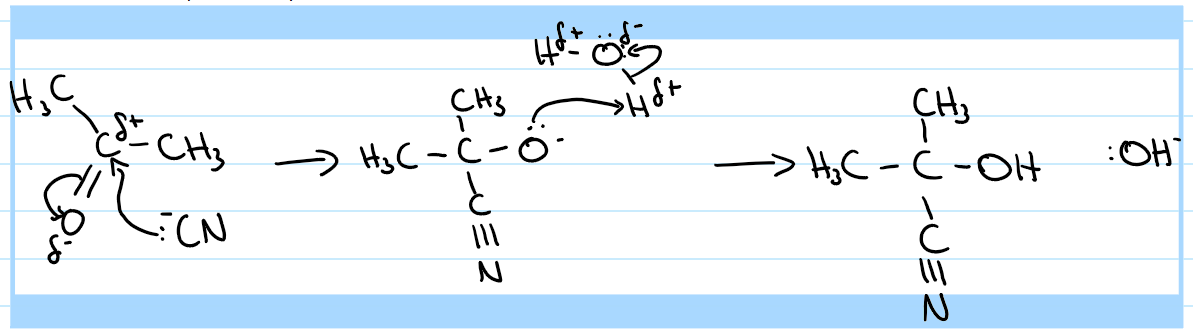
what are the reactants for extending the carbon chain by nucleophilic addition
aldehyde/ketone and a cyanide salt e.g. NaCN with H2SO4 - would be HCN however it is highly toxic so is produced in situ instead
how can the carbon chain be extended using a haloalkane
nucleophilic substitution
what is the mechanism of nucleophilic substitution for extending the carbon chain
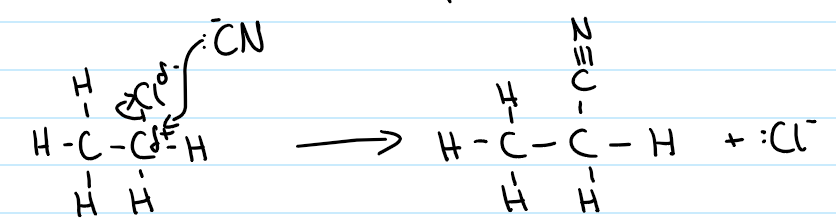
what are the reactants and conditions for extending the carbon chain by nucleophilic substitution
haloalkane and a cyanide salt e.g. NaCN, heat under reflux, ethanol used as a solvent
why is the introduction of a nitrile group into a compound very useful in synthesis
makes the carbon chain longer
what can nitriles be converted into
amines and carboxylic acids
how can nitriles be converted to amines (reaction type, reactants, conditions)
reduction reaction, heat to 150’ with hydrogen, nickel catalyst
e.g. CH3CH2CN + 2H2 → CH3CH2CH2NH2
how can nitriles be converted to carboxylic acids (reaction type, reactants, conditions)
acid hydrolysis, dilute aqueous acid e.g. HCl, heat under reflux
e.g. CH3CN + HCl + 2H2O → CH3COOH + NH4Cl