Unit 3: Lecture 1-4
 Call Kai
 Learn
 Practice Test
 Spaced Repetition
 Match
 Flashcards
 Knowt Play
1/46

Earn XP
Description and Tags
Evolution
47 Terms
Biological evolution defined
the descent of modern organisms with modification from preexisting life-forms
Ecology subtopics
species interactions, dispersal, population dynamics, community structure, ecosystem functions, spatial structure
Evolution subtopics
natural selection, sexual selection, gene flow, genetic drift, migration
Structure and function of species, biodiversity, human society
Things evolution explains
Biogeography
Cofounding evidence: similar species often in the same geographic region, different species with similar forms in different regions, specific traits of organisms living in certain environments (thick, waxy leaves in desert plants)
Comparative morphology
Cofounding evidence: study of similarities and differences in body plans of major groups, puzzling patterns (homologous structures, developmental homology, vestigial structures)
Human arm: Dog foreleg: Seal flipper
Homologous structure example
Both chick and human embryos have gill pouches and tails
Developmental homology example
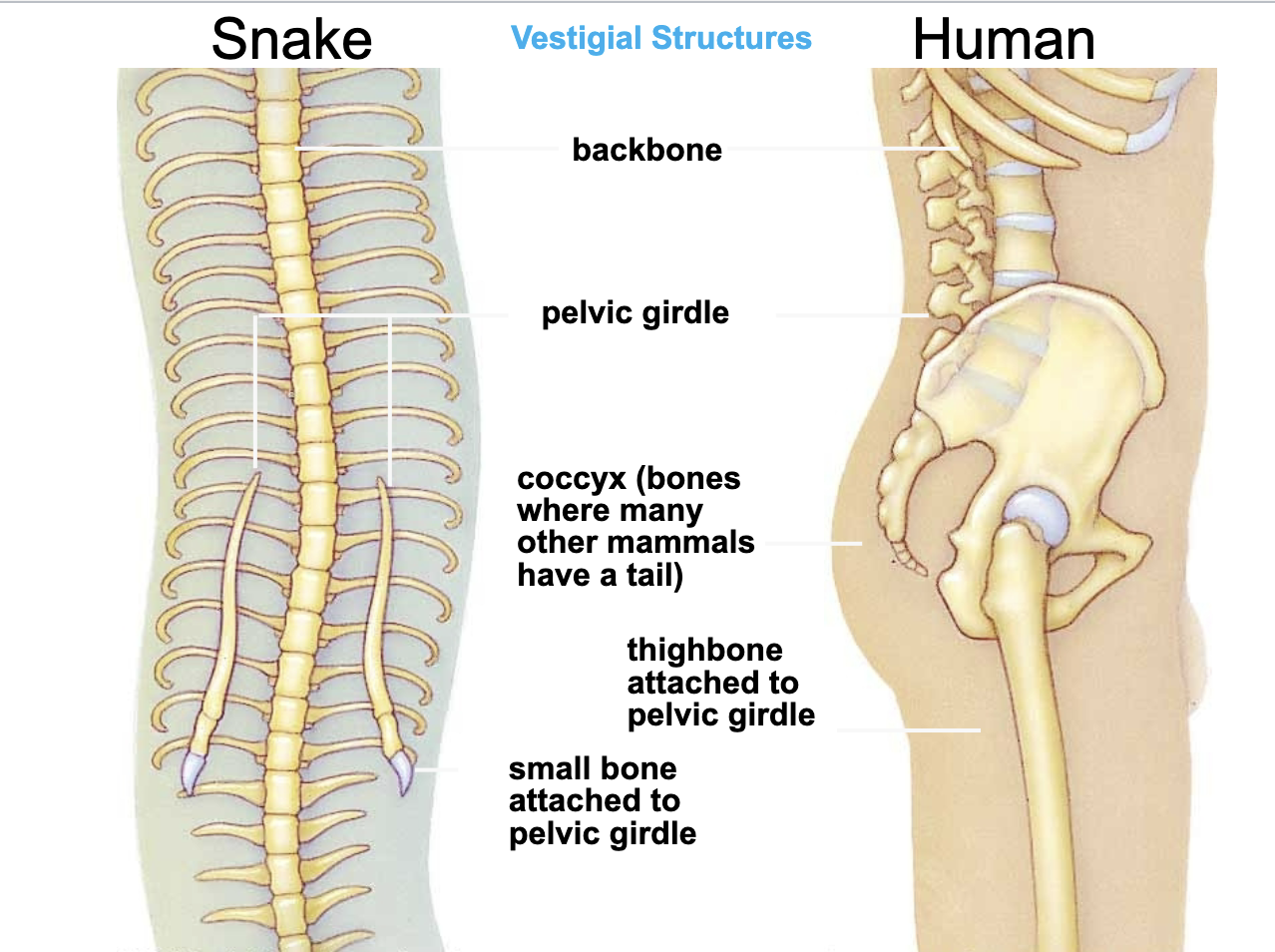
Snake: Human
Vestigial structure example
Geological discoveries
Cofounding evidence: Georges Cuvier, James Hutton & Charles Lyell
Georges Cuvier 1769-1832
Concluded deeper layers contain simpler fossils than shallow layers, some fossils seem to be related to known species, from one layer to the next; some fossils appear or disappear
James Hutton (1726-1796) & Charles Lyell (1797-1875)
Concluded that geology changes gradually over time
Charles Darwin (1831)
Galapagos Finches: observed variety of lifestyles and body forms, correlated variations with environmental challenges
Peter and Rosemary Grant
Long-Term Galápagos Study 1973: provided the first direct, real-time proof that evolution by natural selection happens rapidly in the wild
Alfred Wallace (1850s)
independently developed a theory similar to Darwin’s
Origin of Species (1859)
Book by Darwin theorizing natural selcection and evolution
Darwin’s 6 facts:
Any species is capable of increasing size exponentially
Populations tend to remain stable in size
Resources are limited
Individuals in any species vary
Some vary in ways that aid survival and reproduction
Variation is inherited
Inference from Darwin’s facts 1-3
Few offspring survive to reproduce: “struggle for existence”
Inference from Darwin’s facts 4-6
Certain inherited traits increase probability of survival and reproduction
2 Darwin conclusions
Overproduction and struggle for existence
Heritable individual variation
Final Darwin conclusion
Differential reproductive success causes evolution: Natural selection
Clauses of Darwin’s theory
natural selection acts only on heritable traits
traits mayt be more or less beneficial depending on circumstances
populations evolve, not individuals
“The Descent of Man and Selection in Relation to Sex”
Published by Darwin 1871: Applies evolution theory to humans, sexual selection
Sexual selection (Darwin definition)
advantage which certain individuals have over others of the same sex and species, solely in respect to reproduction
Sexual Selection
natural selection for mating process, selection for phenotypic differences that increase mating success - within or between sexes
Asymmetrical investment in offspring
females invest directly in offspring, males invest in mating opportunities → inter/intrasexual selection
Non-adaptive choice
Female selects a mate based on a specific trait that does not provide her or her offspring with any direct survival or health benefits: sensory bias, species recognition
Directly adaptive choice
Female selects a mate based on a specific trait that does provide her or her offspring with direct survival or health benefits: phenotypic trait infers higher fitness
Indirectly adaptive choice
Female selects a mate based on a specific trait that signals higher fitness
Intersexual selection
Female reproductive success not limited by access to mates → females will be choosy to maximize quality of offspring, since they have to invest so much in esc
Intrasexual selection
Male reproductive success is limited by access to mates → males will be competitive
Sexual dimorphism
Both intersexual and intrasexual selectionn lead to _______ _______
Precopulatory competition
Male-male competition before sex: fighting
Postcopulatory competition
Male-male competition after sex: sperm competition
Costs to sexual reproduction
Slower population growth, more energetically costly
Benefits to sexual reproduction
Increases genetic variability, greater resistance to disease, greater resistance to changing envrionments
Parthenogenesis
Form of asexual reproduction where an embryo develops from an unfertilized egg
Gene pool
All genes and alleles in a population
Microevolution
Change in frequency of alleles in a population or the gene pool of a population
p
frequency of dominant allele
q
frequency of recessive allele
of copies of allele / sum of all alleles
p or q =
1
p + q = or p² + 2pq + q² =
p²
frequency of homozygous dominants
q²
frequency of homozygous recessives
2pq
frequency of heterozygous dominants
5 Causes of microevolution
mutation
gene flow
genetic drift
nonrandom mating
natural selection