Bone Overview
 Call Kai
 Learn
Learn Practice Test
 Spaced Repetition
 Match
Match Flashcards
 Knowt Play
1/57

There's no tags or description
Looks like no tags are added yet.
Name | Mastery | Learn | Test | Matching | Spaced | Call with Kai | Chat |
|---|
No analytics yet
Send a link to your students to track their progress
58 Terms
How is bone different from cartilage? (5 main differences)
1. Calcified and rigid (mineralized)
2. Vascular
3. Contains nerves
4. Dynamic
5. Only appositional growth
What are the 6 functions of bone?
1. Structural support of soft tissues
2. Protection of internal organs
3. Locomotion (movement and grip)
4. Metabolic reservoir for Ca, PO4, Mg, and Na.
5. Hematopoiesis and regulating the "stemness" of hematopoietic stems cells and immune cells.
6. Endocrine organ
T/F: Bone has the same strength as cast iron.
True
Bone stores _____% of the body's calcium and ______% of the phosphorus.
99, 85
What are some of the endocrine functions of bone? (3)
1. regulate pancreatic β-cell proliferation
2. regulate insulin synthesis and sensitivity
3. regulates male fertility through secreted Osteoclacin.
Different parts of the skeleton are formed by __________________ cells derived from three different compartments.
Mesenchymal
What are the 3 components of Mesenchymal cells that eventually form the skeleton?
1. Neural crest
2. Sclerotome/somite
3. Lateral plate mesoderm
Neural crest derived mesenchymal cells give rise to which bones?
craniofacial bones
Sclerotome/somite derived mesenchyme give rise to what parts of the skeleton?
most axial skeletal elements
Lateral plate mesoderm derived cells give rise to which bones?
limb bones
What is the first overt sign of skeletal development?
the condensation of mesenchymal progenitor cells
Skeletal patterning requires what signaling pathways? (5)
1. Wnts
2. BMPs
3. FGFs
4. Hedgehogs
5. Notch
The ECM of mature bone is composed of ____% organic material, _____% inorganic material, and _____% water.
30, 50, 20
What is the organic portion of bone ECM?
collagen, proteoglycans, and structural glycoproteins.
About 90% of the matrix proteins in mature bone are what?
collagen
What is the function of collagen in bone ECM?
it serves as a scaffolding before the mineral is deposited.
What type of collagen is most prevalent in bone
I
What is the ground substance of bone ECM?
a small proportion of the ECM that consists of small leucine-rich proteoglycans in the bone/dentin
What are the 4 structural glycoproteins in bone ECM?
1. Osteonectin (cell adhesion)
2. Osteopontin (cell migration)
3. Bone Silo Protein
4. Osteocalcin (Ca binding)
What is the structure of type I collagen?
a heterotrimer triple-helical molecule consisting of two a1 chains and one a2 chain.
What is osteogenesis imperfecta?
congenital defect of bone formation resulting in weak bone. No cure
Autosomal Dominant Mutations of what two genes represent 90% of osteogenesis imperfecta cases.
1. COL1A1
2. COL1A2
Autosomal recessive mutations of what 2 genes represent only 10% of osteogenesis imperfecta cases?
1. CRTAP
2. P3H1
What eye sign/symptom indicates osteogenesis imperfecta?
blue sclera
A "knockout" of the gene for which non-collagen matrix protein results in osteoporosis?
osteonectin
A "knockout" of the gene for which non-collagen matrix protein results in death?
Fibronectin
A "knockout" of the gene for which non-collagen matrix protein results in dense bones?
Thrombospondin
A "knockout" of the gene for which non-collagen matrix protein results in normal bones but calcified blood vessels?
Matrix-gla-protein
A "knockout" of the gene for which non-collagen matrix protein results in reduced bone formation?
bone sialoprotein (SIBLING)
A "knockout" of the gene for which non-collagen matrix protein results in increased bone mass and osteoblast number?
Matrix extracellular glycoprotein (SIBLING)
A "knockout" of the gene for which non-collagen matrix protein results in osteopenia?
Biglycan (a proteoglycan)
What is the inorganic composition of bone ECM?
primarily composed of calcium and phosphorus salts and small amounts of magnesium, sodium, and bicarbonate
Calcium and phosphorus salts are present in both amorphous and as insoluble crystals. What are the 2 possible crystals, from most to least abundant?
1. Hydroxyapatite
2. Whitlocke
About _____% of adult bone mass is composed of hydroxyapatite and whitlocke crystals.
50
What is the dynamic nature of bone?
its constant state of change, involving continuous processes of bone remodeling to maintain its strength, adapt to mechanical forces, and regulate mineral balance
Water is more abundant in (bone/cartilage).
cartilage
Fibrillar collagen is more abundant in (bone/cartilage).
cartilage
Proteoglycans are more abundant in (bone/cartilage).
cartilage
While the major proteoglycan in cartilage is aggrecan, the major proteoglycan in bone is ______.
SLRPs
What 7 types of cells are present in bone?
1. Osteoprogenitor cells
2. Osteoblasts
3. Osteocytes.
4. Fibroblasts
5. Osteoclasts
6. Endothelial cells
7. Neuronal cells
What is the role of Osteoprogenitor cells in bone?
immature cells that divide to give appositional growth to bone. fibroblast like cells in the periosteum and endosteum.
What is the role of osteoblasts in bone?
the fundamental unit of bone! synthesize and secrete osteoid, which becomes mineralized to give bone; once differentiated do not divide.
What is the role of osteocytes in bone?
surrounded by matrix, maintain matrix; do not divide
What is the role of osteoclasts in bone?
remodel bone by resorbing bone matrix, responsible for the dynamic nature of bone
What is Osteoblast ontogeny?
the developmental pathway from mesenchymal stem cells (MSCs) to functional bone-forming osteoblasts
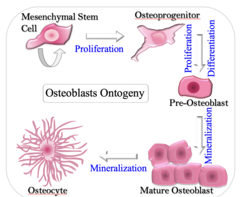
T/F: Osteoblast ontogeny is a reversible process.
False
What are the 3 possible fates of osteoblasts on the bone surface?
1. Apoptosis (majority)
2. Become bone lining cells (aka dormant osteoblasts)
3. Become osteocytes
How are osteocytes connected to each other and cells on the bone surface?
dendritic processes that extend to bone marrow and periosteal surface
What are the 4 functions of osteocytes?
1. Transport material through GAP junctions
2. Mechano-sensor (shear stress fluid flow, load)
3. Maintain bone matrix by secreted factors
4. Regulate phosphate homeostasis by producing FGF-23, Phex, and DMP1.
Among all bone cells in the adult skeleton, what % are osteocytes?
90-95
Among all bone cells in the adult skeleton, what % are osteoblasts?
4-6
Among all bone cells in the adult skeleton, what % are osteoclasts?
1-2
What is the mineralization process of bone?
Orchestrated process in which crystals of calcium phosphate are produced by cells and laid down in precise amounts within the fibrous organic matrix.
Where does mineralization start in bones?
Mineral crystals are initially deposited at discrete sites in collagenous matrix (nucleation sites
Mineral crystals in bone increase in dimension due to what 2 factors?
1. Addition of ions to crystals
2. Aggregation of crystals.
What 5 factors determine the bone mineralization rate?
1. pH
2. Concentration of calcium and phosphate
3. Ratio of inorganic phosphate (Pi) and pyrophosphate (PPi)
4. Presence of other ions and charged macromolecules.
5. Strong anionic proteins have high affinity for Ca2+ therefore they function as hydroxyapatite nucleators.
T/F: A neutral pH is essential for mineralization.
True
Inorganic phosphate (promotes/inhibits) mineralization, and pyrophosphate (promotes/inhibits) mineralization.
inhibits, promotes