PSYC2030 WEEK 4
 Call Kai
 Learn
Learn Practice Test
 Spaced Repetition
 Match
Match Flashcards
 Knowt Play
1/26

There's no tags or description
Looks like no tags are added yet.
Name | Mastery | Learn | Test | Matching | Spaced | Call with Kai | Chat |
|---|
No analytics yet
Send a link to your students to track their progress
27 Terms
ORIGIN OF LANGUAGE IN INFANCY
Peripheral auditory system matures by 26 weeks' gestation
Pitch, rhythm, phonetic information
NEWBORN PREFERENCES FOR
Human speech sounds
Infant-directed speech
Allows them separate words from sentences
Native language
Native accent
PREFERENTIAL SUCKING PROCEDURE
Makes use of the sucking reflex
Newborns – 3 months
Suckle fast = play native language sound
Suckle slow = play non-native language sound
AUDITORY SPEECH DISCRIMINATION
Habituation-dishabituation procedure
Native (ba vs pa )
Non-native (ki vs qi)
Infants are born with 'universal' ears
Lose non-native phoneme ability 10-12 months
VISUAL SPEECH DISCRIMINATION
Habituation-dishabituation procedure
Native vs non-native
Non-native vs non-native
Infants reliance on visual cues shifts with age
4 months = eyes
8 months = mouth
12 months = eyes
BABBLING
Newborns = cries, burps, grunts
3 months = cooing
4 months = monosyllables
6 months = repetitive babbling
9 months = conversational babbling
Turn-taking
Language-specific speech perception & production
FOUNDATIONS OF WORD LEARNING
6 months
word segmentation + joint attention
12 months
receptive vocabulary (70 words) + communicative intent (pointing) + first word production + referential problems
18 months
Productive vocabulary (50-75 words) + vocabulary spurt + telegraphic speech
JOINT ATTENTION
They watch to see what people are attending to as they speak
Gaze -> gestures
FIRST WORDS
Important people
Common objects
REFERENTIAL PROBLEMS
Overgeneralisation
Applying a word to a wider collection of objects and events than is appropriate
Undergeneralization
Applying a word too narrowly than is appropriate
VOCABULARY SPLURT
Rate of vocabulary acquisition increases rapidly
Average of 9 words per day
Brain maturation (nature)?
Referential or 'naming' insight (nurture)?
TELEGRAPHIC SPEECH
Leave out smaller and less important words
Start with two word utterances (1 verb + 1 object)
Word order errors are rare
ACQUISITION OF SYNTAX
Morphological markers
Around 3 years old
's' for plurals
'ed' for past tense
Use of past tense
Noticeable overregularization errors between 3-8 years
LANGUAGE AND SOCIO-ECONOMIC STATUS
Children from high SES backgrounds were exposed to 30million more words than children from low SES backgrounds
Meta-analysis showed gap between low and high was actually smaller than above
The gap was bigger when focused on just child-directed speech. If comparing all speech, the gap is not as big.
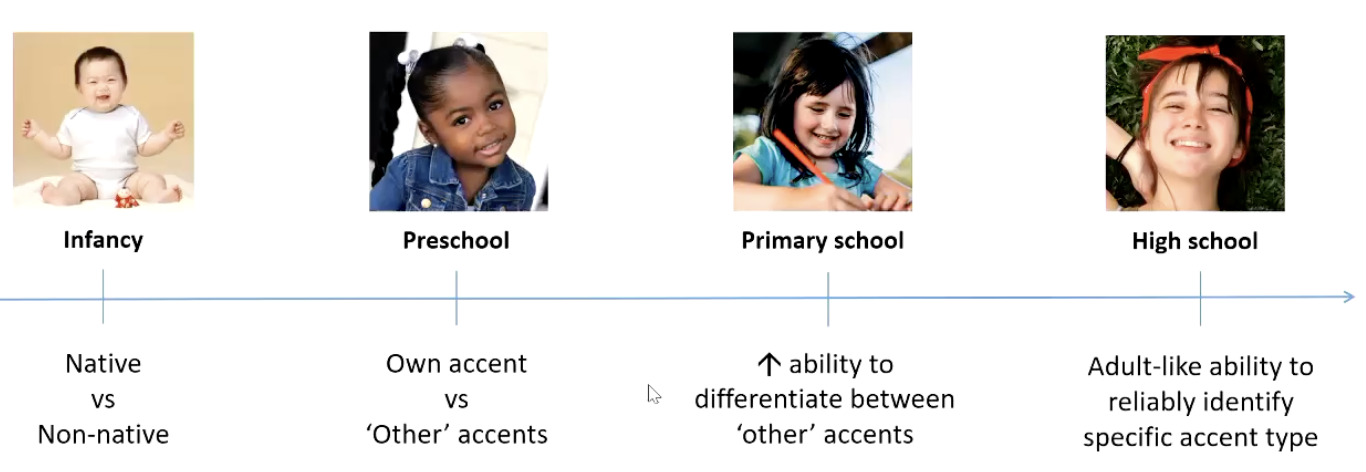
ACCENT AS SOCIAL GROUP MEMBERSHIP CUE
Comes from the survival instinct of friend vs foe
Linguistic cue (accent) -> social categorisation -> social inferencing -> social preferencing
Based on stereotypes
We prioritise accent over race
SIMULTANEOUS BILINGUALISM
Both languages learned from infancy at the same time
Both languages develop together
SEQUENTIAL BILINGUALISM
Child learns one language first and the second language later
The age at which the second language is learned can influenced speech sounds/phonetics and accent
PHENOMES
The smallest units of sounds that distinguish words
Humans capable of producing roughly 800 phenomes, but individual languages only use a subset of these
PERCEPTUAL NARROWING
The developmental process in which infants become increasingly specialised in perceiving the speech sounds of their native language.
BILINGUAL INFANTS
Children exposed to two languages from infancy maintain sensitivity to the phenomes used by both languages
People who learn a second language later in life are more likely to retain an accent
DO BILINGUAL CHILDREN GET CONFUSED?
No
Bilingual children can distinguish the two languages very early in childhood
They learn:
What sounds belong to what language
Rules/syntax of each language
Different rhythms of each language
PROSODY
The rhythm, stress and intonation patterns of speech.
Differences in rhythm can provide infants with information about which language they are hearing
CODE-SWITCHING
Switching between two languages during communication.
Bilingual children can understand when and with whom it is appropriate to use each language
Code switching does not = confusion
HOW BILINGUAL CHILDREN LEARN WORDS?
Mutual exclusivity:
Assumption that one object = one label, therefore, child likely to associate new words with unfamiliar object
Monolingual children commonly use this
Bilingual children rely less on this as they know one object can have multiple labels
Visual information:
Bilingual children focus on audio-visual information
Pay attention to the speaker's mouth
DOES BILINGUALISM DELAY LANGUAGE DEVELOPMENT?
A bilingual child may know
50 words in english
50 words in spanish
They may appear behind in ONE language, but their total vocabulary could be equal or greater than monolingual child.
BILINGUALISM AND EXECUTIVE FUNCTIONING
Both languages are active in the brain
Attend to = the language being used
Inhibit = the second language
Repeated practice of attention + inhibition can improve executive functioning
LONG-TERM BENEFITS
Bilingualism is associated with greater cognitive resilience with aging
Contributes to cognitive reserve
Associated with a later diagnosis of Alzheimer's disease