10.9 Exceptions to the Octet Rule: Odd-Electron Species, Incomplete Octets, and Expanded Octets
 Call Kai
 Learn
 Practice Test
 Spaced Repetition
 Match
 Flashcards
 Knowt Play
1/5

There's no tags or description
Looks like no tags are added yet.
6 Terms
free radicals
a molecule or ion with an odd number of electrons in its Lewis structure, tend to be very reactive

6
Boron tends to form incomplete octets with only _ electrons rather than 8.
boron, beryllium
_______ and _________ compounds have incomplete octets; usually accept the incomplete octet as the better Lewis structure, but do not rule out the possibility that a double-bonded Lewis structure might be a minor contributing resonance structure.

3rd
Elements in the ____ row of the periodic table and beyond often exhibit stable expanded octets of up to 12 and occasionally 14 electrons because d orbitals in these elements are energetically accessible and cam accommodate extra electrons.
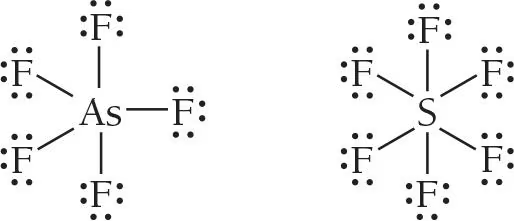
formal
In some Lewis structures, we must decide whether or not to expand an octet in order to lower _______ charge.
do not
2nd-row elements ______ (do/do not) have energetically accessible d orbitals and therefore never exhibit expanded octets.