Marine Biology Exam 2
 Call Kai
 Learn
Learn Practice Test
 Spaced Repetition
 Match
Match Flashcards
 Knowt Play
1/13

Earn XP
Description and Tags
Dr. Traci Erin Cox's Marine Biology at LSUNO
Name | Mastery | Learn | Test | Matching | Spaced | Call with Kai | Chat |
|---|
No analytics yet
Send a link to your students to track their progress
14 Terms
Phylum Cnidaria
Have Ecto & Endo Derm tissue layers
Often Radial Symmetry (oral - aboral body axis)
Stinging/Adhesive structured called cnidocytes containing nematocysts cells
Exhibit alternation of asexual polypoid & sexual medusoid generations
SImple Nerve Net nervous system
Have Planula Larvae
Osmoregulation through body wall
Cnidaria Body Plan
Poses a medusa, polyp or both.
Mesoglea from ectoderm
Tentacled & a mouth lead to gastrovascular cavity that responsible for digestion and circulation
Have a Hyrdrostatic Skeleton (water supported)
Cnidocyte aka Nematocysts
Cnidocil is triggered - the operculum opend and the coiled shaft is everted exposing stylet w spines- may have stinging toxins released

How to Cnidaria Feed?
Carnivores or parasites that use tentacled to capture food and bring to mouth (some w oral disk that closes on food) use a mucus net suspension feeding
Have a symbiotic relationships with zooxanthellae and digest extracellularly
Class Anthozoa - Phylum Cnidaria
Anemones, corals, sea pens and sea pansy (exclusively marine)
Lack Medusa stage ARE Benthic Polyps most w 8 tentacles
Gastrovascular cavity lined w ciliated ,cnidae & gland cells called mesentary filaments (string-like internal tissue folds that corals can extend out of their mouths to digest food, clean surfaces, or attack neighboring competitors)
Pharynx is a flagellated groove
Polyps thats reproduce xesually and asexually (releasing gametes thru cavity)
Anemone Structure- Anthozoa - Cnidaria
Acontia are filaments that are used in defense and feeding … may have defensive structures around oral tentacles to fight with neighbors
Individual polyps in a colony are called zooids which connect thru the mesoglea

Two Types of Coral
Those that build reefs are called Hermatypic- these harbor zooxanthellae (symbiodium)
Ahermatypic corals lack zooxanthellea and fully rely on capturing food (can also be solitary)
Direct / Vertical Transfer Coral (anthozoa) Symbionts
Asexually = symbiont released in egg from mother or are obtained thru phagocytosis from the coral or be infiltrated by the zooxanthellae containing cytoplasmic extensions of the coral cells
Indirect / Horizontal Transfer of Coral (Anthozoa) Symbionts
Are absorbed by environment motile zooxanthellae can show positive chemotaxis in the direction of corals with zero or lower concentrations of zooxanthellae
Corals can obtain zooxanthellae indirectly through the ingestion of fecal matter excreted by corallivores.
Class Scyphozoa - Phylum Cnidaria
True Jellyfish (exclusively marine) cane be both benthic and planktonic bc of medusa and polyp life stages (may even lack polyp stage)
Medusa stage is large - Polyps are small, inconspicuous & can be long lived
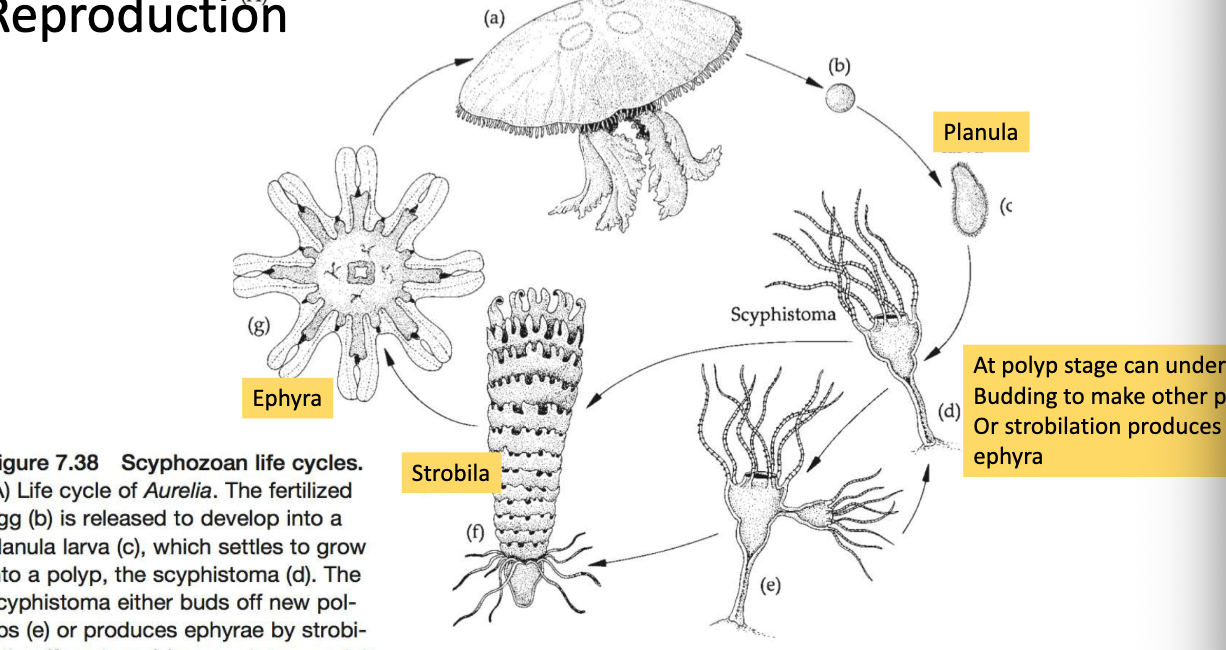
Polyps produce Medusa throu asexual budding called strobilation
Have THICK mesoglea
Medusas move by moscular contraction of the bell

Scyphozoa Structure

Scyphozoa Reproduction
Class Hydrozoa - Phylum Cnidaria
Hydrozoids
Usually colonial & polymorphic Polyps
Medusa and Polyps can be present
Reproduction involves medusa usually involved in production of gametes & polyp asexual budding
Medusa can be retained on polyp
Medusa has a structure called a velum that tends to be clear
Protein exoskeleton usually chiton called a perisarc and living tissue called coenosar
