Cognitive Neuroscience Exam 2
 Call Kai
 Learn
 Practice Test
 Spaced Repetition
 Match
 Flashcards
 Knowt Play
1/122

Earn XP
Description and Tags
superior
123 Terms
Layers of cells at the back of the eye that register light and send that information to the brain
Retina
What tissue is retinal tissue is derived from?
Neural tissue during embryonic development
Where does parallel processing start?
The photoreceptors in the cell
Rods and cones contain pigments that absorb ____ energy and transform it into _________ energy used in the nervous system
Light; electrochemical
Rods contain one pigment, _________, which is sensitive to very small amounts of light
Rhodopsin
There are three types of cones. Each contains a different pigment sensitive to a different wavelength in the visible light spectrum. What are the colors?
Blue, green, and red
Cones are packed more densely in the ________
Fovea
rods are located more in the __________
Periphery
Many rods feed into a ________ _____, compared to only a few cones
Ganglion cell
Their axons extend toward the brain and form the optic nerve
Ganglion cells
Tonotopic mapping refers to organization of the auditory cortex according to
sound frequency
What structure in the ear translates sound vibrations into neural signals
cochlea
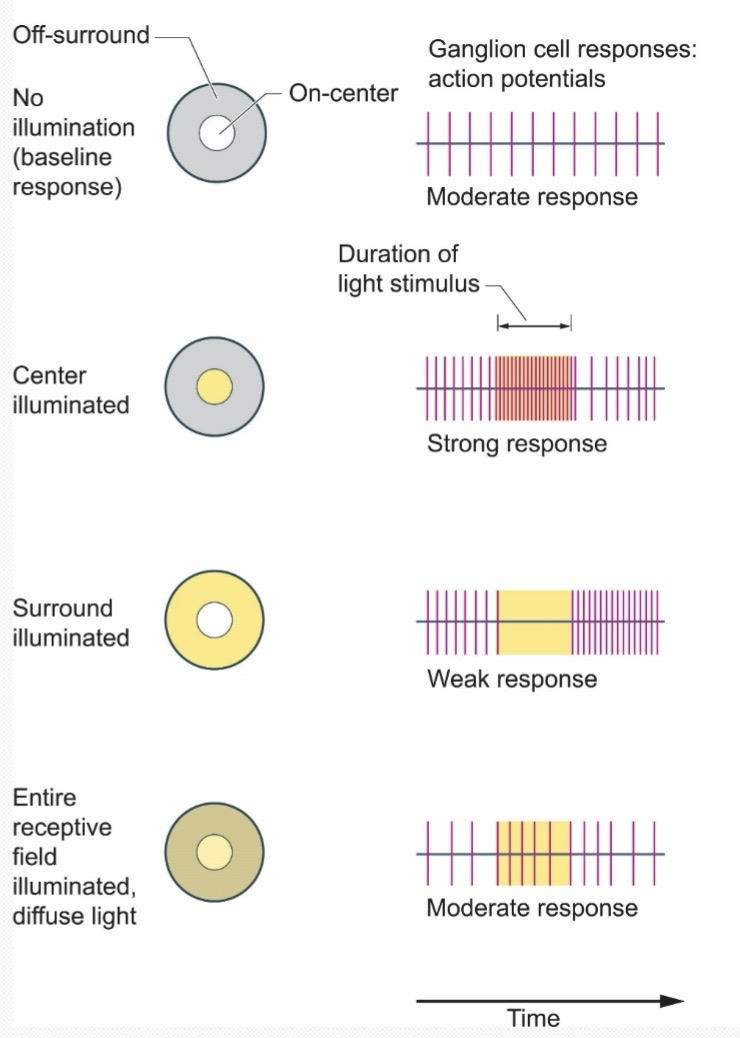
In center-surround receptive fields the light in the center do what, and in the surrounding do what?
light in the center will excite, light in the surrounding will inhibit
What does MEG do more accurately than EEG?
provides information about how deep within the brain the source is located
Describe how ganglion cells function
Their axons extend toward the brain and form the optic nerve
What are the two types of ganglion cells?
magnocellular cells and parvocellular cells
This type of ganglion cells are large and respond to coarse pattern and detect rapid motion
magnocellular
This type of ganglion cells are small, preserve color information and slower
parvocellular
What is the main perceptual effect of cerebral achromatopsia?
only perceiving shades of grey and not colors
A patient can identify objects but cannot reach for them. This indicates damage in the _____ pathway
dorsal (where)
The __________ pathway involved input from M ganglion cells. It sends visual information from the retina to the superior colliculus.
tectopulvinar
Uses a small, specific group of neurons to represent a specific item
sparse coding
pattern of activity across a large population of cells codes for individual objects
population coding
A person cannot recognize familiar faces but can identify objects normally.
Prosopagnosia
Damage to the ventral pathway causes _____ agnosia
visual
What is the sequence that represents the flow of auditory information?
Cochlea → Brainstem → Midbrain → Thalamus → Cortex
There is a particular cell in the ventral processing stream whose job is to fire when you see a particular object. It is an extreme of sparse coding.
Grandmother cell theory
What are the mechanisms that allow us to determine the direction of sound?
Interaural time difference and Interaural intensity difference
Somatosensory agnosia, also known as tacticle agnosia, refers to?
the inability to recognize objects through touch
EEG and ERP are great at _____ and poor at _______
temporal resolution; spatial resolution
The striate cortex, also known as the primary visual cortex, has what kinds of cells?
Simple, complex, and hyper-complex
What ability is an individual with associative agnosia likely to retain?
the ability to copy pictures
6 layers folded in a knee shape, what structure is this?
Lateral Geniculate Nucleus
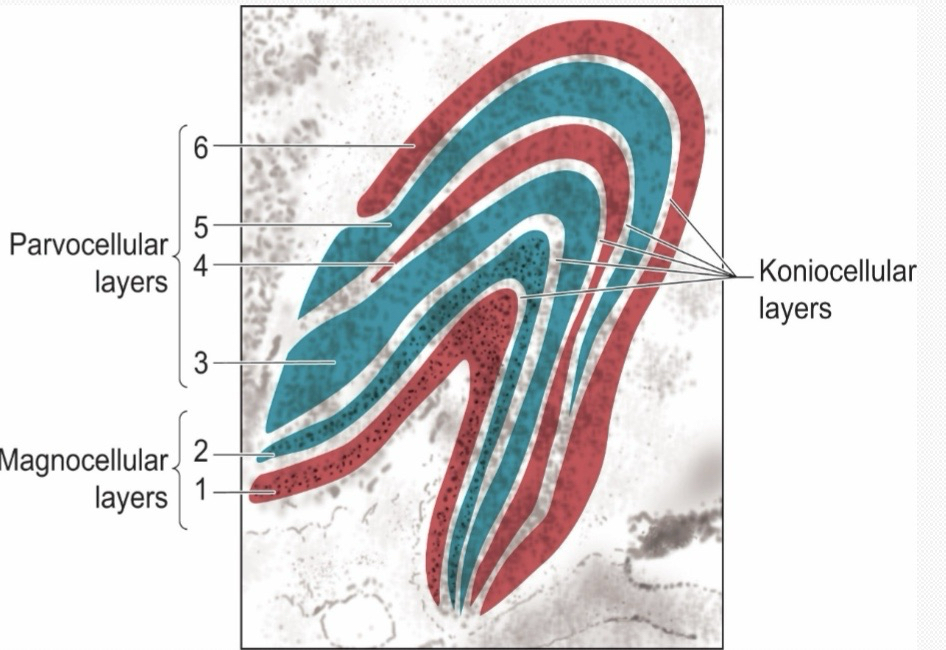
What are the three layers in the LGN?
magnocellular, parvocellular, and koniocellular
Which layers receive from inputs from ganglion cells and the superior nucleus
Koniocellular
What does electroencephalography (EEG) primarily record?
summed postsynaptic electrical activity of neurons
Retinotopic mapping in the LGN ensures what?
each layer has a map of its own so information doesn’t get jumbled up
What is used to map out retinotopic mapping in the LGN?
single-cell recording and fMRI
Most feedback connections to the LGN comes from the _______ ________ ________
primary visual cortex

Projections from the LGN to the primary visual cortex maintain their ______ __________
spatial organization
In the primary visual cortex, mm of cortical surface are devoted to one degree of the world
cortical magnification factor
Based on evidence from monkeys, damage to the magnocellular layer of the LGN would most likely result in difficulty with?
determining the motion of a stimulus
In orientation specificity, many cells in ___ and ______ _______ are tuned to respond to edges with a particular orientation.
V1; higher areas
What did Huber & Weisel discover about orientation specificity?
Simple cells responded to a certain orientation
Auditory information travels through the different structures of the auditory system in what order?
cochlea, superior olive, inferior colliculus, MGN, A1
Think about a single neuron in the left LGN. It receives input from
either the left eye or right eye, depending on which layer of the LGN it is in
Coincidence detectors and delay lines are part of the brain mechanism that
uses temporal differences to localize sounds in the medial superior olive
What does EEG primarily record?
summed postsynaptic electrical activity of neurons
based on evidence from monkeys, damage to the magnocellular layer of the LGN would most likely result in difficulty with?
determining the direction of motion of a stimulus

in the human visual system, neurons in the LOC (lateral occipital cortex) respond most strongly to?
object shapes
Which part of the eye consists of layers of cells that register light beginning the process of representing the visual world?
retina
In the striate cortex, cells are segregated into columns according to which eye sends them information. These columns are referred to as ________.
ocular dominance columns
The auditory canal is located in ________.
the outer ear
Which step of the auditory pathway comes after the inferior colliculus?
medial geniculate nucleus
What is the appropriate order of the ventral processing stream?
V1 to V2 to V4 to anterior inferotemporal areas.
What kind of visual processing do large receptive fields allow for?
object recognition
The word agnosia is best described as meaning ________.
without meaning
Someone with associative agnosia would have difficulties ________.
identifying what they see
Developmental prosopagnosia likely has a genetic component and is thought to be present in approximately ____ percent of the general population.
2
What is true of a patient with developmental prosopagnosia?
Individuals can sometimes have trouble recognizing family members or themselves
Neural modules within the ventral stream may be specialized for recognising specific categories of objects. There is evidence for four types of specialized modules. Which acronyms represent these four types?
VWFA, PPA, EBA, FFA
Which neural modules within the ventral stream is most specialized for recognising faces?
FFA
What are the three ways that auditory agnosia can manifest?
verbal auditory, nonverbal auditory, and mixed auditory
If a person has ________ agnosia, the ability to attach meaning to nonverbal sounds is disrupted.
nonverbal auditory
How many paths separate pathways project from the dorsal stream to other brain regions to support different spatial functions?
3
Which do humans find more challenging to distinguish?
left from right
Research has shown that cells in the ________ are responsive to depth information in both the form of binocular disparity cues and the form of motion parallax cues.
MT
Dorsal stream cells also integrate ________ as a cue for depth because it can provide information about how far away something is because viewing a pattern that is closer has more details than far away patterns.
texture
What are the two frames of reference for coding spatial information?
egocentric and allocentric
Someone who shows spatial neglect of their left side and neglect that is within their reach is said to have which kind of neglect?
peripersonal
What is another name for area MT (which, along with MST, is important for perceiving motion)?
V5
Optic ataxia is a disorder of ________.
visually guided reaching
Which task might be used to study how dorsal stream cells can differentiate between the location of a stimulus and the location of an intended action?
anti-saccade task
A patient is unable to construct new representations of environments, although they are still able to navigate successfully around previously known or previously learned environments. They most likely have which condition?
anterograde disorientation
Diffusion tensor imaging (DTI) is helping for providing information about ________.
white matter
What are the two advantages of PET?
provide information on metabolism, demonstrate the distribution of neurotransmitter binding in people
What does the BOLD signal measure?
Changes in the magnet signal between oxygenated and deoxygenated blood
Which is more invasive? Transcranial direct current stimulation (tDCS) or transcranial magnetic stimulation (TMS)?
TMS, tDCS is generally safe
Optical recording methods use information about what aspects of light to to determine where and when brain activity is happening?
Absorption and scattering
is used to examine the frequency of the summed electrical signal of synchronous firing in the dendrites of populations of neurons, and can be used to distinguish states of alertness, drowsiness, and sleepiness.
EEG
Data comes from; individuals with localized lesions/ Psychiatric or neurological syndromes/ certain
behavioral characteristics
clinical participant populations
Data comes from; neurologically intact individuals
reference population
Methods that determine brain anatomy (structural function)
CT, MRI, and DTI
Methods that localize brain activity
PET, fMRI
Methods that involve electromagnetic recording of brain activity
EEG, ERP, MEG
Allows replicable patterns to be discovered in data and generalized to
new situations
machine learning example
in the striate cortex, these cells respond best to an edge of a specific orientation
simple cells
in the striate cortex, these cells respond best to certain line orientations, but less picky about
the location of the line than simple cells.
complex cells
in the striate cortex, these cells respond best to lines of certain
orientation and certain length. A.K.A end stopped cells.
hyper complex cells
In the striate cortex, these columns have cells that prefer a given line orientation are grouped
together
orientation columns
In the striate cortex, these columns have cells segregated according to which eye sends
them input
ocular dominance columns
In the striate cortex, this column has cells that are all tuned to respond to stimulation at a particular
spatial location.
hypercolumn
No conscious experience of seeing because of extensive damage to the striate cortex, yet are able to make
rudimentary visual discriminations
blindsight
Which area in the striate cortex is sensitive to color?
V4
Becomes larger as we move further along the ventral processing stream
receptive field
At some level, our mental representation of objects is fairly
abstract
invariance in recognition
Brain’s categorization is constant regardless of the form of the
cue that represents the object.
form-cue variance
Ability to recognize objects seen from different angles,
positions, sizes, and kinds of illumination
perceptual constancy
Part of ventral stream anterior to the retinotopically mapped extrastriate areas V2 and V4, active in object recognition, more responsive to shapes than tectures
Lateral Occipital Cortex (LOC)
Important for analyzing parts of objects (Local)
left ventral stream