Quiz 4 - Reverb
 Call Kai
 Learn
 Practice Test
 Spaced Repetition
 Match
 Flashcards
 Knowt Play
1/21

There's no tags or description
Looks like no tags are added yet.
22 Terms
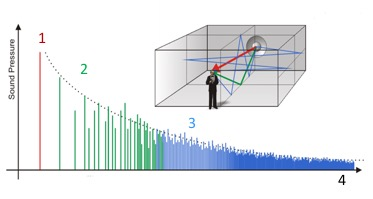
label numbers 1-4
Direct Sound
Early Reflections
Reverb
Time
Direct Sound
The original impulse of sound in an environment.
Early Reflections
The first echoes that bounce back in a space, indicating the size of the space.
Reverb
The series of diminishing late reflections in a space.
acoustic reverb family
room and chamber reverb
mechanical reverb family
plate and spring
digital reverb family
convolution and algorithmic
acoustic chamber
Signal is fed to a speaker in a space and microphones capture the resulting sound
Spring reverb
Often found in guitar amps
Plate reverb
Large sheet of metal is vibrated
Algorithmic reverb
Computer code based on hypothetical rooms or types
Convolution reverb
Utilizes the impulse response of a room derived from a single sound to generate a pattern of reverb
what are benefits of using a parallel (send/return) procedure for adding reverb
-reduced CPU power required over applying as Insert
-allows blending of multiple sources into a single reverb
-easier to edit parameters applied to multiple instruments
When using a parallel process you should always leave the processor's Wet / Dry Blend control at 100% and adjust the blend using the send / return.
True
The send level should always be at unity and the return should be set to the desired reverb level.
False
Algorithm
Chooses the reverb type (i.e. the hypothetical space it is trying to emulate)
Decay
Reverb Time, RT60
Pre Delay
The gap between the direct sound and the onset of reverb
Diffusion
Adjusts the density of the reverb
Wet / Dry Blend
Adjusts the balance of the unprocessed and processed signal
LPF
Rolls of the high frequencies
HF Cut
Chooses how fast the high frequencies decay