Physics 247: Intro to Modern Physics I
 Call Kai
 Learn
Learn Practice Test
 Spaced Repetition
 Match
Match Flashcards
 Knowt Play
1/47

There's no tags or description
Looks like no tags are added yet.
Name | Mastery | Learn | Test | Matching | Spaced | Call with Kai | Chat |
|---|
No analytics yet
Send a link to your students to track their progress
48 Terms
What do vectors have
Magnitude and Direction (Lecture 1, Covered September 2)
Multiplying a vector by a scalar preserves what. What does it not preserve
Direction is preserved. Magnitude changes assuming the scalar is not equal to 1 (Lecture 1, Covered September 2)
What are the two ways to multiply vectors
Dot product and Cross product (Lecture 1, Covered September 2)
What is the algebraic definition of the dot product
Where A = <a1,a2,a3> and B = <b1,b2,b3> (Lecture 1, Covered September 2)

What is the geometric definition of the dot product
Where A = <a1,a2,a3> and B = <b1,b2,b3> (Lecture 1, Covered September 2)

What is the algebraic definition of the cross product
(Lecture 1, Covered September 2)
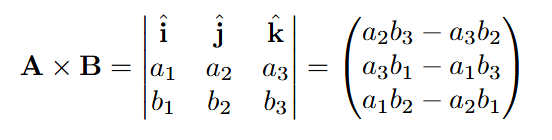
What is the geometric definition of the cross product
(Lecture 1, Covered September 2)

Of the two ways to multiply vectors, which results in a scalar and which results in a vector
Dot product results in a scalar and the cross product results in a vector (Lecture 1, Covered September 2)
Typically, what are the letters used to denote position, velocity and acceleration respectively
x, v, and a (Lecture 1, Covered September 2)
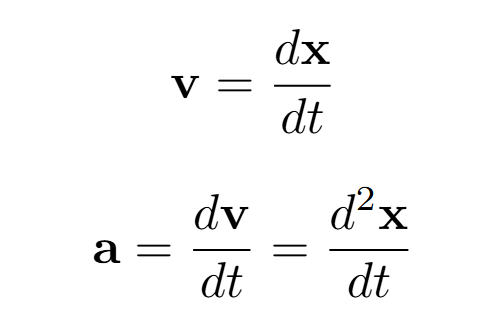
How are position, velocity, and acceleration related via calculus
(Lecture 1, Covered September 2)
What is an alternative notation for derivatives that is commonly used in physics
(Lecture 1, Covered September 2)

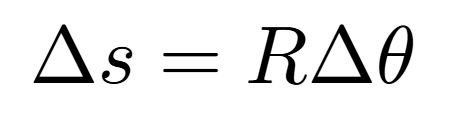
What is the arc length of a circle equal to in terms of it’s radius and angle
Delta s is the change in arc length, R is the radius of the circle, and Delta theta is the change in angle (Lecture 2, Covered September 4)
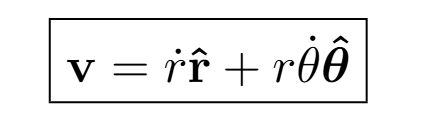
What is velocity in polar coordinates
Note, the vector r is r = xi +yj (Lecture 2, Covered September 4)
What is acceleration in polar coordinates
(Lecture 2, Covered September 4)

The components of the acceleration vector in polar coordinates have names. What are there names
(Lecture 2, Covered September 4)

When does Newtonian Mechanics “break down”
Newtonian Mechanics breaks down for objects that are very very small, i.e., much smaller than an atom, or very very fast objects, approaching the speed of light c. You must apply quantum mechanics or other principles in these scenarios (Lecture 3, Covered September 9)
What is an inertial system
A system moving at constant speed (Lecture 3, Covered September 9)
What is Newton’s First Law
A uniformly moving object continues to move uniformly, at constant speed, unless acted on by a net force. (Lecture 3, Covered September 9)
What is Newton’s Second Law
(Lecture 3, Covered September 9)

What is Newton’s Third Law
An object acting on another object will exert an equal, but opposite force (Lecture 3, Covered September 9)

What is the acceleration due to gravity on Earth
g is approximately 9.81 m/s² (Lecture 3, Covered September 9)
What is Newton’s Gravitational Constant equal too
(Lecture 5, Covered September 14)

What is the mass of the Earth
(Lecture 5, Covered September 14)

What is the radius of the Earth
(Lecture 5, Covered September 14)

What is Hooke’s Law
(Lecture 6, Covered September 16)

What is the formula for the force of friction
f is the friction force, mu is the coefficient of friction and N is the normal force (Lecture 7, Covered September 18)

What is the coefficient of static friction and coefficient of kinetic friction. Which one is usually bigger
The coefficient of static friction occurs when an object is not moving against a surface. The coefficient of kinetic friction occurs when an object is moving against a surface. The coefficient of static friction is usually bigger kinetic friction (Lecture 7, Covered September 18)
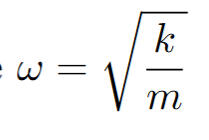
What is the oscillation frequency for a spring
(Lecture 7, Covered September 18)
What is the formula for momentum
(Lecture 8, Covered September 21)

What is momentum in terms of Newton’s Second Law
(Lecture 8, Covered September 21)

What is the momentum for a system of particles
(Lecture 8, Covered September 21)

When does conservation of momentum apply
Conservation of momentum applies when there are no external forces on the system (Lecture 8/9, Covered September 21)
What is the center of mass formula
(Lecture 8, Covered September 21)

What is the geometric definition of work
(Lecture 11, Covered September 28)

What is the integral definition of work
(Lecture 11, Covered September 28)

When is a force conservative
(Lecture 11, Covered September 28)

What is the formula for kinetic energy
(Lecture 11, Covered September 28)

What is the work-energy theorem
(Lecture 11, Covered September 28)

What is mechanical energy
Its the sum of Kinetic Energy and Potential Energies (Lecture 12, Covered September 30)
What is power? What is it mathematically
Power is the rate at which work is done (Lecture 12, Covered September 30)

If we have a conservative force, then work is what as it relates to the path taken
Work is independent of path (Lecture 12, Covered September 30)
When do we have elastic collisions
If kinetic energy is conserved, the collision is elastic (Lecture 15, Covered October 9)
When do we have inelastic collisions
If kinetic energy is NOT conserved, the collision is inelastic (Lecture 15, Covered October 9)
How is angular momentum defined
(Lecture 16, Covered October 12)

What is moment of inertia equal too in integral form
(Lecture 17, Covered October 14)

What is the parallel axis theorem
l is the distance between the axes, I_0 is the moment of inertia around the axis through its center of mass. Note, the two axes have to be parallel for the theorem to apply (Lecture 17, Covered October 14)

What is torque defined as
(Lecture 17, Covered October 14)
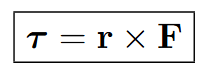
What is dL/dt where L is angular momentum
(Lecture 17, Covered October 14)
