Ch. 14 – Principles of Disease and Epidemiology
 Call Kai
 Learn
Learn Practice Test
 Spaced Repetition
 Match
Match Flashcards
 Knowt Play
1/69

There's no tags or description
Looks like no tags are added yet.
Name | Mastery | Learn | Test | Matching | Spaced | Call with Kai | Chat |
|---|
No analytics yet
Send a link to your students to track their progress
70 Terms
What is pathology?
The study of disease caused by pathogens.
Study of the relationship between pathogen & host.
What is etiology, and what is the cause of a disease called?
The study of the cause (origin) of a disease.
The pathogen that causes it = the "causative agent."
What is pathogenesis?
The development of disease (the disease process).
Where you see structural/functional changes in the host.
Define infection vs. disease and how they relate.
Infection: invasion or colonization (attachment) of the body by pathogens.
Disease: an abnormal state in which the body is not performing normal functions.
Infection → leads to disease.
What are the 2 types of disease and how do they differ?
Infectious disease: involves a pathogen (Exam 2 & 3).
Non-infectious disease: does not involve a pathogen (Exam 4).
What is normal microbiota (N.M.)?
Microbes that cause no harm to the host if they remain in a specific body area.
Resident vs. transient microbiota?
Resident: always present (permanent) in and on the human host.
Transient: take up temporary residence in & on the host; remain only hours to months.
Where on the body would you expect to find transient microbiota?
On the skin (e.g., the hands), where they can be removed by handwashing.

What is symbiosis?
The relationship between microbe and host: who benefits & who does not.
What is commensalism? Give an example.
One organism benefits, the other is unaffected.
Ex: Staphylococcus epidermidis on the skin (N.M., bacteria on skin).
What is mutualism? Give an example
Both organisms benefit (ex: beneficial microbes).
Ex: E. coli in the large intestine (N.M., E. coli in colon); makes vitamin K.
What is parasitism? Give an example.
One organism benefits at the expense of the other.
Parasite = pathogen; always harms the host.
Ex: Influenza viruses on a host cell ("obligate intracellular parasite").
What are Koch's postulates?
Rules/conditions showing that a specific pathogen is responsible for a specific disease (with specific symptoms);
ex: chickenpox virus → chickenpox.
Called the germ theory.
What theory do they support, and what are the 4 criteria?
The same pathogen must be present in every case of the disease.
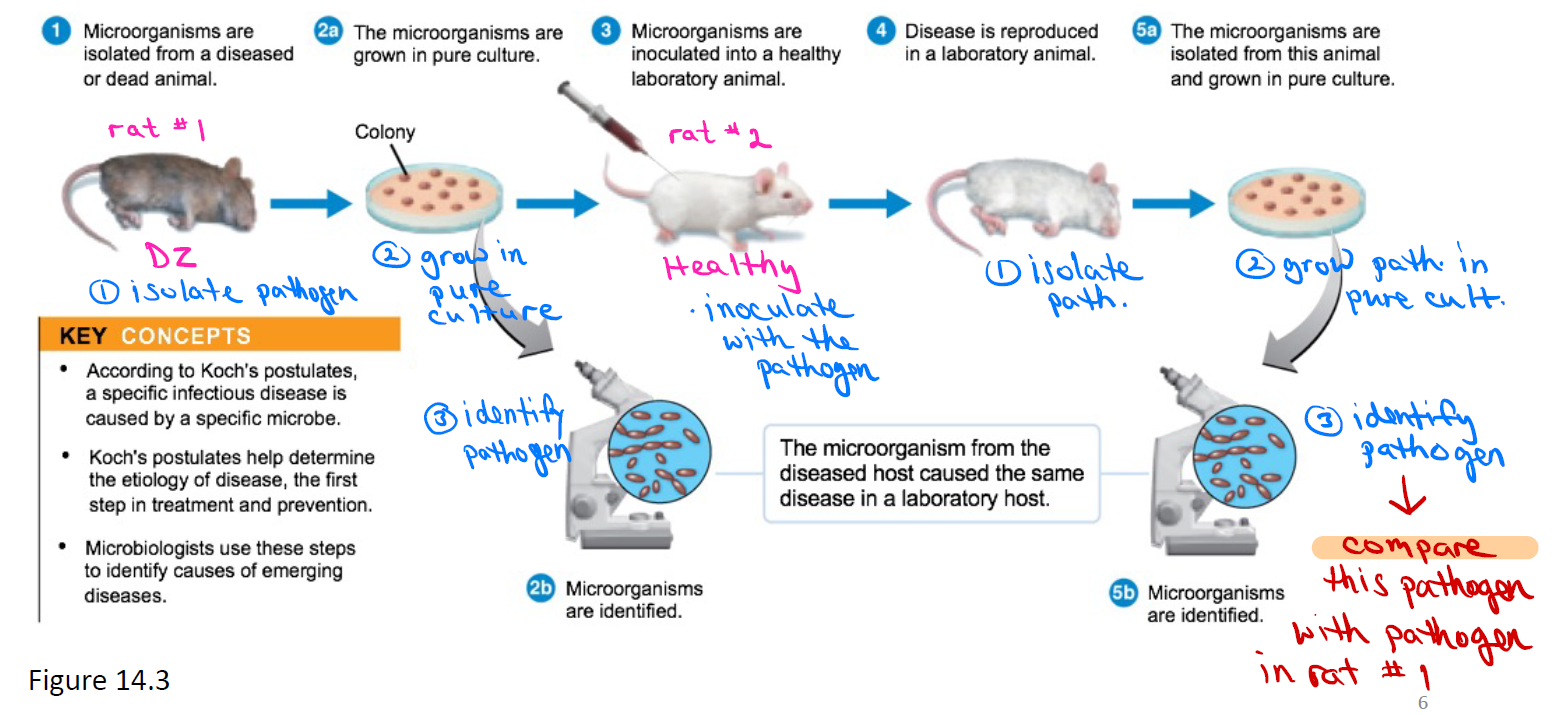
The pathogen must be isolated from the diseased host (rat #1) and grown in pure culture.
The same pathogen from the pure culture must cause the disease when inoculated into a healthy host (rat #2).
The pathogen must be isolated from the inoculated animal and shown to be the original organism.
Walk through Koch's postulates using the lab animal steps.
What are the 3 exceptions to Koch's postulates?
Some pathogens can cause several disease conditions:
- Streptococcus pyogenes → Strept throat OR Scarlet fever.Some pathogens cause disease only in humans:
- Cannot reproduce the disease in lab animals.Some microbes cannot grow on artificial media:
- Running the experiment on lab media gives false results.
Symptoms vs. signs?
Symptoms: changes in body function that are felt by the patient; are not measured/observed.
Pain, fatigue, nausea, dizziness.
Signs: changes in the body that can be measured or observed.
BP, HR, Temp, RR.
What is a syndrome? Give examples.
A specific group of signs & symptoms that accompany a disease; common in most cases of the disease.
Ex: AIDS, Down's syndrome.
What is a communicable disease, and what makes one contagious?
Communicable: a disease that is spread from one host to another.
Contagious: a disease that is easily & rapidly spread.
Ex: Chickenpox.
What is a noncommunicable disease? Give examples.
A disease that is not spread from one host to another.
Ex: Tetanus, cancer, diabetes, autoimmune disease.
What does "occurrence of a disease" mean?
The frequency of disease.
Incidence vs. prevalence?
Incidence: number of people who develop a disease during a specific time period; a narrow time frame
(ex: 1 year out of 10, or 1 month out of 1 year).
Prevalence: number of people with a disease at a certain time, regardless of when it first appeared; includes both old and new cases (past + present) → broad/wide time frame.
Prevalence indicates how widespread the disease is.

Which term refers to a larger time period? Explain using influenza as an example.
Prevalence.

What is a sporadic disease? Give an example.
Occurs only occasionally; no pattern of disease, random manner.
Ex: Mad Cow disease.
What is an endemic disease? Give an example.
Constantly (always) present in a population; disease localized in a population.
Ex: Malaria.
What is an epidemic disease? Give an example.
An "outbreak": acquired by many people in a given area in a short time; spreads quickly.
Ex: Influenza.
What is a pandemic disease? Give examples.
A worldwide epidemic; global scale.
Ex: HIV/AIDS, COVID-19.

What is an acute disease? Give an example.
Symptoms develop rapidly, but the disease lasts only a short time.
Ex: Influenza.
What is a chronic/persistent disease? Give an example.
Symptoms develop slowly; the disease lasts a long time.
Ex: Tuberculosis.
What is a subacute disease?
Intermediate between acute and chronic.
What is a latent disease? Give an example.
"Hidden": the causative agent (pathogen) is inactive for a time, then activates and produces symptoms.
Pathogen is hidden/dormant for a long time.
Ex: Shingles.
What is herd immunity, how is it accomplished, and give examples.
Immunity where the entire population is protected.
Accomplished through vaccinations.
Ex: Chickenpox, Measles.
How does NO herd immunity work?
No herd immunity: no one is immunized → contagious disease spreads through the population.

How does herd immunity work?
Yes herd immunity: most are immunized → spread of disease is contained.
If most of the population gets immunized → the entire population is protected, including the healthy non-immunized.

What is a local infection? Give an example.
Pathogens are limited to a small area of the body; pathogens do not spread.
Ex: Skin infections.
What is a systemic (generalized) infection, and which type is worse?
An infection throughout the body; the pathogen has spread via the bloodstream.
Systemic is worse than local.
What is sepsis/septicemia?
A systemic infection: uncontrollable spread of microbes in the blood (blood infection); spreads throughout the body.
"-emia" = via bloodstream.
A life-threatening condition.
What are the 3 types of sepsis?
Bacteremia: bacteria in the blood.
Toxemia: toxins in the blood; toxins made by pathogens.
Viremia: viruses in the blood.
What is a primary infection? Give an example.
Infection that causes the initial illness; most infections remain as 1° infections.
1° infections can predispose you to 2° infections because of a weak immune system.
Ex: HIV → weakens the host immune system.
What is a secondary infection, and what are opportunistic pathogens?
Caused by opportunistic pathogens after a primary infection.
Opportunistic pathogens: pathogens that take the opportunity of a weak immune system to cause disease.
Ex: AIDS-related opportunistic infections → respiratory disease, neurological disease.
What are predisposing factors? List the examples
Factors that make the body more susceptible (likely) to disease.
Gender: females → UTIs.
Age: elderly.
Lifestyle: IV drug users.
Inherited traits: diabetes in families.
Climate & weather: tropics/warm & wet → malaria.
Poor sanitary conditions: parasitic worm disease.
What is stage 1 of disease, and what happens?
Incubation period.
No signs & symptoms present; interval between initial infection and first signs & symptoms.
You are infectious; pathogen is growing.
What is stage 2 of disease, and what happens?
Prodromal period.
Early, mild symptoms; short period after incubation.
1st appearance of signs & symptoms.
What is stage 3 of disease, and what happens?
Period of illness.
Most severe signs & symptoms.
Start producing Ab's.
What is stage 4 of disease, and what happens?
Peak of illness.
Number of pathogens & Ab's is at its highest.
Leads to either: 1) period of decline or 2) death (only if the immune system is overwhelmed).
What is stage 5 of disease, and what happens?
Period of decline.
Number of pathogens decreases.
Signs & symptoms subside (decrease).
What is stage 6 of disease, and what happens?
Period of convalescence/recovery.
Body returns to its pre-diseased state; patient regains strength.
No signs & symptoms ("asymptomatic"), but patient is still infectious!
Pathogens leaving body → number of pathogens is very low.
What is a reservoir of infection?
Continual sources of infection; location of pathogen.
The place where a pathogen can be found.
What is a human reservoir?
Pathogen usually found in humans.
Sick people or "carriers" with no signs & symptoms; carriers do not know they have the pathogen.
What is an animal reservoir, and what are zoonoses? Give an example.
Pathogen usually found in animals.
Zoonoses: ability to transmit pathogen from animals to humans (zoonotic transmission).
Ex: Chickens → influenza virus H5N1 → humans.
What is a non-living reservoir? Give examples.
Pathogen found in contaminated inanimate (non-living) things.
Ex: contaminated soil, air, water, food.
How are diseases transmitted?
Causative agents (pathogens) are transmitted from the reservoir of infection to a susceptible host.
What are the 3 principal routes (ways)?
Contact transmission: involves close contact.
Vehicle transmission: involves a non-living thing.
Vector transmission: involves a living thing.
What is direct contact transmission?
Requires close association (touching) between infected person and susceptible host.
From infected person → non-infected person.

What is indirect contact transmission, and what is a fomite?
Spreads to host by a contaminated non-living object called a fomite.
From fomite → uninfected person.

What is droplet transmission?
Transmission via airborne particles less than 1 meter (source is < 3 ft away).
From a cough/sneeze from an infected person less than 1m away.

What is vehicle transmission, and what are its 3 types?
Transmission by a contaminated inanimate reservoir (non-living thing).
Airborne: contaminated air (Exam 3).
Waterborne: contaminated water (Exam 2).
Foodborne: contaminated food (Exam 2).

Airborne transmission vs. droplet transmission?
Airborne: via airborne particles more than 1 meter.
Droplet: via airborne particles less than 1 meter.
What is vector transmission, and what is a vector?
Involves a contaminated (infected) living thing.
Vector: an infected animal that transmits disease from one animal to another.
(mosquito)
What accomplishes vector transmission? Give examples.
Arthropods: a living thing (animal) with a pathogen on or inside it.
Ex: fleas, ticks, mosquitoes.
What is mechanical vector transmission? Give an example.
Arthropod vector carries pathogen outside its body.
Called "passive transport" of pathogen.
Ex: Flies; pathogen on its feet, wings.
What is biological vector transmission? Give an example.
Arthropod vector supports the life cycle of pathogen in its body.
Pathogen transmitted via bites.
Called "active transport" of pathogen.
Ex: Mosquito bite with pathogen in its GI tract.
What is a healthcare-associated infection (HAI), and how common is it?
An infection acquired in the hospital/clinical environment.
Affects 1 in 25 hospital patients.
1.7 million infected per year; over 99,000 deaths (CDC 2020).
What are the 3 common sources of HAIs (chain of infection)?
Improperly cleaned healthcare settings.
Weakened immune status of the host.
Transmission of pathogens.

What are the 3 common sites of HAIs and their causes?
Surgical site infections: at the site of incision.
Lower respiratory infections: use of respiratory devices.
Gastrointestinal infections: improper disinfection of clinical devices & settings.
What are the 2 most common microorganisms involved in HAIs, and what infections do they cause?
Staphylococcus aureus: surgical wound; 16% of total HAIs.
Clostridium difficile: diarrhea after abdominal surgery; 15% of total HAIs
What is epidemiology?
The study of where and when diseases occur and how they are transmitted in populations.
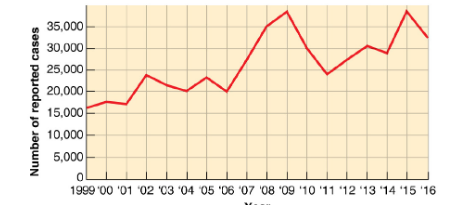
What does the CDC do?
Collects & analyzes epidemiological information in the U.S.
Morbidity vs. mortality?
Morbidity: number of people or incidence of a specific notifiable disease.
Mortality: number of deaths from notifiable diseases.
What are nationally notifiable infectious diseases? Give examples.
Diseases in which physicians are required by law to report occurrence to the CDC.
Ex: HIV infection, Gonorrhea, Syphilis.