Animal Diversity study guide
 Call Kai
 Learn
 Practice Test
 Spaced Repetition
 Match
 Flashcards
 Knowt Play
1/124

There's no tags or description
Looks like no tags are added yet.
125 Terms
Which of the following is thought to be the most closely related to the common animal ancestor?
Protist cells, specifically choanoflagellates.
For each of the following characteristics, indicate its prevalence among animals. All cells are diploid (except gametes).
Most animals in the course slides. Haploid male bees, ants, and wasps are exceptions.
For each of the following characteristics, indicate its prevalence among animals. Alternation of generations.
No animals in the course’s ploidy-based definition. It means alternating multicellular haploid and diploid generations.
For each of the following characteristics, indicate its prevalence among animals. Cellular level of organization (no tissues or organs).
Few animals, such as sponges.
For each of the following characteristics, indicate its prevalence among animals. Eukaryotic.
All animals.
For each of the following characteristics, indicate its prevalence among animals. Gametes produced by meiosis.
Most animals use meiosis in the usual diploid sexual cycle. Haploid males can be an exception.
For each of the following characteristics, indicate its prevalence among animals. Haploid adult.
Few animals, including male bees, wasps, and ants.
For each of the following characteristics, indicate its prevalence among animals. Heterotrophic.
All animals.
For each of the following characteristics, indicate its prevalence among animals. Multicellular.
All animals.
Animals do not reproduce asexually.
False.
Which of the following are principle modes of animal nutrition? Please select all that apply.
Carnivores, detritivores, filter feeders, herbivores, heterotrophs, omnivores, and parasites. Heterotrophy is the umbrella category.
Which of the following is the correct order embryonic stages during embryonic development?
Zygote → blastula → gastrula.

On the Canvas embryonic development diagram, what does A identify?
Zygote (fertilized egg).

On the Canvas embryonic development diagram, what does B identify?
Blastomeres (individual cleavage cells).
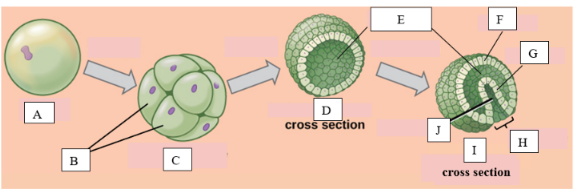
On the Canvas embryonic development diagram, what does C identify?
Morula (solid cleavage-stage cell cluster).

On the Canvas embryonic development diagram, what does D identify?
Blastula (stage with a blastocoel).

On the Canvas embryonic development diagram, what does E identify?
Blastocoel (cavity of the blastula and its remnant in the gastrula).

On the Canvas embryonic development diagram, what does F identify?
Ectoderm (outer germ layer).
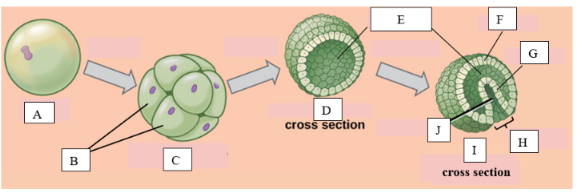
On the Canvas embryonic development diagram, what does G identify?
Endoderm (inner germ layer lining the primitive gut).

On the Canvas embryonic development diagram, what does H identify?
Blastopore (opening into the primitive gut).

On the Canvas embryonic development diagram, what does I identify?
Gastrula (stage formed by gastrulation).

On the Canvas embryonic development diagram, what does J identify?
Archenteron (primitive gut cavity).

Please indicate the symmetry of each of the following organisms shown in the image above. A
Asymmetrical

Please indicate the symmetry of each of the following organisms shown in the image above. B
Radial symmetry

Please indicate the symmetry of each of the following organisms shown in the image above. C
Biradial symmetry

Please indicate the symmetry of each of the following organisms shown in the image above. D
Pentamerous radial symmetry

Please indicate the symmetry of each of the following organisms shown in the image above. E
Bilateral symmetry
The lining of the digestive tract is derived from _____.
Endoderm.
The muscular and skeletal systems are derived from _____.
Mesoderm.
The nervous and sensory systems are derived from _____.
Ectoderm.
The epidermis of skin, sweat glands and hair follicles are derived from _____.
Ectoderm.
Which of the following characteristics is NOT associated with a pseudocoelom?
Derived from mesoderm only. A pseudocoelom lies between mesoderm and endoderm.

Please match each of the images above with its characteristic coelom. A
Acoelomate (flatworm)

Please match each of the images above with its characteristic coelom. B
Pseudocoelomate (nematode)

Please match each of the images above with its characteristic coelom. C
Eucoelomate (annelid)
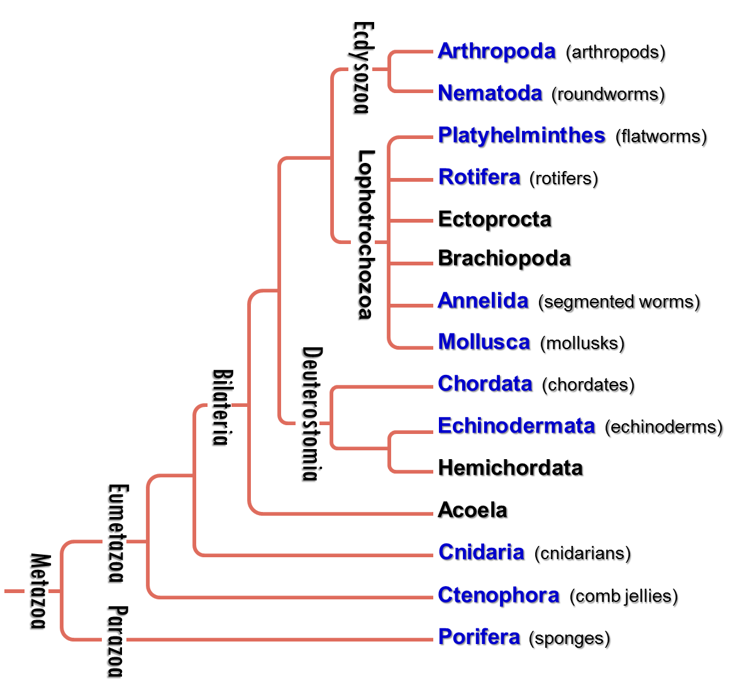
Please indicate the type symmetry characteristic of each of the following clades. Porifera
Asymmetrical

Please indicate the type symmetry characteristic of each of the following clades. Ctenophora
Radial in the course key (often described as biradial)
Please indicate the type symmetry characteristic of each of the following clades. Cnidaria
Radial
Please indicate the type symmetry characteristic of each of the following clades. Echinodermata
Bilateral in the course tree and as larvae. Adults are typically pentaradial.
Please indicate the type symmetry characteristic of each of the following clades. Chordata
Bilateral
Please indicate the type symmetry characteristic of each of the following clades. Annelida
Bilateral
Please indicate the type symmetry characteristic of each of the following clades. Rotifera
Bilateral
Please indicate the type symmetry characteristic of each of the following clades. Mollusca
Bilateral
Please indicate the type symmetry characteristic of each of the following clades. Platyhelminthes
Bilateral
Please indicate the type symmetry characteristic of each of the following clades. Nematoda
Bilateral
Please indicate the type symmetry characteristic of each of the following clades. Arthropoda
Bilateral
For each of the following clades, please indicate if they are diploblastic, triploblastic, or neither diploblastic nor triploblastic. Porifera
Neither diploblastic nor triploblastic
For each of the following clades, please indicate if they are diploblastic, triploblastic, or neither diploblastic nor triploblastic. Ctenophora
Diploblastic
For each of the following clades, please indicate if they are diploblastic, triploblastic, or neither diploblastic nor triploblastic. Cnidaria
Diploblastic
For each of the following clades, please indicate if they are diploblastic, triploblastic, or neither diploblastic nor triploblastic. Echinodermata
Triploblastic
For each of the following clades, please indicate if they are diploblastic, triploblastic, or neither diploblastic nor triploblastic. Chordata
Triploblastic
For each of the following clades, please indicate if they are diploblastic, triploblastic, or neither diploblastic nor triploblastic. Mollusca
Triploblastic
For each of the following clades, please indicate if they are diploblastic, triploblastic, or neither diploblastic nor triploblastic. Annelida
Triploblastic
For each of the following clades, please indicate if they are diploblastic, triploblastic, or neither diploblastic nor triploblastic. Rotifera
Triploblastic
For each of the following clades, please indicate if they are diploblastic, triploblastic, or neither diploblastic nor triploblastic. Platyhelminthes
Triploblastic
For each of the following clades, please indicate if they are diploblastic, triploblastic, or neither diploblastic nor triploblastic. Nematoda
Triploblastic
For each of the following clades, please indicate if they are diploblastic, triploblastic, or neither diploblastic nor triploblastic. Arthropoda
Triploblastic
For each of the following clades, please indicate if they are protostomes, deuterostomes, or neither protostomes nor deuterostomes. Porifera
Neither protostome nor deuterostome
For each of the following clades, please indicate if they are protostomes, deuterostomes, or neither protostomes nor deuterostomes. Ctenophora
Neither protostome nor deuterostome
For each of the following clades, please indicate if they are protostomes, deuterostomes, or neither protostomes nor deuterostomes. Cnidaria
Neither protostome nor deuterostome
For each of the following clades, please indicate if they are protostomes, deuterostomes, or neither protostomes nor deuterostomes. Echinodermata
Deuterostome
For each of the following clades, please indicate if they are protostomes, deuterostomes, or neither protostomes nor deuterostomes. Chordata
Deuterostome
For each of the following clades, please indicate if they are protostomes, deuterostomes, or neither protostomes nor deuterostomes. Mollusca
Protostome
For each of the following clades, please indicate if they are protostomes, deuterostomes, or neither protostomes nor deuterostomes. Annelida
Protostome
For each of the following clades, please indicate if they are protostomes, deuterostomes, or neither protostomes nor deuterostomes. Rotifera
Protostome
For each of the following clades, please indicate if they are protostomes, deuterostomes, or neither protostomes nor deuterostomes. Platyhelminthes
Protostome
For each of the following clades, please indicate if they are protostomes, deuterostomes, or neither protostomes nor deuterostomes. Nematoda
Protostome
For each of the following clades, please indicate if they are protostomes, deuterostomes, or neither protostomes nor deuterostomes. Arthropoda
Protostome

T/F: Worms are a monophyletic group.
False. The organisms called worms occur in multiple evolutionary lineages.
With respect to the animal phylogenetic tree, it is common for _____ data to misplace animals in close relation to other species, whereas _____ data often reveals a different and more accurate evolutionary relationship.
Morphological, molecular.
What structural feature do choanoflagellates and sponge choanocytes share?
A flagellum surrounded by a collar of microvilli.
How does budding differ from fragmentation?
In budding a new individual grows as an outgrowth. In fragmentation a separated piece develops into a new individual.
How does parthenogenesis differ from budding and fragmentation?
An unfertilized egg develops into offspring. Budding and fragmentation use somatic tissue.
What produces haploid males and diploid females in the lecture’s haplodiploidy examples?
Males develop from unfertilized eggs. Females develop from fertilized eggs.
In the lecture’s ZW turkey example, what sex is a viable ZZ parthenogenetic offspring?
Male.
How can an animal be sessile and still have a motile life stage?
The adult can be attached while its larva moves or disperses.
What structural material is a major component of the extracellular matrix discussed in class?
Collagen.
How do muscle, nervous, connective, and epithelial tissue differ in function?
Muscle moves, nervous tissue coordinates, connective tissue supports, and epithelium covers or lines surfaces.
What distinguishes cleavage from ordinary growth-associated mitosis?
Cleavage partitions the embryo into more, smaller cells without increasing its overall size.
Where does the morula fit in the early developmental sequence?
After zygote cleavage and before the hollow blastula.
What is the key transition from blastula to gastrula?
Cells rearrange during gastrulation and establish germ layers and the primitive gut.
How do the blastocoel, archenteron, and blastopore differ?
Blastocoel is the blastula cavity. Archenteron is the primitive gut. Blastopore is the opening into it.
What follows gastrulation in the vertebrate developmental sequence shown in class?
Neurulation and organogenesis.
Which two germ layers are present in a diploblast, and which layer is added in a triploblast?
Diploblasts have ectoderm and endoderm. Triploblasts also have mesoderm.
Why is mesoglea between cnidarian tissue layers different from mesoderm?
Mesoglea is gelatinous extracellular material. Mesoderm is an embryonic germ layer.
What do Hox genes control?
Regional identity along the body axis by regulating other developmental genes.
What does similar Hox expression in mouse and human body regions illustrate?
Conservation of the genetic program for regional body identity.
What was the point of replacing a posterior Hox13 gene with an anterior Hox1 gene in the slide thought experiment?
Changing a regional identity signal could cause posterior tissue to develop anterior characteristics.
Which two phyla were highlighted as lacking Hox genes in the slides?
Porifera and Ctenophora.
Compare complete and incomplete insect metamorphosis by stage.
Complete: egg → larva → pupa → adult. Incomplete: egg → nymph → adult.
How does a nymph differ from a larva in the insect comparison?
A nymph resembles a smaller adult. A larva often differs substantially and becomes an adult via a pupal stage.
Which four body-plan traits does the chapter use for classification?
Symmetry, germ layers or tissue organization, body cavity, and developmental pattern.
How can you distinguish bilateral, biradial, and pentamerous radial diagrams?
They show one, two, and five symmetry planes, respectively.
What benefit does cephalization provide to a directionally moving animal?
Concentrates sensory and nervous structures at the leading end.
Why does a flatworm count as triploblastic even without a body cavity?
It has three germ layers. Presence of a cavity is a separate trait.
How do the linings of a true coelom and a pseudocoelom differ?
A true coelom is fully lined by mesoderm. A pseudocoelom lies between mesoderm and endoderm.
What three functions can a fluid-filled body cavity serve?
Cushion organs, provide hydrostatic support, and give organs room to grow or move independently.
Which two phyla are pseudocoelomates in the course chart?
Rotifera and Nematoda.
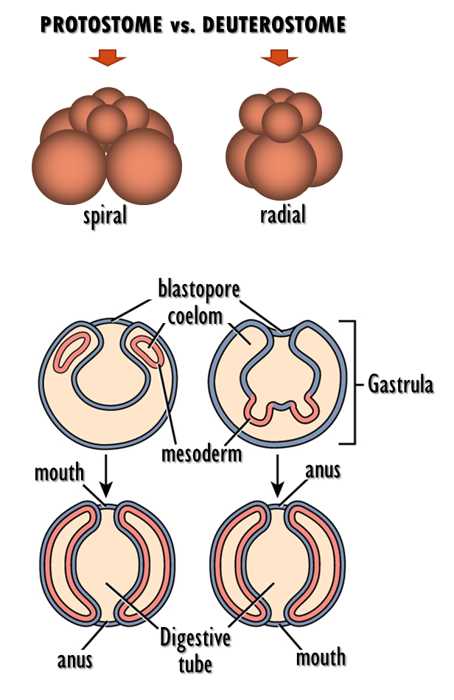
What are the classic protostome patterns for cleavage, coelom formation, and blastopore fate?
Spiral, usually determinate cleavage, schizocoely, and blastopore to mouth.

What are the classic deuterostome patterns for cleavage, coelom formation, and blastopore fate?
Radial, usually indeterminate cleavage, enterocoely, and blastopore to anus.