Enzyme, Leaf parts, and Plant types
 Call Kai
 Learn
 Practice Test
 Spaced Repetition
 Match
 Flashcards
 Knowt Play
1/19

There's no tags or description
Looks like no tags are added yet.
20 Terms

Enzyme
A biological catalyst, typically a protein, that increases the rate of chemical reactions by lowering activation energy without being consumed.

Active site
The specific region on an enzyme where substrate molecules bind and undergo a chemical reaction to form products.

substrate
specific molecule that an enzyme binds to and acts upon during a chemical reaction

allosteric site
a binding location on a protein, receptor, or enzyme that is completely separate from the active (orthosteric) site

Catalyst
substance—usually a protein called an enzyme (or occasionally catalytic RNA)—that speeds up chemical reactions

competitive inhibitor
a molecule that is structurally similar to a normal enzyme substrate and competes with it to bind to the enzyme's active site

noncompetitive inhibitor
a molecule that reduces an enzyme's activity by binding to an allosteric site rather than competing with the substrate for the active site

denaturation
the process where an enzyme (a protein catalyst) loses its native three-dimensional shape and active site due to external stressors like high heat or extreme pH, making it unable to bind substrates and halting its catalytic activity

activation energy
the minimum amount of energy required to start a chemical reaction by breaking existing chemical bonds and reaching an unstable, high-energy state

transpiration
the passive process where water evaporates from the moist cell surfaces of a plant's leaves and diffuses as water vapor out into the atmosphere

cuticle
the protective, waxy, non-cellular outer layer that covers the aerial parts of plant to prevent water loss (transpiration)

stomata
microscopic pores or openings found mostly on the underside of plant leaves and young stems (the holes)

guard cells - water
paired plant cells flanking leaf pores called stomata that regulate gas exchange and water loss through changes in water potential and turgor pressure

mesophyll
the core internal ground tissue of a plant leaf, located between the upper and lower epidermis, and serves as the primary site of photosynthesis by having many chloroplast
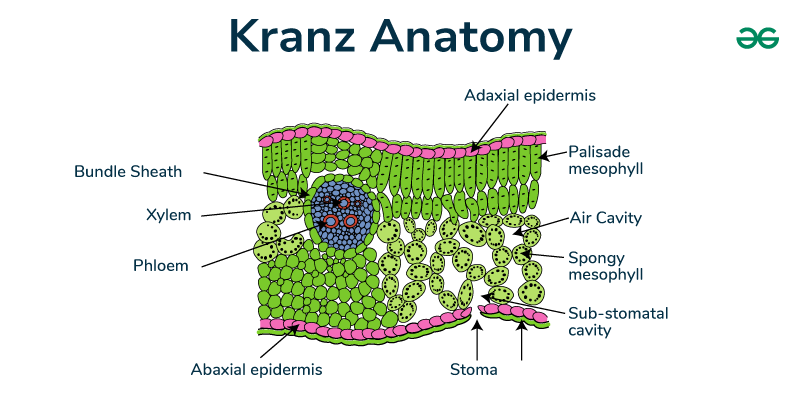
bundle sheath
a layer of compactly arranged cells that surrounds the vascular bundles (the xylem and phloem) in plant leaves and stems

C3 plant
a plant that uses the standard Calvin cycle as its sole mechanism for carbon fixation, producing a three-carbon molecule (3-phosphoglycerate or 3-PGA) as the first stable product
C4 plant
a plant that uses a specialized carbon fixation pathway (the C4 or Hatch-Slack pathway) to produce a 4-carbon organic acid as its first stable carbon product
CAM plant
a plant that uses Crassulacean acid metabolism (CAM), a special type of photosynthesis that helps plants survive in hot, dry, or desert environments by separating carbon capture and sugar production in time

photorespiration
light-dependent metabolic pathway in plants where the enzyme RuBisCO binds oxygen instead of carbon dioxide, reducing the overall efficiency of photosynthesis

compartmentalization
the act of separating things into distinct parts and preventing them from mixing together