neurological disorders
 Call Kai
 Learn
Learn Practice Test
 Spaced Repetition
 Match
Match Flashcards
 Knowt Play
1/46

There's no tags or description
Looks like no tags are added yet.
Name | Mastery | Learn | Test | Matching | Spaced | Call with Kai | Chat |
|---|
No analytics yet
Send a link to your students to track their progress
47 Terms
circadian rhythms
Our body have a 24-hour rhythm. Anything with a 24- hour rhythm is called a circadian rhythm
Many processes our body does—digestion, sleep, exercise– is best one a specific time of day
Almost all 24-rhythms in our body are regulated by a single brain area—the suprachiasmatic nucleus (SCN
suprachiasmatic nucleus (SCN)
receives light information from body, eyes, tell body when to start clock
Is set in morning by light
Light at night can cause disruption to circadian rhythm
daylight saving effect on circadian rhythm
misalignment betwene DST and cirvcadian rhythm causes spike in diseases, accidents (eg car crash)
Eg in period in US of DST, increased risk of car crash, (almost 10% increase of incidence)
the brain is complex
~86 billion neurons in the brain
~40,000 synapses (neuron-neuron connections) on each neuron
Variable & changing
Strengthening & weakening connections
burden of disease : DALYs
Beyond just prevalence and incidence: the Disability-Adjusted Life Years (DALYs)
# DALYs = Years of life lost (YLL) + years lived with a disability (YLD)
DALYs: quantifyimg how a disease affects and individual
Increases number of diseases/disabilites that affect brain
Quantifying how many years of low quiality of life ar epeple experincing
the cost of brain disease
The ‘cost’ of a disease can include:
Treatment costs
Research costs
Loss of people from workforce
The cost of neurological diseases in USA + Europe, alone, is 1.7 trillion USD
The entire GDP of Australia (the 13th largest GDP in the world) is ~1.7 trillion USD
types of cells in the brain
Neurons
the primary cells that hold memories, transmit information, and create our consciousness
Astrocytes
Cells that regulate the environment around neurons and synapses (connections)
Oligodendrocytes
Cells that insulate axons (long wire-y bits of neurons) to facilitate electrical transmission
Microglia
Specialised immune cells of the brain
spatial organisation of the brain
Our brain is left-right flipped
Or, one hemisphere of the brain controls the contralateral side
E.g. left side of the brain is responsible for the right side of the body
Our brain is also somewhat top-down flipped
E.g. The top represents lower visual space, out legs and feet
Some functions are ipsilateral (brain areas are on same side of the body as peripheral organ they control)
E.g. pain and heat perception

mapping function to brain area
Sensory and Motor homunculi is how we represent the amount of space in the brain dedicated to that sense or moving that body part
Each aspect of our consciousness (memory, planning, executive function, perception) has a corresponding brain region
However, it is much more complex than a single structure=a single function
have areas more involved in a function, but it is a network of brain areas that actually work togetehr to perform a function (esp for more complex/abstract funtions)
stroke
Any disruption of blood supply to the central nervous system (CNS)—brain and spinal cord
Hypoxia (lack of oxygen) in the brain leads to cell death in minutes
Malnutrition (lack of nutrients, such as glucose) can lead to cell death, but in minutes to hours
types of stroke
Ischaemic stroke (85%) - restriction of a blood vessel supplying the brain or spinal cord with blood
• Often due to Thrombosis
• Patient on top
Haemorrhagic stroke (15%)
• Bleeding in the brain due to a leaky or ruptured vessel
• Patient on bottom
Neurons start dying after 1 minute of loss of blood flow
haemorrhagic: typicaaly more damaging, as harder to fix and blood in brain can create toxic environment for cells
stroke acute symptoms
generally rapid onset,Breif symptoms, brain can repair and rewire, often not permanent damage (but some strokes do elad to pernanent damage)
symptoms incl:
Paralysis or numbness or inability to move parts of The face, arm, or leg - particularly on one side of The body
Confusion- including trouble with speaking
Headache with vomiting
Trouble seeing in one or both eyes
Metallic taste in mouth
Difficulty in swallowing
Trouble in walking (impaired coordination)
Dystonia
Alexia
Agnosia
WHY IS HOLDING YOUR BREATH NOT CAUSING A STROKE-LIKE HYPOXIA?
Training your body to dive:
- Higher blood myoglobin
- More productive spleen (more red blood cells)
- Lowered metabolic rate (less oxygen used)
Pre-dive oxygen loading and metabolic suppression
Our anoxic threshold in a trained diver doesn’t often hit for 5-10 minutes
stroke recovery takes brain re-wiring
Motor recovery after stroke (fMRI) Longitudinal fMRI studies showing the recovery after stroke during a right finger tapping task. As is shown, the contralateral cortex is progressively representing the right hand (Rıos et al., 2005).

risk factors of stroke
age - incidence doubles in each decade after age 55
sex - higher incidence in male
ethnicity
Genetics (32 genes strongly associated with stroke)
Hypertension (half of all stroke patients had documented hypertension)
Smoking (doubles the risk of stroke—including marijuana)
Alcohol & drug abuse
Obesity and sedentary behaviour (often through blood pressure and cholesterol)
Inflammation (infection has been shown to sometimes trigger strokes)

post stroke recovery
Neurons that die are not replaced with new ones, their functions are taken over by other cells
Whole brain areas can change function as stroke victims recover in a process called neuroplasticity
immeditatly after stroke, large area of brain that doesn't work anymore
Therefore whatever it was controlling doesn't work as well
Over time, brain area controlling different things shifts, cell change what they're connected to (neuroplasticity)
traumatic brain injury
Traumatic Brian Injuries (TBIs) cause damage to the brain through several ways:
Tissue is damaged by direct damage to cell bodies at injury location (‘gray matter damage’)
Vascular damage (leading to haemorrhagic strokes
Finally axon damage (‘white matter damage’) can disconnect neurons from each other
secondary injury of brain damage
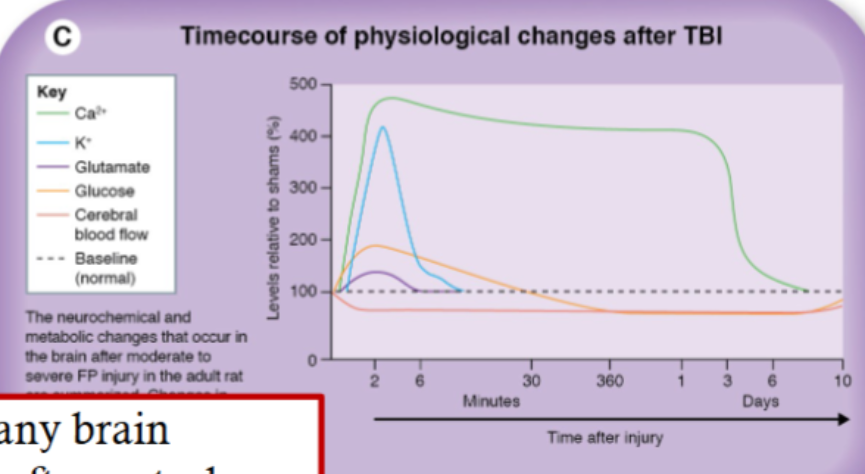
After an traumatic brain injury (TBI), there is a period that the injury seems to spread--this is called the ‘secondary injury cascade’
Whereas the primary injury is physical tissue damage, the secondary injury is biochemical damage
This is the result of both vascular disruptions and the neuronal network being knocked out of balance
After TBI, important ions (Ca+, K+) and nutrients (glutamate, glucose) are out of balance
Combined with altered blood flow causes the metabolic changes of brain cells to become self- destructive
this happens in many brain diseases, including after a stroke
the stroke penumbra
Penumbra: An area outside of the original stroke location that slowly dies off (the secondary injury for stroke)
Also caused by ion imbalances that lead to excitotoxicity
most drugs target stopping prgression of penumbra, rather than initial injury
EXCITOTOXICITY AFTER A STROKE OR TBI
Immediate:
• ↓ATP stores
• ↑Lactic acid
Seconds to minutes
• Ion balance cannot be maintained
↑[NA+]i
↓[K+]i
↑[Ca2+]i
• ‘anoxic depolarization’ - this ion imbalance excites cells
• Oxygen-depleted mitochondria begin making free radicals (reactive oxygen species, ROS)
excitotoxicity spreads
Dying neurons over-excite the downstream neurons until they start dying as well,
Due to depolarisation of neuron, generates action potentials down to other neurons, over exciting downstream neurons and causing spreading damage
free radiacal general
Reactive oxygen species (ROS)/‘Free Radicals’ are generated in the mitochondria and cytosol of neurons with too much calcium (Ca2+)
When the amount of ROS outweighs the cell’s antioxidant molecules, this is called oxidative stress
Any molecule hit by a ROS can be destroyed
Pores open the mitochondria, which leads to a cascade that can lead to cell death (apoptosis)
too much glutamate over excites neurons, causes influx of calcium, and too much calcium causes generation of free radicals
reducing the penumbra
You have a few hours to prevent the damage from stroke to get worse
Blocking the channels that lead to excitation (block glutamate receptors
• NMDA for Ca2+
• AMPA for Na+
Stimulating the channels that lead to inhibition (GABA is inhibitory receptor)
• GABA for Cl-
treatment strategies for stroke
Reperfusion
Reducing excitotoxicity
Manage risk factors
Rehabilitation
reperfusion
get blood flow back: thrombolytic drugs
prevnet excessive movement
reducing excitoxicity
Correcting ion imbalances: Na+, Ca2+ channel blockers
• Reducing excitability: glutamate channel blockers
• Reducing oxidative stress: antioxidant drugs
manage risk facotors
Antihypertensive therapy
• Glucose management
• Antiplatelet therapy
rehabilitation
physical therapy
speech therapy
alzheimers disease prevalence
1 in 6 people over age 60 will have AD by 2030, potentially becoming 1 in 3 (over 60) by 2050
AD is the 7th leading cause of death globally
not increase of incidence in younger people, cases are increasing because people are living longer, not because becoming more prevalent
amyloid beta (AB) plaques
Amyloid Precursor Protein (APP) is cleaved by two secretase enzymes to make Aβ
Aβ proteins misfold and clump together into insoluble oligomers and then plaques
Aβ oligomers inhibit neuron communication and health
the cleaving is a normal process, but if amyloid beta not cleared out, can misfold and cause plaques
tau tangles
After Aβ triggers neurodegeneration, tau pathology begins in late AD
Tau proteins (tubulin associated unit) are modified and dissociate from microtubules
They disrupt function and can spread from neuron to neuron through synapses
Clump together into ‘neurofibrillary tangle
Tau tangles can jump thru synapse to spread neuron to neuron, therefore alzheimers disease is able to spread thru the brain
Tau tangles cause other tau proteins to be modified
brain areas affected in alzheimers
First areas affected: Areas important for creating new memories and retrieving old memories
entorhinal cortex and hippocampus
Then spreading to the neocortex, including prefrontal cortex (executive function), parietal cortex (attention), and visual cortex (vision)

amyloid cascade hypothesis
Amyloid β aggregation is the cause of all other pathologies in AD
• Aβ plaques directly affect neuronal health and activity, causing
• inflammation
• tau protein aggregation
Aβ plaques and tau protein tangles can spread from neuron to neuron, killing them (neurodegeneration)
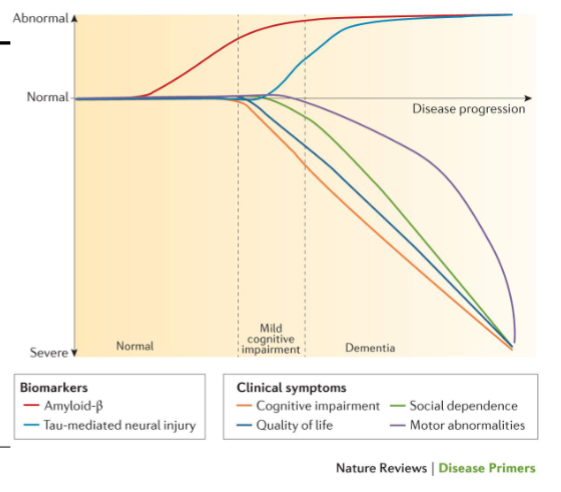
AD is progressive
biomarkers in blood can allow for detection of abnormal amyloid beta levels before cognitive symptoms show
The disease can begin in the brain ~20 years before
symptoms show
• Earlier to give treatment, the more the treatment can help
AD therapeutics
Blocking Aβ production:
• β-secretase and γ-secretase inhibitors
• Unfortunately, did not work well
Targeting Aβ directly
• Anti-Aβ antibodies (immunotherapy) to flag them for the body’s immune system
• Inhibitors for plaque formation
treatments cant completlty eliminate AB, as is needed in brain
major mental illnesses
Major depressive disorder (MDD)
• Anxiety Disorders
• Schizophrenia
• Bipolar disorder
• Attention Deficit Hyperactivity Disorder (ADHD)
very hard to study, and hard to find animal models for study
because onset is young, DALYs are much higher, mean can have larger impact of quality of life
major depressive disorder (depression)
~5% of adults (4% of male-identified, 6% of female-
identified) experience depression
Symptoms include:
Depressive ‘episodes’: periods of symptoms that can alleviate on their own
Poor concentration
Hopelessness
Little pleasure in doing things
Feeling tired
Disrupted sleep
biological determinants of depression
Physical health conditions
Brain derived neurotrophic factor (BDNF) - neurotrophic: helps neurons grow
Genetic polymorphisms relating to major histocompatibility complexes (MHCs) and tryptophan metabolism
Inflammation
Gut microbiome (inflammation)
HPA axis dysfunction
psychological determinants of depression
Negative self-concept
Sensitivity to rejection
Neuroticism
Rumination
Negative emotionality
Meta-emotions (e.g. guilt about anger)
social determinants
Oppression
Sociodemographics
Social support
Food security
Adverse childhood experiences
Bullying
Violent crime exposure
Migrant status
Literacy
estimating genetic heritability: twin studies
using identical vs fraternal twins, can determine to which degrees environment vs genes affects disease probability of development
Schizophrenia: 41-61% of identical twins
develop it if their twin has it
• Heritability: 81%
Depression:
• Heritability:
• Male-identified: 29%
• Female-identified: 42%

brain derived neurotrophic factor (BDNF)
Important molecule to promoting neuron growth and proliferation in development
Both a between-cell signalling molecule (neurotransmitter) and a within-cell signalling molecule
Promotes neuroplasticity—changes in neuron structure that allow for learning, help break out of rumination
neuroplasticity and rumination
depending on size of post-synaptic neuron or amount of receptors, changes response of post-synaptic neuron
Neuroplasticity makes post synaptic neuron have more strength
In rumination, want post0synaptic neuron to have less receptors/be smaller, make a weaker signal to prevent rumination
mechanism of antidepressants
for every antidepressant given, all cause increase in BDNF signalling, sometimes by 50% or doubling it.
Did not know increase bdnf when approved for patients, but just has
evidence linking BDNF and depression
correlational evidence, but potentially evidence for how BNDF helps depression
All antidepressants increase BDNF on average
People that had a larger decrease in symptoms had more BDNF
People that did not respond to antidepressants had stable BDNF
exercise promotes BDNF levels
BDNF levels can be measured in the blood serum, which correlates with BDNF release in the brain
BDNF concentration drastically increases from physical exercis

serotonin and depression
Evidence shows that depression is NOT caused by a deficiency of serotonin
• The ‘chemical imbalance’ (i.e. serotonin) theory of depression is incorrect However, serotonin- promoting drugs help depression symptoms