Chapter 13: mRNA Translation, Genetic Code & Protein Synthesis
 Call Kai
 Learn
 Practice Test
 Spaced Repetition
 Match
 Flashcards
 Knowt Play
1/70

There's no tags or description
Looks like no tags are added yet.
71 Terms
What is the primary function of mRNA in protein synthesis?
To serve as a template for assembling amino acids into proteins.

What was the main conclusion of the Beadle and Tatum Experiment?
The one gene-one protein hypothesis, which states that each gene encodes a specific protein.
What are codons?
Triplet sequences of nucleotides in mRNA that correspond to specific amino acids.

How many common amino acids are there?
20 unique amino acids.
What is the significance of the N-terminus in a polypeptide?
It is the starting end of the polypeptide chain, where the first amino acid has an exposed amino group.
What is the C-terminus in a polypeptide?
It is the ending end of the polypeptide chain, where the last amino acid has an exposed carboxyl group.
What type of bond forms between amino acids during polypeptide synthesis?
Peptide bonds, formed through dehydration reactions.

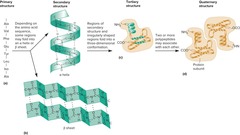
What are the four levels of protein structure?
Primary, Secondary, Tertiary, and Quaternary structures.

What defines the primary structure of a protein?
The sequence of amino acids in the polypeptide chain.

What is secondary structure in proteins?
Coils and folds in the polypeptide chain, stabilized by hydrogen bonds; includes α helices and β pleated sheets.

What determines the tertiary structure of a protein?
Interactions among various side chains (R groups) of amino acids.

What is quaternary structure in proteins?
The structure formed when two or more polypeptide chains associate to form a functional protein.
What role does tRNA play in translation?
tRNA carries specific amino acids to the ribosome and matches them to the mRNA codons.
What is the function of aminoacyl-tRNA synthetase?
It attaches the correct amino acid to its corresponding tRNA.
What are wobble rules?
Rules that allow for flexibility in base pairing between the third base of a codon and the corresponding tRNA anticodon.
What occurs during the initiation stage of translation?
The ribosome assembles around the mRNA and the first tRNA, starting the polypeptide chain.
What happens during elongation in translation?
Amino acids are sequentially added to the growing polypeptide chain as the ribosome moves along the mRNA.
What is the termination stage of translation?
The process where the ribosome reaches a stop codon, leading to the release of the completed polypeptide.
What is simultaneous transcription and translation?
The process where transcription of mRNA and translation into protein occur simultaneously, typical in prokaryotic cells.
What is the importance of posttranslational modifications?
They are crucial for the proper functioning and regulation of proteins after they are synthesized.
What is the relationship between DNA, mRNA, and polypeptides?
DNA is transcribed into mRNA, which is then translated into polypeptides (proteins).
How do amino acids differ from one another?
They differ in their side chains, known as R groups, which affect their properties and functions.
What is the role of ribosomes in translation?
Ribosomes facilitate the binding of tRNA to mRNA and catalyze the formation of peptide bonds between amino acids.
What is the significance of the genetic code?
It provides the rules for translating the sequence of nucleotides in mRNA into the sequence of amino acids in proteins.
What is the directionality of polypeptide synthesis?
Polypeptide synthesis occurs from the N-terminus to the C-terminus, paralleling the 5' to 3' orientation of mRNA.

What is the function of the ribosomal subunits during translation?
They provide the site for tRNA binding and peptide bond formation.
How do the properties of amino acids affect protein function?
The unique properties of amino acids influence the protein's structure and, consequently, its function.
What is the triplet code in genetics?
A system where three-nucleotide 'words' (codons) encode amino acids.
How are codons read during translation?
In the 5′ → 3′ direction.
What do stop codons (UAA, UAG, UGA) indicate?
They signal the end of translation and do not code for any amino acid.
What does it mean that the genetic code is redundant?
More than one codon can specify the same amino acid.
What does it mean that the genetic code is not ambiguous?
No codon specifies more than one amino acid.
What is a start codon and what does it code for?
AUG, which codes for Methionine (Met).
What happens if a nucleotide is deleted from the mRNA sequence?
It changes the reading frame and alters the amino acid sequence.
Who conducted the One-Gene One-Protein experiment?
George Beadle and Edward Tatum.
What organism did Beadle and Tatum use for their experiments?
Neurospora crassa (bread mold).
What was the hypothesis of Beadle and Tatum's experiment?
One gene codes for one enzyme (or one protein).
What did Beadle and Tatum expose to create mutant strains?
X-rays.
What is minimal media in the context of Beadle and Tatum's experiment?
Media lacking essential amino acids required for growth.
What conclusion did Beadle and Tatum reach regarding gene mutations?
A single gene controls the synthesis of a single enzyme.
What are the four modifications of the One Gene-One Enzyme theory?
1. Enzymes are one category of proteins. 2. Proteins can be composed of multiple polypeptides. 3. Some genes do not code for polypeptides. 4. One gene can code multiple polypeptides through alternative splicing.
What are the three stages of translation?
1. Initiation 2. Elongation 3. Termination.
What molecular components are required for translation?
1. mRNA 2. Amino acids 3. tRNA 4. Ribosome.
What is the role of mRNA in protein synthesis?
It serves as the template carrying genetic code from DNA in codon form.
How are amino acids linked during translation?
By peptide bonds to form a polypeptide chain.
What is the significance of the 5' cap and 3' poly-A tail in mRNA?
They are added during processing in eukaryotes to protect mRNA and assist in translation.
What is the function of tRNA in translation?
It carries amino acids to the ribosome and matches them to the codons in mRNA.
What is the importance of the reading frame in translation?
It determines how codons are grouped and read to produce the correct polypeptide.
What is the relationship between genes and enzymes according to Beadle and Tatum?
Mutations in genes can lead to missing or defective enzymes, linking genes to traits.
What is the outcome if a mutant strain cannot produce an essential amino acid?
The strain will not survive on minimal media lacking that amino acid.
What does the term 'polypeptide' denote?
The structure of a protein, while 'protein' denotes its function.
What is the role of tRNA in translation?
tRNA transfers amino acids to the growing polypeptide in a ribosome.
Describe the structure of tRNA.
tRNA has a cloverleaf secondary structure with three stem-loop arms, a 3' acceptor stem, and an anticodon loop.

What is the function of aminoacyl-tRNA synthetases?
They ensure the correct match between tRNA and its corresponding amino acid.
What is the wobble rule in translation?
The wobble rule allows tRNAs to tolerate certain mismatches in the third position of the codon.
What are isoacceptor tRNAs?
tRNAs that can recognize the same codon but carry different amino acids.
What is the primary function of ribosomes in translation?
Ribosomes facilitate the binding of tRNA anticodons with mRNA codons during protein synthesis.
How many types of ribosomes are found in eukaryotic cells?
Two types: one in the cytoplasm/ER and another inside mitochondria/chloroplasts.
What are the two subunits of bacterial ribosomes?
The small subunit (30S) and the large subunit (50S), forming a 70S ribosome.
What are the three functional sites of a ribosome?
The A site (aminoacyl), P site (peptidyl), and E site (exit).
What is the significance of the Shine-Dalgarno sequence in bacteria?
It helps the ribosome bind to the mRNA during initiation of translation.
What is coupling in bacterial translation?
The simultaneous occurrence of transcription and translation in the cytoplasm.
What is the role of initiation factors in eukaryotic translation?
They assist in the binding of the ribosomal subunits and the initiator tRNA to the mRNA.
What are Kozak's rules?
Rules that define optimal conditions for translation initiation in eukaryotes, including the presence of a guanine at the +4 position.
What happens during the elongation stage of translation?
Amino acids are added to the polypeptide chain one at a time through codon recognition, peptidyl transfer, and translocation.
What is the process of codon recognition?
The charged tRNA binds to the A site of the ribosome, determining the next amino acid to be added.
What occurs during peptidyl transfer?
The polypeptide is transferred from the tRNA in the P site to the amino acid on the tRNA in the A site.
What is translocation in translation?
The ribosome moves to the next codon on the mRNA, shifting tRNA from the A site to the P site.
What triggers termination in translation?
The arrival of a stop codon at the A site, which leads to the release of the polypeptide.
What are stop codons?
Nonsense codons that do not code for any amino acid; examples include UAG, UAA, and UGA.
What is the role of the release factor in termination?
It binds to the stop codon and promotes the release of the polypeptide from the ribosome.