World Art History Exam 1
 Call Kai
 Learn
Learn Practice Test
 Spaced Repetition
 Match
Match Flashcards
 Knowt Play
1/51

There's no tags or description
Looks like no tags are added yet.
Name | Mastery | Learn | Test | Matching | Spaced | Call with Kai | Chat |
|---|
No analytics yet
Send a link to your students to track their progress
52 Terms

Artist: Cimabue
Period/ Dates: Late Medieval, Italy, ca. 1200–1400
Title: Virgin and Child Enthroned
Region: Italy
Style: Late Medieval/Italo-Byzantine with early movement toward naturalism
Where (only when needed): Florence, Italy
Techniques and forms: Large altarpiece with a symmetrical composition. Mary and Christ are much larger than the surrounding angels, demonstrating hierarchical scale. Gold background, elongated figures, and stylized drapery reflect Byzantine traditions. However, Cimabue begins suggesting three-dimensional space through the throne and overlapping figures.
Mediums: Tempera and gold leaf on wood panel
Subject/Purpose/meaning: Shows the Virgin Mary enthroned with the Christ Child, surrounded by angels and prophets. It was a religious devotional image emphasizing the importance and sacred status of Mary and Christ
How it relates to the larger context/period trends: Cimabue represents the transition from the highly stylized Byzantine/Medieval tradition toward greater naturalism, which becomes increasingly important in Renaissance art.

Artist: Giotto
Period/ Dates: Late Medieval, ca. 1200–1400; Proto-Renaissance
Title: Frescoes of the Scrovegni (Arena) Chapel, including Lamentation
Region: Italy
Style: Proto-Renaissance
Where (only when needed): Padua, Italy
Techniques and forms: Giotto creates figures with convincing volume, weight, emotion, and three-dimensionality. He uses modeling with light and shadow and creates a more believable sense of physical space. In Lamentation, the diagonal rocky ridge directs your eye toward the dead Christ
Mediums: Fresco
Subject/Purpose/meaning:Lamentation depicts Christ's followers mourning his body following the Crucifixion. The figures express intense human grief and emotion
How it relates to the larger context/period trends: Giotto represents a major move away from flat Byzantine conventions toward the naturalism, emotion, and three-dimensional space that would characterize Renaissance art.

Artist: Jan van Eyck
Period/ Dates: Early Renaissance, ca. 1400–1500
Title: Portrait of Giovanni Arnolfini and His Wife
Region: Flemish/Flanders
Style: Early Renaissance
Techniques and forms: Van Eyck's use of oil paint allows extraordinary detail, rich colors, reflections, textures, and light. Objects have convincing surfaces and textures
Mediums: Oil on wood panel
Subject/Purpose/meaning: Wealthy man and woman standing in a domestic interior. Many objects have been interpreted symbolically—dog, shoes, fruit, candle, mirror, etc.—although interpretations of the exact event depicted remain debated
How it relates to the larger context/period trends: Northern Renaissance artists were known for extreme detail, symbolism, surface textures, and oil painting, whereas Italian Renaissance artists were particularly interested in classical antiquity, anatomy, and mathematical perspective
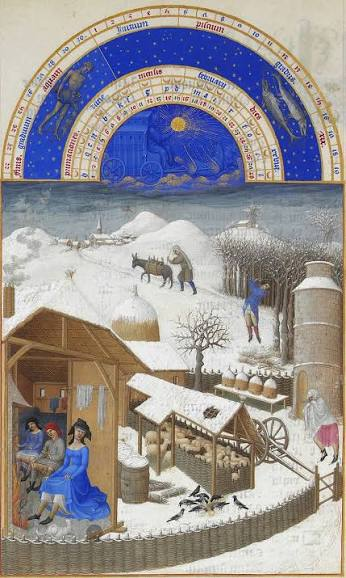
Artist: Limbourg Brothers
Period/ Dates: Early Renaissance, ca. 1400–1500
Title: February: Life in the Country, page from Très Riches Heures
Region: France
Style:International Gothic Style
Techniques and forms: Extremely detailed miniature painting with bright colors and elegant forms. Combines observation of everyday life with decorative Gothic qualities
Mediums: Illumination/manuscript painting
Subject/Purpose/meaning: Represents the month of February and shows everyday winter activities in the countryside
How it relates to the larger context/period trends: International Gothic art was associated with elegance, rich detail, courtly culture, decorative qualities, and increasing observation of nature

Artist: Master of Flémalle Workshop
Period/ Dates: Early Renaissance, ca. 1400–1500
Title: Annunciation Triptych (Mérode Altarpiece)
Region: Flemish/Flanders
Style: Northern Renaissance
Techniques and forms: three-paneled artwork. Extraordinary attention to everyday objects, textures, light, and symbolic details
Mediums: Oil on wood panels
Subject/Purpose/meaning: Center shows the Annunciation, when the angel Gabriel announces to Mary that she will become the mother of Christ.
How it relates to the larger context/period trends: Excellent example of Northern Renaissance artists combining religious subjects with contemporary everyday settings and disguised symbolism

Artist: Filippo Brunelleschi
Period/ Dates: Early Renaissance, ca. 1400–1500
Title: Church of San Lorenzo
Region: Italy
Style: Early Renaissance architecture
Where (only when needed): Florence
Techniques and forms: Uses classical columns, rounded arches, symmetry, mathematical proportions, and geometric clarity
Mediums: Architecture—stone/masonry
Subject/Purpose/meaning: Christian church designed using architectural ideas inspired by ancient Greece and Rome
How it relates to the larger context/period trends: Renaissance architects deliberately revived Greco-Roman classical architecture, rejecting many characteristics of medieval Gothic architecture

Artist: Donatello
Period/ Dates: Early Renaissance, ca. 1400–1500
Title: David
Region: Italy
Style: Early Renaissance
Techniques and forms: Nude figure with contrapposto, placing weight primarily on one leg and creating a relaxed natural stance. Revives classical traditions of the freestanding nude.
Mediums: Bronze; freestanding sculpture/sculpture in the round
Subject/Purpose/meaning: Biblical David stands after defeating Goliath, whose severed head appears beneath him.
How it relates to the larger context/period trends: Revival of classical nudity, contrapposto, naturalism, and freestanding sculpture.

Artist: Perugino
Period/ Dates: Early Renaissance, ca. 1400–1500
Title: Christ Giving the Keys to Saint Peter
Region:Italy
Where (only when needed): Sistine Chapel, Vatican, Rome
Techniques and forms: Major example of linear perspective. Orthogonal lines converge at a central vanishing point near the centrally positioned building
Mediums: Fresco
Subject/Purpose/meaning: Christ gives keys to Saint Peter, symbolizing Peter's authority and, within Catholic tradition, the authority of the papacy
How it relates to the larger context/period trends: Shows the Renaissance interest in mathematics, perspective, rational space, balance, classical architecture, and naturalistic figures.
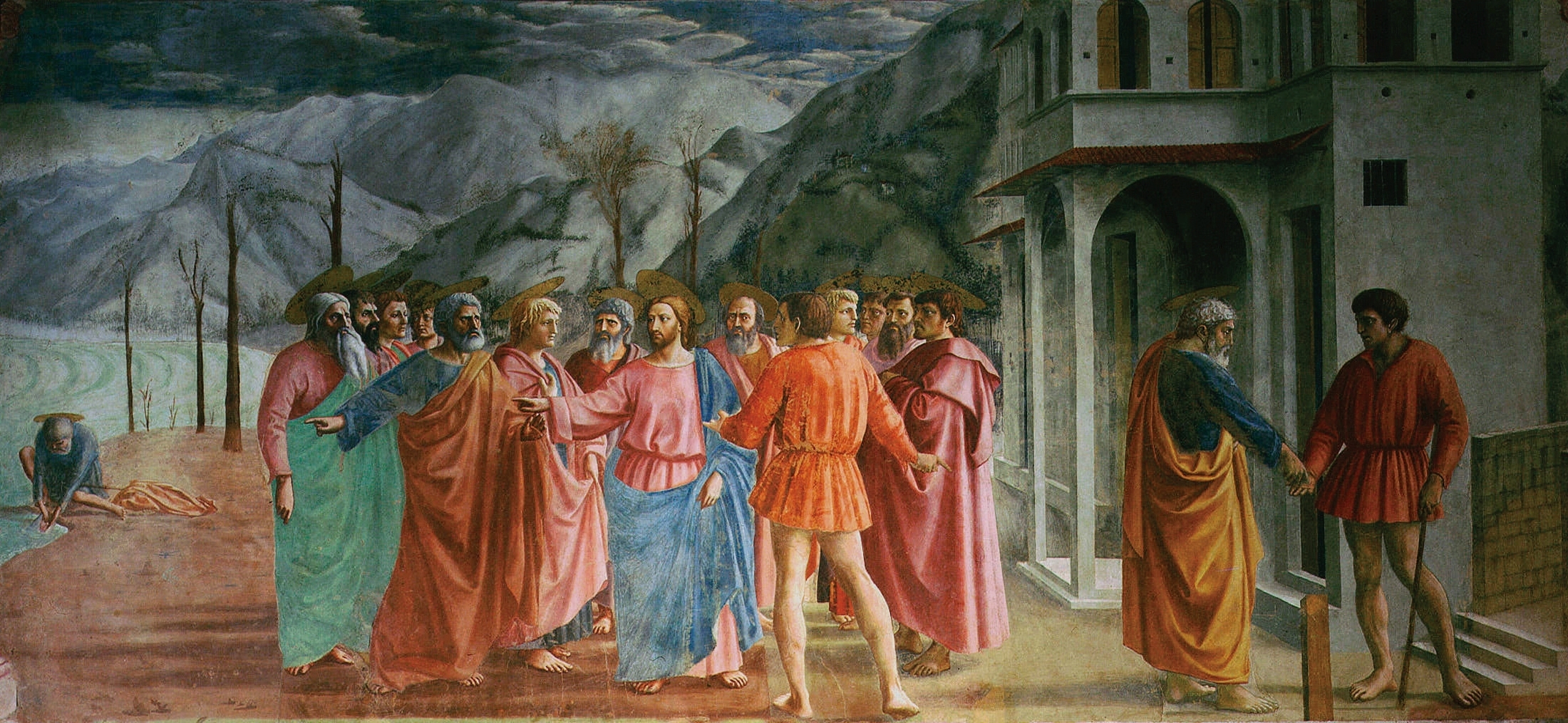
Artist: Masaccio
Period/ Dates: Early Renaissance, ca. 1400–1500
Title: The Tribute Money
Region: Italy
Where (only when needed): Brancacci Chapel, Florence
Techniques and forms: Uses linear perspective, atmospheric perspective, modeling with light/shadow, and naturalistic figures
Mediums: Fresco
Subject/Purpose/meaning: Biblical story in which Christ instructs Peter to retrieve money from a fish to pay a tax
How it relates to the larger context/period trends: Masaccio helped establish the Renaissance approach to realistic human figures occupying believable three-dimensional environments

Artist: Botticelli
Period/ Dates: Early Renaissance, ca. 1400–1500
Title: Primavera
Region: Italy
Style: Early Renaissance with classical/mythological subject
Techniques and forms: Graceful, elongated figures, elegant flowing contours, rhythmic lines, and detailed vegetation
Mediums: Tempera on wood panel
Subject/Purpose/meaning: Subject/Purpose/Meaning: Complex mythological scene centered around Venus, surrounded by figures including Cupid, the Three Graces, Mercury, Zephyrus, Chloris, and Flora. Often connected to spring, love, fertility, and Neoplatonic ideas.
How it relates to the larger context/period trends: Demonstrates Renaissance humanism and renewed interest in Greco-Roman mythology, allowing artists to create major works with non-Christian subjects

Artist: Leonardo da Vinci
Period/ Dates:High Renaissance, Italy, ca. 1495–1520
Title: Mona Lisa
Region: Italy
Techniques and forms: Famous for sfumato—subtle blending without harsh outlines, producing smoky transitions between light and shadow
Mediums: Oil on wood panel
Subject/Purpose/meaning: Portrait traditionally identified as Lisa Gherardini
How it relates to the larger context/period trends: High Renaissance ideals of naturalism, psychological presence, harmony, and technical mastery

Artist: Leonardo da Vinci
Period/ Dates: High Renaissance, ca. 1495–1520
Title: The Last Supper
Region:Italy
Where (only when needed): Monastery in Milan
Techniques and forms: Strong one-point linear perspective converges around Christ's head. Christ forms a stable triangular shape while apostles are arranged into groups
Mediums: Experimental tempera/oil technique on a dry wall, rather than traditional true fresco
Subject/Purpose/meaning: Christ announces that one of his apostles will betray him, producing different emotional reactions among them.
How it relates to the larger context/period trends: High Renaissance combination of perspective, balance, naturalism, psychology, and emotional expression

Artist: Raphael
Period/ Dates: High Renaissance, ca. 1495–1520
Title: The School of Athens
Region: Italy
Where (only when needed): Stanza della Segnatura, Vatican, Rome
Techniques and forms: Perfectly balanced monumental composition using linear perspective and classical architecture.
Mediums: Fresco
Subject/Purpose/meaning: Gathering of great ancient Greek philosophers and thinkers. Plato and Aristotle occupy the center
How it relates to the larger context/period trends: Perhaps one of the clearest examples of Renaissance humanism and admiration for classical Greece and Rome.

Artist: Michelangelo
Period/ Dates: High Renaissance, ca. 1495–1520
Title: David
Region: Italy
Techniques and forms: Monumental nude influenced by classical sculpture. Contrapposto, idealized anatomy, but psychological tension
Mediums: Marble; freestanding sculpture
Subject/Purpose/meaning: Biblical David preparing to confront Goliath. Became a symbol of Florentine strength and civic independence
How it relates to the larger context/period trends: Demonstrates High Renaissance fascination with the idealized human body, classical antiquity, anatomy, and monumental scale

Artist: Michelangelo
Period/ Dates: High Renaissance, ca. 1495–1520
Title: Sistine Chapel Ceiling
Region: Italy
Where (only when needed): Sistine Chapel, Vatican, Rome
Techniques and forms: Monumental muscular figures, complex poses, illusionistic architecture, exceptional anatomical knowledge
Mediums: Fresco
Subject/Purpose/meaning: Primarily depicts narratives from Genesis, including Creation, Adam and Eve, and Noah, surrounded by prophets, sibyls, and other figures
How it relates to the larger context/period trends: Embodies High Renaissance ideals of monumentality, idealized human anatomy, classical influence, and artistic mastery

Artist: Titian
Period/ Dates: High Renaissance, ca. 1495–1520
Title: The Pastoral Concert
Region: Venice, Italy (Venetian)
Style: Venetian Renaissance
Techniques and forms: Emphasis on color, light, atmosphere, and sensuality rather than sharply defined outlines
Mediums: Oil on canvas
Subject/Purpose/meaning: Two clothed men and two nude women occupy an idyllic landscape. The precise meaning remains uncertain; the women may function as idealized or allegorical figures connected to music, poetry, or inspiration
How it relates to the larger context/period trends: Venetian Renaissance painters became especially known for colorito—emphasis on color and painterly effects

Artist: Tintoretto
Period/ Dates: Later Renaissance, ca. 1520–1600
Title: The Last Supper
Region: Venice, Italy
Where (only when needed): Palladio's Church of San Giorgio Maggiore, Venice
Techniques and forms: Dramatic diagonal composition, extreme perspective, strong contrasts of light and dark, supernatural light, and energetic movement.
Mediums: Oil on canvas
Subject/Purpose/meaning: Christ's Last Supper with the apostles
How it relates to the larger context/period trends: Compare this directly with Leonardo. Leonardo: balanced, calm, horizontal, symmetrical High Renaissance. Tintoretto: diagonal, dramatic, energetic, asymmetrical Later Renaissance.

Artist: Palladio
Period/ Dates: Later Renaissance, ca. 1520–1600
Title: Villa Rotonda
Region: Italy
Style:
Where (only when needed): Vicenza
Techniques and forms: Extremely symmetrical building with four classical temple-like porticoes and a central domed room.
Mediums: Architecture
Subject/Purpose/meaning:Country villa/residence.
How it relates to the larger context/period trends: Palladio's architecture demonstrates the Renaissance revival of classical Roman architecture, symmetry, mathematical proportion, columns, pediments, and domes

Artist: Bronzino
Period/ Dates: Later Renaissance, ca. 1520–1600
Title: Allegory with Venus and Cupid
Region: Italy
Style: Mannerism
Where (only when needed):
Techniques and forms: Elongated bodies, strange poses, artificial appearance, crowded composition, cool polished surfaces, and intentionally complicated imagery
Mediums: Oil on wood panel
Subject/Purpose/meaning: Venus and Cupid appear within an elaborate allegory involving love, desire, deception, jealousy, and time. Its precise interpretation is complex.
How it relates to the larger context/period trends: Mannerism deliberately moves away from the harmony, stability, and natural proportions of the High Renaissance

Artist: Albrecht Dürer
Period/ Dates: 16th-century Northern Renaissance, ca. 1500–1600
Title: Adam and Eve
Region: Germany
Techniques and forms: Extremely precise lines, hatching and cross-hatching create shading and volume. Idealized nude figures show Dürer's interest in Italian Renaissance proportions and classical art
Mediums: ENGRAVING
Subject/Purpose/meaning: Biblical Adam and Eve before the Fall.
How it relates to the larger context/period trends: Dürer combines Northern European attention to detail with Italian Renaissance interest in ideal proportions, anatomy, and classical art

Artist: El Greco
Period/ Dates: 16th-century Northern Renaissance, ca. 1500–1600
Title: Burial of Count Orgaz
Region: Spain
Where (only when needed): Toledo
Techniques and forms: Dramatically elongated figures, expressive gestures, intense colors, and distinction between earthly and heavenly realms
Mediums: Oil on canvas
Subject/Purpose/meaning: Depicts the legendary burial of Count Orgaz, during which Saints Stephen and Augustine miraculously descend to bury him
How it relates to the larger context/period trends: Reflects the intense spirituality of Catholic Spain and the Counter-Reformation, while El Greco's elongated, expressive figures differ greatly from straightforward Renaissance naturalism

Artist: Hieronymus Bosch
Period/ Dates: 16th-century Northern Renaissance, ca. 1500–1600
Title: Garden of Earthly Delights
Region: Netherlands
Techniques and forms: Extremely detailed but fantastical rather than conventionally naturalistic, filled with bizarre creatures, impossible objects, and strange environments
Mediums: Oil on wood panels; triptych
Subject/Purpose/meaning: Commonly interpreted as addressing sin, temptation, earthly pleasure, and consequences, although Bosch's exact intended meanings remain debated.
How it relates to the larger context/period trends: Shows that the Northern Renaissance wasn't uniformly naturalistic. Bosch combines extraordinary Northern detail with fantastical, symbolic imagery

Artist: Unknown
Culture: Aztec Empire
Period/ Dates: ca. 1325–1521
Title: The Goddess Coatlicue
Region: Mexico
Techniques and forms: Monumental, highly symbolic and stylized sculpture rather than Renaissance-style naturalism. Contains combinations of human and animal imagery
Mediums: Stone sculpture
Subject/Purpose/meaning: Coatlicue was an important Aztec earth/mother goddess. Her frightening appearance incorporates imagery associated with death, sacrifice, fertility, and regeneration.
How it relates to the larger context/period trends: Aztec religion closely connected nature, agriculture, gods, warfare, sacrifice, death, and regeneration

Artist: Unknown/Inca builders
Culture: Inca Empire
Period/ Dates: 1400s–1532
Title: Machu Picchu
Region: Peru
Techniques and forms: Famous for sophisticated dry-stone masonry. Stones were carefully cut and fitted together without mortar
Mediums: Stone architecture
Subject/Purpose/meaning:Inca architectural complex generally understood as a royal/elite estate with ceremonial, residential, and agricultural functions
How it relates to the larger context/period trends: Demonstrates sophisticated Inca engineering, masonry, agriculture, and integration of architecture with the natural environment
Why do people make art? What were the major concerns of the periods we've covered?
Art can be made for many reasons, including religious worship, teaching, recording people or events, expressing ideas or emotions, displaying wealth or power, political/social purposes, and creating beauty. In the periods we have studied, Medieval art focused heavily on Christianity and teaching religious ideas, while Renaissance artists became increasingly interested in naturalism, humanism, classical Greece and Rome, perspective, individual achievement, and the human body. Aztec and Inca art was also closely connected to religion, political power, nature, and society.
What are patrons, and why are they significant?
A patron is a person or organization that commissions or financially supports an artist or artwork. Patrons are important because they often influence the subject, purpose, size, location, and appearance of art. Renaissance patrons included the Catholic Church and popes, wealthy merchants and banking families such as the Medici, governments, guilds, and aristocratic families. Artists therefore did not always have complete freedom over what they created.
What are formal, conceptual, and contextual analyses?
Formal analysis examines what an artwork looks like, including its color, line, shape, composition, texture, space, and materials. Conceptual analysis considers the artwork's subject, symbolism, ideas, and meaning. Contextual analysis looks at the historical, religious, political, economic, and social circumstances surrounding the artwork. Using all three allows us to understand not only what an artwork looks like, but what it means and why it was created.
What are primary, secondary, and complementary colors?
The traditional primary colors in painting are red, yellow, and blue, which are used to create other colors. Secondary colors are orange, green, and violet, created by mixing two primary colors. Complementary colors sit opposite each other on the color wheel and create strong contrast: red and green, blue and orange, and yellow and violet.
What is composition?
Composition is the arrangement and organization of the visual elements within an artwork. Renaissance artists often favored balanced, symmetrical, stable compositions, particularly during the High Renaissance. A common arrangement was the pyramidal or triangular composition, which creates stability and directs attention toward important figures. Leonardo frequently used this type of organization.
What are the different kinds of artistic style?
Style is the characteristic manner in which something is represented. Naturalistic art closely resembles the observable world, while idealized art improves or perfects reality. Stylized art alters natural appearances according to established conventions, while abstract art simplifies or changes recognizable forms. Nonobjective/nonrepresentational art does not depict recognizable subjects at all. Renaissance art generally moved toward greater naturalism and idealization.
(MEDIEVAL) What was Medieval society like, and what changed around 1200–1400?
Medieval European society was strongly influenced by the Catholic Church, Christianity, feudal social structures, and agricultural life. Beginning around 1200–1400, European cities, trade, banking, and universities expanded, creating growing urban and merchant classes. Increased interest in observation, learning, individuals, and the physical world gradually contributed to the transition toward the Renaissance, particularly in prosperous Italian cities.
(MEDIEVAL) What characterized Medieval art, and how did Giotto and Masaccio change it?
Much Medieval art emphasized religious meaning rather than realistic representation, often using flattened space, gold backgrounds, hierarchical scale, frontal figures, and stylized anatomy. Giotto began giving figures greater weight, volume, emotion, and physical presence and placed them in more believable environments, making him an important Proto-Renaissance artist. Masaccio built upon Giotto's naturalism during the Early Renaissance by using linear perspective, consistent light and shadow, realistic anatomy, and convincing three-dimensional space, as seen in The Tribute Money.
(RENAISSANCE) What major ideas and trends characterize the Renaissance?
The Renaissance was marked by humanism, individualism, naturalism, renewed interest in ancient Greece and Rome, scientific observation, mathematics, and greater interest in the physical world and human body. Artists developed techniques including linear perspective, atmospheric perspective, contrapposto, anatomical accuracy, modeling with light and shadow, and increasingly realistic space. Religious subjects remained extremely important, but artists also explored portraiture, mythology, classical philosophy, landscapes, and secular subjects.
(RENAISSANCE) What impact did the printing press have?
Before the printing press, European books were primarily handwritten manuscripts, often copied by scribes and sometimes decorated with elaborate illuminations, making them expensive and time-consuming to produce. Johannes Gutenberg's movable-type printing press in the 15th century made it possible to reproduce books much more quickly and cheaply. Printing helped spread literacy, Renaissance ideas, scientific knowledge, and eventually Reformation ideas throughout Europe. Printmaking techniques such as woodcuts and engravings also allowed artworks to circulate widely.
(RENAISSANCE)What distinguishes the Italian and Northern Renaissance?
The Italian Renaissance was especially influenced by the surviving art and architecture of ancient Greece and Rome and emphasized classical ideals, anatomy, mathematical perspective, monumental figures, and balanced compositions. The Northern Renaissance, particularly in Flanders, emphasized extraordinary surface detail, textures, symbolism, domestic interiors, and careful observation of nature, aided by sophisticated use of oil paint. The two traditions influenced one another as artists, artworks, techniques, and ideas circulated throughout Europe.
(RENAISSANCE) What were major Renaissance cultural centers?
Important Italian Renaissance centers included Florence, Rome, and Venice. Florence became wealthy through banking and commerce and was associated with patrons such as the Medici family; Rome became especially important because of papal patronage; and Venice became wealthy through international trade and developed its own distinctive painting tradition. In the North, prosperous Flemish commercial centers such as Bruges supported artists through wealthy merchants, aristocrats, and other patrons.
(RENAISSANCE) What materials distinguished Italy and Northern Europe?
Northern Renaissance painters became particularly famous for their sophisticated use of oil paint on wood panels, which allowed slow blending, glazing, brilliant colors, reflections, and extremely fine details. Italian artists continued using tempera but increasingly adopted oil painting while also making extensive use of fresco for large wall paintings. Italian Renaissance sculptors prominently revived large-scale marble and bronze sculpture inspired by antiquity.
(RENAISSANCE) Who were important Renaissance patrons?
Renaissance patrons included wealthy merchants, bankers, rulers, aristocrats, guilds, governments, popes, and the Catholic Church. The Medici family became especially important patrons in Florence, while popes commissioned enormous artistic projects in Rome, including works in the Vatican and Sistine Chapel. Patronage demonstrated wealth, political power, religious devotion, education, and social status while providing artists with financial support
(RENAISSANCE) How did High Renaissance artists build on the Early Renaissance?
Early Renaissance artists developed techniques such as linear perspective, naturalistic anatomy, classical forms, and convincing three-dimensional space. High Renaissance artists including Leonardo, Raphael, and Michelangelo mastered these innovations and combined them into compositions characterized by harmony, balance, monumentality, idealized beauty, and technical mastery. Instead of merely discovering how to represent convincing space and bodies, High Renaissance artists used these techniques with extraordinary confidence and sophistication.
(RENAISSANCE) What were the ideals of Leonardo, Raphael, Michelangelo, and Titian?
Leonardo emphasized naturalism, psychological expression, scientific observation, and techniques such as sfumato. Raphael became known for harmonious, balanced compositions and classical ideals, exemplified by The School of Athens. Michelangelo emphasized monumental, idealized, muscular human bodies and powerful emotional presence. Titian and the Venetian tradition emphasized rich color, light, atmosphere, sensuality, and painterly effects.
(RENAISSANCE) What makes Venetian art distinctive?
Venetian Renaissance painting placed particular emphasis on color, light, atmosphere, texture, and sensual visual effects, sometimes described through the concept of colorito. Oil paint worked especially well for creating these effects. Artists such as Titian and Tintoretto demonstrate the Venetian interest in rich color and atmospheric effects, contrasting somewhat with central Italian artists' strong emphasis on drawing and clearly defined forms.
What did Brunelleschi, Michelozzo, Bramante, and Palladio contribute?
Renaissance architects revived architectural principles from ancient Greece and Rome, including symmetry, mathematical proportions, columns, pilasters, rounded arches, pediments, and domes. Brunelleschi helped establish Early Renaissance architecture through mathematically organized classical designs; Michelozzo applied Renaissance principles to palaces; Bramante helped establish the monumental classical architecture of the High Renaissance; and Palladio developed exceptionally symmetrical classical designs such as the Villa Rotonda. Their buildings reflect Renaissance admiration for order, reason, proportion, and antiquity.
What inspired Renaissance architecture?
Renaissance architects looked primarily to ancient Greek and Roman architecture, including surviving Roman buildings and the writings of the ancient architect Vitruvius. They revived classical features such as columns and classical orders, rounded arches, domes, pediments, symmetry, and mathematical proportions. These features reflected the Renaissance belief that beauty could emerge from rational order and harmonious proportions.
What basic architectural forms should you recognize?
Important architectural features include columns, capitals, pilasters, arches, domes, pediments, entablatures, façades, naves, aisles, transepts, and central versus longitudinal plans. Renaissance architects frequently used rounded Roman arches and classical columns rather than the pointed arches associated with Gothic architecture. Centralized and symmetrical plans became especially important because they reflected Renaissance ideals of balance and mathematical harmony.
Compare Donatello, Verrocchio, and Michelangelo's David.
All three artists depict the biblical hero David, but they approach him differently. Donatello's bronze David is a youthful nude shown after defeating Goliath, standing in contrapposto over Goliath's head and reviving the classical freestanding nude; Verrocchio's bronze David is clothed, youthful, confident, and also shown after the victory. Michelangelo's monumental marble David is an idealized, muscular nude shown before the battle, creating psychological tension and transforming David into a powerful symbol of Florence. Together they demonstrate the Renaissance's increasing engagement with classical sculpture, naturalism, anatomy, and heroic human potential.
What is a Pietà, and how does Michelangelo's compare with the Medieval Vesperbild?
A Pietà depicts the Virgin Mary mourning and holding the dead body of Christ following the Crucifixion. The Medieval Vesperbild emphasizes Christ's wounds, suffering, death, and Mary's grief through harsh, expressive, and often deliberately disturbing forms. Michelangelo's Pietà transforms the subject according to High Renaissance ideals by presenting beautiful, idealized, anatomically convincing figures arranged in a stable pyramidal composition. The comparison demonstrates the shift from Medieval emphasis on intense suffering toward Renaissance ideal beauty, naturalism, harmony, and classical form.
Compare Leonardo and Tintoretto's Last Supper.
Leonardo's High Renaissance Last Supper is balanced, symmetrical, stable, and mathematically organized, with one-point perspective directing attention toward Christ at the center. Tintoretto's Later Renaissance version places the table on a dramatic diagonal, uses intense light and shadow, supernatural figures, movement, and a less stable composition. The contrast demonstrates the transition from High Renaissance ideals of order and harmony toward the drama, instability, spirituality, and emotional intensity of later 16th-century art.
What caused Mannerism, and how was it different from earlier Renaissance art?
Mannerism developed after the High Renaissance during a period of political and religious instability, including warfare in Italy, the 1527 Sack of Rome, and the Protestant Reformation. Rather than continuing the High Renaissance preference for harmony, natural proportions, and stable compositions, Mannerist artists deliberately used elongated bodies, unusual proportions, artificial colors, complicated poses, compressed or irrational spaces, and ambiguous subjects. Parmigianino's elongated Madonna contrasts with Raphael's balanced naturalism, while Bronzino's strange and complicated Allegory with Venus and Cupid contrasts with Botticelli's more graceful treatment of classical mythology.
What was the Reformation, and how did it affect Catholic art?
The Protestant Reformation began in the early 16th century as a challenge to the authority and practices of the Catholic Church and resulted in new Protestant Christian traditions. The Catholic Church responded through the Counter-Reformation, reaffirming Catholic teachings and recognizing art as an important tool for religious instruction and devotion. Catholic art increasingly emphasized clear religious messages, emotional involvement, spirituality, and inspiring viewers' faith, which was particularly significant in Catholic regions such as Italy and Spain.
How did women fare during the Renaissance?
Renaissance society generally gave women fewer legal, educational, professional, and economic opportunities than men, with social expectations emphasizing marriage, motherhood, chastity, beauty, and domestic responsibilities. Women in art were frequently depicted according to ideals of beauty, virtue, motherhood, marriage, or as religious and mythological figures, and the female nude became an important artistic subject. Women artists faced major obstacles because they often lacked access to formal artistic training, workshops, anatomy study, and prestigious commissions, although some women nevertheless established significant artistic careers.
What Italian influences appear in Dürer and El Greco, and how does Bosch differ?
Dürer's Adam and Eve combines Northern Europe's extraordinary attention to detail with Italian Renaissance interests in classical antiquity, ideal human proportions, anatomy, and the nude, while his engraving technique demonstrates Northern printmaking expertise. El Greco absorbed Italian influences during time spent in Italy, but his Burial of Count Orgaz uses dramatically elongated figures, expressive color, and intense spirituality associated with his distinctive later style and Counter-Reformation Spain. Bosch's Garden of Earthly Delights instead retains aspects of the Late Medieval Northern tradition, using meticulous detail and fantastical, symbolic imagery to explore themes commonly interpreted as temptation, earthly pleasure, sin, and punishment.
What are the main themes of Aztec and Inca art, and how do they compare with Renaissance Europe?
Aztec and Inca art was closely connected to religion, political authority, nature, social organization, and the power of rulers and gods. Aztec works such as Coatlicue use highly symbolic imagery associated with nature, fertility, death, sacrifice, and regeneration, while Inca sites such as Machu Picchu demonstrate extraordinary stone engineering and integration of architecture with the natural landscape. Like Renaissance Europeans, Aztec and Inca societies used art to express religious beliefs, political authority, and cultural values, although their styles, materials, beliefs, and visual traditions were very different. Spanish conquest in the 16th century devastated both empires, destroyed or transformed many Indigenous cultural traditions and artworks, and introduced European Christianity and artistic traditions into the Americas.