Unit 2 Macroeconomics
 Call Kai
 Learn
 Practice Test
 Spaced Repetition
 Match
 Flashcards
 Knowt Play
1/33

There's no tags or description
Looks like no tags are added yet.
34 Terms
GDP
Measures all FINAL goods and services produced within a country over a given time period
GDP Formula (expenditure approach)
G + I + C + (X - M)
G (government spending)
I (business spending)
C (consumer spending)
(X - M) (net expenditures)
Intermediate Good
Goods that are used in the production of other goods—not part of the GDP!
ex. Computer chips
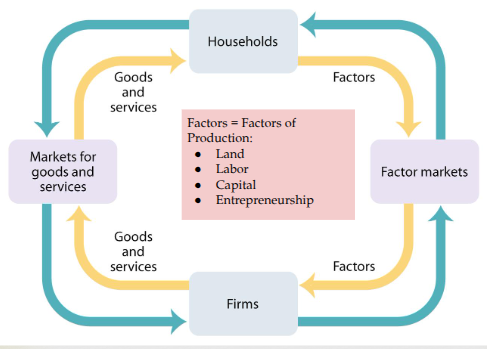
Circular Flow Model
Households - Purchase goods + provide services to market
Firms - Sell products to households + gain products (revenue)—used to buy factors of production
The Business Cycle

Recurring pattern of expansion and contraction in an economy over time. At 0% unemployment, the business cycle is at its peak.
Unemployment
% of people who don’t have a job and are currently looking for one. Structural, frictional, and cyclical
Unemployment rate formula
(# unemployed/ # in labor force) x100
Employment rate formula
(# employed/ # in labor force) x100
Labor force
Number of people 16 and over (not institutionalized) who are employed and unemployed.
Labor force formula
employed + unemployed
Labor force participation rate formula
(# in the labor force/ working age population) x100
Frictional unemployment
In-between jobs, looking for a better job, graduated
Structural unemployment
skills not currently in demand
Cyclical unemployment
Contractionary period of the business cycle
Inflation
Change in the general price level. Demand-pull, Cost-push, and built-in.
Natural Rate of Unemployment (NRU)
Baseline unemployment rate in a healthy economy when the market is at equilibrium
NRU Formula
Structural UR + Frictional UR
Cyclical unemployment %
Actual UR - NRU
Consumer Price Index (CPI)
Average change in prices paid for goods/services. Base year = 100
CPI Formula
(Market basket of goods for current year/ Market basket of goods for base year) x100
Inflation Rate formula
(CPI new - CPI old/ CPI old) x100
Okun’s Law
A 1% change in cyclical unemployment = 2% inverse change in real output
Demand-Pull Inflation
When demand exceeds capacity to produce those goods.
Cost-push Inflation
When firms experience an increase in the costs of production
Built-in Inflation
When people believe the economy will change in some way, they negotiate to exceed those expectations.
Real GDP
GDP adjusted for inflation (using GDP deflator)
Nominal GDP
GDP as calculated
GDP Deflator
Adjustment for inflation
GDP formula (income approach)
W + i + R + P
W (wages/consumption)
i (interest)
R (rent)
P (profit)
Real inflation
Nominal inflation rate - rate of inflation
Nominal inflation
Unadjusted, face-value inflation rate
GDP Value added approach
Price of outputs - Cost of inputs = value added at each stage of production
Full employment
All resources being used efficiently + 0 cyclical unemployment.
Market Basket
Consumption bundle used to measure changes in price level over time.