Ionic Bonding
0.0(0)
Studied by 4 people Call Kai
 Learn
Learn Practice Test
 Spaced Repetition
 Match
Match Flashcards
 Knowt Play
Card Sorting
1/21

Earn XP
Last updated 12:03 AM on 11/29/22
Name | Mastery | Learn | Test | Matching | Spaced | Call with Kai | Chat |
|---|
No analytics yet
Send a link to your students to track their progress
22 Terms
1
New cards
Why do atoms form bonds?
Atoms with an incomplete valence shells are unstable. By forming bonds, atoms fill their outer shells and become stable
2
New cards
What type of atoms form bonds?
The type of bond depends on the type of atom involved
3
New cards
Between what atoms do ionic bonds form?
Between a metal and non-metal atoms
4
New cards
Between what atoms do covalent bonds form?
Between non-metals only
5
New cards
Between what atoms do metallic bonds form?
Between metal atoms only
6
New cards
What do all bonds involve?
Changes to the number of atoms in the valence shell
7
New cards
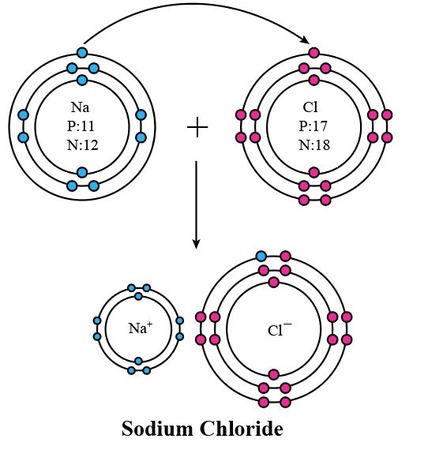
What is an ionic bond?
A chemical bond between two ions with opposite charges
8
New cards
Are ionic bonds positive with positive, or negative with negative, or positive with negative?
Ionic bonds are always between positive charged ions and negative charged ions
9
New cards
Are ionic bonds between metals and metals, or non-metals and metals, or non-metals and non-metals?
Ionic bonds are always metals and non-metals
10
New cards
What holds the ions together?
Electrostatic attraction
11
New cards
What does the chemical formula of an ionic compound show?
The fixed ratio of atoms found in an ionic compound
12
New cards
What is a ionic lattice?
Millions and millions of ions packed together in a regular cubic arrangement, joined by ionic compounds. It is a giant 3D structure.
13
New cards
What is the overall charge of ionic compounds?
Zero
14
New cards
How do you write formulas for ionic compounds? Write the formula for zirconium nitride.
Write Zr (the symbol of the first ion, in this case zirconium is Zr)
2. Write a number in subscript, this number is the charge of the other ion (in this case the charge of nitrogen is -3, so you would write Zr3 (imagine the 3 is in subscript)
3. Write the symbol of the next ion, in this case N for nitrogen
4. Write the charge of the first ion, in this case the charge of zirconium is +4 so you would write 4 in subscript next to N
Final product: Zr3N4 (imagine the numbers are in subscript)
2. Write a number in subscript, this number is the charge of the other ion (in this case the charge of nitrogen is -3, so you would write Zr3 (imagine the 3 is in subscript)
3. Write the symbol of the next ion, in this case N for nitrogen
4. Write the charge of the first ion, in this case the charge of zirconium is +4 so you would write 4 in subscript next to N
Final product: Zr3N4 (imagine the numbers are in subscript)
15
New cards
What are multivalent ions?
If an element can form more than one type of ion, it could have two charges, depending on the type of ion it forms
16
New cards
How do you distinguish between the ion type when writing compound names?
Write roman numerals after the name of the element (ex. Nickel can form 2+ or 3+, so if you were talking about the 3+ ion, you would write nickel (III), but if you were talking about the 2+ nickel ion, you would write it as nickel (II)
17
New cards
How would you write Co (with a 3+ charge) and O (with a 2- charge) (Co is cobalt and O is oxygen)
Cobalt (III) oxide
18
New cards
How do you know which ionic charge a formula is talking about if it doesn't say it?
1. Multiply the charge of the second ion by how many there are (ex. MoCl3, multiply the charge of chlorine (Cl is 1-) by how many there are (3) = -1 x 3 = -3
2. -3 is the overall negative charge. The opposite is the overall positive charge, in this case +3
3. Ask yourself: What number times how many ions there are of the first ion equals the overall positive charge? Ex. What x 1 = 3? 3! This is complicated but bear with me
Ex: -1x3=-3 The -1 is the charge of chlorine, the 3 is how many there are of the chlorine, the -3 is the overall negative charge
_ x 1 = 3 the what is what charge the first ion will be, the 1 is how many there are and 3 is the opposite of the overall negative charge, the overall positive charge
This is my thought process and I know it's confusing but I can't write out my thoughts they go too fast
-1 x 3 = -3
3 x 1 = 3
MoCl3 is Molybdenium (III) chloride
2. -3 is the overall negative charge. The opposite is the overall positive charge, in this case +3
3. Ask yourself: What number times how many ions there are of the first ion equals the overall positive charge? Ex. What x 1 = 3? 3! This is complicated but bear with me
Ex: -1x3=-3 The -1 is the charge of chlorine, the 3 is how many there are of the chlorine, the -3 is the overall negative charge
_ x 1 = 3 the what is what charge the first ion will be, the 1 is how many there are and 3 is the opposite of the overall negative charge, the overall positive charge
This is my thought process and I know it's confusing but I can't write out my thoughts they go too fast
-1 x 3 = -3
3 x 1 = 3
MoCl3 is Molybdenium (III) chloride
19
New cards
How would you write TiS2?
Titanium (IV) sulfide
20
New cards
What is a polyatomic ion?
An ion made up of a group of atoms
21
New cards
How do you write the formula for polyatomic ion bonds?
1. Find the element on the periodic table, then find the polyatomic ion on the list our teacher gave us. Ex. Ni is nickel and SO4 is sulfate
2. Balance them so the charge is neutral. Ex. Nickel has a charge of 2+ and sulfate has a charge of 2-. This means we need one of each to make a zero pair
3. Write out the formula (never write charges in the formula). Ex. NiSO4. This shows we have one Ni and one SO4, -2 + 2 = 0
2. Balance them so the charge is neutral. Ex. Nickel has a charge of 2+ and sulfate has a charge of 2-. This means we need one of each to make a zero pair
3. Write out the formula (never write charges in the formula). Ex. NiSO4. This shows we have one Ni and one SO4, -2 + 2 = 0
22
New cards
When do you use brackets when writing formulas of compounds that include polyatomic ions?
You use brackets if there is more than one polyatomic ion. Ex. Nickel (III) sulfate is NiSO4 because Ni is nickel and SO4 is sulfate, and you only need one of each to make a zero pair. But barium nitrate is Bo(NO3)2 because Bo is barium and NO3 is nitrate, but there is 3 nitrate ions