BIOL 201 Evolution and Ecology Midterm 1
 Call Kai
 Learn
Learn Practice Test
 Spaced Repetition
 Match
Match Flashcards
 Knowt Play
1/57

There's no tags or description
Looks like no tags are added yet.
Name | Mastery | Learn | Test | Matching | Spaced | Call with Kai | Chat |
|---|
No analytics yet
Send a link to your students to track their progress
58 Terms
What is Hardy-Weinberg equilibrium?
A null model
States that allele frequencies in a given population will remain stable from generation to generation if the 5 assumptions are met
What is evolution?
A change in allele frequencies over generations
Mechanisms of evolution
Mutation
Genetic drift
Gene flow (migration)
Selection
How are new alleles formed?
Exclusively through mutation
Conditions/assumptions of Hardy-Weinberg equilibrium
Random mating
Infinitely large population
No genetic drift
No gene flow/migration
No selection
When is genetic drift most likely?
When the population is small
E.g., when the population size has been reduced due to the bottleneck or founder effect
The bottleneck effect
The size of a population is rapidly reduced (such as by disease or a natural disaster) → small population that isn’t necessarily a representative sample of the alleles present in the previously large population → allele frequencies shift and some are lost (genetic drift)
The founder effect
A small group is separated from the larger population (such as by migration or environmental changes) → small population that isn’t necessarily a representative sample of the alleles present in the previously large population → allele frequencies shift and some are lost (genetic drift)
Selection is, by definition, (random / non-random)
non-random
Null hypothesis
Hypothesis stating that something will not occur
Default assumption that there will be no statistically significant difference between two groups or variables
Does inbreeding cause evolution? Why or why not?
No, it does not change the frequencies of alleles in a population
It only changes genotype frequencies, referring to how existing alleles are paired
Effects of inbreeding
Increased rate of homozygosity due to pairing a higher number of identical alleles
When is the null hypothesis rejected?
When χ2 > χ2crit
Binomial distribution
Gives the probability of X successes in n trials
Applies when each trial has 2 possible outcomes (one of which is arbitrarily called a success), the trials are independent, and the probability of success, p, is the same in every trial
Randomly sampling n individuals from a large population meets these conditions
What does it mean (in terms of evolution) if a population is NOT in Hardy-Weinberg equilibrium?
Simply means that one of the five assumptions of HWE were not met
Often means the population is evolving, but not necessarily if the only unmet condition is random mating (as some types of random mating do not shift allele frequencies)
Which mechanisms of evolution are random (1) and which are not (2)
Mutation, genetic drift, gene flow
Selection
Wahlund effect
Reduction in heterozygosity (more than would be expected in a population)
Occurs when two small populations of the same species are geographically separated, and the subpopulations are analyzed as if they are a single population
E.g., population 1 has a high frequency of A and a low frequency of a, while population 2 has the opposite frequencies. Combined, it will appear that there are fewer Aa individuals than would be expected for a single population given the amount of both types of homozygotes
Examples of non-random mating
Inbreeding (doesn’t change allele frequencies)
Assortative mating (mates are similar; doesn’t change allele frequencies)
Disassortative mating (mates are opposite; doesn’t change allele frequencies)
Sexual selection (a type of natural selection; is likely to change allele frequencies)
Does non-random mating always cause evolution?
NO
Only when it results in changes in allele frequency in the population over generations
When do mutations in DNA occur (2)?
DNA replication
DNA repair
When do beneficial alleles become fixed in the population?
The allele is recessive
The allele is additive
When are deleterious alleles erased from a population?
The allele is dominant
The allele is additive
Can additive alleles be masked or mask other alleles?
NO
The frequency of a lethal allele in a population to its ______ ___ because…
mutation rate
Individuals carrying the allele will be dead and therfore unable to reproduce, so the allele dies with them. They are only as frequent as their formation
Mutation rate (1) vs. substitution rate (2)
The rate at which new alleles are formed by errors in DNA replication and repair. Before evolution can act on the alleles
Closer to the observed *1*: deleterious alleles become less prevalent and are substituted for more beneficial alleles as they increase in the population. After evolution has acted on the alleles

Equilibrium frequency formula for deleterious recessive case
μ = mutation rate
s = selection coefficient (the strength of selection against the allele, from 0 to 1)
These tend to reach higher frequencies because they can hide in the population within heterozygotes

Equilibrium frequency formula for deleterious dominant, but non-lethal case
μ = mutation rate
s = selection coefficient (the strength of selection against the allele, from 0 to 1)

Which phase of meiosis is this? What occurs here?
Prophase I
Homologous chromosomes pair up
Crossing over

Which phase of meiosis is this? What occurs here?
Metaphase I
Homologous chromosomes (in sets of sister chromatids since they’ve been replicated) line up beside each other along the metaphase plate
Independent assortment of chromosomes

Which phase of meiosis is this? What occurs here?
Anaphase I
Nondisjunction could occur here (would result in 2 gametes with n-1 chromosomes and 2 gametes with n+1 chromosomes)

Which phase of meiosis is this?
Telophase I
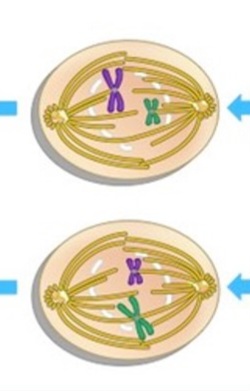
Which phase of meiosis is this?
Prophase II

Which phase of meiosis is this? What occurs here?
Metaphase II
The chromosomes (each with 2 sister chromatids) line up along the metaphase plate

Which phase of meiosis is this? What occurs here?
Anaphase II
Nondisjunction could occur here if sister chromatids failed to separate (would result in 2 normal gametes, one with n-1 chromosomes, and one with n+1 chromosomes, if it only occurred once in one of the two cells going through anaphase II)
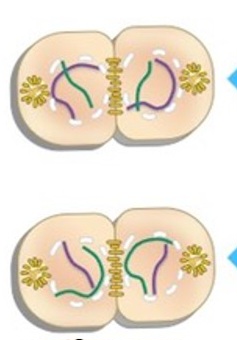
Which phase of meiosis is this? What occurs here?
Telophase II
Four total unique gametes are formed
In which stage of meiosis does crossing over occur (including I or II)?
Prophase I
In which stage of meiosis does independent assortment occur (including I or II)?
Metaphase I (separation occurs during anaphase I)
Independent assortment
Chromosomes are sorted into gametes independently of one another
What is the advantage of sexual reproduction?
Increases genetic variation by making new combinations of chromosomes (through independent assortment) and alleles (through recombination)
How does recombination contribute to genetic variation?
Increases genetic variation by mixing and matching alleles (e.g., crossing over)
Nondisjunction
The failure of homologous chromosomes or sister chromatids to separate during anaphase
Can occur during anaphase I, anaphase II, or mitosis
Results in daughter cells or gametes with unequal numbers of chromosomes
During what phase(s) of meiosis can nondisjunction occur?
During anaphase I or II
Can be due to problems during metaphase, such as spindle fiber attachment, but actually occurs in anaphase
Meiosis (increases / reduces / maintains) ploidy
reduces
Crossing over vs. recombination
Recombination is a broader term referring to when DNA is broken and rearranged/inserted with other DNA to create new combinations of alleles
Crossing over is a mechanism that leads to recombination
Crossing over specifically refers to the swapping of DNA segments between non-sister chromatids on homologous chromosomes during prophase I of meiosis
Crossing over is more likely to occur between genes located (close together / far apart) on the chromosome
far apart
Phenotypic plasticity
A single genotype can produce different phenotypes (physical traits, behaviour, or physiological states) in response to environmental conditions
Broad sense heritability
Proportion of phenotypic differences that can be attributed to genetics (encompassing all aspects of genetics) as opposed to environmental factors
H2 = VG / (VE + VG)
Phenotypic variation (VP)
The sum of genetic variation (VG) and environmental variation (VE)
Narrow sense heritability
Proportion of phenotypic differences that can be attributed to specifically additive alleles as opposed to other genetic factors or environmental factors
h2 = VA / (VE + VA + VD + VI)
Epistatic gene
A gene that masks or modifies the expression of another separate gene
Hypostatic gene
A gene that is masked or modified by another separate gene, altering the phenotype asociated with it

Which type of selection is this?
Directional selection

Which type of selection is this?
Stabilizing selection

Which type of selection is this?
Disruptive selection
𝑅 = ℎ2 × 𝑆
Multiplying the strength of selection (the difference between the average of the trait in the population and the reproducing individuals) by the narrow-sense heritability gives a predicted value for how much the trait that is being selected for or against will change from one generation to the next
E.g., if the mean mass of toads in a population is 623 grams, but the mean mass of reproducing individuals is 702 grams, then the selection strength is 79. If narrow-sense heritability is 0.4, then 0.40×79=32 grams, which is approximately how much more the new generation of toads will weigh on average compared to the general population
Linkage equilibrium
Occurs when/a state in which alleles will combine and be inherited independently of each other, completely randomly. Basically when there is no linkage between alleles
Occurs most often when two alleles are located on separate chromosomes or far apart on the same chromosome
Disequilibrium is when alleles ARE linked
Genetic drift
Loss of allelic diversity
Hg+1 = Hg (1 - 1 / 2N)
G refers to generation, and H refers to heterozygosity
Heterozygosity formula
As the population (N) goes to infinity, Hg+1 gets closer to Hg
As the population (N) get smaller, Hg+1 gets increasingly smaller than Hg, meaning the frequency of heterozygotes is decreasing each generation
Explains why smaller populations are so affected by drift (alleles eventually become fixed or lost)