ECCB 302 Verts Lec exam 3
 Call Kai
 Learn
 Practice Test
 Spaced Repetition
 Match
 Flashcards
 Knowt Play
1/89

There's no tags or description
Looks like no tags are added yet.
90 Terms
Major groups of Craniata

Characteristics of Amniotes (and which taxa are amniotes)
amniotic eggs
impermeable skin
costal ventilation of lungs
temporal fenestration
Turtles, lepidosaurs, archosaurs, mammals
be aware of geologic time scale (periods of mesozoic, timing of this era, and the periods, major events)
aw hell nah bruh

characteristics of Archosaurs
Antorbital fenestra
shape of the orbit
teeth
bipedalism
fourth trochanter (nub on the bone)
characteristics of Crocodilians
Arose in triassic
Nostrils on tip of snout
Secondary palate separates mouth from nasal passage
Flap of tissue at base of tongue can seal mouth and throat from water
Depressor mandibulae is a short and weak muscle that opens a crocodilian’s mouth
Ventricular septum in the heart
how does Crocodilian heart differ from turtles and lepidosaurs?
they have a 4 chambered heart
be aware of groups of dinosaurs (major groups and groups within each)
bruhhhh
Saurischia
“Lizard-Hipped”
bipedal
Sauropodomorpha, Theropodomorpha, Coelurosaurs

Ornithischia
“Bird-Hipped“
bipedal
probably had cheeks and horny beaks rather than teeth at front of mouth
3 groups: Thyreophora, Ornithopoda, Marginocephalia

Cretaceous-Paleogene (KT) Boundary
66mya
Major Events:
Extensive mountain building (Rockies pushed up for the 2 nd time)
Inland seas drying up
Flowering plant radiation and 2nd insect radiation
General blossoming of life (mammals just taking off), but then an asteriod impact
Massive extinctions from dust cloud darkening of Earth
Permo-Triassic Crisis
99% of life was wiped
Cretaceous
145-65 mya
Jurassic
205-145 mya
Triassic
250-205 mya
Mesozoic ERA
250-65 mya (age of reptiles)
Archosauria - origin and when did they take off?
Originated in Permian period but took off in Mesozoic
Diapsida- evolved in ______ period
Carboniferous period of Paleozoic Era— 300mya+
Tetrapoda
largest subdivision of Sarcopterygii
pectoral girdle separated from skull
has zygapophysis on vertebrae
limbs with phalanges
pelvic girdle attached to vertebral column
Sarcopterygii
27,000 extant species
1st appeared in early Devonian period and still persist
good fossils bc presence of dermal bone and endochondral bone
Characteristics of Coelurosaurs (When did they live? What did they look like? What characteristics did they share with birds?)
Cretaceous
Were small and used hands or feet
Furcula, fused bony sternum, egg brooding posture, sleeping posture, T. rex proteins
Characteristics of Dromeosaurs (When did they live? What did they look like?)
Cretaceous
Small
Large toe and claw, 2nd digit
Feet similar to birds
Remarkable tail structure
Used fore feet to seize prey
Characteristics of Pterosaurs (When did they live? What did they look like? How did they differ from modern birds?)
Triassic
Box 16-3 —whatever that means????
Flight mechanically demanding
Wing different than birds
also are quadrupedal
Shared characteristics between theropods and birds
hollow, pneumatic bones
s-shaped neck
tridactyl foot
posture
Hypotheses for the origin of flight
2 hypotheses
Arboreal or “from the trees down”
Terrestrial or “from the ground up”
arm and wrist movements seem to be consistent with prey seizing
feathered forelimbs seem poorly suited for climbing
arms used to aid in balance while running, then evolved to short flights
Examples of extinct “birds”
Teratornis- closely related to new world vultures
What class do birds belong to?
Aves
Time periods that major radiations were/are present
you tell me
Feathers – how did they evolve? Know the differences (and the importance of these differences) between filamentous feathers, symmetrical vane, and asymmetrical vane
evil

Archaeopteryx
asymmetrical vaned wing and tail feathers
longer arms
reduced tail
Microraptor characteristics
gliders not flyers
thats all the info.
feathers on legs and arms
Jeholornis
Early Cretaceous
Bird-like wings, thorax, skull
dinosaur tail
teeth
short, rounded wings
Confuciusornis
Early Cretaceous
crow sized
elongated tail feathers
several species
fish-eating
toothless beak
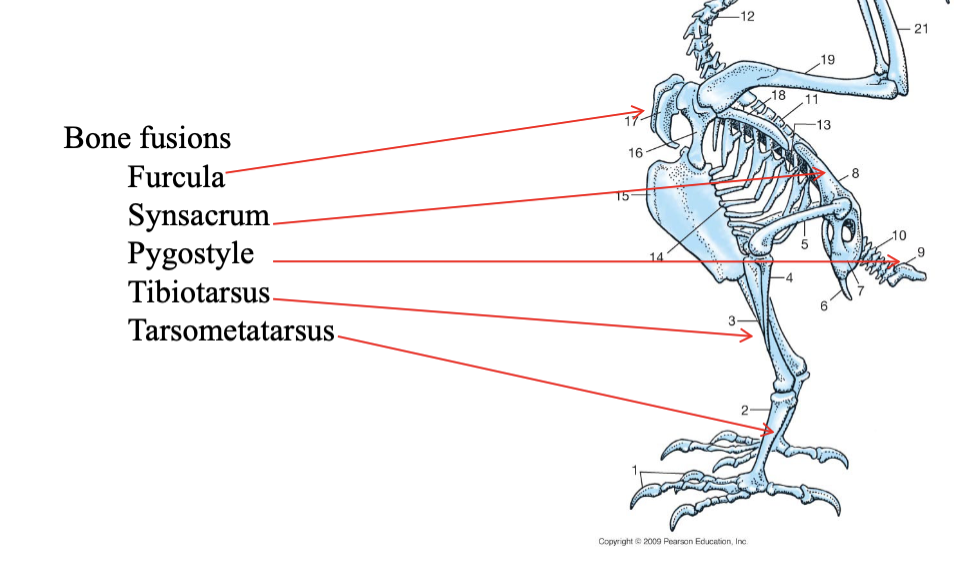
pygostyle
Enanthiornithines
Metatarsals fused differently + different articulation between scapula and coracoid as compared to modern birds
Teeth
Small to medium sized (nothing super-sized)
Ecologically diverse (how could we know this? fossil record)
why is morphology generally constrained in birds?
Remarkable uniformity in the morphology of birds, mostly as the result of the specializations for flight
composition of feathers
-Composed of a specific type of beta keratin
-Calamus anchors feather to the skin
-Rachis
-Barbs
-Barbules
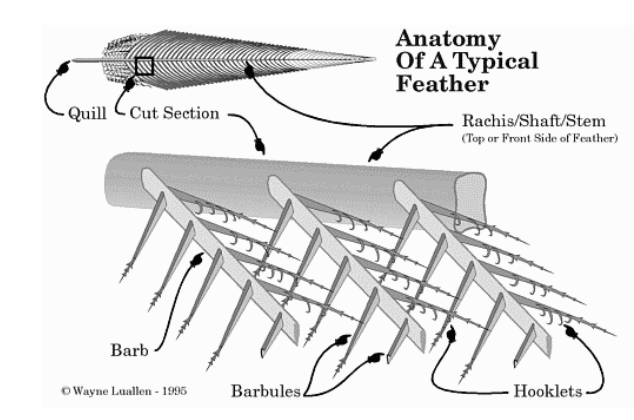
Contour feathers
Remiges – wing feathers
Rectrices – tail feathers
Semiplumes
long rachis with plumulaceous vanes
Down
entirely plumulaceous and rachis is shorter than the longest barb or absent
Bristles
stiff rachis and barbs only at the base or absent
Filoplumes
fine hairlike feather with few short barbs at the tip, used for sensory
bone fusions
Know some of the “modern” birds that have gone extinct, how some of those extinctions were caused, and the effect some of those extinctions on other organisms
Passenger Pigeon –was thought to be the most abundant bird in the world, went extinct in 1914
Dodo
Moas hunted to extinction
Hawaiian birds due to malaria
Know the 2 major suborders of birds and examples of their constituents
Palaeognathae - Tinamous and Ratites
Neognathae- Galliformes and Anseriformes
Importance of phylogenetic placement of tinamous and ratites
Traditional views: Thought that Ratites monophyletic
Tinamous are nested inside Ratites
Ratites are not monophyletic
Evolution of “flightlessness”
Biogeographic implications
Know any Orders (and the common names of these Orders) shown in slides
oh my god
Know if any of these Orders belong to “land birds”, “super fliers”, “water bird”, “shore bird”
Know phylogenetic placement of:
Palaeognathae, Neognathae, Galliformes, Anseriformes, Neoaves, and landbirds
wing stuff?????
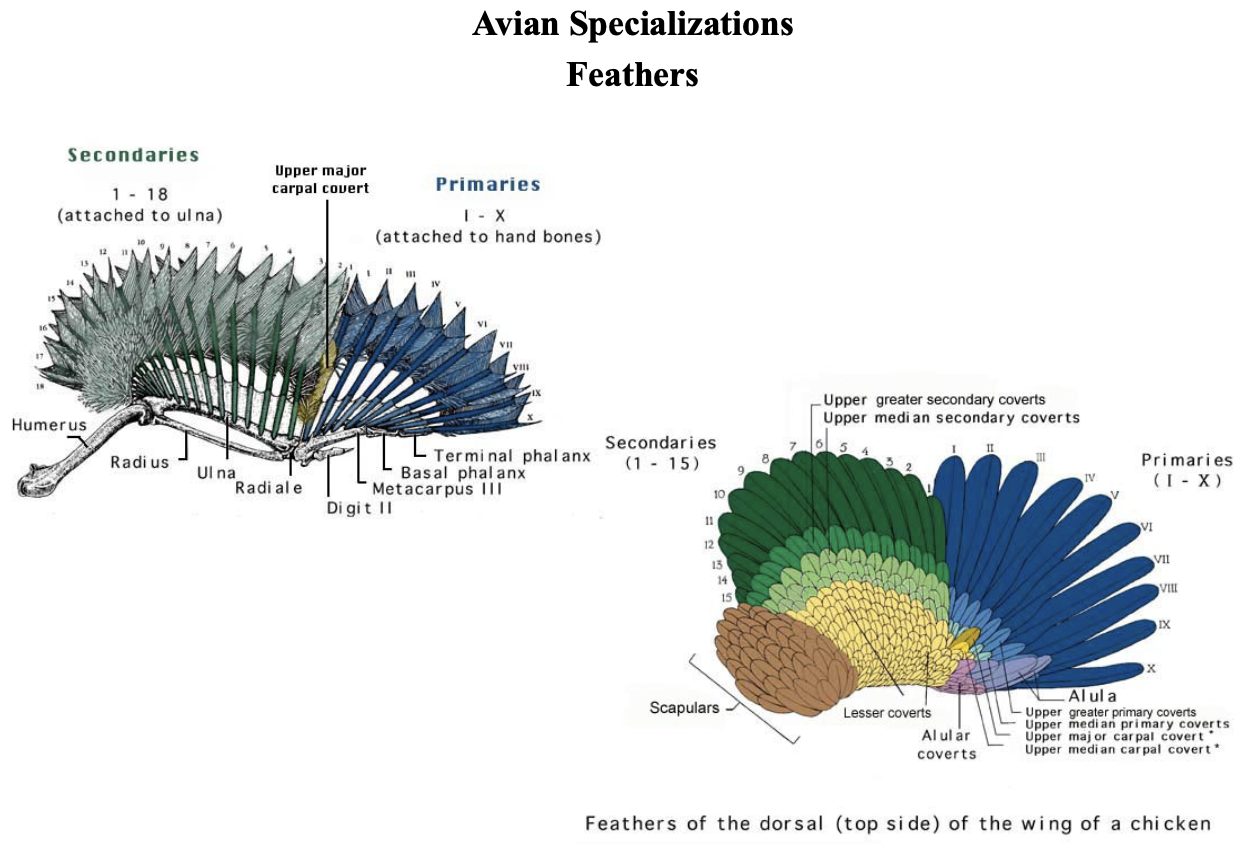
Avian bones are…
Pneumatic, air filled
Function of feathers
Insulation, flight, ornamental/sexual signaling
Muscle fiber/metabolic differences (depending on biology of the bird, where would you expect to find muscles with a lot of myoglobin?)
Muscle fiber types and metabolic pathways
Dark Meat: high capacity for aerobic metabolism; myoglobin
White Meat: less sustained capacity for aerobic metabolism
Strong fliers: breast muscles with high aerobic metabolic capacities, but this varies by flight “strategy”
Which wing feathers (specifically) are responsible for flight?
Wing function as an airfoil and propeller
Primaries propel, secondaries lift
In general, how do birds fly?
What is the function of the alula?
providing lift and preventing stall during slow flight and high angle maneuvers like landing
What is wing loading?
ratio of birds’s body mass to its total wing surface area
Know which muscles are important for flight, and function of each muscle
-Downward stroke of the wings produces thrust (generated with primaries)
-Major muscles involved with flight
1) Pectoralis major – pulls wing down
2) Supracoracoideus – lifts wing
Understand differences in wing proportions relative to type of flight
-Flight muscles account for 25-35% of the total body mass of strong fliers
-Predatory birds, limb muscles 10% (flight muscles ~20%)
-Swimming birds, even distribution of limb and flight muscles
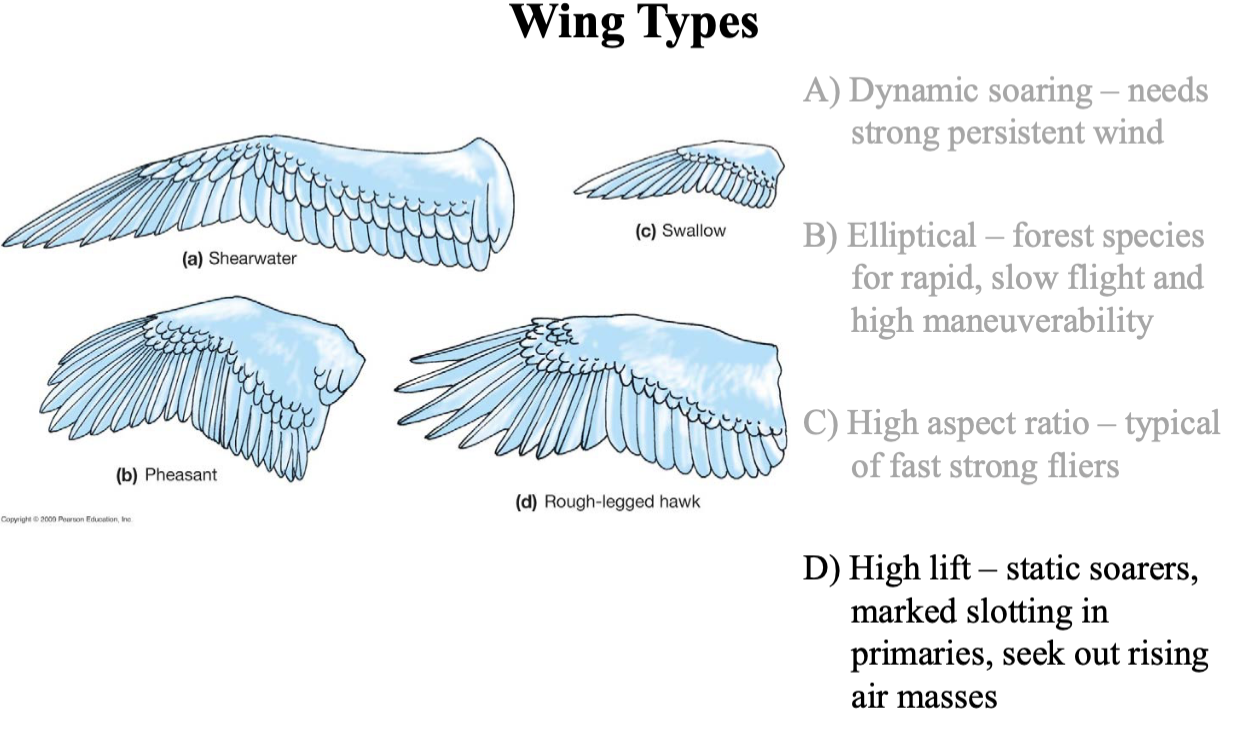
What are the 4 major wing shapes and how do they differ from one another? Know an example of a bird with each major wing shape.
What are the 4 main types of flight?
Gliding - simple, wings locked with no wing beat. distance traveled a function of 3 items
Flapping - most common form of flight
Soaring - dynamic and static
Hovering
not mutually exclusive and more than one type can be used per species
Understand respiratory and circulatory system of birds
respiration:
7 air sacs
no residual volume (air) in lungs
air sacs poorly vascularized, modifications in lungs to help pick up O2

bird circulation
circulation:
separate systemic and pulmonary of the heart
division via a permanent septum between ventricles
permanent ventricle allows higher rates of flows associated with higher overall metabolism in birds
Understand how and why endothermy evolved in birds
Air exchange and sustained locomotion/activity produces heat and a substantial amount of energy lost as heat
Body forms and posture changes to better deal with increased activity
Temperature regulation via ectothermy or endothermy
For endothermy to evolve, need insulation and high metabolic rate
Feathers –insulation, but can be moved to enhance air flow across the body to facilitate cooling
Bird hind limbs
perching- anisodactyl
hopping, walking, running- hallux lost/almost completely lost (emus)
climbing- zygodactyl
surface swimming- palmate feet/lobate/totipalmate (ducks)
diving/underwater swimming- posterior leg position (grebes)

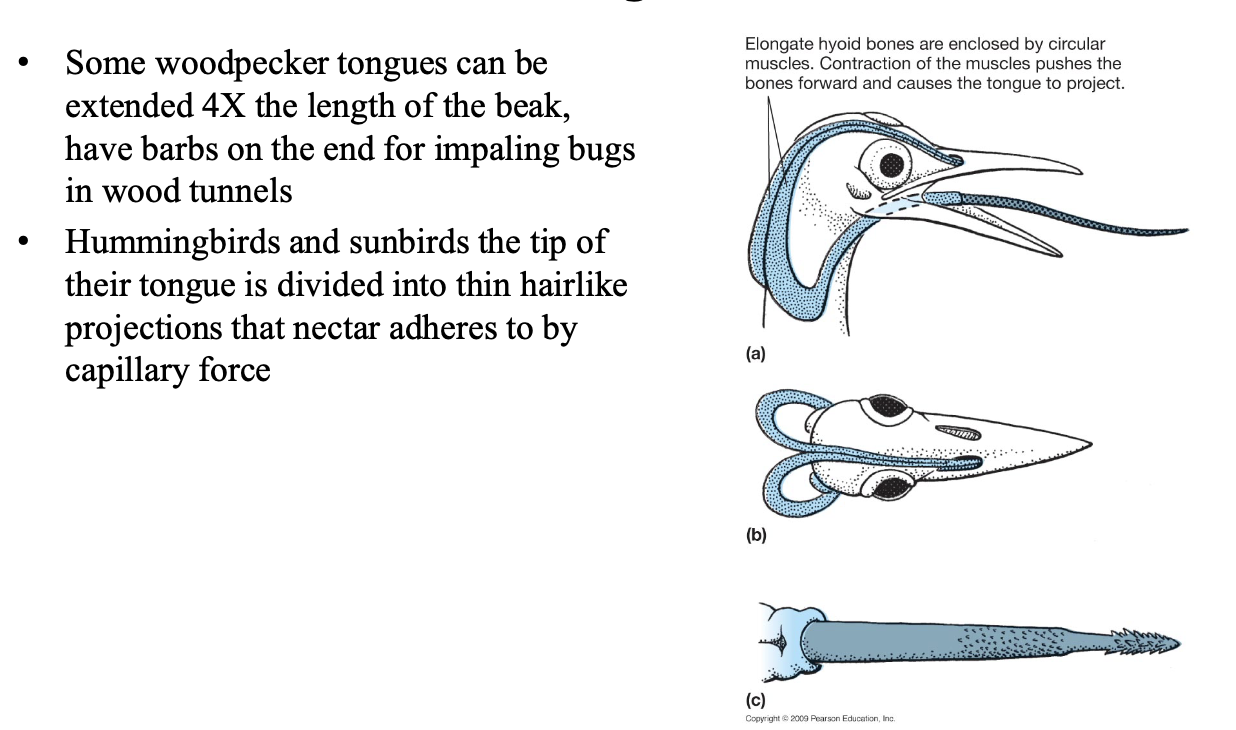
bird tongues
beak types

Bird feet

Be able to explain and define aspects of the bird digestive system
No teeth, gastric apparatus helps process food that would normally occur in the mouth
ceca breaks stuff down in birds with lower quality diet

Know the major senses of birds and details of each sense: Vision
Most important sense for birds
different eye shapes are a function of fitting large eye in small skull
No eyelids - nictitating membrane provides blink
pecten in back of eye- might help provide extra O2 to eye
Know the major senses of birds and details of each sense: Hearing
Most birds hear the same amount as humans
Owl are exception bc facial disk that acts as a parabolic sound reflector
owls also have asymmetry in the shape of the disk of the skull
Know the major senses of birds and details of each sense: Olfaction
Most birds have a poor developed sense of smell
kiwi and vultures are a few exceptions
Myoglobin
a protein in dark meat- high capacity for aerobic metabolism; myoglobin
lift
-Lift: vertical force equal to or greater than weight of bird
Drag
Resistance- force that is opposed to forward motion and wing movement
aspect ratio
Length : Width of wings
Know the visual and auditory ways that birds communicate with each other
-Color often important in social interactions
-Postures
-Vocalizations
-Male vs female coloration and sexual selection
-Truth in advertising
What is “Truth in Advertising”?
visual signals that correlate with quality of male (health, parasite load, ability to evade predators)
What is a birdsong? Who sings and how are songs learned?
Bird songs are specifically the breeding calls of many bird species
Learned behavior
Males only
Regional dialects; individual variation
Know the definitions of the various mating systems birds can exhibit
Monogamy (Greek mono = one, gamy = marriage)
Polygamy (Greek poly = many)
Males (polygyny)
Females (polyandry)
both sexes (Promiscuity)
Extra Pair copulations
What is the difference between social and genetic monogamy?
Social Monogamy - Share responsibility for clutch but have extra-pair copulations (contrast to genetic monogamy)
Genetic Monogamy- An exclusive reproductive strategy where a pair only reproduces with each other, meaning all offspring in a brood or litter share the exact same two genetic parents. (like life long mates?)
What are the advantages for extra-pair copulations and social monogamy?
increases fitness and genetic diversity, benefits to both sexes
Know the different types of polygamy
Males (polygyny)
Females (polyandry)
both sexes (Promiscuity)
Why are birds oviparous? (know good and bad hypotheses)
1) Constraints due to flight
2) Ancestral condition
3) Endothermy and retention of eggs in the oviduct - best explanation
Know some details about bird eggs and nests
nests- structure built to protect eggs and/or young from abiotic and biotic stress
range from shallow holes to enormous structures in trees
most species nest individually
do birds have environmental sex determination?
no, they’re like humans
Why are there variations in clutch size?
nutrition, energy differences in species?
not all eggs will make it so greater number will ensure some survive
some lay 1 some lay hella
What are different ways birds can incubate their eggs?
body heat, sun, rotting vegetation, some wait for all eggs to be laid to incubate them- ensures they all hatch at the same time
What are the differences between altricial and precocial young?
Altricial - Naked and dependent on parents (ex:robins)
Precocial- self sufficient (ex: chickens)
What are the advantages of migration?
Advantages: food resources, avoid temperature stress, longer days—generally translates to larger broods being possible compared to tropical species that do not migrate = higher fitness
Disadvantages: Mortality rates high during migration, requires energy
What cues do birds use to orient and migrate?
Preparation: Zugdisposition, Zugstimmung
Timing: Day length and internal rhythms
Navigation and Orientation: sun, Earth’s magnetic field, light, odors, landmarks, sounds
Extra-pair copulations
when an individual that has a social pair-bond mates with an outside individual of that primary pair