Chapter 4 - Quantum Mechanics
 Call Kai
 Learn
 Practice Test
 Spaced Repetition
 Match
 Flashcards
 Knowt Play
1/42

Earn XP
Description and Tags
09/10/26
43 Terms
intro to quantum mechanics
we know that wave-particle duality exists for all particles, and not just photons. therefore, electrons can exist as waves. but where do waves start and end, and therefore, how do we know where an electron is?
properties of waves that electrons can demonstrate and prove themselves as waves by showing?
diffraction: where a wave will bend around an obstacle
interference: the ability for waves to interact with each other. this appears as constructive and destructive interference.

how does an electron diffraction experiment work?
an electron source shoots electrons at a screen with a slit. the electrons move through the slit and then into the crystal lattice.
note that in order for this experiment to work, we have to understand that each electron in the beam is behaving as a wave.
each wave (or particle) hits an atom in the crystal lattice, and then the wave splits, allowing the different parts of the wave to interfere with one another (other parts of itself) to produce the patterns we’ve seen
where did the de broglie wavelength formula come from?
a way to describe a particle is through its momentum (m * v)
a way to describe a wave is through its wavelength (distance between the same points on a wave)
de broglie hypothesized that all particles can exist as waves, and so, he related the two properties.
de broglie formula
λ = h / p and p = m * v
λ = wavelength
p = momentum of particles
h = planck’s constant
m = mass of the particle (kg)
v = velocity of the particle in (m/s)
relationships between variables and wavelength
wavelength and planck’s constant are directly proportional
wavelength and momentum are inversely proportional
wavelength and mass are inversely proportional
wavelength and velocity are inversely proportional
what the fuck is an angstrom? (Å)
a non-SI unit of length equal to 10⁻¹⁰ meters. you’ll see it used to describe the spacing between atoms in crystals
wavelength and spacing of atoms in crystals
if the wavelength of electrons is much smaller than the spacing between the atoms in crystals, the electrons will simply pass through the space between the atoms largely unperturbed (undisturbed)
if the wavelength of electrons is much larger than the spacing between the atoms, each wave will be diffracted by a large number of atoms and thus blur the diffraction pattern.
the sharpness of the diffraction pattern is maximized when the electrons have a wavelength similar to the atomic spacing
features of a transverse wave
amplitude is the difference between the mid-point and the wave crest or trough
wavelength is the length of one complete cycle of a wave
frequency is the number of complete cycles of the wave that transmit per unit time

formula for the speed of wave travel
v = f * λ, where
v = velocity in m/s
f = frequency in 1/s, also known as Hertz (Hz)
λ = wavelength in m

comparing the speeds of waves based on v = fλ
because the velocity of a wave changes its frequency and wavelength, we can only compare waves when they’re moving at the same velocity, in the same way we can’t add fractions without a common denominator
sine waves
many wave phenomena in nature, like electromagnetic radiation (light) and de broglie waves can be represented using sine functions.
formula for sine wave functions
f(x) = Asin( 2πx / λ) , where
A is a constant
x is the distance from the origin
λ is the wavelength
2π accounts for the radians for a full cycle
using the sine wave function formula, when do we get nice-looking waves?
whenever the value of x is such that it is able to simplify the argument of the function to nπ after being multiplied to by 2, letting it then cancel the denominator
basically, whenever the distance from the from the origin is half of the wavelength, which can help us ensure that the endpoint of the wave is when it hits zero again. (provided it started at zero (makes sense tho, sin(0) = 0)
standing waves
waves that appear to be still or standing, and do not carry energy from one location to another
what are nodes?
points on a standing wave where the oscillation amplitude is 0. where the wave passes through zero, or changes sign.
NOTE: the attachment, or endpoints of the waves are not considered nodes
n = # of nodes = # peaks - 1
the distance between nodes is also half a wavelength, or x
wave-like behaviour of particles and probability
because quantum mechanics sees particles as a wave, which has an undefined beginning and end, and technically exists everywhere within these boundaries, the position of a particle becomes more about the probability that it is somewere, not certainty.
what’s the Heisenberg uncertainty principle?
Δp * Δx >= h / 4π, where
Δp = the uncertainty we have about the position of the particle
Δx = the uncertainty we have about the particle’s momentum
h is still planck’s constant
it states that one cannot know (with zero uncertainty) both the position and momentum of a microscopic particle at the same time
what other information can we derive from the heisenberg uncertainty principle
Δp * Δx >= h / 4π
because it doesn’t equal zero, that means that we can never have 0 uncertainty in a measurement. i.e. we can never be fully, 100% sure
just because it can’t equal zero doesn’t mean we can’t have small numbers though. what it does mean is that if we have very little uncertainty in either the momentum or position, that the uncertainty for the other must be very very large, so that product can still = h / 4π
this is also the principle that tells us that we can’t follow classical models anymore
what is the classical 1D particle-in-a-box?
classical particles are only allowed to move in one direction, in this case, along x-axis
there are no external forces acting on the particle, and the energy barriers are infinitely high placed at x = 0 and x = L that prevent the particle form escaping
the classical particle could be anywhere in the box, or it could be moving along the x-axis, bouncing off of the walls. if the energy is conserved, the particle will move with constant speed

classical particle in a box’s energy
the energy of the classical particle can be described using the typical kinetic energy equation:
E = ½ mv2 = p2 / 2m
p = 0 when the particle is at rest (cuz v = 0)
what is the probability distribution of the classical particle in a box?
its actually uniform throughout the whole box because its equally likely to be on the left or right side of the box
because its equally likely to be on either side of the box, its average position is in the middle
in a similar fashion, the average momentum of the particle is 0, because there’s equal chance of momentum in both directions
the probability of the particle being inside the box is 100%

what is quantum mechanics?
its the theory that allows us to compute the properties of waves that describe particles
we do this using wavefunctions
what are wavefunctions? (Ψ)
because of the de broglie formula, we expect quantum particle will exhibit wave-like behaviour
a wave function is the mathematical description of this behaviour, and contains all the information about a quantum system in a given state
it also allows us to compute the probability of finding a quantum particle in a particular volume of space
overall, a wave function links the wave-like properties and probabilistic interpretation that are two hallmarks of quantum theory
note that the wavefunction has to equal zero at both walls, but the energy of the particle itself does not
what does it mean for something to be quantized and non-quantized
a quantized thing is something that can only exist in specific states, like how shoe sizes come in set sizes
overall, these are discrete quantities
a non-quantized thing is something that can exist as a spectrum of states, like how your foot could be anywhere between sizes 8 and 9
overall, these are continuous quantities
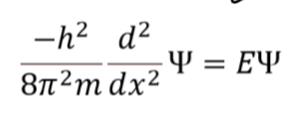
what’s the schrodinger equation?
it represents a quantum particle in one dimension, where
h = planck’s constant
x = the position of the particle
V is the potential energy
Ψ = the wave function
E = energy
the d2 / dx2 means that we’ve taken the second derivative of the wave function. (in the blue section)

interpretation of the schrodinger' equation
the blue section represents the kinetic energy of the particle
the yellow section is the potential energy
the red section, or the solutions to the equation represent the possible states of the particle
note how the potential energy, or V(x) is dependent on the position of the particle. ai says that inside the box, potential energy is 0, which would effectively take the yellow part out of the equation, but we’ll see if it holds
note that

what is the little generalization i wrote for nodes and L and stuff?
wavelength (λ) = 2/n * L
n = # of nodes
the quantum mechanics basics slide
energies, or E
only certain energies are allowed (energy is quantized)
wavefunctions Ψ
describe the behaviour of the quantum particle with the corresponding energy
probability distributions Ψ2
gives the probability of finding the particle in a particular region of space
whats the schrodinger equation for the particle in the box?
well its the regular equation, but without the term for potential energy, because there isn’t any while the particle is in the box
note that for this equation to be true, the wavefunction Ψ must be a mathematical function whose second derivative gives the same function times a constant
there are three functions who have this property. sin(kx), cos(kx), and ekx
more on the quantum particle in a box
why does it have to be a standing wave inside the box?
because the wavefunction has to equal zero at both walls. remember that the probability of the particle being outside the walls is 0, and the wavefunction that models this probability therefore must also equal zero. this is why we use sin funcs btw
the only waves that satisfy this are sin waves, and they also represent the allowed energy levels of the particle
where did the quantization of energy come from? i.e. why does the wave function have to equal zero at both sides?
because the particle is inside the box. there is a 100% probability that the particle is inside the box, and a 0% that it is outside. therefore, the wavefunction, which describes the possible energy states, has to equal zero at both edges of the box (and beyond). but while there can be technically infinite solutions to this boundary condition, each one is a standing wave that has the wavefunction exist in the proper form. as well, each of these different solutions has a different amount of energy.
whats the equation for standing sin waves in the box? and how does this relate to the wavefunction?
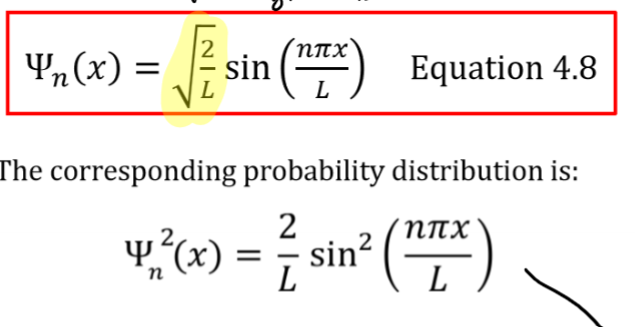
sin (nπx / L) describes the wave’s shape, which in a way is the same thing as the wavefunction. but the wave function deals more with probability. probability can also be derived through this function, but the numbers are off in a way that the other function, Ψ(x) = sqrt(2/L) sin (nπx / L) adjusts for using the root, and makes the number's nicer.
difference between the wavefunction and the wavefunction squared
a regular wavefunction has solutions that correspond to (a quantum state, which correspond to) the allowed energy levels of the particle
a squared wavefunction finds the probability distribution of that particle within the box, which can be used to find the probability of the particle being at a specific point.
(it also makes the wavefunction entirely positive, which helps it describe probabilities, because you cant have a negative probability, while you can have a negative wavefunction)
why havent we abandoned classical mechanics?
because in certain contexts, its ideas are still applicable.
thinking about the classical particle-in-a-box, its probability distribution was a uniform line across the box. which is exactly what we would see if the quantum state (or n) of a wavefunction was really high, because it would have like a million ups and downs and effectively be a straight line.
what’s the energy quantization equation for quantum particles?
En = h2n2 / 8mL2
where n must be a Natural, i.e. 1, 2, 3, … but not 0, because the wave needs energy to exist (therefore the lowest energy state isn’t 0, but 1)
note, energy is directly proportional to number of nodes and also the quantum state (n)
also, n and E are proportional
λ and E are inversely proportional
L and λ are proportional and together are inversely proportional to E
what is the ground state?
the term for when the particle has the lowest possible energy i.e. n = 1, this is because the energy quantization formula says that the lowest energy happens when n doesn’t equal 0
also referred to as the zero-point energy
what’s the excited state then?
the term for when the particle has an energy state higher than its lowest energy, (i.e. n > 1)
also described as the first energy state (because n = 1 is ground state idfk) or the 2nd state. be careful with this!!
can particles transition between states?
yes they can! and better yet, these transitions are quantized.
quantum particles in a box can change their energy levels by absorbing or emitting energy.
if a particle absorbs energy, the state of the particle (n) will increase
likewise a particle in an excited state an emit energy and drop into a lower energy state (lower n value)
a particle in the ground state cannot emit energy
how does n describe both the quantum state (energy level) and also number of nodes?
n only ever describes the energy level of a particle in the box (the wave)
but, the number of nodes a wave has is a function of that number (i.e. a direct result of that number, remember higher energy = higher n = higher node #)
# of nodes = n - 1 (remember never count the start and endpoint
how do we mathematically describe energy changes in a particle?
ΔE = Efinal - Einitial or
ΔE = (h2n2 / 8mL2) - (h2n2 / 8mL2) or
ΔE = h2n2 / 8mL2 (nf2 - ni2)
if ΔE > 0, we absorbed energy
if ΔE < 0 we emitted energy
what does ΔE mean?
if ΔE > 0, we absorbed energy
if ΔE < 0 we emitted energy
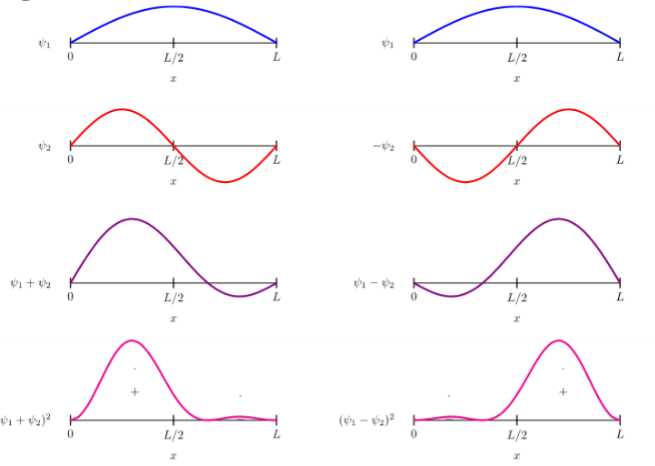
superposition of wave functions
wavefunctions can experience constructive and destructive interference through the action of combining them
i.e. Ψ = c1Ψ1 + c2Ψ2 + c3Ψ3 … (c is a constant)
the resulting wavefunction is called a superposition
superpositions have properties different from their original wave functions
and also different probability densities