U2 topic 6 (enthalpy changes)
 Call Kai
 Learn
 Practice Test
 Spaced Repetition
 Match
 Flashcards
 Knowt Play
1/9

There's no tags or description
Looks like no tags are added yet.
10 Terms
What is the standard enthalpy change of reaction, ΔᵣH°?
Give an example equation
The enthalpy change when molar amounts of reactants, as shown in the balanced equation, react under standard conditions
E.g:
H₂(g) + ½O₂(g) → H₂O(l)
NOTE:
Reactants in the amounts shown by the balanced equation
Standard conditions: usually 298 K and 100 kPa
Can be exothermic or endothermic
What is the standard enthalpy change of neutralisation, ΔneutH°?
The enthalpy change when when one mole of water is produced by the neutralization of an acid with an alkali, under standard conditions.
Key points:
Must form exactly 1 mol water as product
ALWAYS exothermic (in our syllabus)
define standard enthalpy change of formation, ΔfH°?
Give an example equation
- The enthalpy changewhen1 mole of a compound
- from its constituent elements intheir standard states
[like Br(l) and Na(s)]
- under standard conditions of 298K and 1atm
E.g:
C(s) + 2H₂(g) → CH₄(g)
NOTE:
Must form exactly 1 mol product
Can be exothermic or endothermic
elements themselves HAVE NO ΔfH°
(such as O2, H2 etc)
constituent elements = reactant elements that make up the product/compound
What is the standard enthalpy change of combustion, ΔcH°
The enthalpy change when 1 mole of a substance is completely burned in excess oxygen, under standard conditions.
E.g:
1CH₄(g) + 2O₂(g) → CO₂(g) + 2H₂O(l)
Completely burned burned in excess oxygen
1 mol of reactant
(if q has 2 mol, then make sure to give 2ΔcH° aswell, given in picture)ALWAYS exothermic → ΔcH° is negative

What is the standard enthalpy change of atomisation, ΔatH°?
Give an example
The enthalpy change when1 mole ofgaseousatoms is formed from an element in its standard state, under standard conditions.
Examples:
½Cl₂(g) → 1Cl(g)
Na(s) → 1Na(g)

standard state of Br2 = liquid
Product must be 1 mol and gas cuz it is atomisation
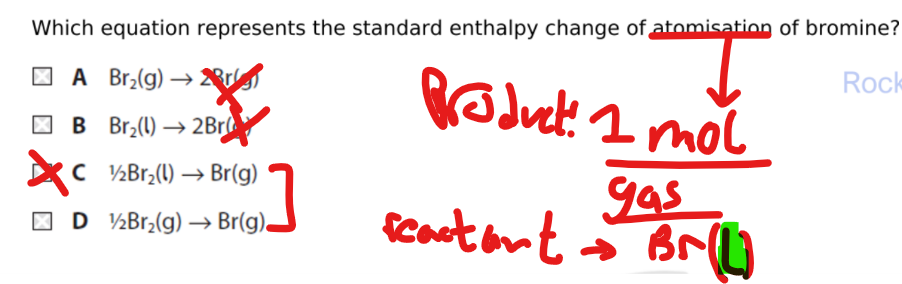

ANSWER = B

State whether these are exothermic or endothermic
combustion
nuetralistation
atomisation
combustion = exo
nuetralistation = exo
atomisation = endo

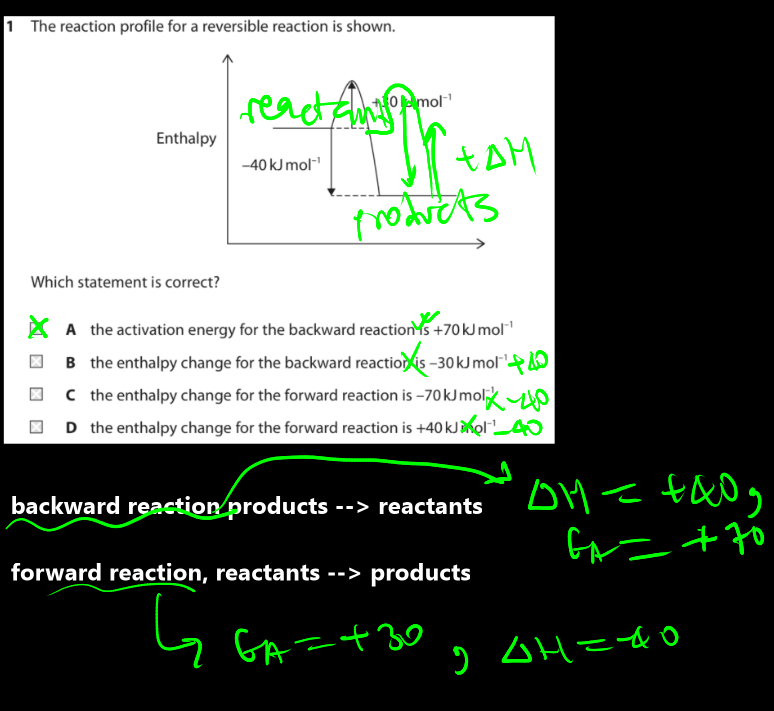
backward reaction in green ink
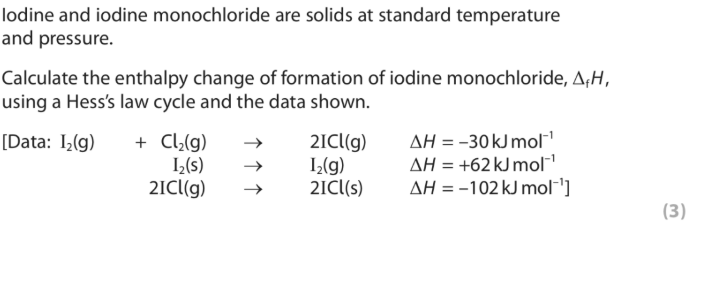
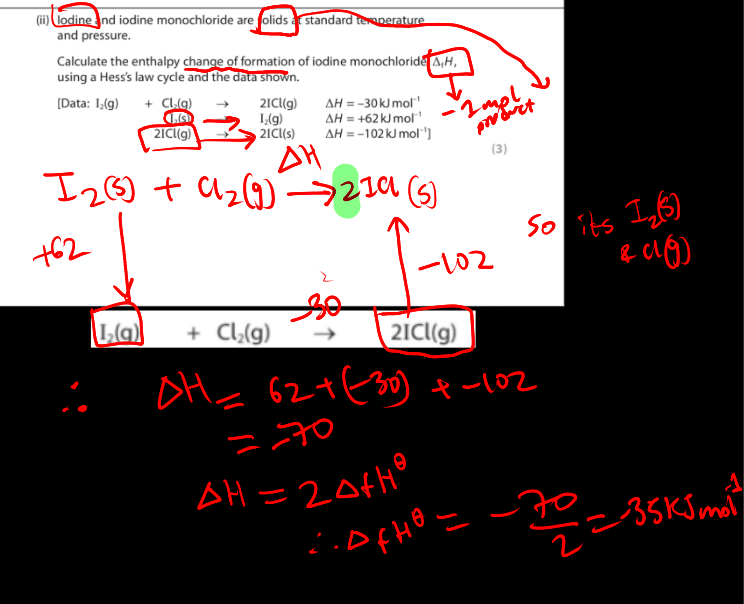
since we find ΔfH°, the elements on reactant side MUST BE IN STANDARD STATE
so I2 is solid
ALSO final answer ΔfH° must be 1 mol, so we divide ΔrH° by 2