Circulatory system
 Call Kai
 Learn
 Practice Test
 Spaced Repetition
 Match
 Flashcards
 Knowt Play
1/104

There's no tags or description
Looks like no tags are added yet.
105 Terms
What is the purpose of the circulatory system?
o deliver O2 to the cells within its body. This is for aerobic respiration within cells.
What happens to a fluid when oxygen enters it?
Oxygen will slow down the fluid therefore every animal wants to increase the efficiency of oxygen entering the cells.
How does oxygen pass from becoming gaseous to dissolved into water?
The alveoli are lined with water to dissolve the water
What are limitations to animals that do not have respiratory organs or a circulation system? (E.g Jellyfish)
Low metabolic rate
Small (High surface area to volume ratio)
Boundary layer (water tends to behave as if it were in layers, so the water layer adjacent to the boundary will be unable to flow and move, therefore diffusion will happen very slowly)
Cellular organisation (cells with the highest oxygen requirements are located at the surface of the animal)
If an animal cannot rely on diffusion alone for their oxygen intake, what would they require?
Circulatory system
List function of the circulatory system
Deliver O2
Remove CO2
Immune response
To transport other solutes/nutrients.
To transport heat
To enable movement.
What are the main requirements of a circulatory system?
Pump (Heart, contractile tubes)
Circulatory fluid (Blood, hemolymph)
Blood vessels (Veins, arteries, capillaries)
What are the two main types of circulatory system
Open circulatory system (insects)
Closed circulatory system (Human)
What do open circulatory systems consist of
Consists of a heart with vessels which are open.
The circulating fluids bathe the tissues directly.
Flow into spaces between the tissues called sinuses and lacunae.
Movement assists with the flow.
Describe the heart in the open circulatory system in insects.
When the heart contracts haemolymph is driven into the arteries and out into the sinuses and lacunae.
Ostia close. (Pore close)
During relaxation the ligaments expand the heart back to its original volume.
Ostia open bringing in haemolymph from the pericardial sinus
What are the advantages of an open circulatory system
Lower hydrostatic pressure – reduced energy costs. (E.g spiders use hydrostatic pressure to extend their legs, so when they die they curl up)
Describe features of closed circulatory system
Circulatory fluid is contained within a network of vessels.
Heart/s contracts and blood is driven into large vessels, then smaller vessels, which pass through tissues/organs
What are advantages of a closed circulatory system
Increased hydrostatic pressure!
Regulate the distribution of the blood.
What type of organisms contain a closed circulatory system?
Annelids, cephalopods and vertebrates.
What are the three hearts in the octopus?
Systemic heart and two smaller auxiliary branchial hearts.
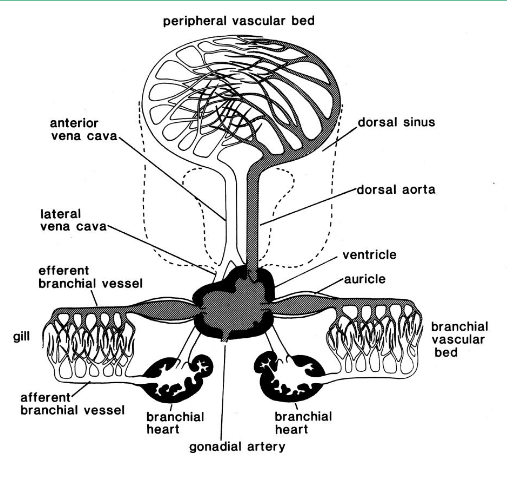
What are the purposes of the branchial heart in octopus?
The branchial heart will repressurise the blood.
Why does the blood pressure decrease at the gills?
The capillary effect which causes the blood to slow down through the gills. Which is why the branchial heart is necessary.
How is the cardiovascular system organised within vertebrates
Heart 2-4 chambered.
Arteries – take blood from the heart to organs.
Arterioles within organs pass blood into the capillaries.
Capillaries are where gaseous exchanges occur.
Capillaries converge into venules.
Venules carry blood into the veins.
Veins carry the blood to the heart.
Give the name of two chambers of the heart in vertebrates
Atria - received the blood
Ventricles - Muscular pumping force
Give the two chambers of the heart in teleosts
Sinus venosus – collects the blood prior to it entering the atrium.
Conus arteriosus – evens out blood pressure.
What type of closed circulatory system do teleosts have?
Single circulatory system - each cycle of blood through the body enters the heart only once.
Describe the double circulatory system
Blood passes through the heart twice
Who has a double circulatory system?
Amphibians, reptiles, birds and mammals have double circulatory systems.
The pumps serve different tissues.
Pulmonary circuit – blood from the right.
Systemic circuit – blood from the left.
How many chambers do amphibians have in their heart?
Amphibians have a three chambered heart 2 Atria 1 Ventricle.
Describe the double circulatory system in amphibians
Ridge between the right and left ventricle reduces mixing.
Diverts oxygen poor blood from the right atrium into the pulmocutaneous circuit.
Diverts oxygen rich blood into the systemic circuit.
When submerged they will shut down blood flow to the lungs.
what does the term Branch refer to?
Gills
What dodes the term pulmo refer to?
lung
How many chambers of the heart do reptiles have?
3 (2 ventricles and the foremen of panizza)
What must the reptile's circulatory system do?
Cardiac shunting (Be able to shut down as reptiles will hold their breath)
What name is given to contraction, when the heart pumps the blood
Systole
What name is given to relaxation, when the chambers fills with blood
Diastole
How would you calculate the cardiac output?

Name the 2 types of valves which are composed of connective tissue
Atrioventricular (AV) valves: located between the atrium and ventricles.
Semilunar valves: found in the pulmonary trunk and aorta.
What would happen if you have a slightly leaky valve
Heart murmur
What are the valves important for?
They are very important in maintaining the unidirectional flow of blood through the heart.
What does it mean when the cells of the heart are myogenic?
Autorhythmic (The contractions of the heart are not controlled by the brain)
What are the contractions of the heart controlled by?
Pacemaker (sinoatrial (S-A) node)
What allows for the rapid spread of depolarisation than would otherwise be possible through the ventricles?
Atrioventricular (A-V) node
A-V bundle branches
Purkinje fibres

Describe the heart beat
The S-A node begins depolarisation of the heart, it travels through the atrial muscle. When it is spread to the AV node it is delayed, the AV node. Then before the wave of depolarisation moves down the depolarisation spreads through the conducting system and Purkinje causing the bottom of the heart to become depolarised, completing the heart beat


Describe this ECG diagram

List the three types of blood vessels
Capillaries
Arteries
Veins
Describe Capillaries
narrow diameter and thin walls to facilitate the exchange of substances.
Describe Arteries
thick elastic walls to maintain blood pressure.
Describe Veins
0.3 x thickness of arteries, contain valves to assist in blood flow back to the heart.
What blood pigment do mammals have?
Haemoglobin (Iron subunits)
What blood pigment do mollusks have?
Haemocyanin (copper subunit)
What blood pigment do Cypunkulids brachiopods annelids have?
Haemerythrin
What blood pigment do some annelids have?
Chlorocruorins
What are the functions of blood pigments?
Increase the oxygen carrying capacity of blood.
Buffer blood. (buffering the pH of the blood, as dissolved CO2 in the blood causes acidity to increase)
Transport CO2.
What is haemoglobin contained within?
Erythrocytes
How many erythrocytes are present in one ul
5-6 millions
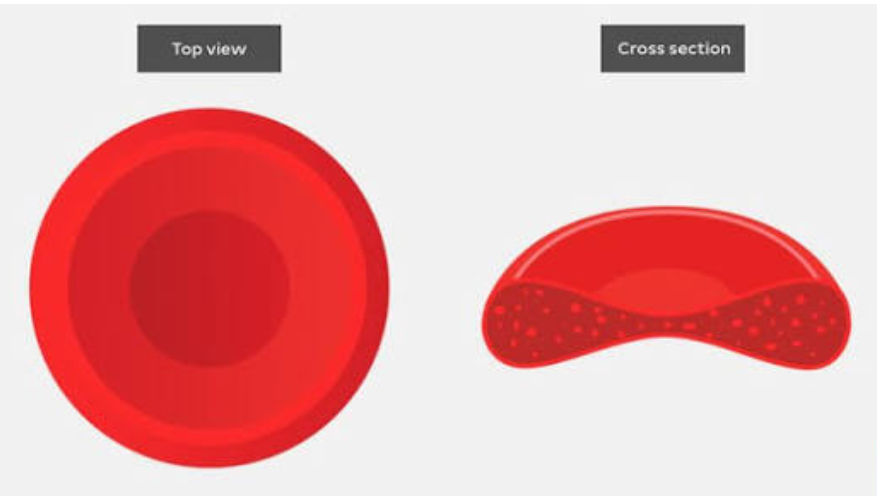
Describe the structure of erythrocytes
Bi-concave discs 7-8 μm in diameter and anucleate
How many haemoglobin per erythrocyte?
250 million
How long do erythrocytes typically last
120 days
Where are erythrocytes made?
The red bone marrow
Describe O2 relationship to haemoglobin in relation to partial pressure
At high O2 partial pressure Hb binds to O2.
At low partial pressure O2 is offloaded.
When is the partial pressure of O2 low?
Capillaries
What is oxygen affinity influenced by?
Temperature.
pCO2
pH
2,3-DPG levels
List the three main ways in which CO2 is carried into the blood
CO2 reacts with water producing bicarbonate and a proton. The proton can then cause oxyhemoglobin to offload the oxygen (Most common)
Stay dissolved as carbon dioxide (Only a small percentage at roughly 5-10%)
Bind to haemoglobin to form HbCO2 (Carbamino haemoglobin) ( Only a small percentage at roughly 5-10%)
What is the name of the enzyme that catalyses the reaction of carbon dioxide reacting with water producing bicarbonate and a proton?
Carbonic anhydrase
What happens when the bicarbonate leaves the erythrocyte in the blood
The bicarbonate will leave the erythrocyte, causing a chloride to enter, this contributes to the chloride shift
Why must the bicarbonate leave the erythrocyte in the blood?
Because the reaction will slow down, meaning the oxygen will not be offloaded from the erythrocyte.
What is the purpose of the exchange of chloride ions
Exchanges a bicarbonate ion for a chloride, causing an increase of carrying capacity of erythrocytes. This buffers a change in pH
Describe allosteric modulator
When a substance that binds to a secondary (allosteric) site on a receptor or enzyme
What is the Bohr effect
The change in the affinity of haemoglobin based solely on pH
Describe the effect on pH of increased partial pressure of CO2
An increase in the partial pressure of CO2 causes a decrease in the pH.
What are the problems of extracting oxygen from water
Aquatic organisms must move 1 litre of water to extract 1 ml O2 compared to 25 ml of air! This is because..
The content of oxygen in water is much lower
Water is much denser than air (x800)
Water viscosity is greater (Sticky) (x35)
Slow rates of diffusion in water
What is the solubility of the gas in water dependent on?
The gas
The pressure of the gas
The temperature of the water (increase temp, decrease solubility)
The presence of solutes
Three ways to change the rate of diffusion of O2 and CO2 between the internal environment and internal environment
Very thin membrane
Increase surface area
Concentration gradient between external environment and internal environment is as big as possible
What are some limitations to organisms that do not have specific organs or a circulatory system?
Low metabolic rate
Small (large SA:V)
Boundary layer
Cellular organisation
Describe the boundary layer effect
Water animals are subject to a layer of water around the animal which is very thick and is stationary. Causing a reduction in speed of objects through that water, meaning O2 and nutrient delivery to the surface is limited.
What do organisms that use diffusion for gaseous exchange typically have
Small (large SA:V).
Low metabolic rate.
Motile.
Cell located adjacent
to the environment.
What are the advantages of organisms that use diffusion for gaseous exchange?
Inexpensive
What does partial pressure determine?
The rate of supply of oxygen
What is the rate of O2 delivery dependent on?
O2 is delivered at a rate that is dependent on the difference in the partial pressure between the blood and the mitochondria.
What are the four types of blood flow?
Countercurrent gas exchange (Roughly 75%) (water)
Cross current gas exchange (50+%) (terrestrial)
Cocurrent gas exchange (limited at 50%) (water)
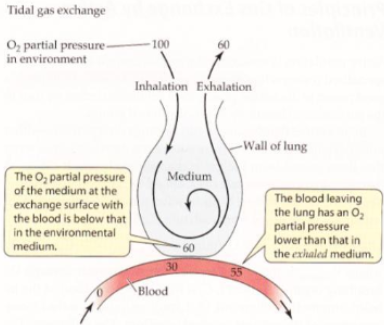
Tidal gas exchange (30%) ( terrestrial)
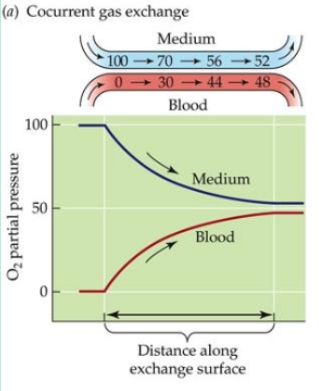
Describe cocurrent flow
At the beginning of gas exchange the concentration gradient is large, as gas exchange continues the concentration gradient decreases until both the medium and the blood have the same concentration and meets equilibrium.
50% exchange
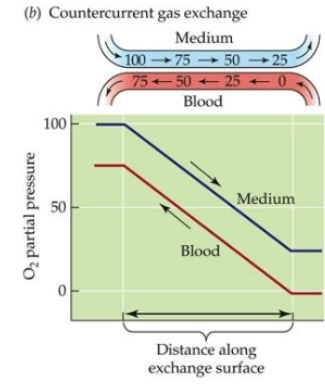
Countercurrent flow
As the gas exchange continues the medium is becoming replaced, this means the blood and the water are unable to reach equilibrium so there is lots of gas exchange
75% exchange
Cross current
Used by birds. Capillaries are separated into multiple blood streams increasing surface area for gas exchange

Tidal gas exchange
Used by most mammals. Lots of air that has been breathed in is breathed back out so it is extremely inefficient
Describe external gills
-vulnerable to damage and require structural support
-ventelation is not required

Describe internal gills
-Protected
-enhanced efficiency
-ventelation required

List the types of gills
Tuft – raise area of integument.
Filament – typically associated with blood/haemolymph supply.
Book – Limulus.
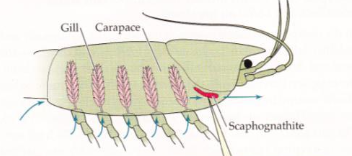
Lamellar – crustaceans and fish.
How do lamellar gills get water flow/ventilation?
Ventilation occurs via beating of the scaphognathite
How are lamellar gills protected from damage?
protected by the carapace within the branchial chamber
Describe the structure of a gill arch
V- shaped arrangement.
Gill filaments are found on the gill arch
Lamelli are found on gill filaments
Meaning there is an extremely high surface area for oxygen/ carbon dioxide exchange.
countercurrent blood flow
Buccal(mouth)-opercular pumping
What is operculum
Operculum is a flap to protect their gills
Describe how lamellar gills fish gain oxygen
Fish opens mouth, increase the volume of mouth by dropping buccal cavity, decrease pressure
Close mouth
Lift buccal cavity increasing pressure decreasing volume in the buccal cavity
Causing the water to be forced over the gills
Buccal cavity further contracts forcing water out of the operculum, maintaining a unidirectional flow
Describe the tracheal system in insects
Spiracles, which are connected to their trachea is the site where gas enters the insect.
The trachea are air filled tubes carrying oxygen to tracheoles. The tracheoles split into tracheolar blind endings that contain fluid. The oxygen is dissolved in this fluid, increasing the osmolarity, increasing the rate of oxygen delivery into the cell.