Place of articulation (phonetics)

0.0(0)
Studied by 0 people
call kaiCall Kai
learnLearn
examPractice Test
spaced repetitionSpaced Repetition
heart puzzleMatch
flashcardsFlashcards
GameKnowt Play
Card Sorting

1/11

encourage image

There's no tags or description

Looks like no tags are added yet.

Last updated 8:20 PM on 10/6/26
Name
Mastery
Learn
Test
Matching
Spaced
Call with Kai
Chat

No analytics yet

Send a link to your students to track their progress

12 Terms

1
New cards

Bilabial

Both lips are used as the articulators. Examples are the initial consonants [p], [b] and [m] in PIN, BIN and MAN.

<p>Both lips are used as the articulators. Examples are the initial consonants [p], [b] and [m] in PIN, BIN and MAN.</p>
2
New cards

Labio-Dental

The lower lip & the biting edge of the upper central teeth = articulators. 2 examples are the initial fricative consonants [f] and [v] in FAT and VAT. Some speakers use this approximant [ʋ] as the articulation of in words such as ROY and RED. (The sound is not quite the same as a [w]

<p>The lower lip & the biting edge of the upper central teeth = articulators. 2 examples are the initial fricative consonants [f] and [v] in FAT and VAT. Some speakers use this approximant [ʋ] as the articulation of <r> in words such as ROY and RED. (The sound is not quite the same as a [w]</p>
3
New cards

Dental

The back of the upper teeth & the tip of the tongue. For some speakers it is the blade. Ex: are the 2 sounds [θ] and [ð] in the words THIGH and THY; these are dental fricatives. Dental plosives are {d} and {t} of WIDTH and EIGHTH.
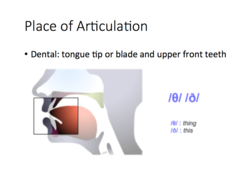
<p>The back of the upper teeth & the tip of the tongue. For some speakers it is the blade. Ex: are the 2 <th> sounds [θ] and [ð] in the words THIGH and THY; these are dental fricatives. Dental plosives are {d} and {t} of WIDTH and EIGHTH.</p>
4
New cards

Alveolar ridge

with the blade or tip of the tongue. There are a number of these consonants in English, for example the [t] in TEN & [d] in Den, the [n] & [l] in KNELL (no [k] sound!), the [s] of SCENIC, the [z] of BUSY, & the {r} of RED if it is pronounced as a tap or a trill.

<p>with the blade or tip of the tongue. There are a number of these consonants in English, for example the [t] in TEN & [d] in Den, the [n] & [l] in KNELL (no [k] sound!), the [s] of SCENIC, the [z] of BUSY, & the {r} of RED if it is pronounced as a tap or a trill.</p>
5
New cards

Post-Alveolar/ hard palate

the area at the rear edge of the alveolar ridge. Productions of [tr] of TRY & [dr] of DRY often involve post-alveolar articulations. A common pronunciation of the {r} in RED is an approximant, [ɹ]. (In some books you will find [r] used as the symbol instead of [ɹ].)

<p>the area at the rear edge of the alveolar ridge. Productions of [tr] of TRY & [dr] of DRY often involve post-alveolar articulations. A common pronunciation of the {r} in RED is an approximant, [ɹ]. (In some books you will find [r] used as the symbol instead of [ɹ].)</p>
6
New cards

Palato-Alveolar

This is best thought of as an alveolar place, but there is simultaneous raising of the front of the tongue towards the hard palate. SHop, viSion, treaSure

<p>This is best thought of as an alveolar place, but there is simultaneous raising of the front of the tongue towards the hard palate. SHop, viSion, treaSure</p>
7
New cards

Retroflex

This refers to the shape of the tip & blade of the tongue i.e: curled back. It is used to indicate a place of articulation, namely the hard palate, underneath which the tip and blade curl back. Ex: (in English, depending on the accent, include) the of RED

<p>This refers to the shape of the tip & blade of the tongue i.e: curled back. It is used to indicate a place of articulation, namely the hard palate, underneath which the tip and blade curl back. Ex: (in English, depending on the accent, include) the <r> of RED</p>
8
New cards

Palatal

The hard palate is one of the articulators; the other is normally the front of the tongue. The of YES [j] is a palatal approximant. Many speakers use a palatal fricative [ç] for the at the beginning of HUGH.
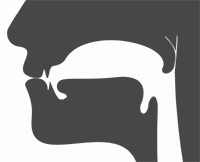
<p>The hard palate is one of the articulators; the other is normally the front of the tongue. The <y> of YES [j] is a palatal approximant. Many speakers use a palatal fricative [ç] for the <H> at the beginning of HUGH.</p>
9
New cards

Velar, soft palate or velum

is one of the articulators; the other is usually the back of the tongue. Ex: are the plosives [k] in CATCH. [g] in Get. & the nasal [ŋ] in HANG. The [w] sound of WET is also velar, but it involves an additional place of articulation.

<p>is one of the articulators; the other is usually the back of the tongue. Ex: are the plosives [k] in CATCH. [g] in Get. & the nasal [ŋ] in HANG. The [w] sound of WET is also velar, but it involves an additional place of articulation.</p>
10
New cards

Uvular

is relatively small & the production of these sounds frequently involves not only the uvula but also the bottom half of the soft palate. The voiced uvular fricative [ʁ] can occasionally be heard in certain rural accents as realisations of the {r} in DRY

<p>is relatively small & the production of these sounds frequently involves not only the uvula but also the bottom half of the soft palate. The voiced uvular fricative [ʁ] can occasionally be heard in certain rural accents as realisations of the {r} in DRY</p>
11
New cards

Glottal

Used as articulators to obstruct or narrow the air-flow from the lungs. The glottal plosive, [ʔ] is produced with the vocal folds pushed together so that air-pressure builds up beneath the closure; after a short time the folds move apart & the pressurised air is released.

<p>Used as articulators to obstruct or narrow the air-flow from the lungs. The glottal plosive, [ʔ] is produced with the vocal folds pushed together so that air-pressure builds up beneath the closure; after a short time the folds move apart & the pressurised air is released.</p>
12
New cards

Labial-Velar

DOUBLE ARTICULATION using The lips, the back of the tongue, & the soft palate. The [w] in WET is a labial-velar approximant. I.e: The consonant [wh] of WHEN in American pronunciations of the word is a voiceless labial-velar fricative [ʍ].



