Medieval Art and Architecture: Romanesque to Gothic
 Call Kai
 Learn
 Practice Test
 Spaced Repetition
 Match
 Flashcards
 Knowt Play
1/33

There's no tags or description
Looks like no tags are added yet.
34 Terms

Plan of the early monastery of Cluny, Cluny II, 10th century (early Romanesque)
period: early romanesque

Cluny III, ground plan and interior, France 1088-1130 (early Romanesque)
Period: Early Romanesque
Expanded because so many people started visiting
Solomonic Colum, it is twisted, took 2 or 4 columns and just twisted them, take ing a rop and rolling it up. The reason they calle it colosmic because the tamepl of solom, this twising frmm looks similar to soslomin temple.
Defining momnet, euroe being nalnked with white church, they begin to regualte regiolon prtaices, ex is spain clneer is a lieetel different. Kind of regualting happens.

Bayeux Tapestry, England c. 1070 (early Romanesque)
Period: early romanesque
It's named after the place it was found; it is the chronicle of the Battle of Hastings and William the Conqueror becoming the king of England. It is not a tapestry; it is an embroidery. Woven form of documentation. Might have hung in the church of Bayeux. The most popular argument is that there is a bishop, Bernard, who is charged with settling land disputes between Anglo-Saxons who fought against William and Williams people who fought for the land. The argument is that this would have been placed all around, so people can have a reminder that this was a well-fought argument, and that the sense of why you are the person who gets to make the decisions. This is political propaganda.
Cathedral of Santiago de Compostela, Spain 1078-1118 (early Romanesque)
It is a rigorous path to reach a massive cathedral; most of this isn't medieval; it's completely down to the cathedral's foundation. Very similar plan to a monastery; we have a church, cloister, etc. Cannons are for a cathedral; they are not monks. They didn't have to be celibate or live in the church. They had responsibilities that went beyond prayer and labor; it was like taking care of the community, visiting people in person, a lot of service work. Burials of Dukes, wide nave with a side aisle. Structure of the church matches the early Christian structure of churches in Rome. Compostela vs Toulouse debate: who was the first to build the first Romanesque cathedral? There is no triforuim. A lot of elderly monks and cannons. On feast days, they pull out the massive inscense burner, they swing it across the transcept.

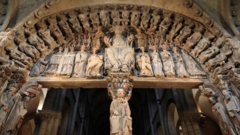
Puerta de las Plateria's, Cathedral of Santiago de Compostela, ca. 1078-1103 (early Romanesque)
The local community would go through this side, elaborate program that helps us introduce us to the Romanesque church portal is, polyglobal arch, southern Muslim Spain, they start popping up because by this period they have been trying to regain this area. Very common. The tympanum is the arch that has art on it. Ways to add sculptures to the façade. North and south portals probably had symmetric programs; they want to use all the sculptures. They have been compressed into the space so they can use them. These scenes relate to the passion of Christ, often connected to holy week aka easter; the custom of Easter didn't come from the first until the actual easter Sunday. second side is even more unusual because we have winged monkeys in the middle, we have an image of Christ to the side, and an angel; this image speaks to Christ resisting temptations. Not every part is normal: the monkeys are what is tempting him, and the angel is helping him resist the temptations, and there are actual images of temptations; she is a representation of lust, folklore says that the woman with loose hair, who has an affair, and her husband finds out and kills her lover and returns his head to her.

Bernard Gelduin, Christ in Glory, Church of St. Sernin Toulouse, France. c. 1096 (early Romanesque)
Of the actual church: Basilica format has survived. Window level and ground level. Walls are massive., Two aisles, massive nave, with a transverse arch, and radiating apse. "Gallery Clearstory". Inside the church, there is a Christ in Majesty. Which is the Christ in glory. How do we know it is Christ in Majesty? It would be the crucifix nimbus; the book open his hand- prayer/blessing hand pose.

Miegeville door, Church of St. Sernin, Toulouse, France. ca. 1118 (early Romanesque)
Saint peter is on it. It is believed it is saint James the apostle of Christ. The tempmuime, We have arch angels, Cruciform nimbus, shows us it is Christ. The angels are lifting him up, this is the "ascension of Christ". The people at the bottom are the apostles, the witnessed the accensions, here he is looking up to the heavens.

Emperor Leo VI, the Wise, paying homage to Christ, mosaic, Hagia Sophia, Constantinople, late 9th century (late Byzantine)
In the narthex in groin vaults. The mosaics. It is leo 6th, establishing a new bloodline, affirming his connection to this really important sight. What is leo doing in the image? He is kneeling/ bowing down before Christ, and you would have your hands open. Leo is referred to as "The Wise", a devoted man who lived a very long time, he was interested in literature and law. The Learned nsted of the wise, a developed man instead of an empioror. There is mary in and ri cel an dthe arch angel gabeirla in the circle. The image of christ in magetsry however this si pointint towards the annucation. This has greek on it, and it is reffering to aplha and omega. The kneeling gesture is the proskynesis. late Byzantine
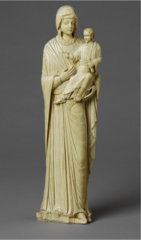
Virgin and Child, Ivory statuette, 11th century (late Byzantine)
It is ivory, and there is a flatness to it, the back. An alter piece, is currently in the Metropolitan Museum of Art. This statuette, carefully cut from an ivory plaque, follows a widespread Byzantine image type called the Hodegetria, in which the Virgin supports the Christ Child with her left arm. It takes its name from an icon housed in the Hodegon Monastery in Constantinople. late Byzantine

Cathedral of St. Mark, Venice, b. 1063 (late Byzantine)
- For most of its life, it was a basilica. It also served as the private chapel of the Doge (the ruler of Venice) and a state sanctuary. It only officially became the cathedral church of Venice in 1807. The mark is the lion with the wings. Other saints are on the top as well. Relic of Saint Mark. The four magnificent bronze horses on the balcony are known as the Horses of Saint Mark (or the Triumphal Quadriga). Spolia refers to repurposing building materials or statues stripped from conquered ancient cities. These horses, along with hundreds of marble columns and the famous purple porphyry statue of the Four Tetrarchs, were stolen from the Hippodrome of Constantinople when the Venetians sacked the Byzantine capital during the Fourth Crusade in 1204. Displaying these horses right on the public facade was a deliberate, aggressive piece of political theater. It broadcast Venice's immense maritime and military strength, essentially telling the world that they had brought the greatest empire of the East to its knees. Body of saint mark is in a crypt below, it is kept safe.

Palace Chapel, Palermo, 12th century, consecrated 1140. Palermo, Sicily (late Byzantine)
- The Palatine Chapel, for the palace's use, shows a separation within the territory; Roger II ruled over a population that was predominantly Muslim. Christianizing a Muslim area, we have pointed arches; we see this in Muslim architecture. Chapel down below. We have a cloister, an aisle, a narthex, and a raised platform. Palatine chapels often hold bodies of the rulers of the territory. It looks massive; however, it was a more intimate space. A different approach to a dome; it is not a pendentive approach. It is a squinch; often Muslims use it. But it isn't always the case. It's adjusting our triangle form. There is also muqarnas; it creates this really elaborate form, it was colored. They are made to look like a star, so like a starry sky in the nave of the church.

Church of S. Clemente, Rome, rebuilt after 1084, consc. 1128 (mature Romanesque)
We have seen this before because you can go into the catacombs through this place, as well as the Mithraeum. We also had a choir within the church. It's the large rectangle. Like early Christianity in Rome, it was much like that, but then it was changed. A lot of marble work, Cosmati floors. It becomes branded in a way that the name is the thing itself. But the Cosmati family is most known for this type of floor work. Extremely large choir.

The cross of the Tree of Life, S. Clemente, Rome, 12th century (mature Romanesque)
The mosaic inside is important, if there I only two people near a cross it is Mary and John. Peacock on it, which is a symbol of Christ. We have all types of people of the early, it's the tree of life and I see it as a contrast with how Christ spreads life. We have two images of Christ: we have Christ in majesty, and the hand. Layer and layer of iconography in it.

Gislebertus, Last Judgement, Autun, France Cathedral, c. 1140 (mature Romanesque)
In the church, they have the writing from Gislebertus. A figure between the doors is siant lazierous. He is the man that Christ brings back to life. According to legend, they came to France and became bishop; this site is to said to be his burial site. This is a depiction of the Last Judgment; we have Christ in majesty with angels holding him up. They are nude, they are raised from there tomb to be judged. It isn't a gentle process to be judged; there is claws grabbing a man to judge him. It is part of the belief that it's both faith and acts. It depicted both heaven and hell. The terror vs. the calm peaceful eternal life. There is zodiacs and the labor of the months; in the outermost, the presence of this suggests that Christ is both the leader of heaven and the earth.

Church of the Madeleine, Vezelay, c. 1120-1132 (mature Romanesque)
Christ in majesty, but it was destroyed in the French Revolution; they wanted to recreate it. Does not have the original façade. The interior portals of the narthex coming in. Madeleine is an important saint. The tympanum and the jamb sculptures.

Pentecost and Christ's Mission to the Apostles, Vezelay, c. 1130s (mature Romanesque)
The central image: Christ in majesty, figure in the center, classical elements of a cruciform nimbus. Light is streaming out of his hands; we also have people surrounding him; one of the people has a key, aka Saint Peter. Image of Christ and the apostles. Image of Pentecost, mission to the apostles. It is an unusual iconographic construction. Below Christ and the apostles, on the lintel, we see the Crusades and the pilgrims, so we see pilgrims and crusaders. On the tympanum there are mythical people, fantastical representations of people. There are two portals: the first portal is the Mary Theotokos, the adoration of the shepherds; the central image is Mary. Left to right, the angel Gabriel, aka the Annunciation, the Incarnation of Christ. Mary visiting Elizabeth; Elizabeth is a cousin, who is much older than Mary, and that child is John the Baptist. Aka the visitation of Christ and John, and the nativity and adoration of the Magi. The second image speaks to the resurrection of Christ. Mary madeleine coming into contact with Christ; the French Revolution took their heads off. Image of the ascension.
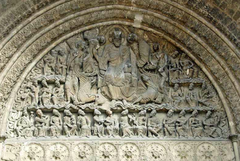
Apocalyptic Vision, Abbey of St. Peter, Moissac, 1125-1130 (mature Romanesque)
program.
Apocalyptic Vision, Abbey of St. Peter, Moissac (1125-1130)
Context: Benedictine monastery with a single-nave church; technically not a basilica.
Main portal (Apocalyptic Vision):
Animals spouting foliage, possibly reflecting Middle Eastern artistic influences brought back by pilgrims.
Crossing lions suggest exposure to Middle Eastern art and designs.
Ribbon-like patterns resemble Kufic designs from the Middle East.
Christ in Majesty is surrounded by the Tetramorph (symbols of the four Evangelists: John, Luke, Mark, and Matthew).
Twenty-four elders hold musical instruments, reflecting instruments from the period.
Based on the Book of Revelation, this scene represents the end of time. It is different from the Last Judgment in both imagery and meaning.
Location: The monastery was on an important pilgrimage road.
Other Portal Sculptures
- Left portal (Mary's life):
Annunciation: Mary and Gabriel.
Visitation.
Nativity.
Adoration of the Magi.
Flight into Egypt.
- Right portal (moral lessons and biblical stories):
Represents the Seven Deadly Sins.
Lust: Often represented by a woman with toads on her, symbolizing decay.
Demons appear throughout the scenes.
A dying person, interpreted as a daughter, has demons dragging away her soul because of greed.
Rich Man and Lazarus:
A poor, homeless man is shown alongside a wealthy man who has everything.
Angels carry the poor man to the bosom of Abraham (a biblical representation of heaven).
The rich man looks up from hell and sees Lazarus.
Figures at the Entrance and Exit
Entrance: Old Testament prophets Isaiah and Jeremiah.
Identified by the scrolls they hold.
Exit: New Testament figures Peter and Paul.
Represent the apostles and the development of the new Christian community, distinct from the Jewish community.
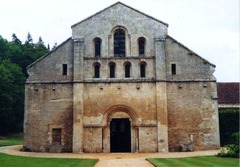
Abbey Church of Fontenay, 1130-1147 (mature romanesque)
Because they have this idea of poverty and simplicity. This survived because it was so far out; some have transformed into different functions because they because it was so far out, some have transformed into different functions, becaued ethey are very solid structures. There is vultryly no scultpures, is it's a very imple structure, stroing simplictym and also on the interior. they have a kitchen and a place to wash there hands, it is a monastery. Cistercian monastery, it happened to be very geometric. An attempt to regulate the space in very dilbibrate ways. The interior of the church. There is no clear story, there is no trigram, it's the natal value that leads directly to the barrel vaulet, this is an isolated community and are not building on that same scale. it's called proto gothic, it is not the gothic we would think but it has a pointed arches and that is an element. the width of the nave is the width of the nave arcade. the sysmtery and modular structure wa secret mathematically planned. the cisteriauims, also received important land owners bodies and had them in these spaces. no embleshment, the capitals has a hint of foliage so zero to nun scultupres. in the storage facility's there is a ribbed vault. some of the architecture elements have been painted but not to the level we have been seeing. in this case this would be the embellishment, and this is also technically a feature of gothic architecture.

Christ in Majesty, San Clemente de Tahull, ca. 1123 (mature romanesque)
Context: Spanish Romanesque church with a large bell tower visible from the roads, a small interior, an apse, and side chapels.
Mural: Originally painted directly onto the church wall; now preserved in an art museum using the strappo technique (removing the painted surface).
Imagery:
Christ in Majesty sits inside a mandorla with a cruciform halo.
Holds an open book and raises his hand in blessing.
Surrounded by angels and the Tetramorph (four Evangelists).
Alpha and Omega symbols appear on either side of Christ.
Saints are identified by name, including Mary, John, and Bartholomew.
Mary holds an unusual bowl with red flames rising from it, interpreted as a possible reference to the Holy Grail and the Last Supper.
Pilgrimage connection: The imagery relates to pilgrimage traditions and legends surrounding the Holy Grail, particularly the route to Jaca.
Style and technique:
Bright, vibrant colors, including lapis lazuli blue.
Polished stucco creates a shiny surface.
Italo-Byzantine influence, with attempts to create three-dimensional figures and depth.
Yellow paint imitates the appearance of gold.
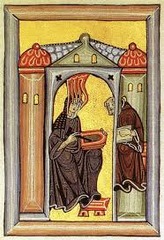
Hildegard of Bingen, manuscript, protogothic
A preflifc writer, writers devoltional music, saint who wrote about her visions. Mystical tricusions about god and soul, writers exenetiveley, she traveled because of the binesisn of the abbey, they had money? Migranes might be the root cause of the vsion. The patterns, This is a manuscript, ink on vellum. Pentacost scenes usually a flame or light coming down upon somtehing, it is trying to depict she had a vision. How do we communicate that a vison happens, Tedriols of light emilating from her, she had a witness, we are likely looking at her a priest and writes her biography as well as confessors/advisors(someone who is helping you with your moral life), she has a writing block and her stylis, it is being witness, and reaognied something was happening to her. No location, a rise of a type of scholastic humanism
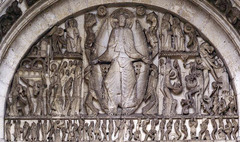
Church of Sainte-Foy Conques, France, protogothic, The last judgement
The last judgment, the chaos has devils, people are bring roasted, burned teeth pulled out, devil is forcing people who are going into hell are being ofrced in. Contsratsingf I sthe heaven side, we have the images of ressueration of the dead, angels lifting the lids for people to come out, the scales are not tehre but the demon can be intriped to be pulling down the scale. Eating the face of another person. People on right of christ people are being elevated and the peole on the left are being damned in this depeicteion of the last judgement.
Has the basic of a pilagrams church. Just a regualr small town churhc on the pillgramge road.

Reliquary Sainte-Foy, Conques, France, protogothic
Sainte-foy he bites her finger off? And that becomes a relic?? Competyed made up of inlay that was actyallt given to the people for her, Fillagree work, engraved areas, works of coming to eygpt- Fatimid glass, named after the daughter.

Abbey Church of St. Denis, Paris, apse (early gothic)
Outside the city wall churches, a structure tht has surrfered a lot with time, the french reveoltion, place where the ealry king were buried, and connected to the monacrhy, and those were being destroyed. SIgnifcatnt reconstruction. Standrad layou, it has three doors. It didn have a plan for 2 bell toweers however the sceond oen wa snever built. This site is a very ealy stucture of carolingtion, very imoront chruch for the ealry king of france. Abbot Suger, he had to make an argument for why they had to rebuild this site. The argument was that it needed to be safe, ot could no longer support the amount of people who were coming on the pilgramiges, and the damage that comes with it. West portal and the apse are teh first to be worked on. Christ in throne, also looks like he is on a cross. So sort of looked like crufixed, there is also the apoolsyles. Resration of the body, musictions, harpes, iamge from reveoltions. 24 elders is on the archviolts. Christ is also not fully covered, because it is a crufixion scene. We have images that relate to the crufixion, the crown of thron, the nails. The APSE, we have rather dramatic lancet windows. We have the base elements we shoudle xpoect, a nave archade, triforum and clestory. The rise of really large brutrsies. They have become so much bigger an dtaller because they put in so much more glass. This is considered a flying buchrecisies. They are destreuibing the weight from the wall to the buchreiss. Still isnt done with reconstruction. It's a floral shape, it feel segmanted. Mnay alters. They have bene opened up so much but they are radiitng chapes. Three dotted lines, for a ribbed vault. The ribbed vault help distribute the weight, that process also gives a feel to it that you are being lifted into the heavens. A place where you are expted to be buried if you were a king.
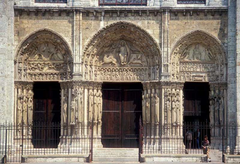
Royal Portal, Chartres Cathedral (Early Gothic)
Blend of forms , some what based off of abbey church. But also a unvisrtity. They took the relic pf the virgn that surived in the ifre to get money to rebuild. The rebuild to the same level but wanted it bigger and better. We have a really cpmplex prorgams that inclues the jams, they also have a contuinous band of history in the capitals. The centrela one I sthe ending f the porgam instead of the beginning the program. The jams is where you start, very enlongated, They are colum like, we are looking at old teatsemt prohets, kings, and queens. The foundation of the royal portal is restsing on the jams an dthe old testamanet. These are on the tempanem. The annucation/incarction, The visitation , the birth, etc. In the arcivolt, we have a women holding a harp, we have a schoalr, we have someome with a sheild, we are looking at vurtus and liberal arts. The last supper, and post resustaion scene so the life of christ. We have a reprensetion of revelotions, which fills out the entiry of the program. It is christ in magesty. Mark, luke, john, matthew is also there. The transcept is very short, the choir would be really big, also ribbed vault and transver arches. The labryinth is on the ground, it was made to be used. Ribbes are becoming more compound as they are coming up.

Tree of Jesse, Chartres Cathedral, 1150-1170 (Early Gothic)
King of Jesse, Jesse is Davids father there is an old tetsemnt weight on it. The tre eis coming from between his legs, basically amry and christ human ancestrory.
Trade windows, the stone masions are creating jams, etc, so we have a represnetaion on the site being built.

Cathedral of notre dame, Paris (Early Gothic)
Named after the Virgin, "Our lady" is what Notre Dame. Two completed bell towers look the same. The Gallery of Kings is Old Testament. We have more stained glass and culture within in and an even larger portal. The exterior looks different. The transept does not extend out. We have radiating chapels. Nave, two side aisles, and a series of chapels. Flying buttress, have extended dramatically out in the space. At the south portal, there is so much more stained glass. This place has gargoyles near the flying buttress. Cathedrals are usually urban and the seat of the bishop. Only cathedral near water. Every hour bell towers would be ran. Last Judgment scene, on the triforium. Mary on the triforium and a Mary and Jesus statue in front of the stained glass. Much larger gallery triforium. Point of being vertical. Nave to the apse, that there is a shift of the glass, singular rose with lancets, where there are roundels in between. Chevy apse area. The gracious, looks like a monkey, they tended to be water spouts. Gargoyles are to scare away evil spirits.

Portico de la Gloria, santiago de Compestela, c. 1169-1188 (Early Gothic)
Interior narthex, same location that Pope Leo was at. The jams, trimofr figur eith saint james, and a figure of Jesu sin magesty. On the triforim. 24 elders, book of reveltions, man is writing, we have the oxne, lion, man, and eagle. They are all writing, the gospel writers. There is harpes, an explosion of intrsuemmts, also to fconnection to enlag, and the pilgram roads. Bringing togethe rof alot of images/instruments. Old tetsment figures are hol;domg scrolls, and they are painted. They painted bloodo on his hands, this is a rprensettaion of Chriosy wiyh his stigmata. Aka the wounds of christ.

Chartres Cathedral, b.c. 1194 (mature gothic)
There is a laybrinth on the ground. Is the best known. Aspect of devotion. The depth of the portals extend signifncaly out into space. The centeral panel. We have christ shwoung his wounds, mary and john are beside him. The last judgement is from the book of matthew. Hell verus heaven scene in the

St. Theodore, Martyr's Bay, Chartres Cathedral, mid-13th (mature gothic)
Saints instead of old testament people, in the portals. Saint thedore. Some same features are older and younger people in the sucktures and some level of specifcity, he is a soilder saint. We are looking at chainmail armor, in modern clothing of the time. Its extending all the way over his hands and also his hood that covers him up. He has the cloth over the chainmail armor. Elements that tell us the professions of the different saints.

Charlemagne Window, Chartres Cathedral, c. 1210-1236 (mature gothic)
a young love, battle of charmolnge, roland is protecting her. in the poem, he sacrifices his life for charolmange. it's mostly about roland in this stained glass. in the image, the bishop, charlemagne and also roland in it as well. 12th cherry is blossoming of romance literature. other narratives that relate to his life. within this religious structure there is a love poem. sung in courts. that would have been sunge

Reims Cathedral, Reims France b.c. 1211 (mature gothic)
-Mature Gothic architecture: Reims Cathedral is an example of Mature Gothic architecture, built beginning around 1211. - Important religious history: Reims is historically significant because Clovis, the first King of the Franks to convert to Christianity, was baptized here. French kings were also traditionally crowned at Reims Cathedral. - Symbol of Christianity in France: The cathedral represents the lasting importance and influence of Christianity in French history. - Stained glass expansion: Stained glass became increasingly important in Gothic churches. At Reims, it expands into more areas of the cathedral, allowing more colorful light to enter the building. - Sculptures of French kings: The exterior features sculptures of French kings, connecting the cathedral to France's monarchy and religious history. Important Architectural Features
Cathedral of Reims. Expanding sculptures: Sculptures extend farther out from the actual walls, making the figures appear more three-dimensional and lifelike. Detailed west facade: The entire western front is covered with elaborate sculptures and decorative details. Sculptures inside and outside: Gothic sculpture is dramatically expanded throughout both the exterior and interior of the cathedral. Larger use of stained glass: Stained glass is no longer limited to just a few areas and becomes a more prominent feature of the church. Comparison to Notre-Dame: Reims Cathedral was built during the same general Gothic period as Notre-Dame Cathedral. However, Reims takes Gothic architecture further through its expanded stained glass and more elaborate, three-dimensional sculptures.

Annunciation (c. 1245-1255) and Visitation (c. 1230), Reims Cathedral (mature gothic)
In the figures/sculptures, there is more detail in the cloth; it's more naturalistic. In the Annunciation and the Visitation, there are elements that show how they are pregnant through their forms. There is a Roman versus Gothic style in the sculptures; you can see that these two pairs of sculptures are not the same, and the art is different.

Louis IX and Blanche of Castile, Moralized Bible, Paris 1226-1234 (mature gothic)
Louis becomes the king of France at the age of 12, Blanche makes sure that her son fits, so she maintains control of the kingdom for her son until he can actually take control. The image is balanced, and her crown son in it, this is the frontispiece of a moralized Bible. There is also artwork that seems to comment on the text in images. Allows for a level of interpretation. This is the moralized Bible that balance gives to her son. She wanted her son to be developed as well. He does marry and have 11 kings; he was a mama's boy, so mom was first. Part of Blanche's role was to govern and educate her son to become a good Christian king. The bottle is a symbol of work and a circle showing dedication to our illustrator. In the object that Louis is looking at, he can see the book being made in the art.

Sainte-Chapelle, Paris, 1243-1248 (Rayonnant)
This chapel was built to hold the relics that Saint Louis took after the Seventh Crusade when he was captured and ransomed; then, on his way back got the thorn of crown that was in the bible. It is very much within the palace grounds. It's very small, and externally a jewel box for the relics. Because it was small and just a bunch of stained glass within it. It is referred to as the Lady Chapel, and the lower level was said to be for the king/queen. More than half the elevation is stained glass; a clerestory gallery also holds stained glass. This is the kind of style in the south of France: the lower level, the "Lady" level. The king, the blanche, is present through the columns with the tiny castles. The stained glass does not survive because of the French Revolution. There is no bare walls here. The relics were above the altar. The stained glass was primarily focused on Old Testament kings, with a window for the relics being found. Floral detail is a testament to the French kings. Embellishment suggests that this place holds such important relics and that the place where they are held needs to be decorated. It looks like a tree, with more and more patterns. After Saint Louis died, he was canonized.