F2M8 - Ratio and Variance Analysis
 Call Kai
 Learn
 Practice Test
 Spaced Repetition
 Match
 Flashcards
 Knowt Play
1/3

There's no tags or description
Looks like no tags are added yet.
4 Terms
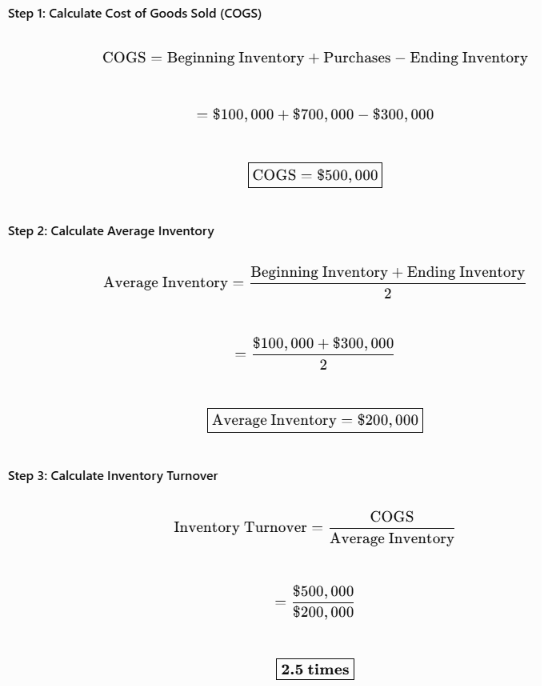
The following information was taken from Baxter Department Store's financial statements:
Inventory at January 1 100,000
Inventory at December 31 300,000
Net sales 2,000,000
Net purchases 700,000
What was Baxter's inventory turnover for the year ending December 31?
A. 3.5
B. 2.5
C. 10
D. 5
CPA exam shortcut
Ratio | Formula |
|---|---|
Inventory turnover | COGS ÷ Average inventory |
Accounts receivable turnover | Net credit sales ÷ Average A/R |
Total asset turnover | Net sales ÷ Average total assets |
Days in inventory | 365 ÷ Inventory turnover |
Stent Co. had total assets of $760,000, capital stock of $150,000, and retained earnings of $215,000. What was Stent's debt-to-equity ratio?
A. 2.63
B. 0.52
C. 1.08
D. 0.48
CPA exam shortcut
Ratio | Formula |
|---|---|
Debt-to-equity | Total liabilities ÷ Total equity |
Debt ratio | Total liabilities ÷ Total assets |
Equity ratio | Total equity ÷ Total assets |
Equity multiplier | Total assets ÷ Total equity |
Interpretation: A debt-to-equity ratio of 1.08 means Stent has approximately $1.08 in liabilities for every $1 of stockholders' equity.
CPA exam tip: When a question provides total assets, capital stock, and retained earnings, calculate equity first, then subtract equity from assets to find liabilities.

If Hutton Inc. sold $100 of inventory for $100 of cash on December 31, Year 2, which of the following ratios would decrease?
A. Return on assets
B. Working capital turnover
C. Net profit margin
D. Return on equity
Mẹo nhớ cho CPA exam:
Sales tăng + Net income không đổi → Net profit margin giảm.
Còn Working capital turnover tăng vì doanh thu tăng nhưng working capital không đổi.
Step 1: Analyze the transaction
Hutton Inc. sells inventory costing $100 for $100 cash.
Account | Effect |
|---|---|
Cash | +$100 |
Inventory | −$100 |
Sales revenue | +$100 |
Cost of goods sold | +$100 |
Net income | No change |
Total assets | No change |
Stockholders' equity | No change |
Because the inventory is sold at cost, there is no profit or loss.
Step 2: Analyze each ratio
Ratio | Formula | Effect |
|---|---|---|
A. Return on assets | Net income ÷ Average total assets | No change |
B. Working capital turnover | Net sales ÷ Average working capital | Increases |
C. Net profit margin | Net income ÷ Net sales | Decreases |
D. Return on equity | Net income ÷ Average equity | No change |
Step 3: Calculate the net profit margin
From the previous question, Hutton's Year 2 results were:
Net sales: $3,000,000
Net income: $350,000
Before the transaction:
Net Profit Margin$350,000\$3,000,000=11.6667
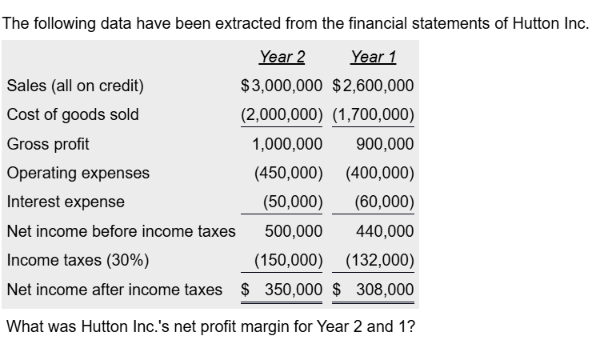
Net profit margin
CPA exam shortcut
Be careful not to confuse these profitability ratios:
Ratio | Formula |
|---|---|
Gross profit margin | Gross profit ÷ Net sales |
Operating profit margin | Operating income ÷ Net sales |
Net profit margin | Net income after taxes ÷ Net sales |
CPA exam tip: For net profit margin, always use net income after taxes, not income before taxes.
