Insulin, Glucagon & Diabetes
 Call Kai
 Learn
 Practice Test
 Spaced Repetition
 Match
 Flashcards
 Knowt Play
1/63

There's no tags or description
Looks like no tags are added yet.
64 Terms
Insulin vs. Glucagon: What are insulin and glucagon?
Protein hormones produced by the pancreas.
Regulate blood glucose levels.
Work in opposite directions to maintain blood glucose homeostasis
Insulin vs. Glucagon: Fed vs. Fasting Metabolism: Where are insulin produced?
Pancreatic β (beta) cells.
Insulin vs. Glucagon: Where are glucagon produced?
During fasting, when blood glucose falls.
Stimulates glucose production and release by the liver.
Helps raise blood glucose.
Insulin vs. Glucagon: What is the main difference between insulin and glucagon?
Insulin | Glucagon |
|---|---|
Fed state | Fasting state |
Lowers blood glucose | Raises blood glucose |
Promotes glycogenesis | Promotes glycogenolysis |
Promotes fatty acid synthesis | Favors fuel mobilization |
Insulin = IN and store. Glucagon = Glucose Gone, make more.
Fed vs. Fasting Metabolism: What happens to metabolism after eating?
Blood glucose increases.
Pancreatic β cells release insulin.
Glucose uptake increases in insulin-responsive tissues.
Glycogen and fatty acid synthesis increase.
Fed vs. Fasting Metabolism: What happens to metabolism during fasting?
Blood glucose decreases.
Pancreatic α cells release glucagon.
Liver glycogenolysis and gluconeogenesis increase.
Stored fuels are mobilized.
Fed vs. Fasting Metabolism: Why does the body store glucose after eating?
Blood glucose is abundant.
Excess glucose can be stored as glycogen.
Energy can also be stored as fat.
Fed vs. Fasting Metabolism: Why does the liver release glucose during fasting?
Helps maintain blood glucose levels.
Supplies glucose to tissues that require it.
Uses glycogenolysis and gluconeogenesis.
Glycogen Metabolism: What is glycogenesis?
Synthesis of glycogen from glucose.
Stores glucose for later use.
Promoted by insulin.
Glycogen Metabolism: What is glycogenolysis?
Breakdown of stored glycogen.
Helps supply glucose during fasting.
Promoted by glucagon in the liver.
Glycogen Metabolism: What is gluconeogenesis?
Production of new glucose from noncarbohydrate precursors.
Can use pyruvate and lactate.
Promoted by glucagon in the liver.
Glycogen Metabolism: How are glycogenolysis and gluconeogenesis different?
Glycogenolysis: Releases glucose units from existing glycogen. (OLD)
Gluconeogenesis: Synthesizes new glucose. (NEW)
Both help maintain blood glucose during fasting.
Glycogen Metabolism: Which enzyme synthesizes glycogen?
Glycogen synthase.
Adds glucose units to glycogen.
Favored by insulin signaling.
Glycogen Metabolism: Which enzyme breaks down glycogen?
Glycogen phosphorylase.
Removes glucose units from glycogen.
Favored by glucagon signaling in the liver.
Phosphorylation and Enzyme Regulation: What is phosphorylation?
Addition of a phosphate group to a molecule.
Can change enzyme activity.
Does not always activate an enzyme.
Phosphorylation and Enzyme Regulation: What is dephosphorylation?
Removal of a phosphate group.
Can activate or inhibit an enzyme.
Its effect depends on the enzyme.
Phosphorylation and Enzyme Regulation: What happens when glycogen phosphorylase is phosphorylated?
Becomes more active.
Glycogen breakdown increases.
Favors glycogenolysis.
Phosphorylation and Enzyme Regulation: What happens when glycogen synthase is phosphorylated?
Becomes less active.
Glycogen synthesis decreases.
Less glucose is stored as glycogen.
Phosphorylation and Enzyme Regulation: What happens when glycogen phosphorylase is dephosphorylated?
Becomes less active.
Glycogen breakdown decreases.
What happens when glycogen synthase is dephosphorylated?
Becomes more active.
Glycogen synthesis increases.
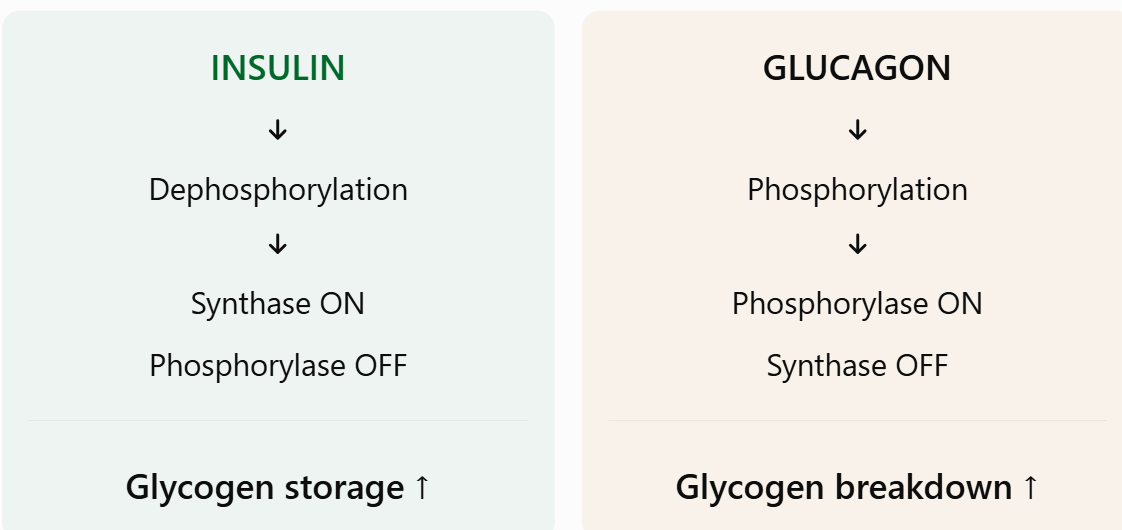
Phosphorylation and Enzyme Regulation: How does glucagon affect glycogen enzymes?
Promotes phosphorylation.
Glycogen phosphorylase ON.
Glycogen synthase OFF.
Net effect: Increased liver glycogen breakdown.

Phosphorylation and Enzyme Regulation: How does insulin affect glycogen enzymes?
Promotes dephosphorylation.
Glycogen phosphorylase OFF.
Glycogen synthase ON.
Net effect: Increased glycogen storage.
Phosphorylation and Enzyme Regulation: Does phosphorylation always activate enzymes?
No.
Activates glycogen phosphorylase.
Inhibits glycogen synthase.
Always identify the enzyme before predicting the effect.
Insulin and Glucose Transporters: What are GLUT transporters?
Membrane proteins that transport glucose into cells.
Use facilitated diffusion.
Do not directly consume ATP.
Insulin and Glucose Transporters: What is facilitated diffusion?
Movement down a concentration gradient.
Requires a transport protein.
Does not directly require ATP.
Insulin and Glucose Transporters: How does insulin increase glucose uptake?
Promotes GLUT4 insertion into cell membranes.
Especially important in skeletal muscle and adipose tissue.
More GLUT4 at the membrane allows greater glucose uptake.
Insulin and Glucose Transporters: What is insulin resistance?
Cells respond less effectively to insulin.
Insulin-regulated glucose uptake and metabolism become impaired.
Can contribute to elevated blood glucose.
Insulin and Glucose Transporters: Does GLUT-mediated glucose transport directly require ATP?
No.
Glucose moves by facilitated diffusion.
Insulin signaling can regulate transporter availability, but transport itself is passive.
Fatty Acid Synthesis and Oxidation: What is acetyl-CoA carboxylase (ACC)?
An enzyme involved in fatty acid synthesis.
Converts acetyl-CoA → malonyl-CoA.
An important regulatory enzyme.
Fatty Acid Synthesis and Oxidation: What is malonyl-CoA?
A precursor used in fatty acid synthesis.
Produced by ACC.
Also inhibits CPT1, reducing long-chain fatty acid oxidation.
Fatty Acid Synthesis and Oxidation: What happens to ACC when insulin is high?
ACC is activated through dephosphorylation.
Malonyl-CoA production increases.
Fatty acid synthesis increases.
Fatty Acid Synthesis and Oxidation: What happens to ACC during fasting?
Phosphorylation favors ACC inactivation.
Malonyl-CoA decreases.
Fatty acid synthesis decreases.
Fatty Acid Synthesis and Oxidation: What is CPT1?
Carnitine palmitoyltransferase 1.
Helps long-chain fatty acids enter the mitochondrial oxidation pathway.
Inhibited by malonyl-CoA.
Fatty Acid Synthesis and Oxidation: What happens when malonyl-CoA is high?
CPT1 is inhibited.
Long-chain fatty acid β-oxidation decreases.
Fatty acid synthesis is favored.
Fatty Acid Synthesis and Oxidation: What happens when malonyl-CoA is low?
CPT1 inhibition is relieved.
More long-chain fatty acids can enter mitochondrial oxidation.
β-oxidation increases when other conditions support it.
Fatty Acid Synthesis and Oxidation: How does insulin regulate fatty acid metabolism?
Activates ACC.
Increases malonyl-CoA.
Promotes fatty acid synthesis.
Suppresses fatty acid oxidation.
Fatty Acid Synthesis and Oxidation: How does glucagon favor fatty acid oxidation during fasting?
Fasting promotes fat mobilization.
ACC activity and malonyl-CoA decrease.
Reduced CPT1 inhibition allows more β-oxidation.

Fatty Acid Synthesis and Oxidation: Why doesn't the body strongly synthesize and oxidize fatty acids simultaneously?
These pathways have opposing functions.
Malonyl-CoA helps coordinate them.
High malonyl-CoA favors synthesis while inhibiting mitochondrial long-chain fatty acid oxidation.
Ketone Bodies and Ketogenesis: What are ketone bodies?
Molecules produced mainly by the liver from acetyl-CoA.
Important alternative fuels during prolonged fasting.
Produced through ketogenesis.
Ketone Bodies and Ketogenesis: What are the three ketone bodies?
Acetoacetate.
β-hydroxybutyrate.
Acetone.
Ketone Bodies and Ketogenesis: Where are ketone bodies produced?
Primarily in liver mitochondria.
Production increases when fatty acid oxidation is elevated.
Ketone Bodies and Ketogenesis: Why does ketone production increase during fasting?
Fatty acid β-oxidation increases.
More acetyl-CoA is produced.
Oxaloacetate availability for the citric acid cycle can become limited.
Excess acetyl-CoA is directed toward ketogenesis.
Ketone Bodies and Ketogenesis: What is the role of oxaloacetate in ketone production?
Oxaloacetate combines with acetyl-CoA in the citric acid cycle.
During fasting, oxaloacetate is needed for gluconeogenesis.
Reduced availability can limit acetyl-CoA oxidation in the cycle.
Ketone Bodies and Ketogenesis: Why can the brain use ketone bodies during prolonged fasting?
Ketone bodies provide an alternative energy source.
Help reduce dependence on glucose.
Become increasingly important during prolonged fasting.
Ketone Bodies and Ketogenesis: What is diabetic ketoacidosis (DKA)?
A dangerous condition involving excessive ketone production and metabolic acidosis.
Usually associated with severe insulin deficiency.
Can cause dangerously acidic blood.
Ketone Bodies and Ketogenesis: Is normal fasting ketosis the same as diabetic ketoacidosis?
No.
Fasting ketosis is a regulated metabolic adaptation.
DKA involves excessive ketone accumulation and dangerous acidification.

What is diabetes mellitus?
A condition involving chronically elevated blood glucose.
Caused by impaired insulin production, insulin action, or both.
What causes Type 1 diabetes?
Autoimmune destruction of pancreatic β cells.
Very low or absent insulin production.
Requires insulin treatment.
What causes Type 2 diabetes?
Insulin resistance.
Often accompanied by progressive impairment of insulin secretion.
Insulin may initially still be produced.
What is the difference between Type 1 and Type 2 diabetes?
Type 1 | Type 2 |
|---|---|
Autoimmune β-cell destruction | Insulin resistance and β-cell dysfunction |
Little or no insulin | Insulin often present initially |
Insulin required | Various treatments, sometimes insulin |
What is hyperglycemia?
Abnormally high blood glucose.
Can result from inadequate insulin production or action.
Persistent hyperglycemia damages tissues over time.
What is hypoglycemia?
Abnormally low blood glucose.
Often defined as below 70 mg/dL.
Can cause sweating, weakness, confusion, and rapid heartbeat
What fasting blood glucose level meets the diabetes diagnostic threshold?
126 mg/dL or higher.
Diagnosis generally requires confirmation if clear symptoms are absent.
What complications can persistent hyperglycemia cause?
Cardiovascular disease.
Kidney damage.
Vision problems.
Impaired wound healing.
A liver enzyme becomes phosphorylated and glycogen breakdown increases. Which enzyme is likely activated?
Glycogen phosphorylase.
Phosphorylation favors its active form.
Promotes glycogenolysis.
A liver enzyme is dephosphorylated and glycogen synthesis increases. Which enzyme is activated?
Glycogen synthase.
Dephosphorylation activates it.
Promotes glycogenesis.
Insulin increases, ACC becomes active, and malonyl-CoA rises. What happens to β-oxidation?
Decreases.
Malonyl-CoA inhibits CPT1.
Less long-chain fatty acid enters the mitochondrial oxidation pathway.
During fasting, malonyl-CoA decreases. What happens to CPT1?
CPT1 inhibition is relieved.
Long-chain fatty acid oxidation can increase.
A patient has severe insulin deficiency and excessive ketone production. What complication is possible?
Diabetic ketoacidosis.
Excess acidic ketones can lower blood pH.
Why can ketone production increase when oxaloacetate is used for gluconeogenesis?
Less oxaloacetate may be available for the citric acid cycle.
Acetyl-CoA accumulates.
More acetyl-CoA can enter ketogenesis.
A person has normal insulin production but reduced cellular responsiveness. Which condition does this describe?
Insulin resistance.
Common feature of Type 2 diabetes.
If glucagon is elevated, what happens to liver glycogen metabolism?
Glycogen phosphorylase activity increases.
Glycogen synthase activity decreases.
Glycogen breakdown is favored.
If a cell has more GLUT4 transporters at its membrane, what happens?
Glucose uptake capacity increases.
Glucose enters through facilitated diffusion.
No ATP is directly consumed by GLUT4 transport.
A fasting liver cell has high β-oxidation and elevated acetyl-CoA. What pathway may increase?
Ketogenesis.
Excess acetyl-CoA can be converted into ketone bodies.