Substitution + Elimination - Orgo Exam 2
 Call Kai
 Learn
Learn Practice Test
 Spaced Repetition
 Match
Match Flashcards
 Knowt Play
1/122

There's no tags or description
Looks like no tags are added yet.
Name | Mastery | Learn | Test | Matching | Spaced | Call with Kai | Chat |
|---|
No analytics yet
Send a link to your students to track their progress
123 Terms
What are the reactants of a substitution reaction?
R (carbon containing group) - LG (leading group)
What are the products of a substitution reaction?
R-Nucleophile + Leaving Group
Substitution reactions occur with
nucleophile and solvent
halogen attached to carbon is
leaving group
the nucleophile has what to make a new bond?
lone pair
what is SN1
substitution nucleophiles 1st order rate
what is SN2
substitution nucleophiles 2nd order rate
the SN1 mechanism has how many steps?
two
the SN2 mechanism has how many steps?
1
what is the first part of an SN1 reaction
R-X, breaks the bond
what is the second part of SN1
nucleophile binds to R (carbon intermediate), X is leaving group
what happens in SN2
Nucleophile binds to R and leaving group breaks bond
what is the difference between SN1 and SN2
SN2 has no carbon intermediate and occurs in one fluid step
mechanisms must follow specific sequences of
bond making and breaking
each bond made or broken must have
a curved arrow
curved arrows represent
the movement of electrons
the arrow points towards
where the electrons are going, in either making or breaking a bond
each step in a mechanism is balanced with respect to
charges and atoms

this is an example of which reaction
SN1

this is an example of which reaction
SN2
what is the rate equation for SN1
rate=K[R-X]
what is the rate equation for SN2
rate=K[R-X][Nuc]
Why doesn’t the rate reaction include a nucleophile for SN1
it is not involved in the rate determining (slow) step
if you double the rx of SN1
the rate doubles
if you double the nucleophile in SN1
nothing changes
if you double the rxs and the nuc in SN1 (whole reaction)
the rate doubles
if you double the rxn in SN2
the rate doubles
if you double the nuc in SN2
the rate doubles
if you double the rxn and the nuc in SN2 (whole rxn)
the rate quadruples

which does this energy diagram represent?
SN1

which does this energy diagram represent?
SN2
the carbocation intermediate is_______ in energy than R-X or R-Nuc in SN1
higher
why is the first hump in SN1 higher in energy than the second
the 1st step was slow and required more energy
** review stereo chemical outcomes
what is the first rule in deciding if SN1 or SN2
the structure of the alkyl halide
what is the second rule in deciding if SN1 or SN2
the strength of the nucleophile (weak or strong)
what is the third rule in deciding if SN1 or SN2
leaving group ability
what is the 4th rule in deciding if SN1 or SN2
solvent
what variables are MOST important in deciding SN1 or SN2?
structure of the alkyl halide and strength of the nucelophile
SN1 has what reaction with a Methyl
no reaction
SN1 has what reaction with a 1° carbon
no reaction
SN1 has what reaction with a 2° carbon
slow rxn
SN1 has what reaction with a 3° carbon
fast rxn
SN2 has what reaction with a methyl carbon
fastest rxn
SN2 has what reaction with a 1° carbon
fast rxn
SN2 has what reaction with a 2° carbon
slow rxn
SN2 has what reaction with a 3° carbon
no rxn
if the rxn is with a 1° or methyl it is likely
SN2
if the rxn is with a 3° it is likely
SN1
if the rxn is with a 2° it is likely
SN1 or SN2
SN1 follows what rules for the structure of alkyl halides?
carbocation stability rules (3° = most stable, methyl = least stable)
more adjacent carbons =
mosre stable carbocations
hyper-conjugation is when
bonds on carbon adjacent to carbocation can donate electrons to carbocation and stabilize it
SN2 prefers 1° or methyl because
less crowding and unobstructed paths with less carbons
in SN1 the strengh of a nucleophile
doesn’t matter much and is usually a weak nuc and solvent
strong nucleophiles usually have
negative charges or neutral strong nuc
example of strong nucleophiles (negative charges)
OH-, OR-, R2N-, N3-, CN-, carboxylic ether-, R-S-, X-
examples of neutral strong nuc (less EN atoms with lone pairs)
R-NH2 (amines), NH3, R-SH, R3P (phosphines), PH3
neutral strong nucs are
less EN atoms that have lone pairs
weak nucleophiles are
neutral EN atoms with lone pair and proton
examples of weak nucleophiles
ROH (alcohol), H2O, Carboxylic acids
if the decisions for SN1 vs SN2 do not line up that means
it is not a substitution reaction
steps 3 and 4 for deciding SN1 vs SN2
influence rates and trends but are not deciding factor in SN1 vs SN2
When the leaving group leaves it gains a _____ charge
negative
the bigger the size of the LG,
the faster the reaction
I is able to take on a larger negative charge than CL because
I is spread out as a larger atom
solvents can stabilize
intermediates and LGs
the more polar the solvent
the faster the SN1 and SN2
all SN1 reactions will have
polar protic solvents
when the solvent is the same as the nucleophile its called
solvoysis
examples of non-polar solvents
haxanes, diethyl ether, ethyl acetate, chloroform, dichloromethane, bentane, tolvene

examples of polar solvents
SMSO, DMF, acetonitrile
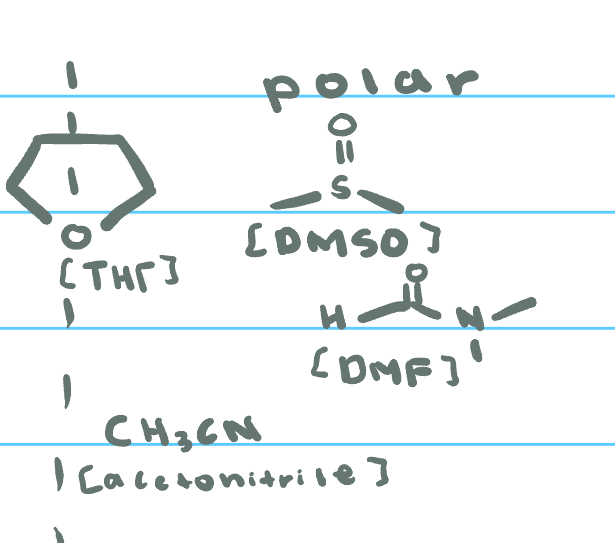
in between polar and non polar solvent
THF
examples of polar protic solvents
alcohols, H2O, carboxylic acids
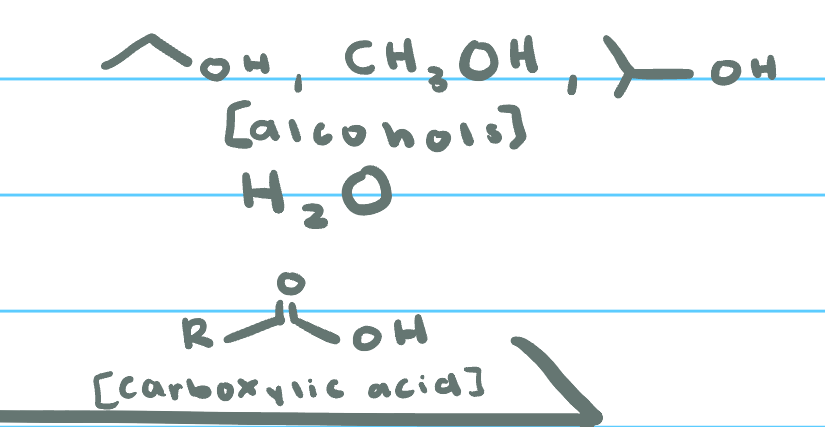
polar protic solvents are
weak nucleophiles (and often solvolysis)
polar protic solvents
stabilize LG in slow step of SN1 (preventing reverse reaction)

this is an example of an
elimination reaction
the reactions of an elimination reaction are
alkyl halides
the products of elimination reactions are
alkene + H-Basem + X- (lg)
the elimination reaction occurs in a
base
base and nucleophiles are often
interchangeable (for elimination rxn)
substitution and elimination reactions are both
reactions of alkyl halides
elimination reactions are also often called
β-hydride elimination

this is an example of
E1

this is an example of
E2
E1 rate law is
rate=K[Rx]
E2 rate law is
K[Rx][Base]

this reaction coordination diagram is an example of
E2

this reaction coordination diagram is an example of
E1
E1 and SN! happen…
together
why do E1 and SN1 happen together
they have the same slow first step
elimination can often form multiple products
true
the more substituted alkene will be the
major elimination product
a more substituted alkene is the alkene with
more carbons attatched to the α and β carbons of alkene
the more substituted alkene has the most carbons attached and is therefore
the most stable
substitution and elimination can have
the same reactants but different products (compete with each other)
to draw elimination products make
C=C bonds between α- carbon (where x is attatched) and β-carbon (adjacent carbon)
which carbon is the α-carbon in elimination
carbon where the X is attached
where is the β-carbons in elimination
carbons adjacent to the α-carbon