BSCI223: Mutations & Mutagens and DNA Repair
 Call Kai
 Learn
 Practice Test
 Spaced Repetition
 Match
 Flashcards
 Knowt Play
1/42

There's no tags or description
Looks like no tags are added yet.
43 Terms
What is a mutation?
A heritable change in the nucleotide base sequence of DNA
How do mutations effect an organism?
Almost always deleterious, sometimes makes no difference, rarely introduces a new beneficial property to the organism

Through what process do mutations become heritable?
DNA replication
What is a mutant?
A cell line that has inherited a particular mutation
What are Point Mutations?
When a single nucleotide base pair is mutated
Types of Point Mutations
Substitutions, Frameshift mutations (Insertions and Deletions)
What is a substitution?
One DNA base is changed
What is a insertion (frameshift mutation)?
When a DNA base is added to the DNA sequence
What is a deletion (frameshift mutation)?
When one DNA base is deleted from the DNA sequence
What is a Genotype?
A DNA sequence of a gene/chromosome
What is a Phenotype?
The measurable/observable trait conferred by a gene, mediated by proteins
What are the effects of Point Mutations?
Silent, Missense, and Nonsense mutations
What is a Silent Mutation?
When amino acid sequence is not altered (ie. CAA → CAG)

Silent Mutation: Is DNA mutated? Change in genotype?
DNA is mutated, genotype changes
Silent Mutation: Is protein changed? Change in phenotype?
Protein is not changed, phenotype does not change
What is a Missense Mutation?
Amino acid substitution, the effect depends on location of mutation (ie. CAA → CAT)

Missense Mutation: Is DNA mutated? Change in genotype?
DNA is mutated, genotype changes
Missense Mutation: Is protein changed? Change in phenotype?
Protein is changed, phenotype changes may occur depending on location
What is Nonsense Mutation?
When amino acid is changed into a stop codon (ie. CAG → TAG)

Nonsense Mutation: Is DNA mutated? Change in genotype?
DNA is mutated, genotype changes
Nonsense Mutation: Is protein changed? Change in phenotype?
Protein is changed (almost always causes loss of function), phenotype changes are very likely
What is a mutagen?
An agent that alters genetic (DNA) material, increasing likelihood of mutations
What are some physical mutagens?
UV light, Ionizing radiation (X-rays)
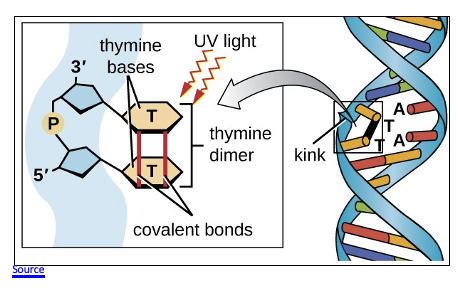
How is UV light a mutagen?
It causes dimer formation between adjacent C, T bases (C=C or T=T); it prevents hydrogen bonding to bases in complementary strand and distorts the DNA structure
How is Ionizing radiation (X-rays) a mutagen?
It can cause breaks in bonds between sugars and phosphates of DNA backbone

What are some chemical mutagens?
Nucleotide analogs, Nucleotide-altering chemicals, and Frameshift mutagens
What are Nucleotide analogs? How are they mutagens?
Structurally similar to nucleotides where it causes mispairing and DNA replication mistakes
How are Nucleotide-Altering Chemicals mutagens?
It changes chemical structure of base (can be converted to a different base or base analog)
How are Frameshift mutagens mutagens?
The molecules insert between bases, causing DNA Polymerase to insert or delete bases in daughter strands
What are types of DNA repair?
Direct, Single-strand, Error-Prone repair
What is Direct Repair?
It occurs when there is a small amount of damage on one DNA strand; it is highly accurate; the enzymatic removal of damage
What are some examples of Direct Repair?
Base-Excision and Light repair
What is Base-Excision repair?
Excises mutated DNA base and replaces it
What is Light repair?
When enzyme activated by visible light (photolyase) breaks pyrimidine dimers (C=C or T=T)
What is Single-Strand repair?
When damage cannot be repaired directly
What are some types of Single-Strand repair?
Nucleotide-Excision and Mismatch repair
What is Nucleotide-Excision repair?
When cell cuts away section of a single strand containing damage and uses complementary strand as template to repair gap
What is Mismatch repair?
Remove and replace mismatched bases where old strand is methylated and must repair immediately before new strand becomes methylated
What is Error-Prone repair?
When damage is so extensive that it can’t be corrected by other repair mechanisms; Both strands may be damaged
What is a type of Error-Prone repair?
SOS Response
What is SOS response?
Last resort before cell death where it fills in gaps with random sequence when a template is not available
What is a test that can be used to identify mutagens?
Ames test
How does the Ames test detect mutagens?
Uses Salmonella bacteria to determine whether a chemical is a mutagen (potential carcinogen). The presence of colonies indicates mutagenic substance. This test reduces time and cost required to test suspected carcinogens.
