Neuromotor Control - Chapter 13 Lecture
 Call Kai
 Learn
 Practice Test
 Spaced Repetition
 Match
 Flashcards
 Knowt Play
1/11

Earn XP
Description and Tags
Development of Mobility
12 Terms
3 requirements for locomotion
Progression: rhythmic steping pattern
Stability: control of balance
Adaptation: ability to modify gait
Emerge sequentially!
Primary constraint on locomotor behavior…
…immaturity of postural control system
Development of Locomotion
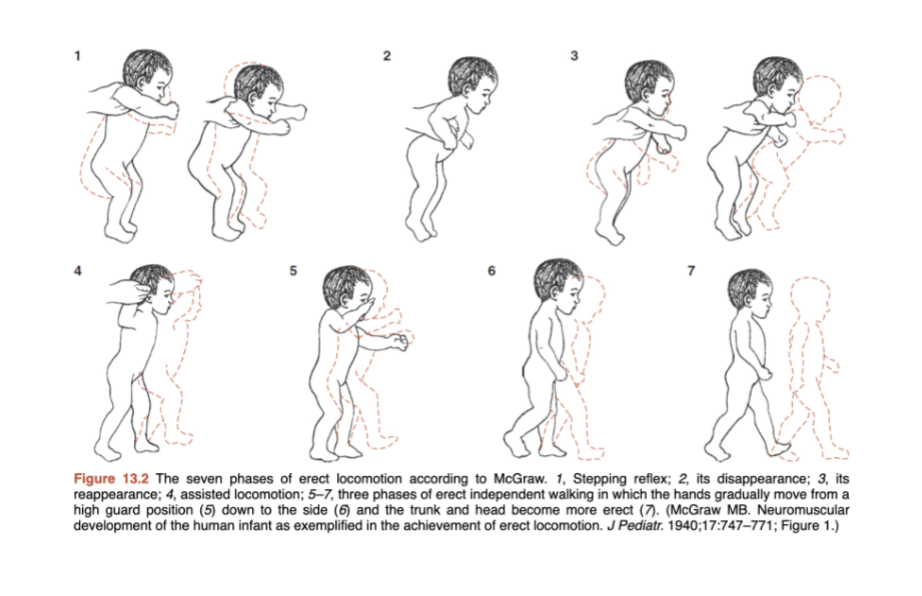
Characteristics of mature gait
Duration of single-limb stance
Walking velocity
Cadence
Step length
Ratio of pelvic span to step width
KEY POINT
Some elements (nervous and musculoskeletal) may be ready for milestone before others, but all systems must wait for maturation of the slowest components before target behavior can appear
What constraints cause a baby to be unable to walk by 12 months?
They aren’t strong enough and balance control is not ready yet
Single-limb stance
Increases steadily from 32% in 1-year-olds to 38% in 7-year-olds
Walking velocity and cadence
Decrease steadily as step length increases
Gait pattern
Matures by 3 years of age (small improvements continue until 7 years of age)
Walking initial phase
Infants learning to control balance (3-6 months after initiation of walking)
Walking second phase
Locomotor pattern (progression) progressively refined (through 5 years of independent walking)
Indicators of balance development
Walking, running, galloping, hopping, and skipping (usually show up in order of intensity/difficulty)