The Anatomy of the Ear
 Call Kai
 Learn
 Practice Test
 Spaced Repetition
 Match
 Flashcards
 Knowt Play
1/36

There's no tags or description
Looks like no tags are added yet.
37 Terms
pinna
the outer ear, collects sounds and send it down ear canal

external auditory canal
transmits sound waves from the pinna to the tympanic membrane of the middle ear

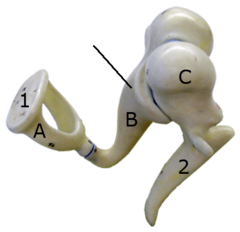
malleus
hammer
hammer; first of the three auditory ossicles of the middle ear
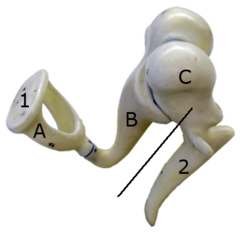
incus
anvil; middle of the three auditory ossicles of the middle ear
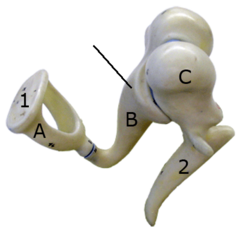
stapes
stirrup
stirrup; last of the three auditory ossicles of the middle ear
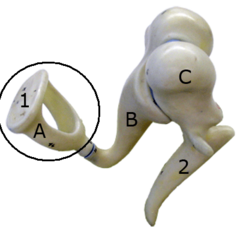
tympanic membrane
The eardrum. A structure that separates the outer ear from the middle ear and vibrates in response to sound waves.

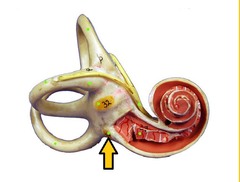
round window
The membrane that relieves pressure from the vibrating waves in the cochlear fluid.
vestibule
In the inner ear, includes a pair of membranous sac, the saccule and utricle. Provides sensations of gravity and linear acceleration.

cochlea
A coiled, bony, fluid-filled tube in the inner ear through which sound waves trigger nerve impulses

vestibulocochlear nerve
(N VIII) contains the vestibular nerve, which monitors sensations of balance, position, and movement and the cochlear nerve, which monitors hearing receptors.

oval window
membrane at the enterance to the cochlea through which the ossicles transmit vibrations

semi-circular canals
Are located above the cochlea.
Structures in the inner ear, sense rotational acceleration, oriented in 3 cardinal directions

outer ear
The portion of the ear consisting of the pinna and the external auditory canal. The outer ear is separated from the middle ear by the tympanic membrane (the eardrum).
middle ear
the chamber between the eardrum and cochlea containing three tiny bones (hammer, anvil, and stirrup) that concentrate the vibrations of the eardrum on the cochlea's oval window
inner ear
the innermost part of the ear, containing the cochlea, semicircular canals, and vestibular sacs
eustachian tube
an air duct from the middle ear to the throat that equalizes external and internal air pressure

auditory ossicles
three small bones linked together that connect the eardrum to the inner ear
organ of corti
The structure in the cochlea of the inner ear made up of the basilar membrane, the auditory hair cells, and the tectorial membrane. The Organ of Corti is the site where auditory sensation is detected and transduced to action potentials.

D
inner ear

B
external ear- consists of the auricle and external auditory canal (meatus)

C
middle ear

vestibulocochlear nerve
hearing and balance; CN VIII

basilar membrane

tectorial membrane

hair cells in ear

sensorineural hearing loss
the most common form of hearing loss, also called nerve deafness; caused by damage to the cochlea's receptor cells or to the auditory nerves
conductive hearing loss
hearing impairment caused by interference with sound or vibratory energy in the external canal, middle ear, or ossicles
receptor of hearing
mechanoreceptor
otoscope
instrument used for visual examination of the ear

Locations in the ear responsible for equilibrium
Semicircular canals: Detect rotational movements (dynamic equilibrium).
Vestibule (utricle and saccule): Detect linear movements and head position (static equilibrium).
Locations in the ear responsible for hearing
Cochlea: Contains the organ of Corti, where sound waves are converted into nerve impulses.
Cause of Motion Sickness
A sensory mismatch between the visual, vestibular, and proprioceptive systems.
Role of the Vestibular System in Motion Sickness
The inner ear detects motion (e.g., rocking of a boat) that conflicts with stationary surroundings perceived by the eyes.
What is the brain destination for the sense of hearing?
auditory cortex of temporal lobe
What nerve carries impulses generated by the ear to the brain?
Vestibulocochlear nerve (Cranial Nerve VIII)
What is the brain destination for the sense of equilibrium?
The cerebellum and vestibular nuclei in the brainstem
Type of receptor hearing is
phasic