back + cervical triangle OIIA
 Call Kai
 Learn
Learn Practice Test
 Spaced Repetition
 Match
Match Flashcards
 Knowt Play
1/23

There's no tags or description
Looks like no tags are added yet.
Name | Mastery | Learn | Test | Matching | Spaced | Call with Kai | Chat |
|---|
No analytics yet
Send a link to your students to track their progress
24 Terms
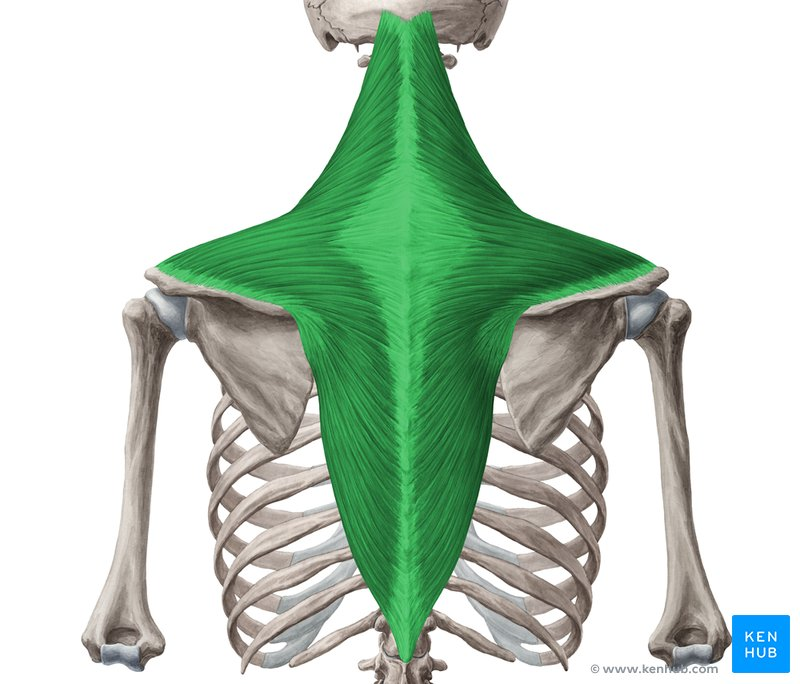
Trapezius
origin: medial third of superior nuchal line, external occipital protuberance, nuchal ligament, spinous process of c7-t12 vertebrae (medial)
insertion: lateral third of clavicle, acromion and spine of scapula (lateral)
innvervation: spinal accssory nerve c3, c4 spinal nerves
action: elevates, rotate glenoid cavity superiorly, extend neck, retract and depress scapula

rhomboid minor
origin: nuchal ligament; spinous process c7 and t1 vertebrae (medial)
insertion: triangular area at medial end of the scapular spine (lateral)
innvervation: dorsal sacpular nerve c4,c5
action: retract scapula and rotate glenoid cavity inferioly; fix scapula to thoracic wall

latissimus dorsi
origin: spinous process of t7-t12, thorocolumbar fasica, iliac crest, and inferior 3 or 4 ribs (medial)
insertion: floor of intertubecular sulcus (groove) of humerous
innervation: thoracodorsal scapular nerve c6,c7,c8
action: extends, adducts, and medially rotates shoulder joint, raises body towards arms during climbing

rhomboid major
origin: spinous process of t2-t5 (medial)
insertion: medial border of scapula from level of spine to inferior angle (lateral)
innvervation: dorsal scapular nerve c4, c5
action: retracts scapula and rotates glenoid cavity inferiorly; fix scapula to thoracic wall

levator scapulae
origin: posterior tubercles of transverse processes of c1-c4 vertebrae
insertion medial border of scapula superior to root of spine
innvervation: dorsal scapular c5, and cervical c3,c4 spinal nerves
action: elevates scapula, rotate the glenoidhumeral cavity inferiorly

thoracolumbar fascia
origin: aponeurosis tendon, superficial layer attaches to superficial muscles and deep layer surrounds deep muscles

splenius capitus (spinotransversalis)
origin: nuchal ligament and spinous process of c7-t6 vertebrae
insertion: mastoid process and superior nuchal line (occipital bone)
innvervation: posterior rami of spinal nerves
action: alone: laterally flex neck and rotate head to side of active muscles, together: extend head and neck
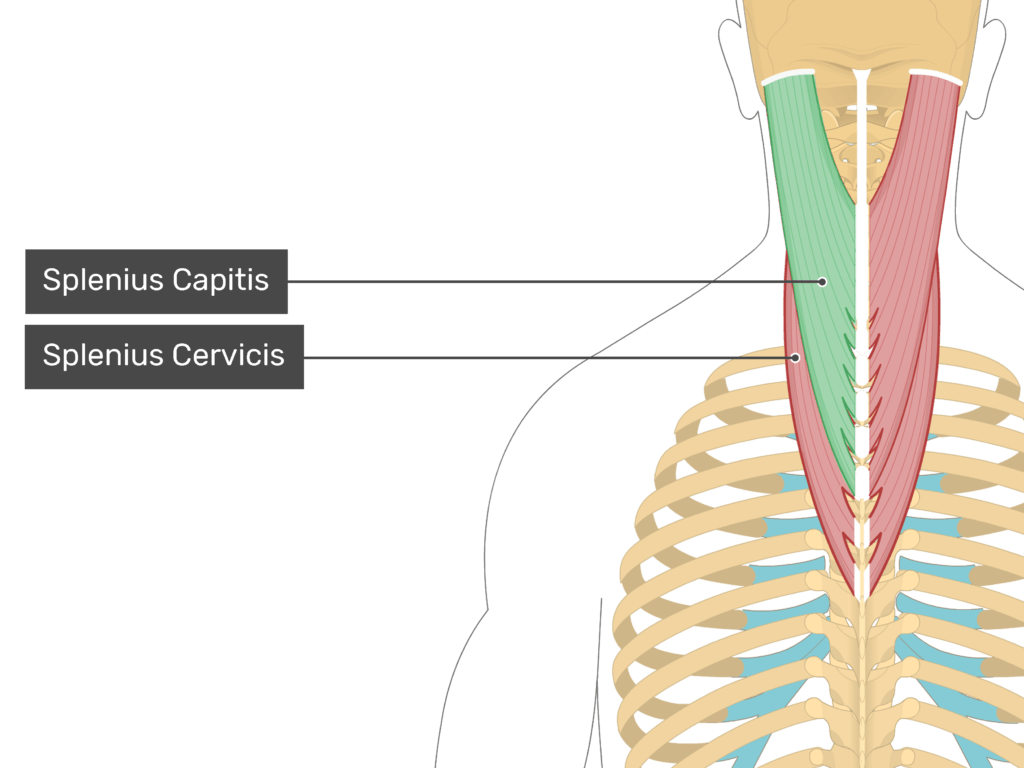
splenius cervicis (spinotransversalis)
origin: nuchal ligament and spinous process of c7-t6 vertebrae
insertion: tubercles of transverse process of c1-c3 or c4
innvervation: posterior rami of spinal nerves
action: alone: laterally flex neck and rotate head to side of active muscles, together: extend head and neck

iliocostalis (sarcospinalis/erector spinae)
origin: posterior iliac crest, posterior sacrum, sacro-iliac ligament, sacral and inferior lumbar spinous processes, supraspinatus ligament
insertion: angles of lower ribs, cervical transverse process
innervation: posterior rami of spinal nerves
action: acting bilaterally: extend vetebral column and head; as back is flexed control movemnt by gradually lengthening their fibers Acting Unilaterlly: laterally flex vetebral column

longtissmus (sarcospinalis/erector spinae)
origin: posterior iliac crest, posterior sacrum, sacro-iliac ligament, sacral and inferior lumbar spinous processes, supraspinous ligament
insertion:: ribs b/w tubercles and angles to transverse processes in thoracic and cervical region to mastoid proces
innervation: posterior rami of spinal nerves
action: acting bilaterally: extend vetebral column and head; as back is flexed control movemnt by gradually lengthening their fibers Acting Unilaterlly: laterally flex vetebral column
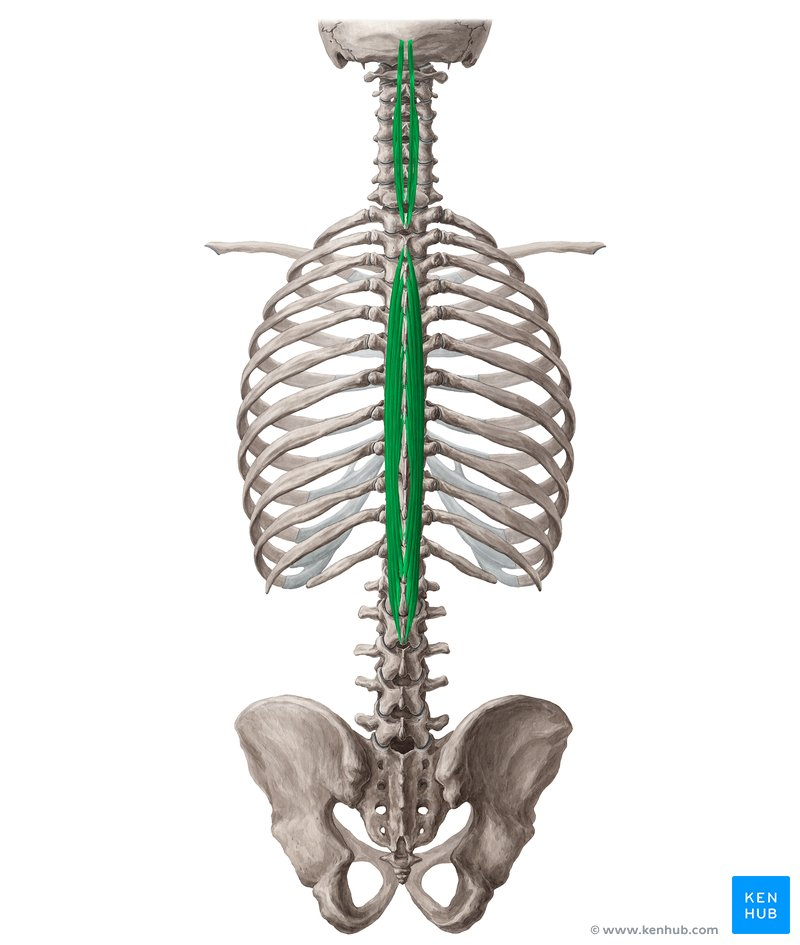
spinalis (sarcospinalis/erector spinae)
origin: posterior iliac crest, posterior sacrum, sacro-iliac ligament, sacral and inferior lumbar spinous processes, supraspinous ligament
insertion: spinous process in upper thoracic region to cranium
innervation: posterior rami of spinal nerves
action: acting bilaterally: extend vetebral column and head; as back is flexed control movemnt by gradually lengthening their fibers Acting Unilaterlly: laterally flex vetebral column

semispinalis (transversospinalis)
origin: transverse process of c4-t10
insertion: fibers run superomedially to occipital bone and spinous processes in upper thoracic and cervical regions, spanning four to six segments
innervation: posterior rami of spinal nerves
action: acting bilaterally: extend vetebral column and head; as back is flexed control movemnt by gradually lengthening their fibers Acting Unilaterlly: laterally flex vetebral column

multifidus (transversospinalis)
origin: posterior sacrum, posterior iliac spine of ilium, aponeruosis of erector spinae, sacro-iliac ligaments, mamilary processes of lumbar vertebrae, transverse processes of thoracic vertebrae, and articular processes of c4-c7
insertion: thickest in lumbar region, superomedially to entire length of spinous processes of vertebrae located 2-4 segments superior to origin
innervation: posterior rami of spinal nerves
action: acting bilaterally: extend vetebral column and head; as back is flexed control movemnt by gradually lengthening their fibers Acting Unilaterlly: laterally flex vetebral column

rotatores (transversospinalis)
origin: transverse process of vertebrae (best developed in thoracic region)
insertion: superomedially attach to junction of lamina and transverse process or spinous process immediately superior to vertebrae of origin
innervation: posterior rami of spinal nerves
action: acting bilaterally: extend vetebral column and head; as back is flexed control movemnt by gradually lengthening their fibers Acting Unilaterlly: laterally flex vetebral column

interspinalis (segmental)
origin: superior surface of spinous process of cervical and lumbar vertebrae
insertion: inferior surfaces of spinous process of vertebrae superior to vertebrae origin
innervation: posterior rami of spinal nerves
action: extension and rotation of vertebral column

intertransversi (segmental)
origin: transverse process of cervical and lumbar vertebrae
insertion: transverse process of adjacent vertebrae
innervation: posterior and anterior rami of spinal nerves
action: lateral flexion of vertebral column/bilaterally stabilizes vertebral column

obliquus capitis superior (suboccipital)
origin: transverse process of c1
insertion: occipital bone between the superior and inferior nuchal lines
innervation: posterior ramus of c1: suboccipital nerve
action: extend the head on c1, rotate head and c1 on c2 vertebrae

obliquus capitis inferior (suboccipital)
origin: spinous process of c2
insertion: transverse process of c1
innervation: posterior ramus of c1: suboccipital nerve
action: extend the head on c1, rotate head and c1 on c2 vertebrae

rectus capitis posterior major (suboccipital)
origin: spinous process of c2
insertion:lateral part of the inferior nuchal line and the occipital bone
innervation: posterior ramus of c1: suboccipital nerve
action: extend the head on c1, rotate head and c1 on c2 vertebrae

rectus capitus posterior minor (suboccipital)
origin: posterior tubercle of the arch of posterior arch of c1
insertion: medial third of the inferior nuchal line
innervation: posterior ramus of c1: suboccipital nerve
action: extend the head on c1, rotate head and c1 on c2 vertebrae

sternocleidomastoid
origin: lateral surface of mastoid process of temporal bone and lateral half of superior nuchal line
insertion: sternal head: surface of manubrium of sternum; clavicular head: superior surface of medial third of clavicle
innervation: spinal accessory nerve, c2-c3
action: laterally flex ipsilaterally; contralaterally rotates; bilaterally: extends neck at atlanto occipital joint, flexes cervical vertebrae so chin approaches manubrium, chin thrust while head is kept level by extending superior cervical vertebrae while flexing inferior vertebrae (head protraction); when cervical vertebrae fixed, may elevate manubrium and medial end of clavicles to assist deep respiration (pump handle)

anterior scalene
origin: anterior tubercles of transverse process of c3-c6 vertebrae
insertion: 1st rib
innervation: cervical spinal nerves c4-c6
action: flexes neck laterally: elevates 1st rib during forced inspiration
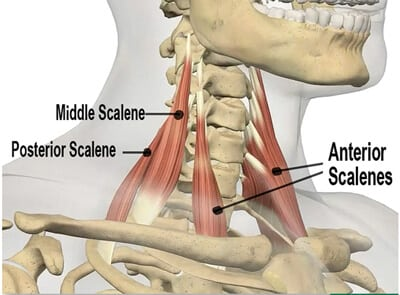
middle scalene
origin: posterior tubercles of transverse process of c4-c7 vertebrae
insertion: superior surface of 1st rib: posterior to groove for subclavian artery
innervation: anterior rami of cervical spinal nerves
action: flexes neck laterally: elevates 1st rib during forced inspiraiton
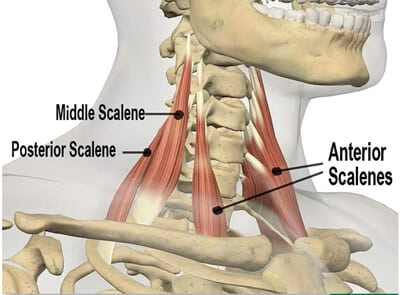
posterior scalene
origin: posterior tubercles of transverse processes of c4-c6 vertebrae
insertion: external border of 2nd rib
innervation: anterior rami of cervical spinal nerves c7 and c8
action: flexes neck laterally, elevates 2nd rib during forced inspiration