Week 5 - breeding program
 Call Kai
 Learn
 Practice Test
 Spaced Repetition
 Match
 Flashcards
 Knowt Play
1/102

Earn XP
Description and Tags
Breeding program
103 Terms
Steps to create a breeding program
Define the aim
Collect performance data
Collect information on the genetic relationship
Determine the animals with the best genetic potential
Select and mate
Evaluate the offspring - did you achieve what you set out to do?
What should be the aim of a breeding/selection program?
Consider:
Traits
Profitability
Fertility
Once a day milking?
What do sustainable breeding programs balance?
They balance economic gain with animal well-being
In dairy cattle, which production traits are considered?
Milk (yield, solids), cull cow weight.
In dairy cattle, which robustness/welfare/health traits are considered?
Fertility, calving difficulty, metabolic disease (ketosis, displaced abomasum), TB, SSC, lameness, longevity.
In beef cattle, which production traits are considered?
Growth, carcass traits, feed efficiency, methane emissions.
In beef cattle, which robustness/welfare/health traits are considered?
Fertility, calving difficulty, lameness.
In sheep, which production traits are considered?
Growth rate, carcass traits, wool yield, litter size.
In sheep, which robustness/welfare/health traits are considered?
Parasite susceptibility, lambing difficulties, reduced mothering ability.
In pigs, which production traits are considered?
Growth rate, carcass traits, feed conversion efficiency, litter size, teat number.
In pigs, which robustness/welfare/health traits are considered?
Disease resistance/stress, piglet mortality, leg soundness issues, reduced sow longevity and reproductive capacity.
In hens, which production traits are considered?
Eggs per laying season, feed efficiency, egg weight/shell thickness.
In hens, which robustness/welfare/health traits are considered?
Disease resistance/stress, bone strength, behaviour: feather pecking, cannibalism.
In sport horses, what production traits are considered?
Jumping ability, athleticism, trainability, durability across discipline
In sport horses what robustness/welfare/health traits are considered?
Lameness, developmental orthopaedic disease, temperament problems if too much focus on “hot” performance lines
Warmblood Fragile Foal Syndrome (WFFS)
In thoroughbred horses, what production traits are considered?
Speed, early maturity, aerobic capacity / stamina Musculoskeletal conformation, Competitive temperament.
In thoroughbred horses what robustness/welfare/health traits are considered?
Fragile bones, high rates of fractures,
Cardiac stress
Bleeding disorders (exercise-induced pulmonary haemorrhage)
Balanced temperament: racing + rehoming
Longevity
In Companion/pedigree dogs what robustness/welfare/health traits are considered?
Brachycephalic breeds → breathing problems, eye disease.
Dachshunds → intervertebral disc disease.
Large breeds → hip/elbow dysplasia.
Inbreeding, allergies
In working dogs what robustness/welfare/health traits are considered?
Hip and elbow dysplasia.
Eye health (collie eye anomaly, PRA in retrievers).
Epilepsy and other neurological conditions.
Longevity and reduced risk of early-onset diseases
In greyhounds what robustness/welfare/health traits are considered?
Bone and tendon strength (avoid fractures and repetitive strain).
Cardiac health (avoiding arrhythmias, sudden collapse).
Good temperament for rehoming after racing — not overly aggressive, adaptable to pet life.
Inbreeding depression.
In companion/pedigree dogs, what production traits are considered?
Breed standards for appearance
Hair shedding
In working dogs what production traits are considered?
Trainability, intelligence, responsiveness.
Stamina and endurance.
Temperament: calm, focused, non- aggressive, stable around humans and animals.
Strong sensory ability (e.g., scent detection, herding instinct)
In greyhounds, what production traits are considered?
Speed and sprint performance.
Musculoskeletal build: lean body, strong hindquarters, powerful stride.
Competitive drive (“chase instinct”)
What is considered to be a working dog?
Service/guide dogs, sheepdogs, police/military dog
What 3 things should be embedded into a breeding program?
Mandatory health checks, genetic screening, and welfare-oriented selection should be embedded into the breeding program.
What animal has the least developed breeding program?
Cats
In pedigree cats, what production traits are considered?
Breed standards for appearance
In pest control cats, what production traits are considered?
Hunting drive and agility
In emotional support cats, what production traits are considered?
Stable, friendly temperament
Adaptability to varied environment.
In Pedigree cats what robustness/welfare/health traits are considered?
Brachycephalic Persians → breathing and eye drainage issues.
Sphynx → skin problems.
Scottish Fold → painful cartilage/joint disease
Inbreeding.
In pest control cats what robustness/welfare/health traits are considered?
Disease resistance, especially in colony/barn settings (FIV, FeLV)
In emotional support cats what robustness/welfare/health traits are considered?
Robust immune system
What are the 2 types of working cats?
Pest control cats and emotional support cats
What does ESA stand for
Emotional Support animal
What is the genetic aim of a breeding program?
To select parents with the greatest breeding values for a particular trait or a group of traits from the entire population, so as to achieve the highest average performance in the offspring
What are the theoretical aims of a selective breeding programme?
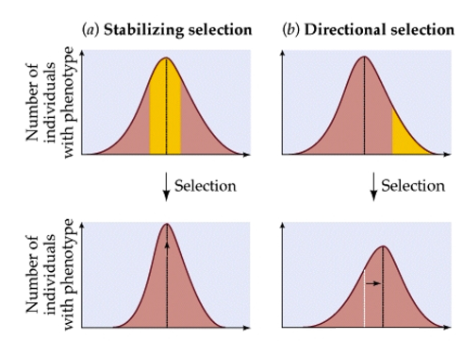
What are the 3 types of selection methods?
Tandem selection
Independent culling
Multi-trait selection index
What is tandem selection?
Selecting for one trait at a time. This can be followed by a second trait and followed by a third trait and so on
Advantages of tandem selection
Significant progress can be made for an important trait eg. scrapie
What are the disadvantages of tandem selection?
Generation intervals can hinder progress, selection for one trait can results in poor progress in other traits eg. milk/fertility
What is independent culling levels?
Set a level of merit for a trait and any animal falling short of that level will be culled
What are the advantages of independent culling levels?
Decisions can be made early in life for certain traits…..
Behaviour in guide dog
What are the disadvantages of independent culling levels?
An animal that excels in one trait is culled if it falls just below the cut-off for another. Strength in one trait cannot compensate for weakness in another.
How do we avoid the disadvantage of independent culling levels
Use a selection index - avoids combining all traits into a single value.
What is multi-trait selection index/total merit index?
Many relevant traits are selected for concurrently with individualized weightings given to each trait
What are the advantages of multi-trait selection index/total merit index?
All traits are selected for concurrently
What are the disadvantages of multi-trait selection index/total merit index?
• phenotypes that are difficult to record are not included eg. feed efficiency
• Shifts in the economic value of some traits can occur over time.
What is the formula for multi-trait selection index/total merit index?

What is genetic improvement for profit?

What economic breeding index
A tool which measures ‘profit’ from breeding in the dairy herd.
Single profit figure: € profit / lactation
What year did EBI start?
2001
Why was EBI developed?
Developed for spring calving herds (90% farms)
What is EBI based on?
Based on the National Farm Economic model
What does the EBI identify?
Identifies the main drivers of future dairy farm profit, which are weighted accordingly.

How many subindexes are there in the EBI?
8
T or F: High overall EBI can hide a weakness in one sub-index, so it is worth looking across the row
True
What 3 EBI systems are in place in the UK
Profitable Lifetime Index (£PLI)
Spring Calving Index (£SCI)
Autumn Calving Index (£SCI)
What is the EBI system in Norway called?
Total merit index (TMI)

What are the 2 indexes for beef production in Ireland?
Beef replacement index
Beef terminal index
What does EBV stand for?
Estimated breeding values
E.g UK Kennel Club EBVs for hip and elbow dysplasia
Why collect performance data?
• Unique reliable identification system is crucial
• Species specific: milk, meat, wool, temperament, survivability, fertility
• Collected from different sources: on farm, factory, performance testing, AI technicians, Veterinarians
• Smart farming: handheld devices, mobile phones etc.
• Advantages of large databases.
Collecting genetic relatedness
• Pedigree registration: herdbooks, studbook, can be operated nationally or by private companies
• DNA analysis, SNP chips
• Data on sire/dam/sibs/half sibs/grandparents
• Additive genetic relationships: full sibs 0.5; half sibs 0.25; parent:offspring 0.5; grandparent: granddaughter/son 0.25.
What questions should be asked when selecting animals for breeding?
• How many animals should we select?
• Look at EBV rankings
• How long should a breeding animal be maintained?
• May vary for sires and dams.
From what list are bulls chosen from?
The ICBF active bull list
Cow data: ICBF Herdplus
EBI profile
Expected calving profile
Fertility and breeding chart profile
Pedigree Herd Profile
Weight, Milk Recording,
Due first serve and Due repeat profiles
Calving Report
EBI Report
Fertility Report
Dairy Cow Report
Slaughter Report
Expected Calving List
Weighing Report
Genomic Evaluation Report
Sire Advice application
Inbreeding Checker
What does COW stand for
Cows own worth
What is COW?
It is an online tool that ranks cows on their expected future profit potential
• Underperforming cows can be culled
• Farmers own health recording is directly beneficial
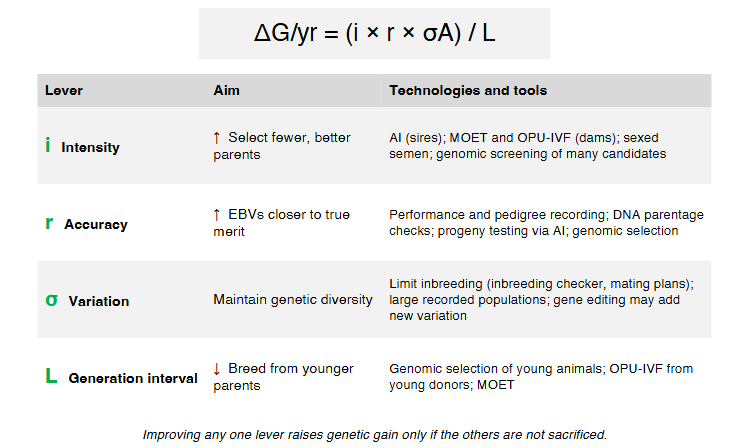
Optimising genetic gain formula?
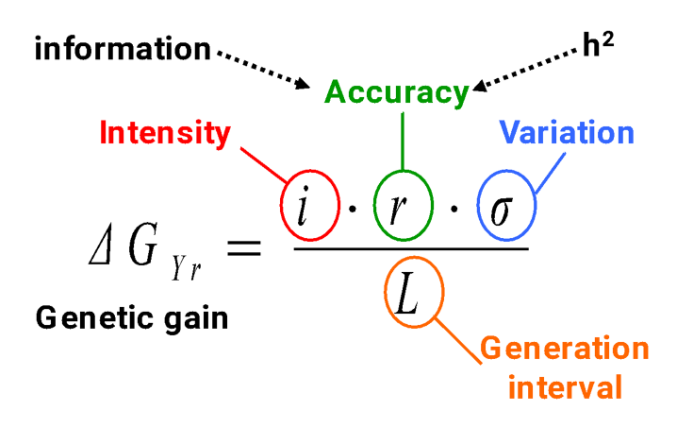
What does the intensity of selection refer to?
The superiority of the individuals selected for breeding, relative to the population from which they were selected.
Differs for sires and dams

Key figures from a selection intensity table?
Example: breeding from the top 50% gives i = 0.80; the top 10% gives i = 1.76
What is accuracy?
Reflects how well the estimated breeding value (EBV) matches the true breeding value of the animal. It's the correlation between the EBV and the true genetic merit (0–1).
What are the factors influencing accuracy?
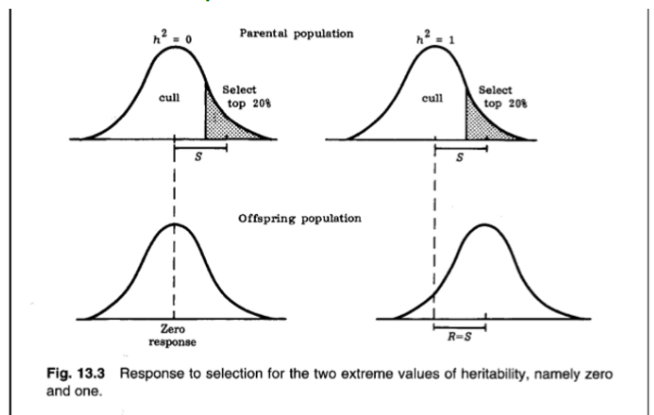
Heritability: accuracy will be lower (closer to 0) if heritability of the trait is low
Relatives information: Accuracy will be lower if performance data for selection decisions were only from relatives not closely related to the candidate for selection (eg grandsire)
Quality and Quantity of records: More records on an individual (repeat years etc) and precise measurements in controlled environments improve accuracy
Progeny testing: records on many offspring (e.g. hundreds of daughters per AI bull) give the largest gains in accuracy
Genomic information: especially for young animals with no phenotypic data.
Formula for the response to selection

Worked example on weaning weight

Worked example on genetic gain equation

How does heritability influence the response to selection on a graph?
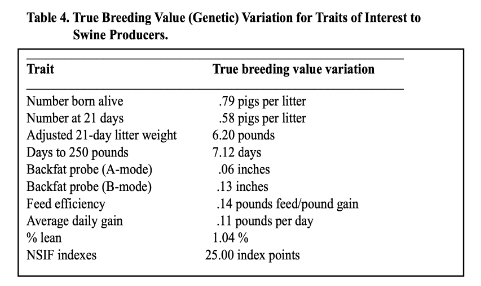
What is variation?
It’s the amount of genetic diversity for the trait in the population (additive genetic standard deviation)
More variation = more room for improvement
Managed through maintaining genetic diversity (avoiding too much inbreeding).
Strong selection reduces variation over time, because the best alleles become more common.
That’s why genetic gain slows down if variation isn’t replenished or managed.
What is required of variation?
Requires large data base, usually breed societies to calculate
What is the generational interval?
The average age of parents at the birth of their replacement.
Males and females are calculated separately and then averaged
This varies considerably between species
- Dairy cow 2-5 years
- Pig 1-3 years
- Sheep 1-4 years
Genomic testing MOET
What are the 4 types of reproductive technologies?
• Natural mating
• Artificial insemination
• MOET
• Cloning
What is artificial insemination?
Placing semen from a selected male into the female’s reproductive tract
Importance of AI
• Spreads genes from a few elite males to thousands of females.
• Reduces disease spread compared to natural mating.
• Enables use of semen from dead, distant, or genetically valuable males
Impact of AI on genetic gain
Greatly increases male selection intensity. With progeny testing, AI lengthened the sire generation interval; combined with genomic selection it now shortens
What is Embryo transfer (MOET)?
Superovulating and collecting multiple embryos from a genetically superior female and implanting them into recipient females
Why is Embryo transfer (MOET) important?
Allows one elite female to produce many offspring per year.
Useful for rare or expensive genetics
Impact of Embryo transfer (MOET)?
Increases selection intensity for females, accelerates genetic progress.
What is Ovum Pick-Up (OPU) & In Vitro Fertilization (IVF)?
Collecting eggs from females, fertilizing them in the lab, and transferring embryos
Why is Ovum Pick-Up (OPU) & In Vitro Fertilization (IVF) important?
• Can use very young or pregnant donors.
• Maximizes use of elite females
What is the impact of Ovum Pick-Up (OPU) & In Vitro Fertilization (IVF)?
Further increases reproductive output from top females.
What is sex-sorted semen?
Separating sperm carrying X (female) vs Y (male) chromosomes
Why is sex-sorted semen important?
• Dairy farms can produce mostly heifers.
• Beef farms can produce mostly males for meat
What is the impact of sex-sorted semen?
Increases efficiency of breeding goals
What is cloning (somatic cell nuclear transfer)?
Creates a genetic copy of an elite animal
What is gene editing/transgenics (CRISPR)?
Introduces or removes specific genes. Can increase genetic variation (novel traits)
What is the impact of cloning and advanced Biotech?
Currently limited but has high potential; raises ethical and regulatory issues.
What is genomic technologies(integrated with production)?
Genomic selection: Using DNA markers to predict breeding values of young animals
Why does genomic selection matter?
• Select animals before their phenotypes are available → shortens generation interval.
• Increases accuracy of selection for low-heritability traits.
What is the impact of genomic selection?
Combine with AI and ET for maximum gain
Summary for the four levers of genetic gain