BSCI223: Metabolism, Energy Production & Storage, and Enzymes
 Call Kai
 Learn
Learn Practice Test
 Spaced Repetition
 Match
Match Flashcards
 Knowt Play
1/30

Earn XP
Name | Mastery | Learn | Test | Matching | Spaced | Call with Kai | Chat |
|---|
No analytics yet
Send a link to your students to track their progress
31 Terms
Metabolism
All biochemical reactions that take place in a living cell
Catabolism
The breakdown of nutrients to release energy
Anabolism
The building of macromolecules and cell components using energy
What is the outcome of metabolism?
Reproduction
What do cells acquire for metabolism?
Nutrients (building blocks and energy)
How does a cell gain energy?
From light or from the catabolism of acquired nutrients
In metabolism, where do cells store metabolic energy?
Chemical bonds of adenosine triphosphate (ATP)
What allows cells to anabolically link building blocks together to form macromolecules?
Enzymes and energy from ATP
Metabolism: Cells grow by assembling ________ into _________.
Macromolecules; cellular structures (ribosomes, membranes, cell walls, etc.)
Metabolism of a substrate is controlled by ______.
Enzymes (reactions will not happen without them)
What are the catalysts that increase the likelihood of a reaction occuring?
Enzymes
Transporters
Proteins that pass material into and out of the cell

Passive Transport
Movement across the membrane without energy (no ATP used)

Active Transport
Movement across the membrane using energy (ATP) through transmembrane permease proteins (gated channels/ports), move material against electrochemical gradient
What breaks down ATP into ADP during transport? What is released to move substance across membrane?
ATPase transport proteins; energy
What molecules cross the membrane by passive transport?
Small or lipid-soluble molecules (water, oxygen, CO2)
What molecules need active transport?
Larger molecules (proteins, amino acids, salts, glucose)
What powers active transport?
ATP or PMF (proton motive force)

What is this metabolic pathway?
Anabolic reaction

What is this metabolic pathway?
Catabolic reaction
What do catabolic pathways produce?
Useful forms of energy and lost heat
What do anabolic pathways do?
Use energy to build the molecules that form the cell
What are the three ways cells store energy?
ATP, Proton Motive Force (PMF), and NADH/FADH2
What is Proton Motive Force (PMF)?
The transfer of H+ through a proton pump generates electrochemical gradient of protons.
What drives conversion of ADP to ATP using ATP synthase (membrane proton channels that phosphorylate ADP)?
Proton Motive Force (PMF)
Proton gradients can also help what?
Bacterial flagellar motion (no ATP produced)
What are the two electron carriers that store high energy electrons?
NADH and FADH2
When two hydrogen atoms (with two electrons) are released from another molecule, they are added to NAD+ to form _________
NADH + H+
Electrons pass from good electron _____ to good electron _____.
donors; acceptors
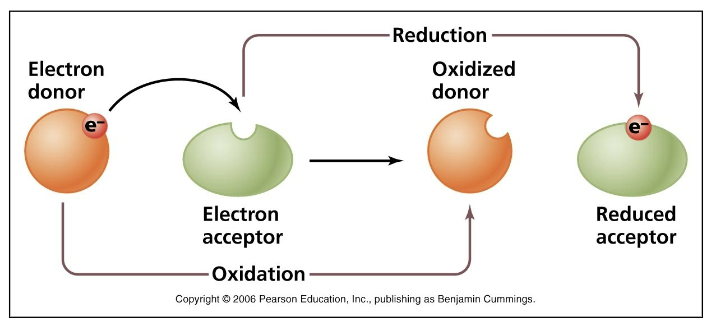
When donor is oxidized, acceptor is ______.
Reduced
What can the metabolic capabilities of a microbial species tell us? How?
Where/when a microbe grows and can be used to identify/characterize microbes (e.g., for clinical diagnosis).
It can help determine what nutrients bacterial cells can metabolize and determine what products are created as a result of metabolism