Art History: Week #9
 Call Kai
 Learn
 Practice Test
 Spaced Repetition
 Match
 Flashcards
 Knowt Play
1/17

There's no tags or description
Looks like no tags are added yet.
18 Terms
Altarpiece
A work or painting of sculpture placed on, above or behind the altar in a Christian church.
Example: Ghent Altarpiece, Renaissance
Triptych
A picture made up of 3 panels. The outer panels are often hinged so they fold over the center panel like doors.

Polyptych
A multi-panel artwork-typically 4 or more painted or carved panels, often hinged-most commonly used as a Christian altarpiece, with a large central panel flanked by smaller wings.
Example: Ghent Altarpiece, Renaissance
Glazing
A technique in oil painting in which thin, translucent layers of paint (glazes) are used to build depth of color in the painted surface
Example: Ghent Altarpiece, Renaissance

Illusionism
The practice of creating works that appear to share physical space with the viewer of convincingly replicate or convincingly replicate visual reality, spanning from ancient Greek painting to modern optical and 3D art.
-Example→Saint Anthony Tormented by Demons, Renaissance

Trompe l’oeil
Means “deceive the eye” referring to artistic technique that creates the illusion of 3-d objects, spaces, or scenes on a 2-D surface
-Masaccio, Holy trinity.
Atmospheric Perspective
A painting technique that creates the illusion of depth by making distant objects appear lighter, bluer, and less detailed than those in the foreground

One-point Linear Perspective
A linear perspective system in which all receding parallel lines (orthogonal) converge toward a single vanishing point on the horizon line
Example: Saint Anthony Tormented by Demons, Renaissance

Woodcut (relief painting)
One of the oldest printmaking techniques, originating in China and evolving into a major artistic medium in Europe and Japan
-Artists carves image into a wooden block, leaving the printing areas level while removing non-printing parts. Ink is applied to surface and block is pressed onto paper or fabric to create prints.
Example: Saint Christopher (Ink prints from raised areas of a carved woodblock)
Engraving (Intaglio painting)
Emerged in 15th cenutry as major art form, evolving from metalwork into a sophisticated printmaking technique that influenced European art for centuries.
-Example→Saint Anthony Tormented by Demons, Renaissance
Contrapposto
A standing figure with its weight shifted onto one leg, causing hips and shoulders to tilt in opposite directions, creating relaxed, naturalist pose.

Foreshortening
Artistic technique of compressing the visible length of a form so that it appears to recede toward or project toward the viewer, creating illusion of depth on a 2-D surface.
-Example-Foreshortened Christ, Renaissance

Birth of Venus, Renaissance
-Shows venus (Aphrodite) goddess of love-born through sea foam
-Painted on canvas cloth stretched around frame
-First monumental nud depiction of a goddess since antiquity: beginning of new depictions of the female body-become more popular
-Shows: medici patronage and Renaissance interest in classical mythology and ideals of beauty
-Use of Illusionism: figures, flowing haie, and wind-blown drapery creates an idealized, believable scene
-Contrapposto: similar to Medici Venus, weight assymetrical
-

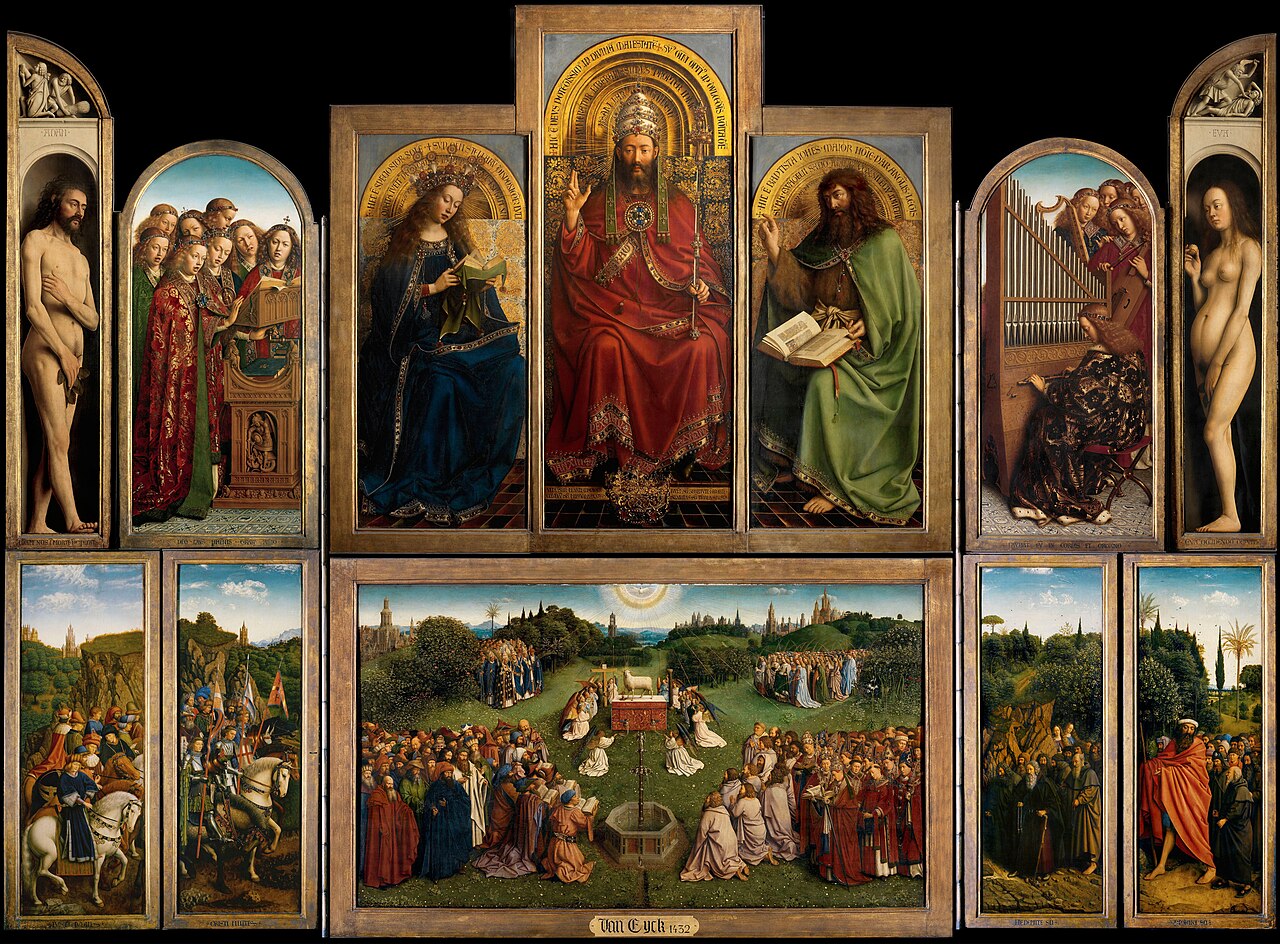
Ghent Altarpiece, Renaissance
Altarpiece: Ghent altarpiece: designed to open and close, revealing different scenes
Polyptch: artwork made w/ multiple panels. has numerous panels arranged into a large, complex composition
Glazing: a painting technique in which thin, translucent layers of paint are applies over earlier layers to create rich colors, depth, and luminosity
Atmospheric perspective: distand landscapes appear paler, hazier, and less distinct.

Deposition, Renaissance
Portrays intense grief through facial expressions, tears, gestures, encouraging viewers to empathize with Christ’s suffering and Mary’s sorrow-meditate on Christ’s sacrifice and emotional pain of those mourning him
Altarpiece: made for religious setting
-Illusionism: figures, tears, clothing, facial expressions
Emotion is the message
a box painted gold w/ tiny cross bows within it (reminder of patrons who commissioned Rogier van der Weyden for their church-cross bow men group who protected community w/ cross bows)->reminds anyone who say piece who paid for it

Foreshortened Christ, Renaissance
Depicts Christ’s body from an extreme viewpoint, with his feet closest to the viewer and his head farther away-depicts body to appear compressed and demonstrates Renaissance experimentation w/ perspective
-Encourages viewers to control Christ with a human perspective, emphasizing suffering and mortality
Uses: Foreshortening: Christ’s body appears shortened becauase it extrends away from viewer
-Illusioninsm: Makes the body seem to occup real space
-Linear perspective: Mantegna uses a carefully chosen viewpoint, although work is best known for foreshortening

Saint Anthomy Tormented by Demons, Renaissance
-Demonstrates how engraving could produce highly detailed images that could be reproduced and distributed to a wider audience
-Religious devotion: depicts Saint Anthony resisting demonic attacks, emphasizing faith, spiritual endurance, and struggle between good and evil.
Uses: Engraving: The artist cuts lines into a metal plate. Ink settles into recessed lines and transfers to paper under pressure
-Illusionism: Fine lines and shading make creature appear 3-D

Masaccio, Holy Trinity Renaissance
Depicts the Holy Trinity-The Father, Son, and Holy Spirit-and includes Mary, Saint John the Evangelist, and the donors. To show the Christian belief in the Holy Trinity-Christ’s sacrifice and death for human’s salvation-shows that death is inevitable
Uses: One-point Linear perspective: uses a single vanishing point to make painted space appear deep and realistic.
Trompe-l’oeil: The illusion of a real chapel makes viewer feel as though the architecture extends beyond the flat wall