Art History Exam #2 Greek
 Call Kai
 Learn
 Practice Test
 Spaced Repetition
 Match
 Flashcards
 Knowt Play
1/30

There's no tags or description
Looks like no tags are added yet.
31 Terms
Sanctuary
A sacred place in ancient Greece where people worshipped gods often having temples, monuments and altars
Peristyle
A row of columns that surround a building or courtyard
Cella (Naos)
The main inner room of a Greek temple where the statue of the god or goddess were kept
Kore
Marble; A statue of a young woman, usually shown fully clothed. Archaic smile (alive and idealized)

Kouros from Attica
Marble: A statue of a young man, usually shown naked, standing upright, celebrating the ideal young male body. Kouros from Attica, dating to the Archaic period, a time that celebrated human achievement. Greeks were influenced by ancient Egyptian art, emphasizing realism and idealized human bodies.

Idealized
Made to look more perfect, beautiful or flawless than in real life
Contrapposto
A pose where most of the body weight is on one leg making the figure appear more relaxed
Black Figure
A Greek pottery style where figures are painted in black or red colored clay
Doric
Simple, plain top or capital, no base and looks sturdy
Ionic
Decorative column style, base and scroll shaped volutes at the top
Corinthian
Most decorative has a base and capital decorated with carved acanthus leaves
Pediment
Triangular section at the top of the temple
Entablature
Horizontal structure containing the architrave and frieze
Frieze
Decorative band containing carvings or sculptures telling story
Architrave
Lowest part of the entablature, directly above the columns
Capital
Top of the column, doric, ionic or Corinthian
Shaft
Long vertical part of the column
Flute
Vertical grooves carved into the shaft of a column
Base
Bottom part of the column that supports it
Exekias, amphora with Ajax and Achilles playing a board game
Athens, Greek, Archaic, c.550–540 BCE. (Black Figure) Ajax and Achilles playing a board game during a break in the Trojan War; Greatest Greek black-figure pottery, consisting of two men who look prepared for war in their armor, cloaks, and shields.
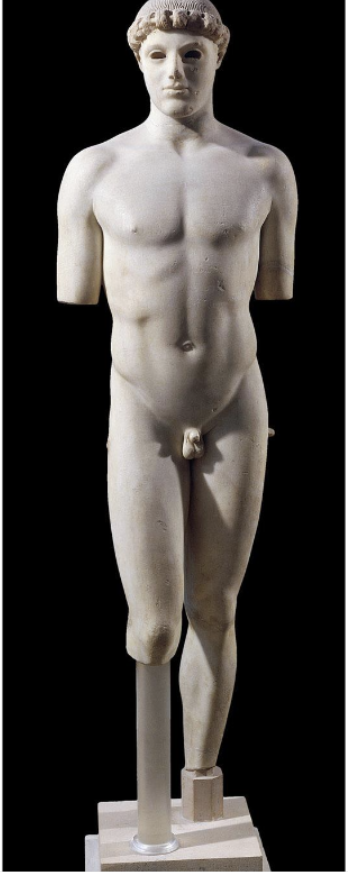
Kritios Boy
480 BCE. Greek, Early Classical, Marble. Contrapposto: the majority of the body weight rests on one leg. This piece bridges the gap between the Archaic Kouros and the highly naturalistic pieces of the Classical period. More serious facial expression versus the archaic smile.
Zeus in Warrior Pose, found off Cape Artemision, Greece,
460–450 BCE. Greek, Early Classical, Bronze. Bronze-casting encouraged artist to more realistic figures. Symbolic of the Greek God or Greek mythology in Greek Religion. Idealized muscles, proper proportions and a sense of movement. Restrain, power and diginity carrier the primary influence of the early classical era.

Chryselephantine
Made of Gold and ivory
Karyatid
Female statue thats serves as a column
Red-Figure
Red decoration on a black background
Naturalism
Mode of representation that mimics perceptual experience
(Temple of Athena Parthenos)
Marble Akropolis, Athens, Greek, High Classical, 447–432 BCE.*Dedicated to Athena, the Parthenon, 8 columns on the front and 17 columns on the side; constructed under the leadership of Pericles, a celebratory monument of Athens ' victory, power, and wealth during the Persian wars. Most influential monuments in world history reflect early classical ideals of balance and harmony.

Central scene (peplos scene)
Classical Greek structure Frieze from the Parthenon, east end, Akropolis, Athens, 447–432 BCE. Marble. Located on the eastern side of the Ionic frieze. It highlights the Panathenaic procession. A ritual of handing Athena a sacred woven peplos. Depicts a contemporary Athenian ritual that connects the goddess Athena to the people of Athens. Presentation of the peplos to Athena during the Panathenaic festival, Athens’ most religious celebration. Seated are the Olympian gods and goddesses observing the event conent religious devotion to civic pride

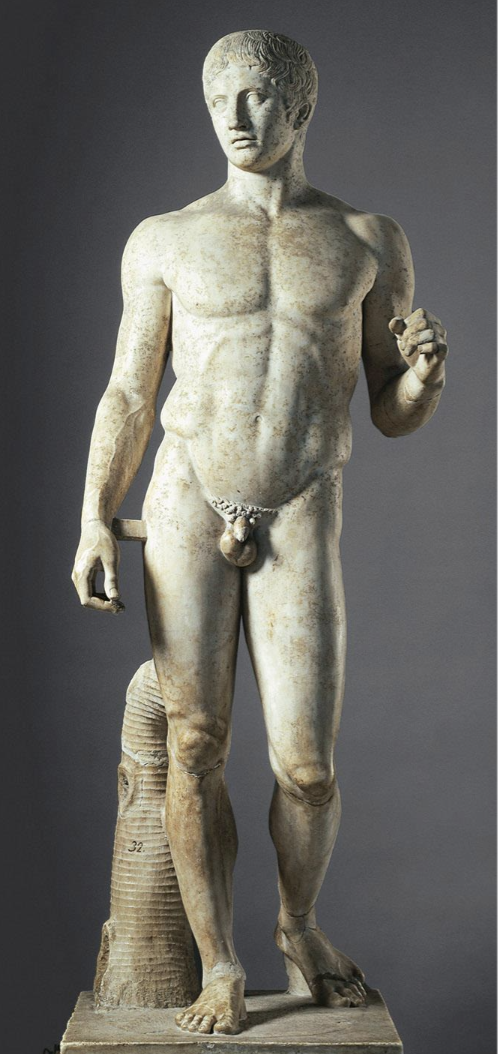
Spear Bearer
Artist: Polykeitos; Roman marble copy of a Greek bronze, High Classical of c. 450–440 BCE. Demonstrates contrapposto, with body weight resting on one leg while the other relaxes. Chiastic balance and harmony through the tense and relaxed body parts. Mathematical ratios could create perfect artistic forms and reflect the Greeks' admiration for the well-trained Greek body.
Dying Gaul
Roman copy of a bronze statue, Hellenistic Greek, of ca. 230–220 BCE. Marble. Wounded Celtic warrior in his final moments before death. Expression of dignity, pain and exhaustion. Wearing a torc or a neck ring commonly worn by Celtic warriors. Sculpture emphasizes emotional intensity and dramatic realism.
Contrasts with the idealized figures of the Classical period, demonstrates how Hellenistic artists sought to evoke empathy and emotional engagement from viewers.

(Athena Battling Alkyoneos)Great Altar of Zeus
Marble relief sculpture; Pergamon (İzmir province, Turkey), c.180–160 BCE. Gigantomachy frieze, which depicts the battle between the Olympian gods and the Giants. Nike the winged goddess flies towards Athena to crown her victory. Athena goddess of wisdom and war seizes the giant Alkyoneos by the hair as she defeats him. Unlike the calm idealism of Classical art this emphasize action, conflict and human emotion.
