Chapter 12: Host Defenses-Innate (Second line of defense down inflammation)
 Call Kai
 Learn
 Practice Test
 Spaced Repetition
 Match
 Flashcards
 Knowt Play
1/20

There's no tags or description
Looks like no tags are added yet.
21 Terms
What are the 4 generalized and nonspecific defenses that work against all pathogens of the second line of defense?
1. Phagocytosis
2. Inflammation
3. Fever
4. Antimicrobial proteins (proteins and peptides/antimicrobial peptides)
What is phagocytosis the cornerstone of? Can phagocytosis occur with or without inflammation or both? What happens when phagocytes capture pathogens? Does inflammation bring in more phagocytic cells?
Phagocytosis is the cornerstone of inflammation
It can occur with or without inflammation
it captures pathogen/microbes, then digest them and releases them
Inflammation brings in Phagocytic cells
What are the 3 general activities of phagocytes?
Survey the tissue compartments and discover microbes, particulate matter (debris), and injured or dead cells
Ingest and eliminate these materials
To read immunogenic information (antigens); collaboration between cells and adaptive immunity to relay info about pathogens
What are APC’s Or antigen presenting cells?
an immune cell that captures pathogens or foreign substances, breaks them into small fragments (antigens), and displays those fragments on its surface to activate T cells
What are the four types of phagocytes/WBCs? Are all phagocytes phagocytic?
• Neutrophils (circulate in blood)
• Monocytes (blood, phagocytic)
• Macrophages: present in tissues
• Dendritic cells: present in tissues
yes, all phagocytes are phagocytic
What are neutrophils? what does high neutrophil count mean? What are neutrophils the primary component of? Where do they migrate to and from?
They are the first responders to infection/inflammation (bacteria, foreign materials, and damaged tissue)
High neutrophil count in the blood is a common sign of bacterial infection
Primary component of pus
They migrate from blood to tissues
What Cells differentiate into macrophages and why? Macrophages can live in certain what and remain there for how long? Give some examples.
Monocytes differentiate into macrophages after they migrate out of the bloodstream and into the tissues
Some macrophages live in a certain tissue and remain there during their life span
Alveolar (lung) macrophages
Kupffer cells in the liver
Macrophages in the spleen, lymph nodes, bone marrow, kidney, bone, and brain
What is a phagocyte? Is phagocytosis a isolated event or part of inflammation?
Phagocyte: White blood cells; “eating cell”
Phagocytosis can be an isolated event or as part of inflammation
What are the events of phagocytosis in order?
Chemotaxis
Adhesion
Ingestion into phagosome
Phagolysosome formation
Destruction
Excretion

What is the chemotaxis step of phagocytosis? They move in response to what? And secreted by who?
Chemotaxis: Phagocytes migrate into a region of inflammation with a deliberate sense of direction, attracted by a gradient of stimulant products from the parasite and host tissue at the site of injury.
Move in response to chemical signals secreted by tissues/damaged cells/microbes themselves

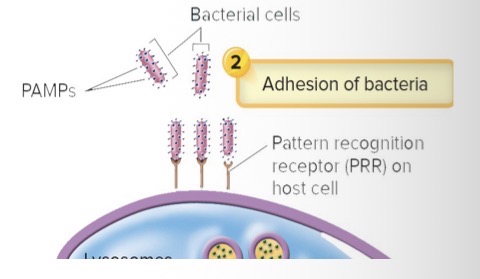
What is the adhesion step of phagocytosis?
Phagocytes use their PRRs to recognize PAMPs on foreign targets (microorganisms). This receptor interaction causes the phagocyte to attach to its target microbe

What is the engulfment and phagosome formation/ingestion to phagosome step of phagocytosis?
Once the phagocyte has made contact with its target, it extends pseudopods (arms) around its target and internalizes it in a vacuole called a phagosome.
It also secretes more cytokines to further amplify the innate response.

What is a phagosome? what step in phagocytosis does it occur at?
a membrane-bound vesicle inside a cell that forms around a large particle—such as a bacterium, dead cell, or debris—engulfed through phagocytosis
occurs during the ingestion to phagosome step

What is the phagolysosome formation step in phagocytosis?
In a short time, lysosomes fuse with phagosome (containing captured target) to form a phagolysosome.
Antimicrobial chemicals are released into the phagolysosome, forming a toxic brew designed to poison and then dismantle the ingested material

What is the destruction step of phagocytosis? what are the two separate systems in this step?
The microbes are killed in fragmented by two separate systems of destructive chemicals that await the microbes in the phagolysosome
The two separate systems include oxygen-dependent system/respiratory burst and enzymes

For the destruction step of phagocytosis what is the oxygen dependent system/respiratory burst? What are the derivatives I have to know? what is the step important for and what can do to our own cells?
Involves formation of several toxic derivatives of oxygen such as superoxide, hydrogen peroxide etc.
it is important for inflammation, but can damage our own cells
Examples of derivatives
Superoxide
Hydrogen peroxide
Singlet oxygen
Hydroxyl ion

For the destruction step of phagocytosis what is the other system that is used that is not the oxygen dependent system? What are the examples that I must know?
Enzymes
Enzymes I must know:
Lysozyme
DNase
PNase
Proteases
Peroxidases

What is the elimination step of phagocytosis?
The small bits of undigestible debris are released from the macrophage by exocytosis
How are targets recognized by phagocytic cells? What are PRRs)
PAMPs and PRRs
PRRs: Pattern recognition receptors
• Found on immune cells, endothelial cells
• Recognize and bind PAMPs

What are PAMPs? Where are they found? Who are the molecules shared/not shared by? What do they serve as? What are the two type of PAMPs?
Pathogen-associated molecular patterns (PAMPs):
Molecules found on microbial surfaces recognized by phagocytes and other defensive cells
Molecules shared by many organisms, but not present in mammals (NOT IN HUMANS)
Serve as “red flags” for phagocytes and other cells of innate immunity
Bacterial PAMPs: peptidoglycan and lipopolysaccharide
Viral PAMPs: double-stranded RNA
Can phagocytosis occur without inflammation? Can inflammation occur without phagocytosis?
Phagocytosis can occur without inflammation
Inflammation cannot occur without phagocytosis