Public Finance: Taxation
 Call Kai
 Learn
Learn Practice Test
 Spaced Repetition
 Match
Match Flashcards
 Knowt Play
1/111

There's no tags or description
Looks like no tags are added yet.
Name | Mastery | Learn | Test | Matching | Spaced | Call with Kai | Chat |
|---|
No analytics yet
Send a link to your students to track their progress
112 Terms
Taxation
process which the State imposes, assesses, and collects taxes
used to raise funds for government operations and public needs
contributions are required by law
strongest among the 3 inherent powers of state
Inherent Powers of State
natural power of every sovereign State
not granted by the people or Constitution
Taxation
Power of Eminent Domain
Police Power
Power of Eminent Domain
takes private property for public use with just compensation
Police Power
regulates persons and property for general welfare
Nature of the Power of Taxation
Inherent in sovereignty - may be exercised even if not expressly granted by the Constitution
Legislative in character - only the legislature compose taxes
Subject to constitutional & inherent limitations - not an absolute power
Characteristics of Tax
Enforced contribution
Proportionate in character
Generally payable in money
Levied on persons, property, or rights/privileges
Territorial in scope
Created by law
For public purpose
Purposes of Taxation
lifeblood of the State
Primary Purpose
Revenue/Fiscal Purpose - raise funds for necessary government expenses
Secondary Purpose
Regulatory Purpose - regulates activities, products, or behaviors and promotes general welfare
Compensatory Purpose - reduction of social inequality, economic growth, and protect local industries against unfair competition
Principles of Taxation
fundamental guidelines that help governments design and administered a tax system that is fair, clear, convenient, and efficient, while generating sufficient revenue for public needs
4 Canons of Taxation by Adam Smith
Additional Principles by Charles F. Bastable
Adam Smith
Scottish philosopher & economist
Father of Modern Economics
studied at University of Glasgow and the University of Oxford
The Wealth of Nations (1776)
4 Canons of Taxation
4 Canons of Taxation by Adam Smith
guidelines that describe the qualities of a good tax system and help ensure that tax collection is fair, clear, convenient, and efficient
Smith identified 4 classic canons of taxation:
Equity
Certainty
Convenience
Economy
Canon of Equity
taxpayers should contribute according to their ability to pay
those with greater financial capacity should generally bear a greater tax burden
promotes fairness and prevents excessive burden on taxpayers with lower capacity
Canon of Certainty
the amount of tax to be paid should be clear
time and manner of payment should be clearly established
prevents taxation from becoming arbitrary or unpredictable
Canon of Convenience
taxes should be collected at a convenient time for taxpayers
method of payment shouldn't be accessible and manageable
makes it easier for taxpayers to comply with their obligations
Canon of Economy
the cost of collecting and administering taxes should be kept low
tax collection should ve efficient and avoid unnecessary expenses
minimizes unnecessary costs for both the government and taxpayers
Additional Principles by Charles F. Bastable
Canon of Elasticity
Canon of Productivity
Canon of Simplicity
Canon of Diversity
Canon of Expediency
Canon of Elasticity
tax system should be flexible enough to generate more revenue when people's income or the economy grow
Canon of Productivity
a tax should generate enough revenue for the government without harming economic production
Canon of Simplicity
tax system should be clear, understandable, and not unnecessarily complicated
Canon of Diversity
government should collect taxes from different sources instead of replying on only one type of tax
Canon of Expediency
taxes should be practical and appropriate based on the country's economic, social, and political conditions
3 Canons of a Sound Tax System
Fiscal Adequacy
Theoretical Justice or Equality
Administrative Feasibility
Fiscal Adequacy
tax revenues must be sufficient to meet public expenditures and government needs without excessive borrowing
Theoretical Justice or Equality
taxation must be equitable and based on the taxpayer’s ability to pay
Administrative Feasibility
tax laws must be clear, easy to execute, and efficient to monitor and enforce
Inherent Limitations of Taxation
Public Purpose
Territoriality (Situs)
Non-Delegability
International Comity
Government Exemption
Public Purpose
taxes must be levied for a public purpose, not private individuals
Territoriality (Situs)
the taxing power is limited to persons, properties, or transactions within the jurisdiction of the Philippines
Non-Delegability
taxing power belongs purely to Congress and cannot be passed to the executive or judicial branches
International Comity
taxation must respect international treaties and foreign sovereignties
Government Exemption
agencies doing essential government functions are tax-exempt (the government cannot tax itself)
Taxation Theories
fundamental principles and ideas that explain the basis and purpose of taxation
explain why the government has the authority to collect taxes and how the tax burden should be fairly shared among taxpayers
they answer key questions:
why does the government have the power to tax?
why are people required to pay taxes?
what is the purpose of taxation?
how should the tax burden be distributed fairly?
what do taxpayers receive in return?
Lifeblood Theory
Necessity Theory
Benefits-Received Theory
Ability-to-Pay Theory
Symbiotic Relationship Theory
Lifeblood Theory
taxes are the lifeblood of the government
it highlights the importance of prompt and effective tax collection
taxes are indispensable for government survival without them, the State cannot function
however, the power to tax is not unlimited; taxation must follow the Constitution and the law and respect taxpayer rights
Key Limitations:
Uniformity Rule
Due Process & Equal Protection
Public Purpose Doctrine
public services, infrastructure, education & healthcare, and peace, order, & national security
Necessity Theory
taxation is a necessary burden to preserve the State’s existence
power to tax is an inherent attribute of sovereignty, the government cannot exist or function without raising revenue to finance its expenses
in the Philippines, this is consistent with Article II, Section 4 of the 1987 Constitution, which states that the prime duty of the government is to serve and protect people
TRAIN Law (RA 10963) - increased excise taxes to fund infrastructure and social programs
Lifeblood Theory VS Necessity Theory
Meaning:
LT - taxes are the lifeblood of the government
NT - taxes are necessary for the government to exist and function
Main Focus:
LT - continuous flow of tax revenue
NT - need for taxation
Purpose:
LT - to keep the government operating continuously
NT - to provide the government with resources to perform its duties
Emphasis:
LT - importance of tax collection
NT - reason why taxation is necessary
Question:
LT - what keeps the government function?
NT - why does the government need taxes?
Benefits-Received Theory
refers to a theory of income tax fairness whereby individuals or businesses should pay taxes in proportion to the government services & public goods they receive
promotes fairness in taxation by linking tax contributions to the benefits obtained from the government
more benefits = greater tax contribution
less benefits = smaller tax contribution
Ability-to-Pay Theory
taxpayers should contribute according to their financial or economic capacity
this approach to taxation is based on the just, fair, and equal sacrifice of taxation
promotes progressive taxation and is consistent with the Constitution’s mandate for fair and equitable taxation
high income = higher tax burden
low income = lighter tax burden
how’s ability to pay measure?
income
wealth or proper
consumption
Progressive Taxation
tax system is progressive when the tax rate increases as taxable income increases
lower-income taxpayers → lower tax rates
higher-income taxpayers → higher tax rates
tax burden increases according to ability to pay
Justification for Ability-to-Pay Theory
Equal Sacrifice
everyone should contribute to taxation in a fair and reasonable way
its goal is to make the burden of paying taxes fair among tax payers
Law of Diminishing Marginal Utility of Income
value or usefulness of additional money is greater for a poor person than for a rich person
people with higher incomes can be taxed more without experiencing the same level of hardship
Interpretation of Faculty
a person’s ability to earn, spend, and contribute depends on their income and wealth
Symbiotic Relationship Theory
Reciprocity Theory
taxation is based on a mutual relationship between the government and citizens
citizens pay taxes = government provides protection, services, and public benefits
both the government and citizens depend on each other
people pay VAT = government builds hospitals and schools that everyone can use
How does the Symbiotic Relationship Theory Work?
Citizens
pay taxes
follow tax laws
support government programs
participate in society
contribute to public funds
Government
collect taxes
provides public services
provides protection and security
builds infrastructure
promotes public welfare
Taxes in the Philippines
Income Tax
Business Tax
Withholding Tax
Transfer Tax
Other Taxes
Income Tax
imposed by the government on income earned by individuals and businesses
Business Income Tax
Fringe Benefit Tax
Compensation Income Tax
Capital Gains Tax
Business Income Tax
taxes imposed on certain business activities & transactions
Percentage Tax
Value-Added Tax or VAT
Withholding Tax
Withholding Tax On Compensation
Expanded Withholding Tax
Final Withholding Tax
Withholding Tax On Compensation
tax on employees’ salaries and wages, deducted by the employer based on graduated BIR tax rates
credited against employee’s final tax liability
Expanded Withholding Tax
tax payments to professionals, businesses, or rentals, withheld by the payor at prescribed rates
rates vary (ranging 5% to 15%)
Final Withholding Tax
tax on passive income like interest, dividends, and royalties, withheld at a fixe rate and considered final
Transfer Tax
Donor’s Tax
Estate Tax
Documentary Stamp Tax
Excise Tax
Donor’s Tax
tax on donations or gifts, or gratuitous transfer of property between living persons
Net Gift - net economic benefit received after allowable deductions

Estate Tax
a tax on the right of a deceased person to transmit their estate to lawful heirs and beneficiaries
it is not a tax on the property itself, but on the privilege of transferring ownership upon death
under the TRAIN Law in the Philippines, the estate tax uses a flat rate of 6% on the next taxable estate
Net Estate - total value of property after allowable deduction
Documentary Stamp Tax
tax on documents, instruments, loan agreements a paper evidencing the acceptance, assignment, sale or transfer of an obligation, rights, or property incident thereto
charged on bank promissory notes
deed of sale and deed of assignment on transfer of shares of corporate stock ownership
Excise Tax
tax imposed on goods manufactured or produced in the Philippines for domestic sale or consumption or any other disposition
imposed on things that are imported
Local Taxes
LGUs are given the authority to create their own sources of revenue and to impose taxes, fees, and charges within their respective jurisdictions
the authority of each LGU to impose taxes is subject to the provisions and limitations provided by law
different levels of local government have different taxing powers
Province Taxes
Municipal Taxes
Community Tax
Barangay Taxes & Fees
Provinces Taxes
Tax on Transfer of Real Property Ownership
Tax on Business of Printing and Publication
Franchise Tax
Tax on Sand, Gravel, and Other Quarry Resources
Professional Tax
Amusement Tax
Annual Fixed Tax on Delivery Trucks or Vans
Tax on Transfer of Real Property Ownership
imposed when ownership or title to a real property is transferred from one person to another
a transfer may occur through the sale, donation, barter, or any other legal method of transferring ownership
real property generally includes land, buildings, and other properties permanently attached to the land
Tax on Business of Printing and Publication
imposed on persons or businesses engaged in the printing and/or publication of various materials
may include books, cards, posters, leaflets, handbills, certificates, receipts, pamphlets, and other similar materials
Franchise Tax
imposed on businesses that operate under a franchise
a franchise generally refers to a special privilege or authority granted to a business to operate a particular services or activity
Tax on Sand, Gravel, and Other Quarry Resources
imposed on the extraction of natural resources such as ordinary stones, sand, gravel, earth, and other quarry materials
these resources may be extracted from public lands or from the beds of seas, lakes, rivers, streams, creeks, and other public waters within the territorial jurisdiction of the province
Professional Tax
annual tax imposed on individuals who are engaged in the practice of a profession that requires a government examination or license
Amusement Tax
imposed on proprietors, lessees, or operators of places of amusement
may include theaters, cinemas, concert halls, circuses, boxing stadiums, and other similar establishments or venues
Annual Fixed Tax on Delivery Trucks or Vans
may be imposed on vehicles used by manufacturers, producers, wholesalers, dealers, or retailers for the delivery or distribution of certain products within the province
distilled spirits, fermented liquors, soft drinks, cigars, cigarettes, and other products that may be determined by the Sangguniang Panlalawigan
Municipal Taxes
Business Taxes
Community Tax
Business Taxes
Manufacturers, Assemblers, Repackers, Processors, Brewers, Distillers, Rectifiers, and Compounders Taxes
Wholesalers, Distributors, Dealers, and Exporters
Fees and Charges on Business and Occupation
Manufacturers, Assemblers, Repackers, Processors, Brewers, Distillers, Rectifiers, and Compounders Taxes
may impose taxes on businesses engaged in manufacturing, assembling, repacking, processing, brewing, distilling, rectifying, or compounding products
Wholesalers, Distributors, Dealers, and Exporters
Tax on Business of Printing and Publication is imposed on persons or businesses engaged in the printing and/or publication of various materials
these may include books, cards, posters, leaflets, handbills, certificates, receipts, pamphlets, and other similar materials
Fees and Charges on Business and Occupation
municipalities may impose and collect reasonable fees and charges related to businesses, occupations, professions, and other activities
these fees may be collected to cover the costs of regulation, inspection, and licensing
before a person or business is allowed to operate legally, the local government may require compliance with certain requirements and the payment of the necessary fees
Community Tax
imposed on individuals who are 18 years old or older and meet certain conditions provided by law
regularly employed on a wage or salary basis for at least 30 consecutive working days during a calendar year
engaged in a business or occupation
own real property with an aggregate assessed value of at least 1,000 pesos
required by law to file an income tax return
Barangay Taxes and Fees
Tax on Stores or Retailers
Service Fees or Charges
Barangay Clearance Fee
Tax on Stores or Retailers
barangays may impose taxes on stores or retailers with fixed business establishments that fall within the gross sales or receipts limits provided by law
tax rate imposed by the barangay may not exceed 1% of the gross sales or receipts
Service Fees or Charges
barangays may collect service fees or charges for services that may provide to residents or for the use of barangay-owned properties and facilities
Barangay Clearance Fee
barangays may collect a reasonable fee for the issuance of a barangay clearance
this document serves as proof that an individual or business has complied with certain barangay requirements
Deadweight Loss of Taxes
economic inefficiency that occurs when a new tax reduces market transactions and overall economic welfare
Transaction
Total Surplus
Deadweight Loss
Transaction
exchange between a buyer and a seller
Buyer - wants to purchase a good/service
Seller - wants to sell a good/service
Price - agreed amount
Exchange - both sides expect to benefit
A buyer is willing to pay 500 pesos while a seller is willing to sell for 300, a mutually beneficial transaction can happen
people trade because both sides expect to benefit, the difference represents potential economic benefits
Total Surplus
the benefit from trade
Total Surplus - measures the total economic benefit created by a transaction, consumer surplus + producer surplus
Consumer Surplus - what the buyer gains, willingness to pay minus the actual price
Producer Surplus - what the seller gains, actual price minus minimum willingness to accept
Deadweight Loss
loss gain from trade
foregone surplus from transactions that no longer occur, not necessarily money literally disappearing
economic value lost when mutually beneficial transaction do not take place
buyer values product at 500 pesos, then seller can provide it for 300 pesos and potential benefit is 200
buyer doesn’t get the product, seller doesn’t receive payment, and 200 pesos potential benefit disappears
potential transaction→ somethings prevent the trade → transaction does not happen → potential benefit is lost → deadweight loss
Causes of Deadweight Loss
Taxes - increase the cost of buying/selling which leads to fewer transactions
Price Controls - can create shortages or surpluses that some trades don’t happen
Monopoly - restricts output and raises price which leads to underproduction
Regulations/Restrictions - can make transactions more difficult or costly that leads to fewer beneficial trades
DWL on Supply & Demand Graph
Before Tax
Quantity
Price
Demand Curve
Supply Curve
Equilibrium
Equilibrium Quantity
Equilibrium Price
After Tax
Price paid by Consumer
Price received by Suppliers
Quantity after Tax
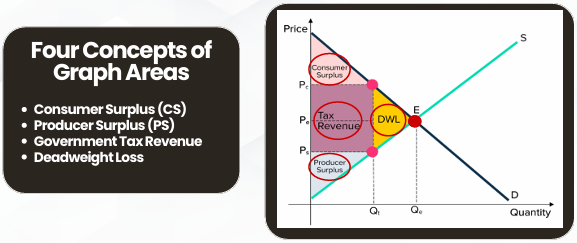
Effects of DWL of Tax
Reduced Market Transactions
Loss of Consumer and Producer Surplus
Uncollected Tax Revenues
Behavioral Inefficiency
Optimal Taxation
design of a tax system that raises sufficient government revenue
minimizes distortions in economic decisions
aims to maximize social welfare
balances revenue generation, redistribution, and economic efficiency
Principles of Optimal Taxation
Efficiency
Equity
Elasticity
Feasibility & Administerability
Efficiency
raise revenue while minimizing distortions to economic behavior
Equity
distribute the tax burden fairly based on principles such as ability to pay and benefits received
Elasticity
consider how strongly taxpayers respond to changes in taxation
Elastic Tax Base
greater behavioral response, greater potential distortion
Inelastic Tax Base
smaller behavioral response, more predictable revenue
Feasibility & Administerability
ensure that taxes are practical to implement, enforce, and comply with
Trade-Off of Optimal Taxation
Efficiency vs. Equity
a more progressive tax system may improve equity, but higher tax burdens can create greater efficiency costs
a system focused heavily on efficiency may generate fewer distortions, but it may provide less redistribution
Main Objective: find a balance where the benefits of fairness and revenue outweigh the economic costs of taxation
2 Fallacies of Optimal Taxation
Fallacy of Counting Distortions
Second-Best Fallacy
Fallacy of Counting Distortions
assumes that fewer distortions is better taxation
the number of distortions alone does not determine efficiency
what matters is the magnitude and economic effects of each distortion
Second-Best Fallacy
assumes that removing a distortion always improves efficiency
some distortions may be unavoidable or impossible to eliminate
removing one distortion may not improve welfare when other distortions remain
tax policy should therefore consider how distortions interact across the economy
Optimal Taxation
posits a tax system should be chosen to maximize a social welfare function, the foundational frameworks established by Ramsey and Mirrlees should have the aspect of designing systems that are economically efficient, socially fair, and politically sustainable and the idea of an analytical tool like the Laffer Curve comes in practice
Key Models of Optimal Taxation
Ramsey Rule
Mirrlees Model
Atkinson-Stiglitz Theorem
Diamond-Mirrlees Theory
Laffer Curve
Ramsey Rule
developed by economist Frank Ramsey in 1927
gives highlight on the principle of elasticity and efficiency with the general rule of taxing goods in inverse proportion to their elasticity of demand and supply
idea is to impose higher taxes on goods with inelastic demand or supply, while applying lower taxes on goods with elastic demand or supply
minimizes economic distortion while still generating maximum revenue by taxing inelastic goods more heavily
Inelastic Goods - higher tax rates as people will still buy or produce them such as medicine or fuel
Elastic Goods - lower tax rates as people will stop buying or producing then if taxed too much like luxury items or leisure goods
What the Ramsel Rule May Not Account For?
it promises efficiency but doesn't promise fairness as it increases the burden on poorer communities especially for acquiring basic necessities
it only minimizes deadweight loss and doesn't consider all possible tax schemes to balance efficiency, equity, and practicality
it is not popular with the general public what may seem efficient may not be efficient to their viewpoint as it may face public backlash and possible protest
Mirrlees Model
developed by Nobel Prize winner James Mirrlees in 1971 as he discovered the challenge behind optimal taxation was information asymmetry
there's an unobserved heterogeneity: the government cannot directly see ability, only the income or numbers of people report which depends on both ability and effort of the taxpayer
the question now stands: How to design a tax system that balances the need for wealth redistribution with the loss of individual incentives to work?
Mirrlees quoted that “the optimal redistribution occurs when there's a balance between the equity and improvements and the efficiency losses”
found that the optimal top marginal tax rate is about 20% which justified flat tax or flat tax rate
proved that the marginal tax rate on the highest-income earner should be 0
full equality (everyone ending up with the same income after taxes) is impossible when ability is private information, it should have a workable balance of redistribution
The Revelation Principle
under of the Mirrlees Model, the goal is to maximize social welfare, while respecting the hidden differences among taxpayers
an ideal tax system may be an Incentive Compatibility Rule where the following are:
high-income earners are to work productively without trying to hide or reduce their income while low-income earners are not discouraged or unfairly burdened
everyone has an incentive to act in their best interest, rather than focusing on how to game the tax brackets
allows the government to consider all feasible tax scheme under the information limits:
Nonlinear Taxes - tax rates that charge depending on income or consumption levels
Interdependent Taxes - taxes that vary depending on combinations of goods
Income-based Taxes - taxes on wages, capital gains or savings, not just commodities
Personal characteristics - age, family size, or health status could influence tax policy design
Atkinson-Stiglitz Theorem (1976)
if income taxes are designed well, there’s no need for extra taxes on goods
if your allowance is already taxed fairly, the government doesn’t need to tax your personal items differently, the income tax will do it job fairly
simplifies tax systems, avoids distortion in consumption
Diamond-Mirrlees Theory (1971)
government should avoid taxing production inputs, instead, they should tax only final goods and services after they are produced
you don’t tax the cotton used to make shirts, let textile factories produce cheaply, then tax the shirts when they reach the store
taxes are collected at the point of consumption, supporting growth while still raising revenue
Optimal Taxation in PH Setting
TRAIN Law (PIT) - mirrlees model, equity, work incentives, and boosting consumption, higher take-home pay, short-term drop in direct revenue
CREATE Act - mirrlees model, efficiency, FDI competitiveness, and expanding capital base, encourages business expansion, requires base broadening
VAT Policy (12%) - ramsey rule, broad-based, low-distortion revenue generation, stable tax base, requires targeted subsidies (4ps) to offset regressivity
EOPT Act - administerability, reducing compliance costs, lessening tax evasion, widens tax base, improves tax effort without rate increases
Pigouvian Taxes (Sin Taxes) - corrective taxation, aims in correcting negative externalities, encourages sustainable practices, raises revenue while reducing negative externalities
Laffer Curve
introduced by Arthur Laffer in 1974 and was popular for its ease of sketch and simplicity to understand
adopts a free-market approach of tax cutting where it displays the relationship between tax rates and tax revenue
illustrates how changes in tax rates may affect the amount of revenue collected by the government
a theoretical model of the relationship between tax rates and tax revenue
to answer the core question of What is the tax rate that maximizes tax revenues?
tax revenue = tax rate x tax base
as tax rates change, the tax base (total taxable economic activity) expands or contracts in response to human behavior, work disincentives, and market incentives
At 0% - revenue is zero because nothings is collected
At 100% - revenue is zero because nobody participates in taxable activity
The Graph and Key Features of Laffer Curve
Horizontal Axis (X-axis): Tax Rate - percentage of taxable income or activity collected as tax, usually expressed from 0% to 100% in the theoretical model
Vertical Axis (Y-axis): Tax Revenue - amount of revenue generated by the government
Upward-Sloping - as the tax increases, tax revenue generally increases because the higher rate outweighs the reduction in taxable activity
Downward-Sloping - beyond T-star further increases in the tax rate may reduce total tax revenue
The Peak (T-Star) - tax rate at which the model reaches its maximum tax revenue

2 Major Regions of the Curve
Normal Zone (Before T*) - low to moderate tax rates, higher tax rates generally increase revenue, and tax disincentives remain relatively limited
a moderate tax increase may generate additional revenue cause the higher rate outweighs the reduction in taxable activity
Prohibitive Zone (After T*) - higher tax rates generally reduce revenue, tax base may contract, and stronger disincentives and reduced compliance
excessively high taxes may discourage investment, production, or reported income
