Optics 500 - Study Guide
 Call Kai
 Learn
Learn Practice Test
 Spaced Repetition
 Match
Match Flashcards
 Knowt Play
1/54

There's no tags or description
Looks like no tags are added yet.
Name | Mastery | Learn | Test | Matching | Spaced | Call with Kai | Chat |
|---|
No analytics yet
Send a link to your students to track their progress
55 Terms
Palpebral Fissure
The opening between the upper and lower eyelids when the eye is open.

Layers of the cornea (anterior to posterior)
1. Epithelium
2. Bownman's Layer
3. Stroma
4. Decements Membrane
5. Endothelium

Endothelium
The last layer of the cornea. This layer is mainly responsible for maintaining corneal dehydration by pumping out excess water and controlling the thickness.
Corneal layers that regenerate without scarring
1. Epithelium - heals without leaving a scar
3. Decements Membrane -heals without leaving a scar
Polymegathism
Overlapping of cells in the endothelium due to chronic edema and PMMA contact lenses. Different-sized cells.

Corneal Apex
steepest part of the cornea
Aspheric Cornea
Steeper in the center, and the surface gets progressively flatter at the edge. The overall shape of the cornea.
Cornea
The clear tissue that covers the front of the eye.
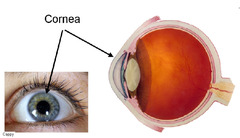
Power of the cornea
+43.00 Diopters
Radius of the cornea
7.85 mm
Neovascularization
growth of abnormal new blood vessels in the cornea.

Tear Layers (outside in)
1. lipid layer
2. aqueous layer
3. mucous layer

lipid layer
outer layer of the tear film which slows down evaporation. (oily layer)

Average blink rate
12-18 blinks per minute
Crystalline Lens
it is the second most refractive structure of the eye. This lens is inside the eye, which allows changing focus. It has a total power of +19.00 Diopters
Cataracts
clouding of the lens. When the crystalline lens has lost its transparency.

Aphakia
absence of the crystalline lens, usually after cataract surgery. The patients prescription then changes to a very high plus.

Corneal contact lens diameter range:
between 7mm - 11 mm in diameter

Semi-sclera contact lens diameter:
between 12-15 mm in diameter
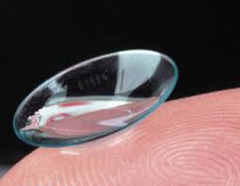
Scleral contact lens diameter
up to 25 mm in diameter

IPC
Intermediate Posterior Curve- always flatter than CPC and steeper than PPC.
CPC
Central Posterior Curve, also called the Base Curve. This is the steepest curve.
PPC
Peripheral Posterior Curve- always flatter than the base curve
OZ
Optic zone - the central zone of a rigid contact lens that contains the refractive power (Rx)
Junctional Zone (JZ)
The junction of the two curves on the back surface of the contact lens.

Chord Diameter
The overall diameter of a contact lens from one edge to the other edge.
LT: Larger diameter = tighter fit

Base Curve
also known as the CPC. The steeper the BC, the tighter the CTL
DK
oxygen permeability. Measures the amount of oxygen that moves through the CTL plastic material.
Dk/L
oxygen transmissibility. The ability of oxygen that reaches the cornea. Where L is the center thickness. The higher the DK the thinner the lens the more oxygen reaches the cornea.
EOP
Equivalent oxygen percentage. Measures how much oxygen actually reached the cornea while the contact lens in on the eye. For successful CTL wear, the EOP must be at least 7%
Hypoxia
lack of oxygen. When oxygen supply falls lower than 7%
Lenticular
Used for high plus and high minus CTL. Lenticular zone has no refractive power.
Myoflange
lenses for high plus prescriptions. Example: +10.00 D
Hyperflange
lenses for high minus prescriptions. Example: -12.00D
Diagnostic Lenses
Dx/Trial Lens. The best fitting method to fit contact lenses
LLP
lacrimal lens power
Keratometer
instrument used to measure the curvature of the cornea. Used for fitting contact lenses. Measurement is taken at every doctors visit.

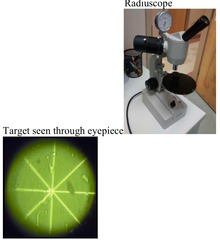
Radiuscope
Measures base curve of a contact lens and detects lens warpage
Topogometer
Attachment to make keratometer more accurate
Pachometer
A medical device used to measure corneal thickness.

Slit-lamp
evaluates contact lens fitting. General inspection of anterior surface of the cornea, evaluates contact lens and cornea relationship and detects abnormal stainings.

With The Rule Astigmatism
WTR - the steepest curve is in the vertical meridian (90-degree axis). For example, K's: 44@180/45@90. There is more power @ 90

Against The Rule Astigmatism
ATR - the steepest curve is in the horizontal (180-degree axis). For example, K's: 45.75@180/44.50@90. There is more power @ 180

Oblique Astigmatism
When meridians contain the greatest difference along the 45 & 135 degree axis. For example, K's: 43.50@45/44.50@135
Irregular Astigmatism
meridians not 90 degrees apart. For example. K's: 45@126/46@85
Central Pooling
The fluorescent pattern of a tight contact lens will show fluorescein accumulating in the center of the lens. (Bubbles in the center)

Central Touch
The fluorescent pattern of a loose contact lens will show little to no fluorescein in the center, and all the fluorescein will accumulate on the outer edge of the lens. (Bubbles on the edge)

Bubbles at the center
fluorescent pattern of a tight contact lens.
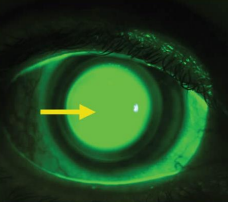
Peripheral pooling
fluorescent pattern of a loose contact lens.

Corneal astigmatism
The astigmatism that results
from the surface of the cornea (measured by the
keratometer). This is the difference in horizontal and vertical k-readings.
Spectacle Astigmatism
The amount of astigmatism found in the refractive prescription (cylinder and axis of Rx)

Residual Astigmatism
Astigmatism left uncorrected. (leftover) Solve using SA-CA=RA
Back Toric Contact Lens Design
RGP design ordered if corneal astigmatism (CA) is equal to or more than 3.00 diopters
Front Toric Contact Lens Design
RGP design ordered if residual astigmatism (RA) is more than 1.00 diopters
BiToric Contact Lens Design
RGP design if CA is equal to or more than 3.00 AND RA is more than 1.00 diopters