AST Lec 10: Spectral Lines
 Call Kai
 Learn
 Practice Test
 Spaced Repetition
 Match
 Flashcards
 Knowt Play
1/23

There's no tags or description
Looks like no tags are added yet.
24 Terms
Explain Thermal Radiation and temperature’s effect on the light’s colour spectrum.
Anything that’s warm glows. Hotter things glow at mostly shorter wavelengths (cool colours), while less hot things glow at mostly longer wavelengths (warm colours).
Warm things emit a glow of ~3300K while hot things emit a glow of ~15000K. What does K stand for?
Kelvins, the number of degrees above absolute zero temp.
What causes Hot Gas Emission?
When low-pressure gas is electrically excited, it glows.
What are Emission Lines?
The specific colours of light that each gas element emits.

Explain the Quantum Mechanics of the “cloud” configurations of electrons.
A Hydrogen atom’s electron can exist in one of many possible cloud configurations. Each cloud has a different energy level. Each element’s atoms has a diff set of clouds.
In the Bohr atomic model, the bigger circles further from the nucleus have _____ energy.
Higher
Explain how Emission works.
Gas cloud is electrified. Energy from the electricity excites electrons into shifting energy levels. When they drop back down to their og level, they release energy in the form of light.
The colour of an atom’s light emission when excited depends on…
How many energy levels it jumps back down from.
Explain how Absorption works.
Every element absorbs a specific frequency of light. The frequency absorbed causes the electrons to jump up a certain number of levels. All other frequencies pass through.
When would you get a spectra of only emission lines?
When a cloud of hot, low-density gas is electrically excited. Each emission line is light coming from the atoms’ electrons falling down a certain number of levels.
When would you get a spectra of only absorption lines?
When a hot light source is intercepted by a cloud of cool, low-density gas. The intensity of the light received is interrupted by lines where the cloud absorbed specific light frequencies.

Label each of these spectra, in clockwise order.
Continuous spectrum, Emission spectrum, Absorption spectrum.
The sun’s continuous spectrum is broken up by many absorption lines. What causes this, and what does it help us determine?
The sun’s rays are partially absorbed by many cooler gases in its photosphere. We can infer the amount of each of these gases by looking at the absorption lines.
Two emission lines seen in a spectrum are seen at different wavelengths (blue and red). From this we can conclude:
The change in energy level of the electrons producing one line is different from the energy change producing the other line.
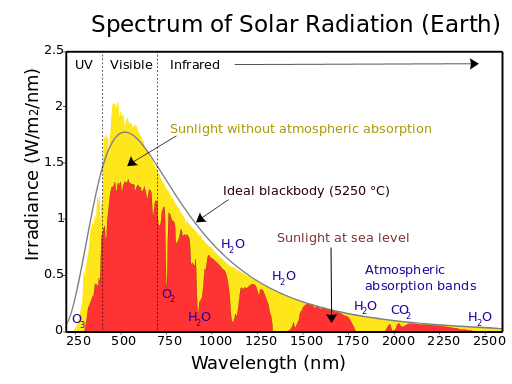
Explain the meaning of the Sun’s spectra.
Of all the solar radiation, the majority of it is visible to us. The continuous spectrum is broken by absorption lines where the radiation passed through first the sun’s photosphere then the Earth’s atmosphere.

Explain the meaning of the Moon’s spectra.
The total light given off by the moon is made up of two parts: reflections of the Sun’s thermal spectrum (first wave), and thermal emissions from the warmed rock (second wave). The Moon has no atmosphere, thus there are no absorption lines.
Describe what the spectra of a nebula would look like, and why.
A series of Emission Lines, due to the hot gas cloud’s excited atoms.
Explain the absorption spectra you find from gas clouds in space.
The cooler gas clouds absorb certain frequencies of the light from surrounding stars.
Explain the spectrum of Mars from space.
The emission lines are light from Mars’ hot upper atmosphere. The main wave is the red light that is reflected off of its rocks, which absorb blue light. The absorption lines are due to Mars’ thin CO2 atmosphere. The second wave is the thermal emission, in infrared frequency.
When you look at Mars, the red-ish light you see with your eyes is:
Reflected light from the Sun that appears red because the surface of Mars scatters red light better than other colours.
There are CO2 absorption lines in the 225K thermal emission in Mars’ spectrum. From this we know:
There is CO2 gas between the surface of Mars and us, and it is colder than the surface of Mars.
How do light spectra tell us about the light source’s temperature, density, and composition?
Temp: location of peak, emission and absorption lines.
Density: # and width of emission/absorption lines.
Composition: unique lines indicate what element.
Explain the Doppler Effect, for both sound and light.
Sound is a pressure wave, the frequency of whose waves determines its pitch. When the source is approaching, the waves compress and pitch goes up. When the source is moving away, the waves elongate and pitch lowers.
The same goes for electromagnetic waves. Approaching light is “blueshifted”, while light moving away is “redshifted”.
A green light in space is moving away from you at a significant fraction of the speed of light. Which of these is true?
It will appear more blue (higher frequency/shorter wavelength).