Test 3 (BUSA 110)
 Call Kai
 Learn
 Practice Test
 Spaced Repetition
 Match
 Flashcards
 Knowt Play
1/33

There's no tags or description
Looks like no tags are added yet.
34 Terms
How do you split the population to get the number of unemployed citizens?
Institutional vs. civilian → under 16 vs. over 16 → doesn’t want to work vs. does want to work → has a job vs. doesn’t have a job
What is LF and what is it made of?
LF = labor force
Civilians, older than 16, wants to work
What does the unemployment rate measure and what’s its formula?
Measures # of civilians over 16 that want to work but don’t have a job
(unemployed/LF)*1
If you were a drug dealer or illegal immigrant, would you be counted as employed?
Yes, all work is counted as employment, illegal or legal
What is LFPR and what’s its formula?
LFPR = labor force participation rate
(LF/working age population)*1
What is included in the working age population?
Civilians over 16
What are the 3 types of unemployment?
Frictional, structural, and cyclical
Frictional unemployment
A short-term, voluntary period of joblessness when workers transition between jobs, move to a new location, or enter/reenter the workforce
Structural unemployment
A long-term, involuntary period of joblessness where workers lose their jobs due to fundamental shifts in the economy, like technology replacing certain skills
Cyclical unemployment
Unemployment caused by recessions and downturns in the business cycle
Is any unemployment good?
Yes, frictional unemployment represents healthy competition, the young replacing the old, and incentives for economic mobility
Yes, structural unemployment represents technological advancement
No, cyclical unemployment should be at 0
What numbers represent a good unemployment rate? What about a bad one?
4-5% = good
6-7% = bad
Data that changes over time
Time-series data
Data collected at a specific point of time
Cross-sectional data
When looking at time-series, what should you pay attention to?
Frequency (monthly, quarterly, annually)
Starting and ending data
What are some important seasonal patterns?
Generally lower unemployment during the summer
Higher sales during holiday season
What is SA data?
SA = seasonally adjusted
Smooths out data for more accurate comparison
Visually, what would SA data look like compared with NSA data?
SA would be a flatter line while NSA would rise and fall
Review of optimization: what are the 3 parts to an optimization problem?
Goal, endogenous variables, exogenous variables
Review of optimization: what is used to solve optimization problem and why is it not always accurate?
Solver (numerical) and calculus (analytical)
Solver can produce disastrous results (incorrect), miserable results (no answer), and false precision (too accurate)
To avoid making these mistakes, you make a graph
If you want to study more than one variable in an optimization problem, you should visualize it how?
With a 3D graph
Constraint
Condition that limits the optimal solution
Tangency
Where 2 points meet
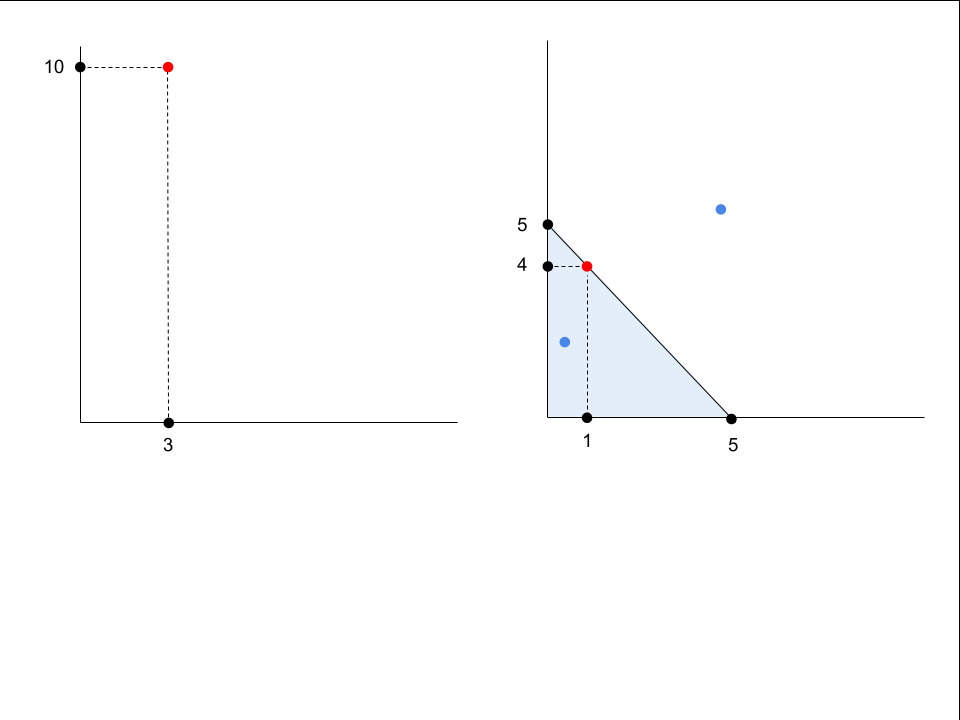
Draw 2 graphs: one that represents unconstrained optimization and another one that represents constrained optimization. On the constrained optimization graph, draw 3 points: wasteful, optimal, and invisible.
Review of comparative statics: What are the 4 steps of comparative statics?
Initial, shock, new, compare
How does comparative statics work with constraints?
Initial constraint and solution
Shock with new constraint
New solution
Compare
Elasticity
A number that represents the responsiveness of a variable on another variable
What is the template for talking about elasticity?
[Exogenous variable] elasticity of [endogenous variable]
Elasticity formula
Percent change of Y/Percentage change of X
What is Y? What is X?
Y = endogenous variable
X = exogenous variable
How do you calculate percentage change?
(new-initial)/initial
Elasticity is…
unitless, which allows you to compare many different variables
Interpretation of elasticity
1) If positive, then the variables move in the same direction. If negative, then the variables move in different directions.
2) If absolute value is more than 1, elastic. If absolute value is less than 1, inelastic.
Elasticity can show…
Competitiveness of a market, nature of demand, and # of substitutes