Unit 8: DNA replication
 Call Kai
 Learn
 Practice Test
 Spaced Repetition
 Match
 Flashcards
 Knowt Play
1/41

There's no tags or description
Looks like no tags are added yet.
42 Terms
Three proposed models of DNA
Conservative Replication
Semiconservative Replication
Dispersive Replication
Conservative Replication
model where the original double helix stays completely intact while serving as a template for a brand-new double helix.
Result: 1 completely old molecule + 1 completely new molecule.
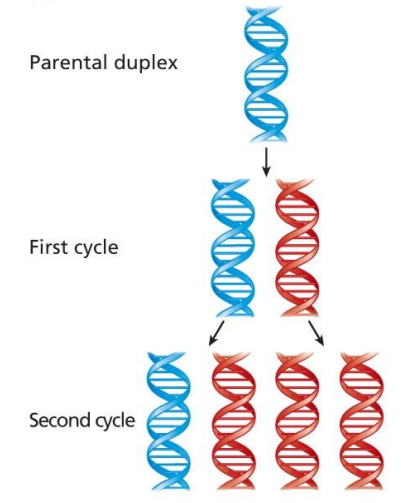
Semiconservative Replication
The actual biological mechanism of DNA replication. The two parental strands unwind, and each acts as a template for a new complementary strand.
Result: 2 hybrid molecules, each made of 1 old strand and 1 new strand.

Dispersive Replication
A model where the parent DNA breaks into small pieces, copies each fragment, and reassembles them into two patchwork helices.
Result: 2 molecules where every single strand contains alternating segments of old and new DNA.

Mesealson-stahl experiment
Allowed researchers to narrow down which DNA model was most correct
Generation 0: grew E. coli cultures with 15N, allowed E. coli to grow till all of the DNA in the medium all has 15N incorperated in DNA. Then perform density gradient centrifugation, which separates DNA by density. Thick band at 15N cuz all of the DNA has 15N
Cycle 1: Transfer into a medium where N is light (14N). Allows to cells to grow then extract to perform DGC, now banding patern is lighter (one contain 15N and daughter contains 14N)
Cycle 2: preform multiple times and find that amount of heavy DNA is halved every cycle (one parent strand is preserved)
DNA form subsequent generations grown in a medium with 14N only included light and intermediate weights, which rejects dispersive replication
Conservative would’ve meant all 15N throughout cycles

direction of semiconservative DNA replication
bidirectionally with a leading and landing stand
Single origin of replication (ori)
bacteria and archaea (circular chomosome)
multiple orignins of replication (ori) per chromosme
Eukaryotes (linear chromosme)

replisome
complex of proteins at each replication fork
________ has two DNA polymerase III proteins – one for the leading and one for the lagging strand

DNA topoisomerase
relaxes supercoiling

Helicase
unwinds double helix

SSB
prevents reannealing of seperated strands

Primase
synthesizes RNA primers

DNA polymerase 3
synthesizes DNA

DNA polymerase 1
removes and replaces RNA primers with DNA
has 5’ to 3’ exonuclease activity that removes the RNA primer

DNA ligase
joins DNA segments
Steps of DNA Replication
Helicase breaks H-bonds, and topoisomerase relaxes supercoiling
Single-stranded binding (SSB) protein prevents reannealing
Primase synthesizes RNA primers
DNA polymerase 3 synthesizes daughter strands, and leading-strand SSB gets deleted for clarity
DNA polymerase 3 elongates the leading strand continuously and the lagging strand discontinuously
DNA polymerase 1 removes and replaces nucleotides of the RNA primer
Ligase and DNA pol 1
are active on leading and lagging strands bit more so on lagging strand
closes gaps between Okazaki fragments
DNA replication bubble
goes in both directions (lead and lagging on both side)

DNA proofreading
DNA polymerase error
Exonuclease removal of a mismatched base pair (daughter strand rotates out of the polymerase site and into the exonuclease site)
Incorrect nucleotide is excised, and replication continues
Daughter strand resumes DNA synthesis
cell usually excises multiple base pair in the are not one single base pair

DNA polymerase
responsible for synthesizing DNA
always needs a template
can only add nucleotides to the 3’-OH of a DNA strand
can’t start making a DNA chain from scratch, but requires a pre-exisitng chair or short stretch of nucleotides called a primer
has proofreading ability
Addition of nucleotides by DNA polymerase
New DNA is synthesized from deoxyribonucleoside triphosphates (dNTPs)
in replication, 3’-OH group of the last nucleotide on the strand attacks 5’-phosphate group of incoming dNTPs
2 phosphates are cleaved
phosphodiester bond forms between the two nucleotides
phospahte ions released

End replication problem
leading strand can be synthesized fully to the end of linear chromosomes, but lagging stand cannot
each round of replication requires RNA primer at the 5’ end, and once that primer is removed, there’s no way to fill the resulting gap with DNA (nothing to extend it from)

Consequences of end replication problem
chromosomes become slightly shorter with each replication cycle
repetitive sequences at the ends of linear chromosomes (telomeres) ensure that a portion of the chromosome can be safely lost without serious consequences
telomeres
Repetitive sequences at the ends of linear chromosomes
typically do not contain coding sequences
recently found that it does encode 2 proteins (very recent)
Telomerase
ribonucleoprotein (protein + RNA)
acts as a template for DNA synthesis.
This RNA is complementary to the telomeric repeat (e.g., …AACCC… sequence here
_______ binds to the 3′ overhang of the existing DNA strand
_________’s own reverse transcriptase activity synthesizes new DNA nucleotides using the built-in RNA as a guide – extending the 3 ′ overhand further
Once that bit of DNA is added, _________ now moves further along (“translocates”) and repeats the process – attach, extend, move, attach, extend, move, etc.
This pattern continues to build out a long singlestranded 3 ′ overhang many of many repeats of the telomeric sequence
Now - with a nice long single-stranded 3' overhang available as a template - conventional lagging-strand machinery can act: primase lays down an RNA primer, and DNA polymerase fills in the complementary strand.

How telomeres are linked to age
A least a few hundred nucleotides of telomere repeats must “cap” the end of each chromosome in order to avoid apoptosis or cellular senescence
Telomere length typically declines with age
Dysfunctional telomeres are associated with genome instability and aneuploidy
Patients with low telomerase activity have a variety of disorders (dyskeratosis congenita, aplastic anemia, pulmonary fibrosis, cancer)
Hayflick limit
Number of times a normal, differentiated somatic cell can undergo cell division before cell division stops
not all cells express telomerase (usually only stem cells and germ cells)
reason for cessation of cell division is that each cycle results in chromosme shortening
Hayflick limit is ~50–70 cell divisions • After this the cell undergoes programmed cell death (apoptosis)
Exceptions to hayflick limit
exceptional cells with an extended or non-existent limit – such as stem cells, germ cell progenitors, and cancer cells – that can divide many more times
These exceptional cells typically have telomerase activity that maintains the chromosome ends
Why wouldn’t evolution favour all cells to have a high level of telomerase activity to ensure chromosomal integrity and cell longevity?
hayflick limit serves as a safety mechanism by limiting how many times a cell can divide
how far a damaged cell can go is limited
old cells are removed via apotosis
trade off is aging
Polymerase chain reaction (PCR)
makes many copies of one segment of DNA/amplifying DNA
PCR is “in vitro DNA replication”
It uses a special type of DNA polymerase (Taq polymerase)
It uses a DNA primer instead of an RNA primer
It uses temperature instead of helicase to unwind (denature) DNA
Just like in vivo DNA replication, it copies DNA semi-conservatively
PCR can be done in a very small volume of fluid
Where does Taq polymerase come from
Thermus aquaticus
a bacteria that can tolerate high temperatures
It lives and undergoes cell division in hot springs
It does not denature at high temperatures – even 95 degrees Celsius!
This unique property allows high temperature to be used to denature DNA without denaturing the polymerase
What does PCR require
DNA template
A supply of the four DNA nucleotides (dATP, dGTP, dCPT, dTTP )
A heat-stable DNA polymerase (”Taq polymerase”)
Two different single-stranded DNA primers
A buffer solution

Limitations of PCR
You need to know something about the sequence you want to amplify in advance in order to design primers
PCR only works for small fragments (usually <2,000 base pairs but sometimes up to ~15,000bp)
Sanger sequencing
answers the question "What is the sequence of this stretch of unknown DNA?" by reading the exact order of the four chemical bases starting from a know flanking regionknown
Known flanking region in SS
short known sequence adjacent to unknown region that gives enough info to form a primer
purpose of a primer is SS
to bind to the known flanking region and initiate sequencing so that the previously known DNA downstream of the primer can be determined
SS: downstream sequencing logic
cuz synthesis extends from a primer bound to a known flanking region, Sanger sequencing determines the sequence of everything downstream of the primer that was previously unknown
what is SS used for
onfirming a mutation, verifying a plasmid insert, or (historically) sequencing entire genomes such as the original Human Genome Project draft (largely Sanger-based before next-gen sequencing took over for large-scale work)
Order of step of SS
begins with extracting genetic material, cutting it into tiny, more manageable pieces, and “reading” the exact order of the four chemical bases

Ingredients for SS
DNA stand to be sequenced (template)
single-stranded DNA primer
DNA pol
large amounts of each of the four deoxyribonucleotides
small amount of one dideoxynucleotide (ACTG)
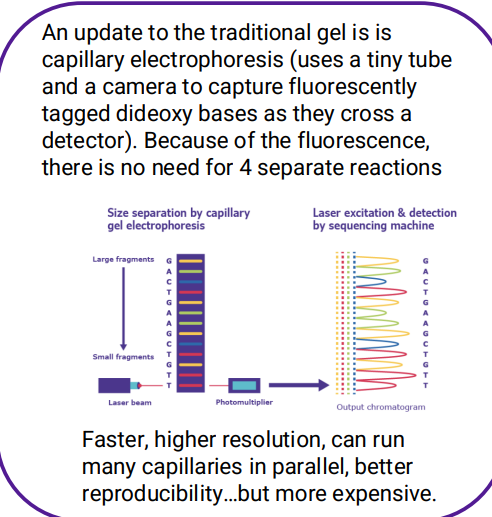
capillary electrophoresis